
July 7, 2026
When Safe Havens Become the Mainstream: Gold's Structural Shift in Chinese Capital Markets
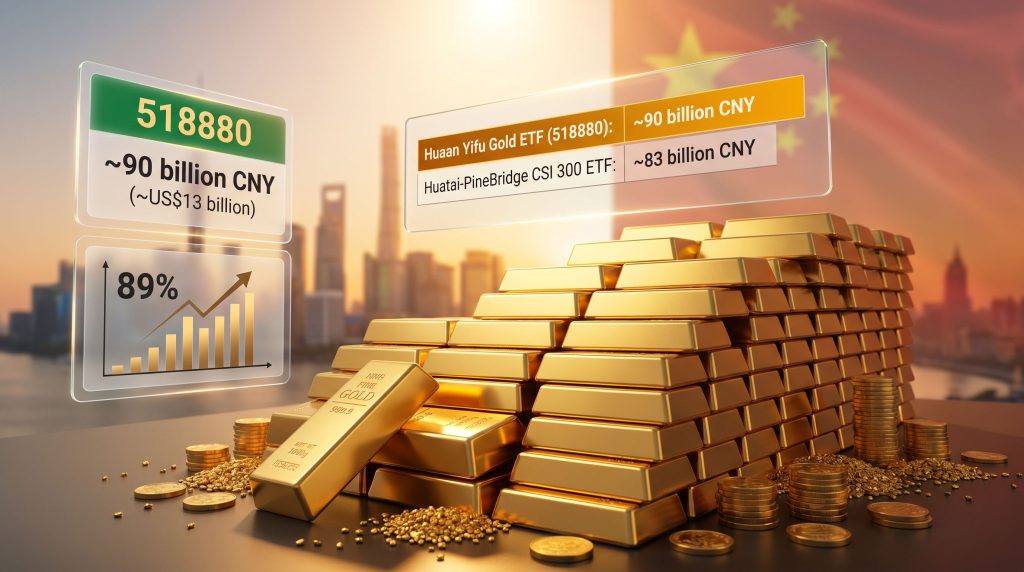
For most of modern financial history, gold has occupied the periphery of institutional portfolios. It pays no yield, generates no cash flow, and resists the kind of earnings-based valuation frameworks that dominate professional asset management. Yet something fundamental has changed in the architecture of Chinese capital markets, and the numbers are difficult to dismiss. The Huaan Yifu Gold ETF in China has become the country's single largest exchange-traded fund by assets under management, overtaking equity-linked funds that have dominated the rankings for years. This is not a momentary price spike story. It is a structural signal about how tens of millions of Chinese investors are repositioning their savings, and it is arriving at precisely the same moment that sovereign institutions worldwide are quietly accelerating their own gold accumulation programmes.
Understanding why this convergence is happening, and what it means for global gold markets, requires looking beyond the headline AUM figure and examining the machinery operating beneath it.
When big ASX news breaks, our subscribers know first
The Fund That Now Sits at the Top of China's ETF Market
The Huaan Yifu Gold ETF in China, listed on the Shanghai Stock Exchange under ticker 518880, was established on July 18, 2013, making it one of the country's longest-running gold investment options. Managed by Hua An Fund Management Co. Ltd., the fund operates with a straightforward mandate: physical replication of gold spot price movements, denominated in Chinese yuan.
Fund Specifications at a Glance
| Attribute | Detail |
|---|---|
| Ticker Symbol | 518880 |
| Exchange | Shanghai Stock Exchange (SHSE) |
| Fund Manager | Hua An Fund Management Co. Ltd. |
| Inception Date | July 18, 2013 |
| Expense Ratio | 0.60% |
| Replication Method | Physical (gold spot holdings) |
| Index Tracked | Gold Spot Index, Benchmark Price Return |
| Currency | CNY |
| Dividends | None |
| Leverage | None |
The physical replication structure is central to the fund's appeal. Rather than using derivatives or structured financial instruments to approximate gold's price behaviour, the fund acquires actual spot gold positions through the Shanghai Gold Exchange. Each unit of the fund corresponds to a proportional claim on physical metal held through that exchange.
This eliminates counterparty risk that can accompany synthetic ETF structures and gives investors clean, unlevered exposure to gold's price in their domestic currency. The fund charges an annual expense ratio of 0.60% and distributes no dividends. All returns are expressed entirely through changes in the unit price, which tracks the gold spot benchmark in CNY.
Where Does the Fund Stand Today?
| Metric | Value |
|---|---|
| Latest Price (as of July 6, 2026) | 8.631 CNY |
| 52-Week Low | 7.304 CNY |
| 52-Week High | 11.977 CNY |
| YTD Performance | -9.32% |
| Peak AUM in 2026 | ~136 billion CNY |
| Current AUM | ~90 billion CNY |
The gap between the 2026 peak AUM of approximately 136 billion CNY and the current level near 90 billion CNY deserves careful interpretation. This contraction reflects two simultaneous forces: a correction in gold prices from their 2026 highs, which reduces the mark-to-market valuation of physical holdings, and a wave of profit-taking by investors who entered at lower price levels.
Neither dynamic suggests structural abandonment of the fund. Furthermore, the fact that the fund remains China's gold market dominance even after this AUM reduction illustrates how deeply the reallocation from equities has been.
A decline in AUM driven by price movement and profit-taking is categorically different from outflows caused by loss of investor confidence. The former is a market mechanic; the latter is a sentiment event. Conflating the two produces a distorted reading of the fund's trajectory.
Displacing the Giants: How a Gold Fund Overtook China's Equity ETF Market
The comparison that matters most involves the Huatai-PineBridge CSI 300 ETF, which previously held the top position in China's ETF rankings with approximately 83 billion CNY in assets under management. The Huaan Yifu Gold ETF in China now holds roughly 90 billion CNY, establishing a lead that reflects something more than a temporary price divergence between asset classes.
Why Did Equity ETFs Hold the Top Position for So Long?
China's largest equity ETFs have historically served a dual function that inflated their size beyond what pure investor demand would produce. Beyond providing broad market access, funds tracking the CSI 300 have been used by state-affiliated entities as market stabilisation instruments during periods of equity volatility.
When domestic stock markets experienced sharp drawdowns, institutional capital flowed into these funds as part of coordinated support mechanisms, artificially sustaining their AUM at elevated levels. As the frequency and scale of such interventions have diminished, the structural advantage that kept equity ETFs at the top of the rankings has weakened. The organic demand that replaced it has flowed, in significant volume, toward gold.
The Domestic Conditions Driving Chinese Investors Toward Gold
Three reinforcing factors have channelled Chinese retail and institutional capital toward gold ETFs:
-
Capital export constraints leave Chinese investors with limited options for international diversification, concentrating demand within the domestic market where gold ETFs represent one of the most accessible commodity instruments available.
-
Falling deposit yields have compressed the opportunity cost of holding non-yielding assets. When bank deposits return minimal real yields, the absence of a dividend from a gold fund becomes less of a deterrent.
-
Diminished confidence in property and domestic equities following prolonged, uneven recovery across both sectors has pushed investors toward assets perceived as reliable stores of value.
Gold ETFs sit at the intersection of these three dynamics. They offer exposure to a globally recognised store of value, are denominated in domestic currency, trade on a local exchange with familiar settlement infrastructure, and carry no counterparty exposure from derivative structures. For a Chinese investor navigating capital controls and uncertain returns from traditional asset classes, the appeal is structural rather than speculative.
Central Bank Gold Accumulation: Sovereign Demand as a Price Floor
The rise of the Huaan Yifu Gold ETF in China does not exist in isolation. Simultaneously, central bank demand boosts gold performance as sovereign institutions accumulate gold at a pace that few mainstream financial commentators anticipated even three years ago.
Global Central Bank Purchases: May 2026
According to data from the World Gold Council, central banks added a net 41 tonnes of gold to their reserves during May 2026, the second-highest monthly figure recorded in 2026, behind only February.
| Country | Net Gold Activity (May 2026) | Notes |
|---|---|---|
| Poland | +18 tonnes | Largest single buyer in May |
| China | +10 tonnes | Largest monthly addition since December 2024 |
| Singapore | +4 tonnes | Returned as net buyer |
| Uzbekistan | Continued accumulation | Multi-month trend ongoing |
| Kazakhstan | Continued accumulation | Reserve diversification program |
| Turkey | Net seller | Partial reserve liquidation |
| Russia | Net seller | Combined ~9 tonnes sold with Turkey |
China's 10-tonne addition in May carries particular significance because it represents the country's largest single-month purchase since December 2024, arriving within a streak of 20 consecutive months of gold reserve additions as of mid-2026. Over the first half of 2026 alone, China added 25 tonnes, bringing total official gold reserves and central banks figures to approximately 2,331 tonnes, representing roughly 9% of total foreign reserves.
Poland's Accelerated Reserve Build
Poland's trajectory deserves separate attention. The country added 64 tonnes during 2026 year-to-date, accumulating total reserves of approximately 614 tonnes against a declared institutional target of 700 tonnes. Poland is now within striking distance of a self-imposed strategic threshold, and if that target is reached, it would represent one of the most ambitious reserve build programmes undertaken by a European central bank in the modern era.
Reading the Strategic Intent Behind Sovereign Accumulation
What makes China's accumulation pattern analytically interesting is not simply the volume but the consistency. Purchases have continued across months when gold prices were elevated, which argues against the interpretation that sovereign buyers are simply buying dips. Instead, the behaviour resembles a deliberate portfolio construction decision to reduce dependence on USD-denominated reserve assets, with gold serving as the primary diversification vehicle.
This distinction matters for price dynamics. Opportunistic buyers withdraw when prices rise. Strategic reserve builders do not, which means their demand provides a more durable floor than speculative or cyclical buying.
Citi Joins London's Precious Metals Clearing Network
A parallel development in global precious metals market infrastructure adds an institutional dimension to the broader gold demand story. Citi became the fifth member of London Precious Metals Clearing Limited (LPMCL), the settlement and clearing backbone of the LBMA and COMEX gold markets. Prior to Citi's entry, the membership consisted exclusively of HSBC, ICBC Standard Bank, JPMorgan, and UBS.
Citi's admission is the first new membership granted to this clearing body in approximately one decade. Through its membership, Citi gains direct participation in settlement services across gold, silver, platinum, and palladium, positioning itself within the core plumbing of one of the world's most liquid precious metals trading venues.
Membership in LPMCL is operationally intensive and requires significant infrastructure investment. A decade-long gap between new entrants reflects how high the barriers to participation are. An institution does not join this network for short-term trading advantages; it joins because it anticipates a sustained, large-scale presence in physical precious metals markets.
The timing of Citi's entry, arriving as gold trading volumes are elevated and institutional appetite for precious metals exposure is deepening, consequently reinforces the broader narrative of structural commitment to the asset class rather than opportunistic positioning.
The Convergence of Three Demand Channels
What distinguishes the current gold market environment from prior bull cycles is the simultaneous activation of structurally distinct demand channels that are moving in the same direction.
| Demand Channel | Primary Driver | Instrument | Horizon |
|---|---|---|---|
| Chinese retail and institutional | Capital controls, yield compression, asset class preference | Gold ETF (518880) | Short to medium term |
| Global central banks | Reserve diversification, USD exposure reduction | Physical gold bars | Long-term structural |
| International institutional | Market access, infrastructure capacity | OTC clearing, London market | Ongoing |
When these channels operate simultaneously, their combined effect on price support is amplified in a non-linear way. Central bank purchases establish a sovereign-backed demand floor. Retail ETF inflows add volume and momentum on top of that floor. Expanded institutional clearing capacity increases the market's capacity to process larger transaction flows without excessive price slippage.
Each layer reinforces the others. The practical consequence is that price corrections in this environment tend to be shallower and shorter-lived than in markets where a single buyer type dominates. No single event, such as a shift in US monetary policy, can simultaneously remove all three demand sources. That structural stacking of buyers is a relatively recent feature of the gold market and one that is not yet fully priced into the analytical frameworks most widely used by Western investors.
The next major ASX story will hit our subscribers first
What Are Central Banks Signalling About the Next 12 Months?
The World Gold Council's most recent annual survey of central bank reserve managers provides forward-looking evidence that aligns with the trend data.
| Survey Metric | Result |
|---|---|
| Central banks expecting global gold reserves to increase (next 12 months) | 89% |
| Central banks planning to increase their own institution's reserves | 45% |
| Same metric, prior year | 43% |
| Same metric, two years prior | 29% |
The progression from 29% to 43% to 45% across three consecutive years is not a statistical fluctuation. It represents a sustained directional shift in how professional reserve managers at the institutional level are evaluating gold's role in their portfolios. The movement is gradual and consistent, which is precisely how structural allocation shifts manifest at the sovereign level, where decisions are driven by committee processes and multi-year strategic frameworks rather than short-term market signals.
Furthermore, with 89% of surveyed central banks anticipating rising global gold reserves over the next 12 months, the sovereign demand channel is positioned to remain active regardless of how retail sentiment evolves or how Western equity markets perform.
Frequently Asked Questions: Huaan Yifu Gold ETF
What is the ticker symbol for the Huaan Yifu Gold ETF?
The fund trades under ticker 518880 on the Shanghai Stock Exchange.
Does the fund pay dividends?
No. The Huaan Yifu Gold ETF in China does not distribute dividends. All investment returns are generated through changes in the fund's unit price, which tracks the gold spot price denominated in CNY.
Is the fund physically backed?
Yes. The fund uses physical replication, acquiring actual spot gold positions through the Shanghai Gold Exchange rather than synthetic instruments or financial derivatives.
Why did this gold fund overtake China's largest equity ETFs?
A combination of domestic capital constraints, compressed bank deposit yields, uneven recovery in Chinese equities and property markets, and rising global gold demand created conditions where gold ETFs became the most accessible and credible store-of-value instrument available to Chinese domestic investors.
What expense ratio does the fund charge?
The annual expense ratio is 0.60%.
When was the fund launched?
The Huaan Yifu Gold ETF was established on July 18, 2013.
Disclaimer: This article is provided for informational and educational purposes only and does not constitute financial advice. Past performance of any fund or asset class is not indicative of future results. All AUM figures, price data, and survey statistics referenced reflect data available as of early July 2026 and are subject to change. Investors should conduct independent research and consult qualified financial advisors before making investment decisions. Forward-looking statements, including central bank survey data and reserve targets, represent expectations rather than guaranteed outcomes.
Want to Capitalise on the Next Major Mineral Discovery Before the Broader Market?
Discovery Alert's proprietary Discovery IQ model delivers real-time alerts on significant ASX mineral discoveries, transforming complex geological data into clear, actionable investment insights for traders and investors at every experience level — explore the historic returns major discoveries have generated and begin your 14-day free trial today to position yourself ahead of the market.