July 16, 2026
Gold M&A at Scale: Understanding the Forces Reshaping Senior Producer Rankings
The global gold mining industry does not consolidate quietly. When two companies of meaningful scale combine, the ripple effects extend far beyond share registries and balance sheets. They reshape competitive rankings, alter supply concentration in specific jurisdictions, and create new categories of inherited risk that only become visible once due diligence gives way to operational reality. The proposed combination of Equinox Gold and Orla Mining is precisely this kind of transaction, one where the financial logic is clear, the strategic rationale is compelling, and the path to completion runs directly through a regulatory gateway in Mexico that has yet to open.
Furthermore, understanding why the Equinox Orla Gold merger Mexico approval process matters requires looking beyond the headline numbers, though those numbers are formidable on their own. Gold M&A activity at this scale is reshaping the senior producer landscape in ways that will be felt for years to come.
When big ASX news breaks, our subscribers know first
The Deal in Numbers: What the Combination Actually Looks Like
Announced on 13 May 2026, the all-share transaction would see Equinox Gold absorb 100% of Orla Mining's outstanding shares, with the merged entity retaining the Equinox Gold Corp. name. The ownership structure following close would allocate roughly 67% of the combined company to legacy Equinox shareholders and 33% to former Orla investors.
The scale of what these two companies represent together is significant by any measure within the Canadian gold sector:
| Metric | Combined Entity |
|---|---|
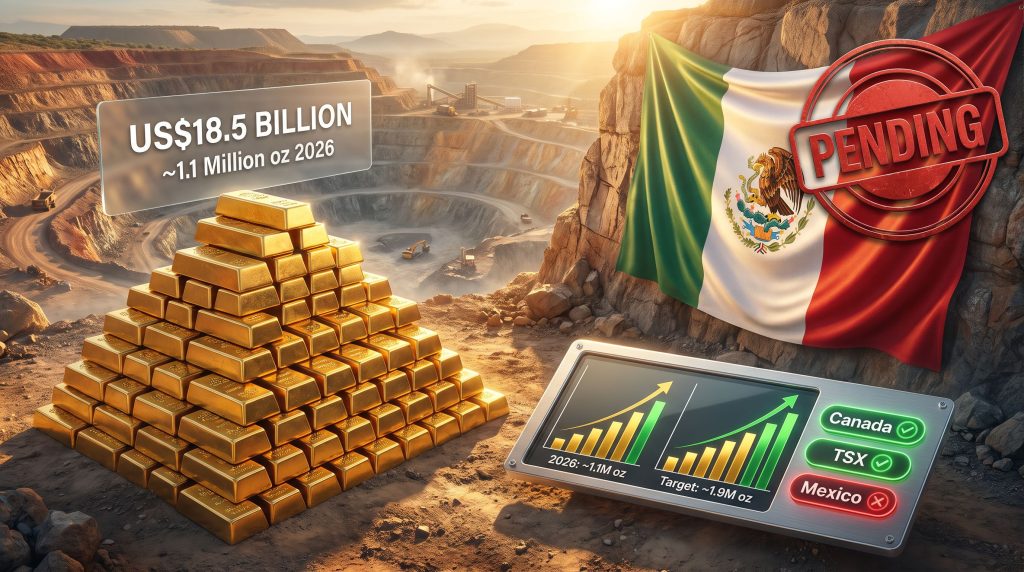
| Implied Market Capitalisation | US$18.5 billion |
| Projected 2026 Gold Production | ~1.1 million oz |
| Long-Term Production Target | ~1.9 million oz annually |
| Operating Countries | 4 (Canada, USA, Mexico, Nicaragua) |
| Active Operating Mines | 6 |
| Proven and Probable Reserves | ~23 million oz |
| Projected 2026 Free Cash Flow | ~US$1.4 billion |
| Ranking Among Canadian Producers | 2nd largest |
Achieving 1.1 million ounces of annual production is a genuine inflection point in the gold mining world. Very few producers reach this level organically. The typical path involves either decades of capital deployment across a single asset or, increasingly, strategic consolidation of complementary portfolios. This deal represents the latter approach executed at scale.
The development pipeline is where the longer-term investment thesis lives. A target of 1.9 million ounces annually would position the merged entity firmly within tier-one producer territory, competing directly with globally recognised names rather than occupying a middle tier where capital costs and institutional investor interest are harder to attract.
Regulatory Checkpoints: What Has Cleared and What Remains
As of mid-July 2026, the transaction has navigated several important procedural milestones while one critical condition remains unresolved.
| Approval Requirement | Jurisdiction | Status |
|---|---|---|
| Competition no-action letter | Canada | Obtained (1 June 2026) |
| TSX listing approval | Canada | Obtained |
| NYSE American listing approval | United States | Still required |
| Orla shareholder vote (66⅔% threshold) | Canada | Special meeting 22 July 2026 |
| Equinox shareholder vote (simple majority) | Canada | Special meeting 22 July 2026 |
| BC Supreme Court interim order | Canada | Obtained |
| Final court approval order | Canada | Expected ~28 July 2026 |
| Competition authority authorisation | Mexico | Pending |
Canada's Competition Bureau issued its no-objection letter on 1 June 2026, signalling that the country's primary antitrust regulator does not intend to challenge the combination. This is a meaningful milestone given Canada's jurisdictional importance to both companies' primary listings and governance structures.
Mexico's competition authority, known as COFECE (Comisión Federal de Competencia Económica), operates under a distinct analytical framework from its Canadian counterpart. When evaluating cross-border mining mergers, COFECE assesses factors including market concentration within Mexican territory, the degree of operational overlap between the combining parties, and the extent to which combined control of strategic assets could affect competitive dynamics in the domestic mining sector.
Given that the merged entity would control two producing gold operations within Mexico — both the Camino Rojo mine in Zacatecas and the Los Filos complex in Guerrero — the scope of COFECE's review is substantive rather than perfunctory.
Both companies have expressed confidence that Mexican clearance will be obtained based on preliminary regulatory engagement, but no formal determination has been announced. The Q3 2026 closing timeline is directly contingent on when this clearance arrives.
Mexico's Strategic Weight: Two Mines, One Compounding Opportunity
Mexico is not a peripheral exposure in this transaction. It is a material contributor to the combined portfolio both in current production terms and in development-stage potential.
Current and projected Mexican output:
- Combined Mexican gold production is expected to reach approximately 115,000 oz in 2026
- This figure draws from both the Camino Rojo oxide operation and Los Filos
- The underground development at Camino Rojo represents a meaningful reserve expansion pathway beyond the existing open-pit heap-leach operation
Camino Rojo: The Heap-Leach Foundation
Camino Rojo in Zacatecas is Orla Mining's flagship producing asset and the operation that established the company as a genuine gold producer rather than a development-stage explorer. The mine uses open-pit heap-leach processing, a method particularly suited to oxide gold deposits where gold particles are disseminated through oxidised rock that responds well to cyanide solution percolation.
Heap-leach operations carry a specific economic profile that investors in gold mining stocks should understand. Capital intensity is lower than conventional milling because ore does not need to be crushed as finely or processed in large enclosed facilities. However, gold recovery rates are typically lower than mill-based processing, often in the range of 65–80% for oxide ores versus 90%+ for milled material.
The trade-off is faster payback periods and lower operating costs per tonne processed, which makes heap-leach assets particularly attractive at current gold prices. The Camino Rojo underground project sits beneath the existing oxide operation and represents a separate mineralogical environment with potentially higher-grade sulphide ore.
Los Filos: The Expansion That Changes the Mexican Equation
The Los Filos complex in Guerrero state is Equinox Gold's existing Mexican operation. Its projected contribution of approximately 280,000 oz per year at full development is the number that makes Mexico's regulatory and social licence environment a long-term strategic priority rather than simply a closing formality.
To put that figure in context, 280,000 oz annually from a single complex would represent roughly 25% of the combined entity's current total 2026 production target. An asset of that magnitude is not peripheral. It is potentially transformative to the portfolio's overall cost structure and cash generation capacity.
| Asset | Type | Projected Contribution |
|---|---|---|
| Camino Rojo Oxide Mine | Operating open-pit heap-leach | Current production base |
| Camino Rojo Underground | Development project | Reserve expansion beyond oxide |
| Los Filos Complex | Operating plus expansion | ~280,000 oz/year at full build |
The USMCA Labor Mechanism: An Inherited Risk With Real Consequences
Perhaps the most underappreciated complexity in the Equinox Orla Gold merger Mexico approval story is not the competition clearance itself but the labour dispute that runs alongside it.
A panel operating under the USMCA Rapid Response Labor Mechanism issued a finding against the Camino Rojo operation prior to the merger announcement. The panel determined that workers at the site faced a serious denial of labour rights, concluding that the operation interfered in union activity in a manner that favoured a company-preferred union. The finding further identified coercion and intimidation as aggravating factors in the violation.
Understanding what the Rapid Response Mechanism actually is matters here. It is not a soft diplomatic instrument. The mechanism was embedded in the USMCA specifically to allow expedited enforcement of labour rights obligations without requiring full dispute settlement proceedings. Complaints can be filed by any of the three signatory governments, panels can be convened within weeks rather than years, and the escalation pathway if remediation is not demonstrated includes the imposition of targeted tariff measures on goods produced at the offending facility.
For a gold mining operation, tariff escalation under this mechanism would add costs to metal exports and potentially complicate relationships with downstream refiners and off-take counterparties who prefer clean supply chains. The reputational dimensions also carry weight in an era where institutional investors apply ESG screening to portfolio holdings with increasing rigour.
Under the all-share structure of this deal, Equinox Gold assumes full operational and legal responsibility for Camino Rojo upon closing. The incoming management team will need to demonstrate credible remediation of the labour rights findings — not simply as a compliance exercise, but as a prerequisite for maintaining the social licence that underpins the operation's ability to function in a Mexican regulatory and community context.
Panama Arbitration: A Contingent Asset Worth Watching
Orla also carries an active international arbitration claim against the Republic of Panama relating to the stalled Cerro Quema gold project, seeking approximately US$400 million in damages. The broader context of Panama mining arbitration illustrates how complex and lengthy such processes can become for mining companies operating in the region.
Under the merger structure, this claim transfers to the combined entity as a contingent asset. Whether it ultimately resolves as an asset or an absorbed cost depends on the arbitration outcome — a binary event that introduces a non-trivial range of outcomes into the combined entity's long-term financial picture.
The Financial Architecture: Break Fees, Voting Thresholds, and Strategic Signals
The deal's financial engineering reveals how each party views its leverage and commitment.
| Party | Break Fee Obligation | Shareholder Vote Threshold |
|---|---|---|
| Equinox Gold | US$475 million | Simple majority |
| Orla Mining | US$250 million | 66⅔% supermajority |
The asymmetry in break fees is deliberate and meaningful. Equinox, as the larger acquirer with the stronger strategic imperative to grow production toward tier-one scale, bears the larger termination penalty. A US$475 million break fee represents a credible signal of commitment to completion and a genuine deterrent to walking away if market conditions shift modestly.
The 66⅔% supermajority required for Orla shareholders reflects standard Canadian corporate law requirements for plan-of-arrangement transactions. This threshold is designed to ensure that fundamental changes of control receive the clear endorsement of a substantial majority of target shareholders, not simply a slim plurality.
Voting support agreements covering approximately 20% of Orla's outstanding shares have already been secured, including holdings associated with investor Pierre Lassonde and Prem Watsa's Fairfax Financial. This provides a meaningful floor of committed votes heading into the 22 July shareholder meeting, though the remaining 80% of shares are not bound by these agreements.
The next major ASX story will hit our subscribers first
Gold Price Environment: Why This Deal Makes Sense Now
The macro context surrounding the Equinox Orla Gold merger Mexico approval timeline is one of historically elevated gold prices. Bullion reached US$5,000/oz in January 2026 before moderating to approximately US$4,700/oz by May. At these price levels, the economics of combining two mid-to-senior tier producers shift materially in ways that favour all-share transactions. The current gold price outlook consequently strengthens the strategic case for consolidation at scale.
When gold prices are elevated:
- The relative cost of share-based acquisitions falls because target companies' in-ground reserves are worth more, making dilution less punishing relative to asset value acquired
- Free cash flow generation at existing operations accelerates, improving debt service capacity for the combined entity
- Development capital for growth projects becomes easier to justify internally and to institutional capital markets
- Index reweighting following scale increases brings new pools of passive capital into the register
The US$1.4 billion in projected 2026 free cash flow for the combined entity is a direct product of this price environment. Furthermore, the gold equities sensitivity to bullion prices means that at US$2,000/oz gold, the same production profile would generate a fraction of that figure. This cash flow capacity is what gives the development ambitions toward 1.9 million oz annually their financial credibility.
Leadership and Integration: Reading the Governance Structure
The combined company's leadership structure offers a window into the integration philosophy. Darren Hall, the current Equinox Gold chief executive, will lead the merged entity as CEO. Jason Simpson, currently chief executive of Orla Mining, transitions to the role of president. The board will be drawn from both organisations, with 11 members total.
This dual-leadership arrangement — pairing an acquirer CEO with a target president — signals a deliberate effort to retain institutional knowledge from the Orla side of the combination. Orla's expertise in heap-leach mine construction and operation at Camino Rojo is operationally specific and not easily replicated. Preserving that operational knowledge through the integration process is arguably as important as any financial synergy the deal generates.
Frequently Asked Questions: Equinox Orla Gold Merger Mexico Approval
Has Mexico approved the Equinox Orla merger?
As of mid-July 2026, Mexico's competition authority has not issued formal approval. Mexican competition authorisation remains an outstanding closing condition. Both companies have expressed confidence in clearance based on preliminary engagement, but no formal determination has been announced.
When is the merger expected to close?
The companies have guided for a Q3 2026 closing, subject to satisfying all remaining conditions including Mexican competition approval, NYSE American listing approval, and final court approval from the BC Supreme Court expected around 28 July 2026.
What happens to Camino Rojo after the merger?
Camino Rojo becomes part of Equinox Gold's portfolio. The oxide open-pit operation continues as a producing asset while the underground development project represents a key growth lever. However, the USMCA labour mechanism ruling means the incoming operator must address outstanding labour rights concerns at the site.
What is the break fee if the deal falls apart?
Equinox Gold would owe Orla Mining US$475 million under certain termination scenarios, while Orla would owe Equinox US$250 million under other defined circumstances.
What is the combined company's total reserve base?
The merged entity holds approximately 23 million oz of proven and probable gold reserves across its global portfolio.
Key Variables Investors Should Monitor
Several factors will determine whether the deal's ambitious production and financial projections translate from guidance into reality:
- Timing of Mexican competition clearance from COFECE, which directly determines whether the Q3 2026 closing window holds
- USMCA labour mechanism remediation at Camino Rojo, which affects both regulatory standing and the operation's social licence in Zacatecas
- Los Filos expansion permitting and community relations in Guerrero state, which underpin the 280,000 oz/year production ambition
- Panama arbitration outcome, which represents a binary contingent value event for the combined entity
- Gold price sustainability at or above US$4,700/oz, which underpins the US$1.4 billion free cash flow projection and the financial case for accelerating development capital
- Management integration depth, particularly retaining Orla's heap-leach operational expertise through the transition period
Disclaimer: This article contains forward-looking production targets, financial projections, and regulatory timelines drawn from company announcements and publicly available information. These figures are subject to change based on regulatory outcomes, operational performance, commodity prices, and other factors outside the companies' control. Nothing in this article constitutes investment advice. Readers should conduct their own due diligence before making investment decisions.
Want to Catch the Next Major Gold Discovery Before the Market Does?
Discovery Alert's proprietary Discovery IQ model scans ASX announcements in real time, instantly identifying significant mineral discoveries across gold and 30+ other commodities — transforming complex data into actionable insights the moment they hit the exchange. Explore how historic discoveries have generated extraordinary returns on the Discovery Alert discoveries page, and begin your 14-day free trial today to position yourself ahead of the broader market.