July 24, 2026
When Scale Becomes Strategy: The Logic Behind Gold Mining's Consolidation Era
The gold mining industry has long operated on a simple but brutal principle: size insulates. Larger producers absorb commodity price swings more effectively, access capital markets on better terms, and spread fixed infrastructure costs across more ounces. For decades, mid-tier producers occupied an uncomfortable middle ground, too large to be nimble exploration plays and too small to attract the institutional capital flows that define senior producer valuations. The Equinox Orla merger approval, finalised through dual shareholder votes on July 22, 2026, represents one of the clearest expressions of this dynamic playing out in real time across Canada's gold sector.
Understanding what this transaction actually means, beyond the headline figures, requires examining the structural forces that made it inevitable, the mechanics that made it possible, and the growth arithmetic that will determine whether it delivers on its considerable promise.
When big ASX news breaks, our subscribers know first
The Numbers That Define the Combination
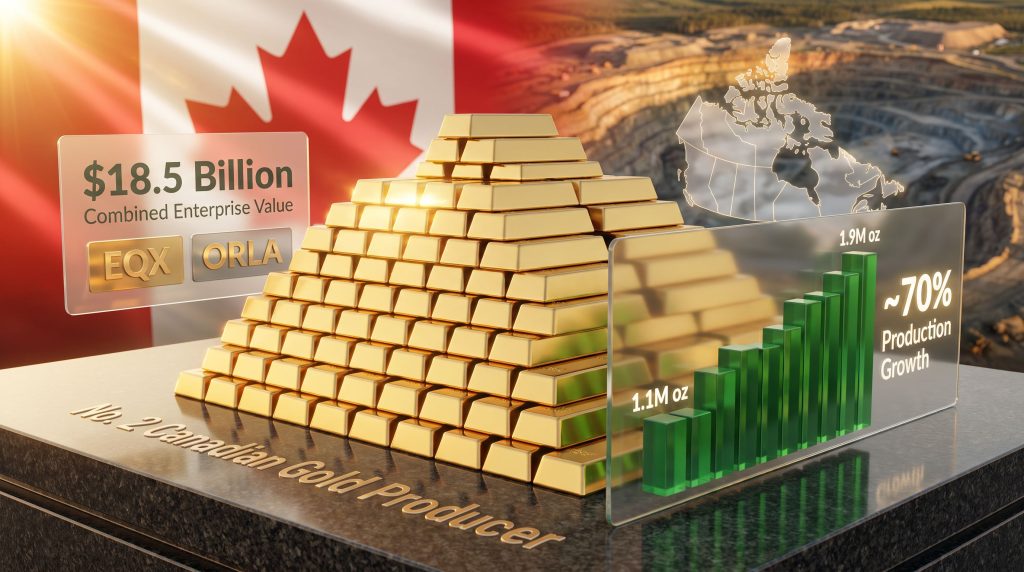
The combined entity carries an enterprise value of approximately $18.5 billion, anchoring its immediate production base at roughly 1.1 million ounces of gold annually across six operating mines, all concentrated within North American jurisdictions. The development pipeline embedded within the merged portfolio targets a growth trajectory toward 1.9 million ounces per year, representing a production uplift of approximately 70% from current output levels.
| Metric | Detail |
|---|---|
| Combined Enterprise Value | ~$18.5 billion |
| Immediate Annual Gold Output | ~1.1 million ounces |
| Projected Peak Annual Output | ~1.9 million ounces |
| Production Growth Potential | ~70% increase |
| Operating Mines | 6 (North America) |
| Equinox Post-Merger Ownership | ~67% of combined entity |
| Exchange Ratio | 1 Equinox share + US$0.0001 per Orla share |
| Canadian Producer Ranking | No. 2 (behind Agnico Eagle) |
These figures place the merged company firmly in Canada's senior producer tier, ranked second only to Agnico Eagle Mines, which produces upward of 3.4 million ounces annually. The gap between the two is substantial, but the merged entity's growth profile is arguably more front-loaded than many comparably sized producers globally. Furthermore, the broader gold market outlook suggests sustained conditions that support this kind of strategic positioning.
How the Equinox Orla Merger Approval Was Structured
The Dual-Vote Mechanism Under Canadian Corporate Law
The pathway to completing this transaction required satisfying two separate shareholder constituencies simultaneously. Both Equinox Gold (TSX/NYSE: EQX) and Orla Mining (TSX/NYSE: ORLA) convened special meetings on July 22, 2026, where their respective shareholder bases voted independently on complementary but distinct resolutions.
Orla shareholders voted to approve a court-sanctioned arrangement structured under the Canada Business Corporations Act, a legislative framework that governs how Canadian corporations can reorganise through merger or acquisition. Equinox shareholders, meanwhile, voted separately to approve the share issuance that forms the consideration for acquiring Orla.
The dual-track approval structure embedded in Canadian corporate law exists specifically to protect minority shareholders in large-scale combinations. Requiring judicial oversight from the Supreme Court of British Columbia, in addition to shareholder approval, adds a procedural layer that many other jurisdictions do not mandate, creating a more deliberate and legally robust merger process.
The sequence of remaining steps before the transaction formally closes follows a clear timeline:
- Shareholder Votes Completed – July 22, 2026 (both companies voted separately)
- Court Sanction Sought – Final order from the Supreme Court of British Columbia targeted for approximately July 28, 2026
- Regulatory Condition Satisfaction – Any outstanding conditions identified in company filings to be resolved
- Transaction Close – Targeted for approximately July 31, 2026, subject to all conditions being met
The involvement of independent proxy advisory firms was a notable feature of the pre-vote process. Both firms endorsed the transaction ahead of the July 22 meetings, citing the strategic rationale around asset diversification, improved capital allocation flexibility, and the strengthened long-term production profile. In large-scale M&A transactions, proxy adviser endorsement carries significant weight with institutional shareholders, reducing governance-related objections that can complicate or delay voting outcomes.
Ownership Economics: What the All-Share Structure Signals
Breaking Down the Exchange Terms
The transaction is structured as an effectively all-share deal. Each Orla Mining share converts into one Equinox Gold share plus US$0.0001 in cash, making the nominal cash component functionally irrelevant to the economics. Post-closing, existing Equinox shareholders retain approximately 67% of the combined company, with Orla shareholders receiving the remaining ~33%.
| Factor | Implication |
|---|---|
| All-share structure | Orla holders gain full exposure to combined company's upside |
| 67/33 ownership split | Equinox shareholders maintain majority control |
| No meaningful cash premium | Signals mutual confidence in sustained gold price strength |
| Growth pipeline participation | Both shareholder groups benefit from the 70% production growth target |
| Proxy adviser endorsement | Independent validation reduces governance risk concerns |
The absence of a meaningful cash component is itself analytically significant. In gold sector M&A, all-share deals typically emerge when the acquirer believes its own shares are fairly valued and when the target's shareholders are sufficiently confident in the combined entity's future to accept equity rather than cash. A cash premium would have implied that Orla shareholders needed immediate liquidity compensation, something an all-share structure deliberately avoids by keeping both parties aligned on long-term performance.
When two producers agree to an effectively cashless merger at this scale, it is a tacit statement about where they believe the gold price cycle is positioned. Neither party demanded a cash exit, suggesting collective confidence in the durability of current bullion pricing across the expected development timeline.
Competitive Positioning in Canada's Gold Landscape
How the Merged Entity Ranks Against Peers
| Producer | Estimated Annual Output | Market Position |
|---|---|---|
| Agnico Eagle Mines | 3.4+ million oz | No. 1 Canadian Gold Producer |
| Equinox + Orla (Combined) | 1.1M oz near-term / 1.9M oz target | No. 2 Canadian Gold Producer |
| Other Mid-Tier Canadian Producers | Sub-1M oz range | No. 3 and below |
The strategic value of this positioning extends beyond the ranking itself. Index eligibility thresholds, institutional mandate criteria, and analyst coverage intensity all scale with production size and market capitalisation. By crossing into senior producer territory, the combined entity becomes accessible to a broader universe of institutional mandates that previously excluded both companies individually. This mirrors wider trends in gold M&A activity observed across other major gold-producing nations.
What Anchors the North American Focus
A less discussed but critically important dimension of this merger is its deliberate concentration within politically stable North American mining jurisdictions. In an environment where global gold producers are increasingly scrutinised for sovereign risk exposure, assets located in Canada, the United States, and Mexico carry measurable valuation premiums.
The Valentine mine in Newfoundland and Labrador is among the flagship operating assets contributing to the combined production base. Newfoundland's regulatory environment and infrastructure access have made it an increasingly attractive jurisdiction for large-scale gold development, and Valentine represents a relatively recent addition to the Canadian producing mine inventory.
Investors with exposure to gold producers in higher-risk jurisdictions face discount factors that erode the per-ounce valuation their resources would otherwise command. The Equinox-Orla combination sidesteps this problem by building scale entirely within North America, which is a deliberate portfolio construction choice that carries long-term valuation consequences.
The Macro Forces Behind the Consolidation Wave
Three Structural Drivers Accelerating Gold M&A
The Equinox Orla merger approval did not emerge in isolation. It reflects a set of converging structural forces that have been reshaping the gold mining landscape over the past several years. Indeed, mining industry consolidation has been accelerating across multiple commodity classes, but gold has seen some of the most pronounced activity.
- Sustained Bullion Price Elevation – Record gold prices near historical highs have elevated the in-ground value of ounces, making acquisition of proven resources economically rational relative to the cost and timeline of organic exploration. Buying established production and development pipelines has, in this environment, become cheaper than finding new deposits from scratch.
- Scale Economics in Capital Markets – Institutional capital allocation increasingly favours larger producers with diversified asset bases. Mid-tier companies that cannot access investment-grade debt markets, or that fall below thresholds for major index inclusion, face a structural cost-of-capital disadvantage that consolidation can resolve.
- Jurisdictional Risk Repricing – The past decade of geopolitical disruption has prompted investors to apply more rigorous sovereign risk discounts to mining assets in politically complex environments. Producers concentrated in stable jurisdictions now trade at premium multiples, creating incentive to aggregate North American assets specifically.
This combination follows a broader wave of consolidation activity in the Canadian gold sector, as mid-tier producers recognise that the operating and financial scale required to compete for institutional capital has risen materially. Transactions that would have seemed ambitious five years ago are now framed as necessary positioning moves in a sector increasingly defined by the gap between senior producers and everyone else.
The next major ASX story will hit our subscribers first
The 1.9 Million Ounce Target: How Realistic Is the Growth Case?
Development Pipeline Mechanics
The gap between current output of 1.1 million ounces and the targeted peak of 1.9 million ounces annually will be bridged by development-stage assets within the combined portfolio progressing through permitting, construction, and commissioning phases. This is not growth that arrives quickly; mine development in North America typically spans multi-year timelines and requires sustained capital allocation.
Several factors support the credibility of the growth target:
- All six current operating mines are in established North American jurisdictions with well-understood regulatory frameworks, reducing permitting uncertainty relative to emerging market alternatives
- The merged entity's enhanced balance sheet capacity reduces the risk of capital constraints derailing development schedules
- Operating six mines simultaneously generates the operational experience and technical workforce depth needed to execute parallel development programs
- Independent proxy advisers reviewed the growth case as part of their endorsement process, adding external scrutiny to the internal projections
A 70% production growth trajectory from a base of six operating North American mines represents one of the more compelling organic growth profiles available in the senior gold producer category globally at the time of the merger's completion.
What investors should monitor closely in the periods following close is the capital expenditure cadence applied to development projects, the permitting timeline at key assets, and whether the operational integration of six mines under unified management delivers the cost-efficiency improvements that typically justify consolidation economics. Consequently, the gold price impact on miners through this integration period will be a key variable to track.
Frequently Asked Questions: Equinox Orla Merger Approval
What did shareholders vote on at the July 22, 2026 meetings?
Shareholders of both Equinox Gold and Orla Mining voted in separate special meetings. Orla shareholders approved the arrangement under the Canada Business Corporations Act, while Equinox shareholders approved the share issuance resolution required to acquire Orla.
When is the Equinox Orla merger expected to officially close?
The transaction targets a closing date of approximately July 31, 2026, contingent on the Supreme Court of British Columbia issuing its final order around July 28, 2026, and any remaining regulatory conditions being satisfied.
What will Orla shareholders receive under the exchange terms?
Each Orla Mining share converts into one Equinox Gold share plus US$0.0001 in cash, making this an effectively all-share transaction.
How large will the combined company be by production?
The merged entity is expected to produce approximately 1.1 million ounces of gold annually from six operating North American mines at close, with development projects targeting growth toward 1.9 million ounces per year.
Where does the combined company rank among Canadian gold producers?
The merged Equinox-Orla entity ranks as Canada's second-largest gold producer by output, behind Agnico Eagle Mines.
Why did independent proxy advisers endorse the deal?
Advisers cited asset base diversification across multiple operating mines, improved strategic capital allocation flexibility, and a materially strengthened long-term production profile as the primary drivers of their endorsement.
What This Merger Signals for the Canadian Gold Sector
The Equinox Orla merger approval crystallises several dynamics that are likely to define Canadian gold mining through the remainder of the decade. Consolidation at this scale sends a clear signal to mid-tier producers still operating below senior thresholds: the cost of remaining sub-scale is rising. For further background on the initial announcement that set this process in motion, Mining Technology's coverage of the merger provides useful context on how the deal was first framed to the market.
Key takeaways for industry participants and investors include:
- Institutional capital access increasingly demands senior producer scale, pushing mid-tier companies toward merger activity or strategic partnerships
- North American jurisdiction concentration is becoming a deliberate portfolio construction strategy, not merely a geographic coincidence
- All-share deal structures at this level indicate mutual conviction in sustained gold price strength across multi-year development timelines
- The 70% production growth benchmark established by this combination will be closely tracked by the sector as a reference case for whether consolidation-driven growth strategies can outperform standalone organic development
- Court-sanctioned arrangement structures under Canadian corporate law provide a replicable legal framework for future large-scale combinations involving TSX-listed producers
The Canadian gold sector is entering a phase where the gap between senior producers and mid-tier companies is likely to widen rather than narrow. Transactions of this scale accelerate that divergence by removing assets from the acquirable mid-tier pool while simultaneously creating a more formidable competitor for the remaining producers still operating below senior thresholds. As Orla shareholders overwhelmingly approved the business combination, the strength of that mandate reflects genuine conviction in the merged entity's strategic direction.
Disclaimer: This article is intended for informational purposes only and does not constitute financial advice. Forward-looking statements regarding production targets, merger timelines, and growth projections involve inherent risks and uncertainties. Actual outcomes may differ materially from those projected. Readers should conduct their own due diligence and consult a qualified financial adviser before making investment decisions. For additional context on the transaction announcement, see the original reporting at Canadian Mining Journal.
Want to Capitalise on the Next Major Gold Discovery Before the Market Does?
Discovery Alert's proprietary Discovery IQ model delivers real-time alerts on significant ASX mineral discoveries, instantly translating complex geological data into actionable investment insights for both short-term traders and long-term investors — explore Discovery Alert's historic discoveries page to understand the returns major mineral finds can generate, and begin your 14-day free trial today to position yourself ahead of the broader market.