July 24, 2026

Africa's Gold Governance Crossroads: When Political Immunity Meets Legal Accountability
Across sub-Saharan Africa, a quiet but consequential shift is reshaping how resource-rich nations confront the informal economies that grow in the shadow of their most valuable exports. For decades, the assumption embedded in the political architecture of gold-producing nations was simple: proximity to power meant proximity to protection. That assumption is now being tested in ways that carry real implications for investors, regulators, and the communities who live downstream from the rivers that illegal mining has poisoned.
Ghana, Africa's largest gold producer, has long sat at the centre of this tension. The conviction of a senior opposition politician on charges directly tied to Ghana illegal mining operations has sent a signal that the country's governance apparatus is willing to move beyond symbolic enforcement and into territory that was previously considered politically untouchable.
When big ASX news breaks, our subscribers know first
Understanding Galamsey: The Informal Economy That Outgrew the Law
Galamsey refers specifically to unlicensed, artisanal gold mining conducted outside Ghana's formal regulatory framework, derived from the phrase "gather them and sell." What began as small-scale subsistence activity has evolved into an organised, semi-industrialised sector with its own supply chains, financiers, equipment networks, and, critically, political patrons.
Ghana's Minerals and Mining Act requires ministerial approval for any assignment of mineral rights. This legal architecture was designed precisely to prevent informal operators from accessing land through backdoor channels. In practice, however, the enforcement of this requirement has historically been uneven, and the gap between law and application has proven enormously profitable for those positioned at the intersection of political authority and mineral access.
The environmental consequences of this gap are severe and measurable:
| Environmental Impact | Estimated Scale |
|---|---|
| Waterways contaminated by mercury pollution | Over 60% of national waterways |
| Forests stripped by illegal operations | Widespread across Ashanti and Western regions |
| Rivers rendered unusable for communities | Multiple major river systems affected |
Mercury, used in rudimentary gold amalgamation processes common among galamsey operators, does not dissipate. It bioaccumulates through aquatic food chains and enters human populations through drinking water and fish consumption. The contamination of over 60% of Ghana's waterways represents a public health crisis that has been decades in the making and will take generations to reverse.
The Conviction That Changed the Calculus
Bernard Antwi Boasiako and the Akonta Mining Connection
An Accra High Court convicted Bernard Antwi Boasiako, the Ashanti regional chairman of the New Patriotic Party, on two substantive charges. The first was granting mineral rights without the legally mandated ministerial approval. The second was knowingly facilitating unlicensed and illegal mining operations through his connection to Akonta Mining. The sentence handed down was 20 years imprisonment with hard labour.
What makes this case analytically significant extends beyond the severity of the sentence. The prosecution targeted an enabling function rather than direct extraction activity. Boasiako was not convicted for physically operating mining equipment. He was convicted for using administrative proximity to political authority to open doors that the law explicitly required to remain closed without proper oversight. Furthermore, this distinction matters enormously for how future cases might be constructed.
According to reporting from mining.com on the conviction, Boasiako is the first senior politician in Ghana to be convicted of illegal mining since the country's independence — a milestone that underscores just how unprecedented the ruling is within the country's governance history.
Legal Precedent Note: By targeting the act of enabling illegal mining through the unauthorised exercise of administrative authority, the Accra High Court has created a framework that could extend prosecution risk to any politically connected individual who facilitates illegal mining access, regardless of whether they physically participate in operations.
The NPP's Response and the Appeal Question
The New Patriotic Party has characterised the ruling as politically driven and indicated its intention to challenge the conviction through the appeals process. This response is predictable and, in comparative governance terms, almost universal when a senior party figure faces criminal conviction in a politically charged context. Whether the appeal proceeds on substantive legal grounds or functions primarily as a political narrative tool remains to be seen.
Shock and anger have reportedly followed the sentencing among Boasiako's supporters, reflecting the deep regional power base he holds in the Ashanti constituency. Historically, the "political persecution" defence has had mixed success in African jurisdictions. Courts in Tanzania and Kenya have upheld resource-related convictions even under significant political pressure, while other jurisdictions have seen enforcement fade when electoral calculations shifted. Ghana's trajectory from this point will be closely watched.
Ghana's Regulatory Architecture in Transition
Cabinet-Approved Mining Law Amendments
The Boasiako conviction did not occur in isolation. In July 2026, Ghana's cabinet approved revised mining legislation for submission to parliament, representing the most comprehensive overhaul of the country's regulatory framework in recent years. Mines Minister Emmanuel Armah-Kofi Buah articulated the policy's core aims as indigenising the mining sector through local content requirements, driving domestic value addition before mineral export, improving linkages between mining revenues and Ghana's manufacturing base, and deploying decisive enforcement mechanisms against illegal operations.
The timing of legislative reform alongside high-profile prosecution is not coincidental. Ghana's current administration appears to be pursuing a dual-track approach: institutional reform on one rail, criminal deterrence on the other. Whether these two tracks remain coordinated or diverge under political pressure is the central uncertainty facing sector observers. The broader mining sustainability transformation underway globally lends important context to why Ghana's reforms are attracting international attention.
GoldBod: Formalisation Through Market Mechanics
Ghana established the Ghana Gold Board, widely referred to as GoldBod, in 2025 as a state-controlled purchasing mechanism for artisanally mined gold. Its logic is straightforward but ambitious: if the state can offer artisanal miners a competitive, accessible, and legitimate off-take channel, the financial incentive to operate through illegal networks is reduced.
GoldBod's operational data through the first half of 2026 suggests the model is gaining traction:
| Metric | Figure |
|---|---|
| Gold purchased from artisanal miners (H1 2026) | 54 tonnes (~1.9 million oz) |
| Projected full-year trajectory | On track to match or exceed 2025 record |
| Average gold price basis for 2026 forecasts | ~$5,000 per ounce |
| Weekly purchase target | ~2.5 tonnes |
| Artisanal sector foreign exchange earnings (2025) | ~$11 billion |
| Large-scale miner foreign exchange earnings (2025) | ~$9 billion |
| Record artisanal output milestone (2025) | 104 tonnes |
The figure that demands particular attention is the foreign exchange comparison. In 2025, Ghana's artisanal sector generated approximately $11 billion in foreign exchange earnings, exceeding the roughly $9 billion contributed by large-scale industrial miners. For the first time in Ghana's recorded mining history, artisanal gold output at 104 tonnes exceeded large-scale production. This inversion has profound implications for how policymakers must now think about the sector: artisanal mining is no longer a peripheral, tolerable informality sitting at the edges of the formal economy. It is the dominant production channel.
The Global Illicit Gold Problem Ghana Sits Within
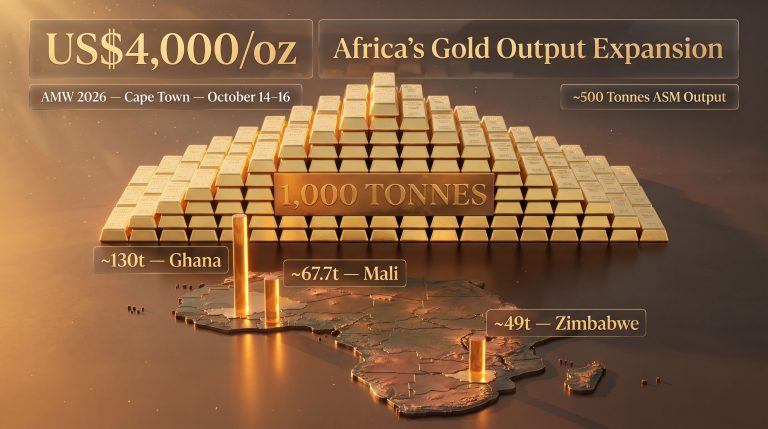
Ghana's governance challenges do not exist in a vacuum. The World Gold Council estimates that approximately 1,000 tonnes of small-scale miner gold enters illicit channels globally each year, with potentially half of that volume reaching criminal networks. Understanding how gold moves through illicit supply chains is important context for evaluating Ghana's reform efforts, particularly when considered alongside the gold market outlook for 2025 and beyond.
Illicit gold is extraordinarily difficult to intercept for several interconnected reasons:
- Informal refining occurs at small scale in dozens of countries, producing bars and granules indistinguishable from legitimately refined material
- Cross-border smuggling exploits porous land borders throughout West Africa, with gold frequently transiting through multiple jurisdictions before reaching international refining hubs
- Trading chain opacity means that gold of questionable provenance can be commingled with legitimate material at intermediate processing stages, effectively laundering its origin
- Price incentives are significant: the differential between what GoldBod pays and what smuggling networks offer in unregulated markets creates ongoing pressure at the point of collection
Ghana's strategic importance within this global picture is significant. As Africa's leading gold producer, the integrity of Ghana's artisanal gold supply chain has outsized influence on regional supply chain standards. In addition, when reviewing global gold production trends, Ghana's artisanal sector now commands a scale that rivals national outputs from other major producing nations.
Investment Climate Implications for Formal Operators
For licensed, large-scale mining operators active in Ghana, the current enforcement environment presents a mixed picture. On one hand, suppression of illegal mining activity improves land access security and reduces the operational friction caused by encroachment on licensed tenure areas — a problem that has historically affected both junior and major operators across the Ashanti and Western regions.
On the other hand, the mining law amendments under parliamentary review introduce potential changes to local content obligations and licensing structures that could affect cost models and project timelines. Investors evaluating Ghana exposure should monitor the legislative progress closely. Furthermore, the broader wave of gold M&A activity observed in 2025 suggests that sophisticated capital is already repositioning itself in anticipation of tightening governance frameworks across key producing nations.
Scenario Analysis: Three Possible Trajectories
| Scenario | Conditions | Likely Outcome |
|---|---|---|
| Enforcement Escalation | Convictions continue; mining law amendments pass | Deterrence strengthens; illicit flows decline; formal sector confidence improves |
| Political Reversal | Appeal succeeds; enforcement deprioritised | Galamsey rebounds; GoldBod gains eroded; investor uncertainty rises |
| Hybrid Stabilisation | GoldBod scales; enforcement targets operators, not communities | Partial formalisation; environmental damage slows; political tension persists |
Disclaimer: Scenario projections above are analytical frameworks based on available public information and historical precedent. They do not constitute investment advice or forecasts of specific policy outcomes.
The next major ASX story will hit our subscribers first
Frequently Asked Questions
What is galamsey and why is it illegal in Ghana?
Galamsey refers to unlicensed artisanal gold mining conducted without the ministerial approvals required under Ghana's Minerals and Mining Act. While licensed small-scale mining is legal and regulated, galamsey operations bypass environmental assessments, royalty obligations, and safety standards entirely.
Why was Bernard Antwi Boasiako sentenced to 20 years?
The Accra High Court convicted Boasiako on charges of granting mineral rights without the legally required ministerial approval and knowingly facilitating illegal mining operations through Akonta Mining. The 20-year sentence with hard labour reflects the severity with which the court treated the enabling of systemic illegal extraction. The case of Ghana illegal mining prosecution at this political level is widely regarded as a landmark moment in the country's legal history.
What is GoldBod and how does it operate?
The Ghana Gold Board was established in 2025 as a state purchasing entity for artisanally mined gold. It operates by offering artisanal miners a formal, accessible buying channel with the dual goal of formalising gold flows and reducing environmental harm from unregulated operations. Its weekly purchase target of approximately 2.5 tonnes, at gold prices near $5,000 per ounce, positions it as a significant market participant.
How does illegal mining affect Ghana's waterways?
Mercury used in informal gold amalgamation processes has contaminated over 60% of Ghana's national waterways. The contamination affects drinking water sources, fisheries, and agricultural water systems, with remediation timelines measured in decades rather than years. Consequently, the mine reclamation importance for affected areas cannot be overstated, as environmental recovery will require sustained institutional commitment well beyond the current enforcement cycle.
Key Data Summary
| Data Point | Figure |
|---|---|
| Prison sentence, senior NPP official | 20 years with hard labour |
| GoldBod purchases, H1 2026 | 54 tonnes (~1.9 million oz) |
| Artisanal sector forex earnings (2025) | ~$11 billion |
| Large-scale miner forex earnings (2025) | ~$9 billion |
| Record artisanal output (2025) | 104 tonnes |
| Global illicit artisanal gold annually | ~1,000 tonnes (World Gold Council) |
| Ghana waterways contaminated by mercury | Over 60% |
| GoldBod weekly purchase target | ~2.5 tonnes |
| Gold price basis for GoldBod 2026 forecasts | ~$5,000/oz |
The Boasiako conviction is best understood not as a singular legal event but as a data point in a longer institutional trend. Ghana is attempting something genuinely difficult: reforming the governance of an informal sector that has grown to dominate its most important export industry, while simultaneously managing the political consequences of prosecuting figures with deep regional power bases. However, whether prosecuting Ghana illegal mining at the political level proves to be a durable deterrent or a temporary inflection point will ultimately depend on whether institutional reform outlasts the electoral cycle in which it was initiated. The outcome of this effort will shape Ghana's investment climate, its environmental recovery trajectory, and the credibility of resource governance reform across West Africa for years to come.
Want to Track the Next Major ASX Mineral Discovery Before the Market Moves?
Discovery Alert's proprietary Discovery IQ model delivers real-time alerts on significant ASX mineral discoveries, transforming complex geological data into actionable investment insights — explore historic discovery returns to understand the scale of opportunity, and begin your 14-day free trial at Discovery Alert to position yourself ahead of the broader market.