
July 1, 2026
Strategic Foundations of Equipment Manufacturing Excellence in Asia-Pacific Mining Markets
Complex industrial ecosystems rarely reveal their underlying dynamics through surface-level analysis. The Asia-Pacific mining equipment sector represents one such intricate environment where technological advancement, operational expertise, and regional market knowledge converge to create competitive advantages that extend far beyond traditional manufacturing metrics. Understanding how equipment manufacturers establish and maintain leadership positions requires examination of strategic frameworks that integrate customer experience, service infrastructure, and innovation pipelines within regulatory environments spanning multiple jurisdictions.
The convergence of operational mining experience with original equipment manufacturer (OEM) leadership creates unique competitive positioning opportunities. When industry professionals transition from mining operations to equipment manufacturing leadership, they bring perspectives shaped by decades of managing equipment under extreme operational conditions, commissioning complex systems during critical project phases, and optimising total cost of ownership across asset lifecycles. This experiential foundation influences strategic decisions around product development, service delivery models, and customer relationship management in ways that purely engineering-focused approaches cannot replicate.
When big ASX news breaks, our subscribers know first
How Regional Infrastructure Shapes Equipment Manufacturing Competitive Advantage
Service Network Architecture as Strategic Asset
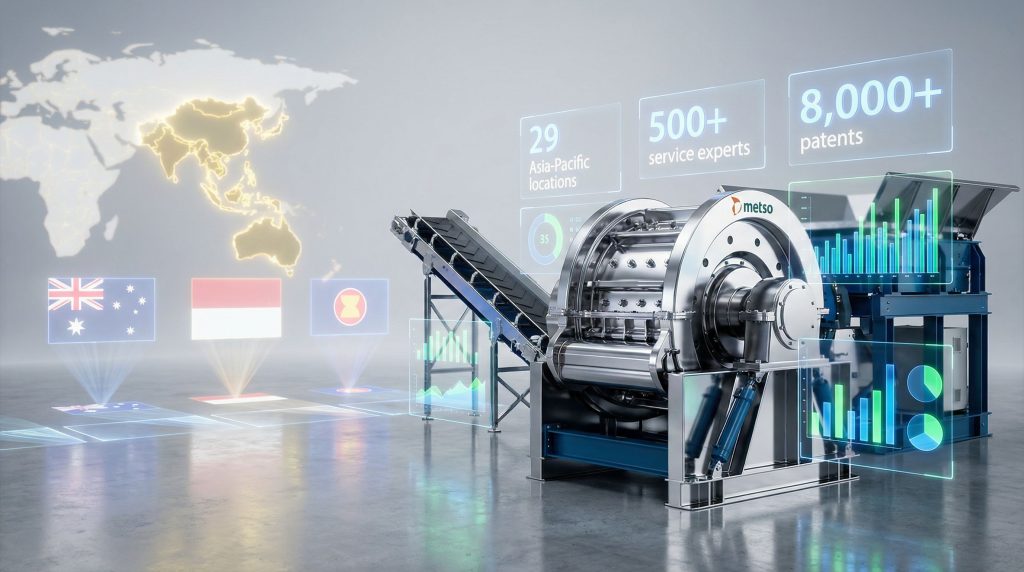
Metso leadership in Asia-Pacific demonstrates how regional infrastructure investment creates sustainable competitive advantages in mining equipment markets. The company's deployment of 29 strategic locations across Asia-Pacific, supported by more than 500 service experts, represents a fundamental approach to market positioning that prioritises proximity to operations over centralised service delivery models.
This infrastructure strategy addresses specific operational realities that mining operations face across diverse geographic and regulatory environments. Australian Pilbara operations require different service response capabilities than Indonesian coal mining operations or Southeast Asian mineral processing facilities. Furthermore, the regional distribution of service capabilities enables rapid response to equipment failures, proactive maintenance scheduling, and technical support during critical commissioning phases.
Comparative Response Time Advantages
Regional service infrastructure provides quantifiable operational advantages that directly impact mining operator decision-making. Equipment downtime costs in large-scale mining operations can exceed $50,000 per hour during peak production periods, making service response times a critical factor in total cost of ownership calculations.
| Service Response Metric | Regional Infrastructure | Centralised Model | Operational Impact |
|---|---|---|---|
| Emergency response time | 4-8 hours | 24-48 hours | 75% downtime reduction |
| Spare parts availability | Local inventory | Global shipping | 5-7 day advantage |
| Technical expertise | On-site specialists | Remote consultation | Real-time problem solving |
| Maintenance scheduling | Integrated planning | Reactive response | 30% cost reduction |
Karratha Service Centre: Flagship Operational Model
The Karratha Service Centre exemplifies how regional service excellence creates customer retention and market share advantages. Located in Western Australia's Pilbara region, this facility serves iron ore operations that process millions of tons annually under extreme environmental conditions. The centre integrates global innovation capabilities with regional operational requirements, enabling rapid deployment of technical expertise and spare parts management.
This operational model demonstrates several strategic principles: local inventory management reduces equipment downtime, regional technical expertise understands specific operational challenges, and integrated service delivery creates customer dependency that extends beyond initial equipment sales. In addition, mining operators increasingly evaluate equipment suppliers based on service availability during critical operational periods rather than solely on capital equipment costs.
Digital Transformation and Predictive Maintenance Innovation
Beyond Traditional Monitoring Systems
The integration of artificial intelligence and predictive maintenance technologies in mining equipment represents a fundamental shift in how OEMs create value for mining operations. While predictive maintenance tools have existed in the industry for 10 to 15 years, recent developments in AI-driven optimization capabilities are enabling new approaches to flow sheet optimisation and operational decision-making.
Modern mining equipment generates massive volumes of operational data through sensors monitoring vibration patterns, temperature variations, pressure changes, and throughput rates. This data, when processed through machine learning algorithms, enables prediction of equipment failures before they occur, optimisation of maintenance schedules to minimise production disruption, and identification of operational parameters that maximise equipment efficiency.
Artificial Intelligence Applications in Equipment Optimisation
Advanced AI systems now enable real-time optimisation of crushing and grinding circuits, automatic adjustment of equipment parameters based on ore characteristics, and predictive modelling of equipment performance under varying operational conditions. These capabilities represent significant competitive advantages for OEMs that can integrate digital technologies with mechanical engineering excellence.
The economic impact of AI-driven optimisation can be substantial:
- Energy consumption reduction: 15-25% through optimised operational parameters
- Equipment lifespan extension: 20-30% through predictive maintenance
- Production throughput increase: 10-15% through real-time optimisation
- Maintenance cost reduction: 25-35% through scheduled interventions
Integration Challenges and Opportunities
Successful digital transformation in mining equipment requires integration with existing operational systems, training of maintenance personnel on new technologies, and development of data analysis capabilities within mining operations. However, OEMs that provide comprehensive digital integration support create significant switching costs for customers and establish long-term competitive advantages.
Customer Experience Translation into Manufacturing Strategy
Operational Background as Strategic Advantage
Leaders with extensive mining operational experience bring unique perspectives to equipment manufacturing strategy that purely engineering-focused approaches cannot replicate. Having managed mining operations at facilities processing 30+ million tons annually, understanding the pressure of equipment commissioning during project ramp-up phases, and experiencing the operational realities of equipment maintenance under extreme conditions provides insights that directly influence product development and service delivery strategies.
This operational experience translates into specific competitive advantages:
- Equipment design decisions that prioritise maintenance accessibility and component durability
- Service support models that understand critical operational moments
- Commercial frameworks that align with mining operator cash flow and capital constraints
- Technology integration that minimises implementation complexity
Lifecycle Partnership Models
The transition from transactional equipment supply to lifecycle partnership represents one of the most significant strategic transformations in mining OEM leadership. Modern mining operators increasingly evaluate equipment through total lifecycle cost metrics rather than upfront capital expenditure alone.
Equipment manufacturers who understand operational realities recognise that success depends not just on technical performance, but on comprehensive support throughout the asset lifecycle, from initial commissioning through decades of operational optimisation.
Total Cost of Ownership Framework
Mining operators now model equipment costs across 10-15 year project phases, incorporating multiple variables:
- Initial equipment capital cost and installation expenses
- Annual maintenance requirements and spare parts availability
- Energy consumption over equipment lifespan (typically 15-25 years)
- Downtime impacts and operational reliability performance
- Environmental compliance and regulatory update costs
- Digital integration and automation capabilities
This comprehensive evaluation approach creates opportunities for OEMs to differentiate through service excellence, reliability performance, and long-term support capabilities rather than competing solely on initial capital costs. Consequently, these data-driven mining operations enable more sophisticated decision-making processes.
Innovation Pipeline and Technology Development
Patent Portfolio as Competitive Moat
Metso's global patent portfolio of approximately 8,000 patents represents significant intellectual property advantages in crushing and grinding technologies. This patent protection enables the company to maintain technological leadership while preventing competitors from replicating innovative solutions.
Recent technological developments include the Metso-Loesche Vertical Roller Mill (VRM) for dry grinding, which sets new benchmarks in sustainable comminution. This technology addresses increasing environmental compliance requirements while delivering operational efficiency improvements that directly impact mining operation profitability.
Sustainable Technology Development
Environmental regulations increasingly influence mining equipment design and selection criteria. Equipment that reduces energy consumption, minimises water usage, and enables circular economy principles in materials processing creates competitive advantages in jurisdictions with stringent environmental requirements.
Key sustainability metrics driving equipment selection:
- Carbon footprint reduction: 20-40% through energy-efficient designs
- Water consumption minimisation: Critical in water-stressed regions
- Waste stream optimisation: Circular economy principles in processing
- Regulatory compliance: Proactive alignment with emerging standards
For instance, these developments align with broader mining sustainability transformation initiatives across the industry.
Commercial Model Innovation and Partnership Strategies
Capital versus Operating Expenditure Optimisation
Mining companies increasingly seek equipment acquisition models that optimise cash flow and reduce upfront capital requirements. This trend creates opportunities for OEMs to develop innovative commercial structures that align equipment costs with operational performance.
Emerging commercial models include:
- Performance-based contracting aligned with production outcomes
- Service-based revenue models reducing upfront capital requirements
- Risk-sharing arrangements between OEMs and mining operations
- Long-term service contracts integrated with equipment supply
Early-Stage Project Integration
Rather than traditional tender processes where equipment is selected late in project development, successful OEMs increasingly integrate with mining projects during early design phases. This early integration enables flow sheet optimisation, equipment specification alignment with operational requirements, and technology roadmap development that extends throughout asset lifecycle.
The next major ASX story will hit our subscribers first
Regional Market Dynamics and Competitive Positioning
Regulatory Complexity Across Jurisdictions
Asia-Pacific mining equipment markets operate within diverse regulatory frameworks that create complexity for global OEMs. Australia's mining equipment standards align with the National Greenhouse and Energy Reporting Scheme (NGERS) and state-specific environmental assessment processes. Indonesia implements specific requirements for equipment local content and technology transfer provisions. Southeast Asian jurisdictions including Thailand, Vietnam, and the Philippines maintain varying equipment certification and safety standards requirements.
Successfully navigating these regulatory environments requires:
- Local expertise in compliance and certification processes
- Regional partnerships with engineering and service providers
- Technology transfer capabilities meeting local content requirements
- Regulatory monitoring systems tracking compliance changes
Supply Chain Resilience Strategies
Geopolitical considerations increasingly influence equipment supply chain strategies in Asia-Pacific markets. Regional manufacturing capabilities, critical component availability, and cross-border equipment deployment require sophisticated risk management approaches.
Supply chain resilience elements include:
- Regional manufacturing capabilities versus global sourcing strategies
- Critical component inventory management and supplier diversification
- Lead time management through strategic inventory positioning
- Geopolitical risk mitigation in cross-border operations
Future Scenario Planning for Mining Equipment Leadership
Scenario 1: Accelerated Automation Adoption
Rapid adoption of automation technologies would fundamentally reshape mining equipment design requirements and service delivery models. Integration challenges between legacy systems and next-generation automation, workforce transformation requirements for OEM service teams, and technology standardisation across equipment platforms would create new competitive dynamics.
Scenario 2: Sustainability-Driven Technology Shift
Increasing environmental regulations and carbon footprint considerations could accelerate adoption of energy-efficient equipment designs and circular economy principles in mining operations. This scenario would favour OEMs with advanced sustainable technology portfolios and comprehensive environmental compliance capabilities.
Scenario 3: Resource Nationalism and Local Content Requirements
Increasing government requirements for local content and technology transfer could drive regional manufacturing expansion strategies. This scenario would require OEMs to develop local capability development programs and regional partnership strategies.
Strategic Implications for Mining Equipment Industry Leadership
Customer Experience Integration
The most successful mining equipment manufacturers integrate operational mining experience into strategic decision-making processes. Leaders who have managed complex mining operations under pressure understand customer priorities in ways that purely technical approaches cannot replicate. This understanding influences product development, service delivery, and commercial model innovation.
Service Infrastructure as Competitive Advantage
Despite digital technology advancement, local service infrastructure remains critical for competitive success in mining equipment markets. Regional expertise, rapid response capabilities, and comprehensive spare parts management create customer retention advantages that extend far beyond initial equipment sales.
Innovation and Partnership Balance
Future success requires balancing technological innovation with partnership-based business models that address total cost of ownership concerns. OEMs that can integrate cutting-edge technology development with comprehensive lifecycle support create sustainable competitive advantages in complex B2B markets. These developments reflect broader industry evolution trends that continue to shape competitive dynamics.
Regulatory Compliance as Market Differentiator
Environmental regulations and sustainability requirements increasingly influence equipment selection criteria. The Asia-Pacific focus demonstrates how OEMs with proactive compliance capabilities and sustainable technology portfolios create advantages in jurisdictions with stringent environmental standards.
This analysis is based on publicly available information about mining equipment industry trends and competitive dynamics. Investment decisions should be based on comprehensive due diligence and professional financial advice. Market conditions and competitive positions may change significantly based on technological developments, regulatory changes, and economic factors not predictable at the time of analysis.
Considering an Investment in Asia-Pacific Mining Equipment Manufacturers?
Discovery Alert's proprietary Discovery IQ model delivers real-time notifications on significant ASX mineral discoveries, empowering investors to identify actionable opportunities in the mining equipment and services sector before broader market recognition. Begin your 14-day free trial today to secure your competitive advantage in capturing emerging mining investment opportunities as they develop.