
May 20, 2026
When Infrastructure Debt Becomes an Economic Threat
Across emerging market economies, the relationship between centralised utility providers and decentralised municipal distributors has long been a pressure point for fiscal instability. When the revenue chain connecting end-users to utility operators fractures at the municipal level, the consequences rarely stay contained. They spread outward, eroding investor confidence, compressing economic output, and placing ordinary citizens at the intersection of governance failure and service disruption. South Africa's current electricity crisis is not simply a story about unpaid bills. It is a case study in what happens when structural fiscal dysfunction reaches a tipping point inside the commercial engine of an entire continent.
When big ASX news breaks, our subscribers know first
What Is the Eskom-Johannesburg Power Debt Dispute — and Why Does It Matter Now?
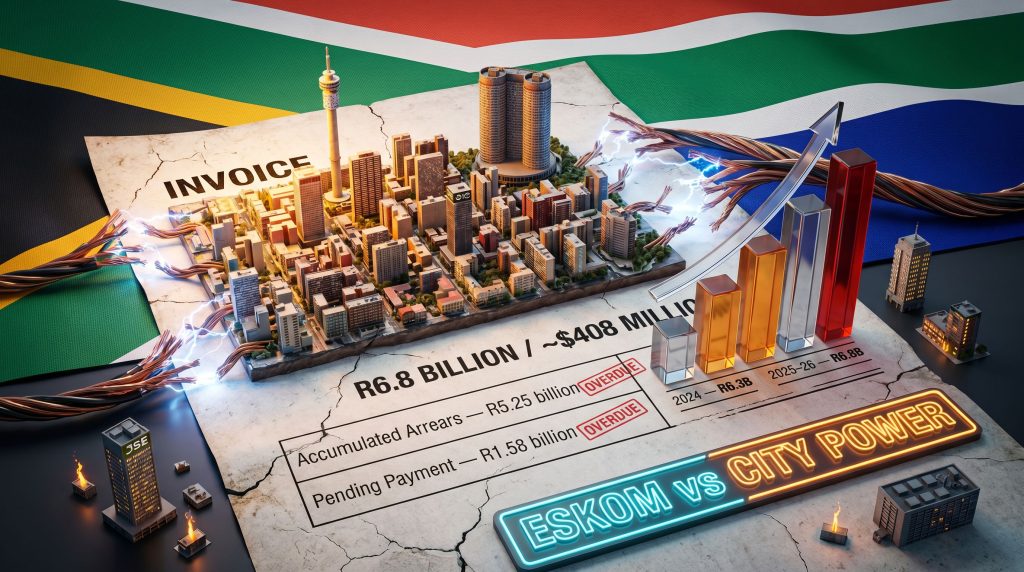
Eskom threatens Johannesburg blackout over unpaid power debt, and South Africa's state-owned electricity utility has issued a formal notice declaring its intent to reduce, interrupt, or terminate bulk electricity supply to specific supply points across the Johannesburg metropolitan area. The trigger is an outstanding combined debt of approximately R6.8 billion, equivalent to $408 million USD, owed by the City of Johannesburg and its municipal electricity distributor, City Power. Eskom's position is unambiguous: more than two years of negotiation and structured repayment assistance have produced no durable resolution, forcing the utility into enforcement mode.
The Scale of the Debt: Breaking Down the R6.8 Billion Figure
The total obligation is not a single lump sum but rather the accumulation of distinct components that together reflect years of compounding non-payment:
| Debt Component | Amount (ZAR) | Amount (USD approx.) |
|---|---|---|
| Accumulated arrears | R5.25 billion | ~$315 million |
| Payment due by June 5, 2026 | R1.58 billion | ~$95 million |
| Total combined obligation | R6.8 billion | ~$408 million |
What makes this figure particularly significant is the nature of the accusation underpinning it. Eskom has not characterised this as a situation where Johannesburg lacks the revenue to pay. Rather, the utility has formally stated that the City of Johannesburg and City Power are collecting electricity charges from end-users but withholding Eskom's allocated share rather than remitting it through the payment chain. This distinction transforms the dispute from a cash flow problem into a governance accountability issue with far broader implications.
Why Johannesburg Is Ground Zero for This Crisis
Johannesburg is not simply a large city. It is the financial and commercial nucleus of Africa's most industrialised economy, contributing roughly 16% of South Africa's total GDP. The metropolitan area hosts the regional headquarters of major banking institutions, mining conglomerates, and multinational corporations operating across the African continent. Any sustained or targeted disruption to electricity supply in this metro creates cascading consequences that extend well beyond city limits.
Furthermore, this situation is not isolated to South Africa. The Venezuela power crisis similarly illustrates how infrastructure debt and systemic mismanagement can converge to produce catastrophic service failures with economy-wide consequences.
Key Structural Insight: The Eskom-Johannesburg standoff is not a billing dispute between two entities. It is a public governance failure unfolding in real time at the centre of Africa's most economically significant urban economy, with the potential to ripple across sectors already under pressure from weak growth, logistics challenges, and energy volatility.
The timing intensifies the political stakes. South Africa's National Treasury has formally raised concerns about Johannesburg's overall fiscal position, and local media have reported details of a letter from Finance Minister Enoch Godongwana to Mayor Dada Morero, pointing to governance deficiencies, mounting obligations, and deteriorating service delivery. Eskom's enforcement notice lands precisely as the Mayor prepares to deliver his State of the City Address, creating acute political pressure to present a credible recovery narrative while simultaneously managing an imminent supply threat.
How Did Johannesburg's Power Debt Reach Crisis Point? A Structural Analysis
The Revenue Collection Breakdown: Where the Money Goes Missing
South Africa's traditional electricity distribution model operates on a straightforward premise: Eskom generates and supplies bulk electricity to municipalities, which then distribute it to residents and businesses, collect payment, and remit Eskom's portion back to the utility. This model has broken down across the system at a structural level.
The Johannesburg case illustrates a specific and particularly concerning variant of this failure. According to Eskom, the city is not failing to collect revenue from electricity consumers. The breakdown occurs further along the chain, where collected funds are not being passed through to Eskom. This suggests that municipal revenue is being redirected, whether to cover other budget shortfalls, service obligations, or operational gaps, before Eskom's share is honoured.
This dynamic mirrors a pattern visible across multiple South African municipalities, where:
- Deteriorating infrastructure increases the cost of distribution operations
- Revenue collection rates from end-users, particularly in lower-income zones, remain inconsistent
- Municipal administrations face competing fiscal pressures that create incentives to delay utility remittances
- Accountability mechanisms for payment compliance lack sufficient enforcement teeth
Johannesburg's Deteriorating Fiscal Position
The debt crisis does not exist in a vacuum. Johannesburg has been grappling with broader fiscal deterioration that National Treasury has formally flagged. The reported communication from Finance Minister Godongwana to Mayor Morero specifically highlighted governance deficiencies, debt accumulation, and service delivery failures as interconnected concerns. This context is critical because it positions the Eskom standoff as one symptom of a larger institutional dysfunction rather than an isolated procurement or billing failure.
The economic challenges of energy transition experienced elsewhere offer a cautionary parallel: when fiscal management fails to keep pace with infrastructure obligations, the consequences compound rapidly across multiple sectors of the economy.
The 2024 Precedent: This Crisis Has Happened Before
The current standoff has a direct historical antecedent. In late 2024, Eskom issued a near-identical supply-cut warning over approximately R6.3 billion ($378 million) in unpaid and pending obligations. Johannesburg's response at the time was to counter-accuse Eskom of overbilling the city by approximately R3.4 billion ($204 million), a dispute that escalated to the point where Electricity Minister Kgosientsho Ramokgopa intervened directly to prevent supply disruptions.
The outcome of that intervention was no permanent structural resolution. The debt has since grown by a further approximately R500 million, reaching the current figure. This trajectory is deeply revealing:
Pattern Recognition: Treating the 2024 crisis as a one-off emergency rather than diagnosing and addressing its structural causes has directly produced a larger, more entrenched 2026 crisis. Each cycle of political intervention without structural reform raises the debt level and reduces the credibility of future enforcement threats.
The recurrence confirms that the problem is systemic, not episodic. Without mechanisms that change the underlying incentive structures governing how municipal electricity revenue is managed and remitted, the pattern will continue.
What Are the Real-World Consequences of an Eskom Supply Cut to Johannesburg?
Immediate Economic Exposure
A targeted reduction in bulk electricity supply to specific Johannesburg supply points would produce immediate disruptions across sectors with limited capacity to absorb further operational stress. The most exposed include:
- Financial services: Banking operations, trading infrastructure, and data centres rely on continuous power availability; even brief interruptions can trigger significant operational and reputational costs
- Mining and resources: Processing facilities and logistics hubs throughout the Johannesburg metro depend on stable power supply for continuous operations
- Retail and commercial zones: High-traffic commercial areas in the CBD and surrounding districts would face customer-facing disruption with limited backup generation capacity at scale
- Small and medium enterprises: This segment bears disproportionate risk, lacking the generator infrastructure or financial buffers that larger corporates maintain for load-shedding continuity
The Diepkloof Hostel Case Study: Disruption Already Underway
The consequences of the broader debt standoff are not hypothetical. City Power has already linked an active outage at Diepkloof Hostel in Johannesburg to the unresolved payment dispute with Eskom. This localised incident is analytically significant because it demonstrates that enforcement pressure from Eskom is already influencing operational decisions at the municipal distributor level, even before any formal supply cut is implemented across bulk supply points.
For residents at Diepkloof and similar areas, the abstract language of utility finance has translated directly into the absence of electricity. This pattern, where high-level debt disputes manifest as ground-level service failures for ordinary residents, illustrates the human cost embedded in what might otherwise appear to be an institutional billing disagreement.
Investor Confidence and Sovereign Risk Implications
Beyond immediate operational impacts, the recurring energy instability in Johannesburg compounds existing concerns about South Africa's investment climate. According to Reuters, foreign direct investment decision-makers evaluating long-term commitments in the country's commercial capital must now factor in the possibility of recurring utility crises as a structural business risk rather than an exceptional event.
Analysts note that sustained uncertainty around electricity reliability in Johannesburg risks dampening industrial output and delaying economic recovery already constrained by weak GDP growth projections. For a country actively competing for manufacturing investment and regional headquarters positioning, recurring blackout threats in its primary commercial hub represent a significant competitive disadvantage. These concerns are further reflected in the broader resource and energy export challenges that other resource-intensive economies have had to navigate when infrastructure governance falters.
Is Eskom's Turnaround Story at Risk? Assessing the Utility's Fragile Recovery
From Crisis to Cautious Optimism: Eskom's Recent Performance Trajectory
For more than a decade, Eskom was synonymous with South Africa's energy dysfunction. Ageing coal-fired generation infrastructure, widespread institutional corruption, and cascading operational failures produced years of rolling blackouts, known locally as load shedding, that cost the economy billions of dollars, weakened industrial output, and systematically eroded investor confidence in the country's infrastructure foundations.
The trajectory began shifting through a combination of aggressive maintenance programmes, improved plant availability, and government financial support. The symbolic marker of this improvement came in 2025, when Eskom reported its first annual profit in eight years, a milestone that carried significant weight for a utility previously regarded as one of South Africa's most acute economic liabilities.
Why Municipal Debt Is the Biggest Threat to Eskom's Recovery
Despite the profit milestone, analysts consistently characterise Eskom's recovery as structurally fragile. The core vulnerability is the municipal debt burden, which directly threatens the cash flow mechanics that underpin the utility's operational and financial stability.
Eskom's revenue model depends on municipalities remitting payment for bulk electricity supplied. When municipalities fail to honour this obligation, the utility's ability to fund critical functions is compromised:
- Ongoing maintenance programmes that have been central to improving plant performance and reducing load shedding frequency
- Capital investment in transmission and distribution grid infrastructure
- Debt servicing obligations associated with government-supported financial restructuring
- Operational expenditure across generation assets nationwide
The utility itself has explicitly noted that the burden of municipal non-payment is ultimately transferred to ordinary South Africans through upward pressure on electricity tariffs and broader strain on public finances. This creates a socially regressive feedback loop where governance failures at the municipal level are effectively subsidised by the wider population through higher energy costs.
The National Municipal Debt Landscape
The Johannesburg situation represents the most visible and economically consequential example of a nationwide problem. The full scale of municipal arrears to Eskom across South Africa runs into tens of billions of rand, reflecting systemic failures that extend far beyond a single metropolitan area.
| Metric | Estimated Scale |
|---|---|
| Total municipal debt owed to Eskom (national) | Tens of billions of rand |
| Johannesburg current outstanding balance | |
| Previous Johannesburg standoff (late 2024) | |
| Disputed overbilling claim by Johannesburg (2024) | |
| Debt increase between 2024 and 2026 standoffs | ~R500 million |
How Is Eskom Trying to Structurally Fix the Municipal Debt Problem?
Distribution Agency Agreements: A Systemic Reform Mechanism
Recognising that negotiated repayment plans consistently fail to produce lasting resolution, Eskom has been promoting a structural alternative: Distribution Agency Agreements (DAAs). These are long-term contractual frameworks under which Eskom assumes direct control of revenue-critical functions that municipalities have demonstrably mismanaged.
The operational functions transferred under a DAA include:
- Billing management – Eskom invoices end-users directly, bypassing the municipal intermediary layer
- Smart meter installation – enabling real-time consumption monitoring, improving revenue accuracy and reducing losses
- Revenue collection – Eskom collects payment directly from electricity consumers, eliminating the point at which municipal authorities can intercept or divert funds
- Partial electricity distribution management – reducing operational and financial risk at the local level
As of May 2026, nine municipalities had formally approved resolutions supporting DAA implementation. However, as MyBroadband reports, while this represents early-stage progress, it also highlights how gradual adoption has been relative to the scale of the national municipal debt problem.
Why DAAs Represent a Structural Shift in South Africa's Electricity Governance
The significance of DAAs extends beyond their operational mechanics. They represent a fundamental rethinking of the relationship between Eskom and local government in South Africa's electricity sector. The question of government intervention in mining and energy sectors more broadly raises similar tensions between central authority and local autonomy that DAAs must navigate carefully.
The traditional model, under which municipalities serve as intermediaries between Eskom and end-users, has failed at scale across the country. DAAs effectively remove the municipal layer from the revenue chain for the specific functions where failure has been most damaging. Rather than continuing to negotiate repayment agreements that repeatedly collapse, Eskom is seeking operational control as a debt-prevention mechanism.
Governance Implication: Widespread DAA adoption would represent a significant transfer of authority away from local government and back toward the central utility. This raises important questions about local government autonomy, democratic accountability for service delivery, and the long-term structure of electricity governance in South Africa. It is a reform with real benefits, but also structural trade-offs that policymakers will need to navigate carefully.
The next major ASX story will hit our subscribers first
What Does This Mean for South Africa's Broader Economic Stability?
The Intersection of Energy Policy, Fiscal Governance, and Investment
South Africa's economic recovery narrative rests on three interconnected pillars: energy stabilisation, fiscal consolidation, and investment attraction. The Johannesburg-Eskom standoff simultaneously undermines all three. Furthermore, understanding the wider geopolitical landscape for mining and energy sectors reveals how domestic governance failures can amplify international risk perceptions, compounding the difficulty of attracting long-term capital commitment.
- Energy stabilisation is threatened by potential supply cuts to the city that generates roughly one-sixth of national economic output
- Fiscal consolidation is undermined by municipal revenue mismanagement that places growing strain on Eskom and, by extension, on government finances
- Investment attraction is weakened by recurring infrastructure governance failures in the country's primary commercial and financial hub
The Political Economy of Enforcement
Eskom faces a fundamental tension that has no easy resolution. Aggressively enforcing payment obligations through supply cuts risks public harm, political backlash, and reputational damage. Yet continued tolerance of non-payment accelerates financial deterioration and undermines the credibility of future enforcement threats.
The 2024 ministerial intervention by Electricity Minister Ramokgopa demonstrated that supply-cut threats carry significant political leverage. It also demonstrated that political resolution does not equal structural resolution. Intervention may delay a crisis without addressing the conditions that produced it, meaning the next cycle begins with a higher debt baseline and a less credible set of enforcement options.
Without binding structural reforms that change the underlying incentive structures, whether through DAAs, legislative enforcement mechanisms, or conditional fiscal transfers from Treasury, the pattern of escalating debt, threatened supply cuts, and political intervention is likely to repeat at increasing scale and cost.
Frequently Asked Questions: Eskom, Johannesburg, and the Power Debt Crisis
What exactly does Johannesburg owe Eskom?
The City of Johannesburg and City Power collectively owe Eskom approximately R6.8 billion (around $408 million USD). This consists of R5.25 billion in accumulated arrears and a further R1.58 billion that was due for payment by June 5, 2026.
Could Eskom actually cut power to Johannesburg?
Eskom has issued a formal legal notice stating its intent to reduce, interrupt, or terminate electricity supply to specific bulk supply points across the metropolitan area. Full city-wide blackouts are operationally complex and politically fraught, but targeted supply reductions affecting specific zones are a documented and credible enforcement tool that has already influenced localised outage decisions at the City Power level.
Has this type of standoff happened before in Johannesburg?
Yes. A near-identical crisis emerged in late 2024 over approximately R6.3 billion in outstanding bills. That dispute required direct intervention from the Electricity Minister to temporarily resolve, but no permanent structural solution was implemented. The current debt figure is larger, confirming that the 2024 intervention addressed the immediate political crisis without fixing the underlying structural failure.
What are Distribution Agency Agreements and how do they address the problem?
DAAs are long-term contracts under which Eskom assumes direct control of billing, smart metering, revenue collection, and parts of electricity distribution in municipalities. By removing the municipal intermediary from the revenue chain, DAAs are designed to prevent the type of revenue diversion that Eskom has accused Johannesburg of practising. Nine municipalities had approved DAA resolutions as of May 2026.
How does this affect ordinary Johannesburg residents and businesses?
Beyond the risk of direct supply interruptions, municipal power debt creates upward pressure on electricity tariffs as Eskom seeks to recover revenue lost through non-payment. Localised outages, such as the disruption at Diepkloof Hostel already linked to the debt standoff, demonstrate that consequences for residents are not abstract or future-dated. They are occurring now.
What is Eskom's current financial position?
Eskom recorded its first annual profit in eight years during 2025, following sustained maintenance improvements and government financial support. Analysts characterise this recovery as real but fragile, with municipal arrears identified as the most significant ongoing structural threat to the utility's long-term financial viability. The fact that Eskom threatens Johannesburg blackout over unpaid power debt despite this improved position underscores just how serious the municipal non-payment problem remains.
Key Takeaways: The Structural Fault Lines Behind the Johannesburg Power Debt Crisis
- The R6.8 billion ($408 million) debt is the accumulated result of years of municipal fiscal mismanagement and a structurally broken revenue remittance model, not a sudden or isolated payment failure
- Johannesburg's contribution of roughly 16% of South Africa's GDP means supply disruptions in the metro carry nationwide economic consequences that extend far beyond the city's administrative boundaries
- Eskom's 2025 profit milestone is real but fragile; municipal arrears remain the single largest structural threat to the utility's continued financial recovery
- Distribution Agency Agreements represent the most credible systemic reform currently on the table, but voluntary and incomplete adoption limits their near-term impact
- The 2024 ministerial intervention demonstrated that political resolution does not equal structural resolution, and each cycle of intervention without structural reform raises the debt baseline for the next crisis
- Without binding enforcement mechanisms or comprehensive structural reforms that change municipal revenue management incentives, the pattern of escalating debt and threatened supply cuts is likely to continue at greater scale
This article is intended for informational purposes only and does not constitute financial or investment advice. Figures referenced reflect reported data as of May 2026. Exchange rate conversions between ZAR and USD are approximate and subject to fluctuation.
Want to Identify Investment Opportunities Emerging From Global Energy and Infrastructure Instability?
The structural fault lines exposed by South Africa's Eskom-Johannesburg crisis — spanning governance failure, commodity exposure, and resource sector volatility — are precisely the conditions that create high-impact discovery opportunities on the ASX. Discovery Alert's proprietary Discovery IQ model delivers real-time alerts on significant mineral discoveries the moment they hit the ASX, transforming complex market data into actionable insights for both short-term traders and long-term investors — explore historic discovery returns or start your 14-day free trial today.