July 3, 2026
The Industrial Backbone Behind Six Decades of Uninterrupted Iron-Ore Flow
Few commodity relationships in the modern industrial era have proven as durable, or as consequential, as the flow of iron ore from Western Australia's Pilbara region to the steel mills of Asia. Before a single headline is written about tonnage records or milestone shipments, it is worth understanding the geological and logistical architecture that makes such continuity possible. Furthermore, Australia's iron ore advantage is not simply a product of good fortune, but the result of decades of deliberate infrastructure investment, geological advantage, and commercial relationship-building at an extraordinary scale.
The Rio Tinto eight-billion tonne iron-ore shipment milestone, reached on 19 May 2026, is the most visible expression of that sustained effort. However, the number itself, staggering as it is, only begins to tell the story.
When big ASX news breaks, our subscribers know first
Why the Pilbara's Geology Makes It Unlike Any Other Iron-Ore Basin
The Pilbara Craton is one of the oldest exposed geological formations on Earth, with surface rocks dating back more than three billion years. What makes it commercially exceptional is not just age, but the concentration of banded iron formations, specifically the Brockman Iron Formation and Marra Mamba Iron Formation, which together host some of the highest-grade direct shipping ore deposits found anywhere on the planet.
Direct shipping ore, or DSO, is a term central to understanding the Pilbara's competitive advantage. Unlike lower-grade magnetite deposits that require energy-intensive processing and beneficiation before they can be used in blast furnaces, Pilbara hematite ore can in many cases be shipped to steel mills with minimal processing beyond crushing and screening. This reduces the cost curve significantly and is a key reason why Rio Tinto's Pilbara operations have remained globally competitive across multiple commodity price cycles.
Iron Content and Grade: Why Quality Matters in Global Steel Markets
Pilbara iron ores typically carry iron (Fe) grades in the range of 57% to 62%+, with relatively low levels of alumina and phosphorus contaminants compared to ores from some competing basins. In steelmaking, ore quality directly affects blast furnace efficiency, slag generation, and ultimately the cost per tonne of hot metal produced. Higher-grade, lower-impurity ores command price premiums on the spot market, and the benchmark pricing mechanisms used across Asian steel markets reflect this quality differential through published indices such as the Platts IODEX 62% Fe CFR China.
The iron ore grade premium market is not static. As Chinese steel mills increasingly adopt tighter environmental controls and efficiency mandates, demand for higher-grade, lower-alumina ores has grown, a structural shift that reinforces the long-term commercial value of premium Pilbara products.
The Rio Tinto Eight-Billion Tonne Iron-Ore Shipment Milestone in Detail
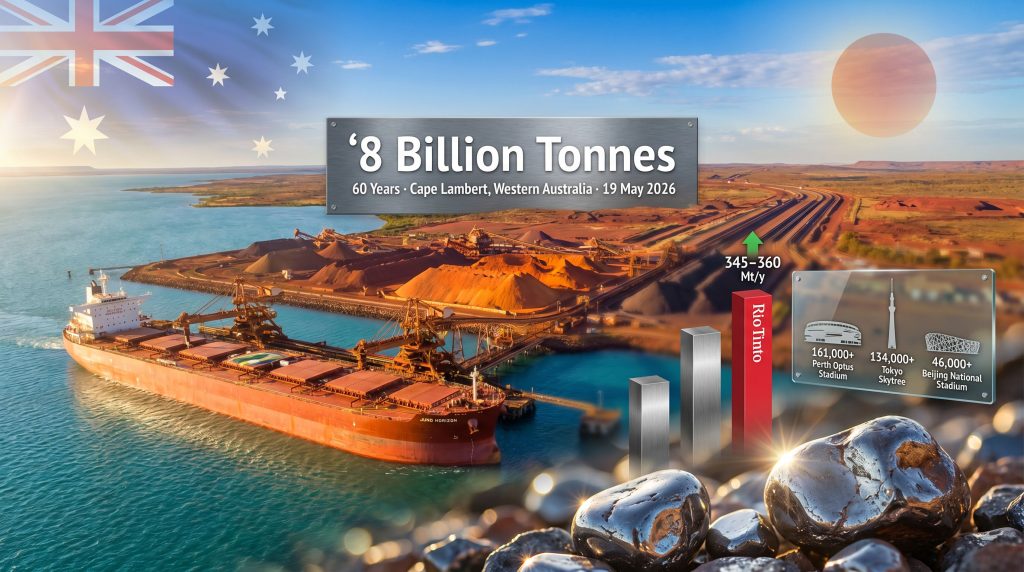
On 19 May 2026, a vessel named Juno Horizon departed Cape Lambert port in Western Australia, carrying the cargo that pushed Rio Tinto's cumulative Pilbara iron-ore shipments past the eight-billion-tonne mark. The destination was Nippon Steel Corporation in Japan, the same country that received Rio Tinto's very first Pilbara shipment back in August 1966.
That symmetry is more than symbolic. It reflects the enduring structure of the Asia-Pacific iron-ore trade corridor, which remains one of the most consistently active bilateral commodity flows in global resources.
| Milestone Detail | Data Point |
|---|---|
| Total cumulative iron ore shipped | 8 billion tonnes |
| Milestone shipment departure date | 19 May 2026 |
| Departure port | Cape Lambert, Western Australia |
| Vessel name | Juno Horizon |
| Destination | Nippon Steel Corporation, Japan |
| First Pilbara shipment to Japan | August 1966 |
| Years of continuous Pilbara operations | 60 years |
Crucially, this cumulative figure incorporates volumes from the Robe River Joint Venture alongside Rio Tinto's wholly operated Pilbara assets. The Robe River assets, which include the West Angelas and Mesa J deposits, have contributed meaningfully to the total over several decades and represent a less-discussed but important component of the overall tally.
Putting Eight Billion Tonnes in Real-World Context
To appreciate the scale of this achievement without resorting to abstract arithmetic, Rio Tinto has offered several structural comparisons. The steel that could be derived from eight billion tonnes of iron ore would be sufficient to construct:
- More than 161,000 Perth Optus Stadiums
- More than 134,000 Tokyo Skytree towers
- More than 46,000 Beijing National Stadiums
These figures underscore not just the volume, but the civilisation-scale contribution that Pilbara iron ore has made to global built infrastructure over six decades.
The Australia-Japan Iron-Ore Corridor: A 60-Year Commercial Anchor
When Rio Tinto's first iron-ore cargo left Western Australia for Japan in August 1966, it did so against a backdrop of Japan's post-war industrial reconstruction and its rapidly expanding steel sector. Japanese steelmakers at the time were seeking reliable, long-term sources of raw materials to feed blast furnaces operating at increasingly large scales. The Pilbara, with its massive, high-grade ore bodies and proximity to Asian markets via relatively short sea lanes, was a natural fit.
What is less commonly appreciated is that the early Australian-Japanese iron-ore agreements were structured as long-term contracts with fixed or semi-fixed pricing, a model that provided capital certainty for both miners developing infrastructure and steelmakers planning capacity expansions. This contractual architecture, sometimes called the annual benchmark system, shaped global iron-ore pricing conventions for decades before the shift to shorter-term index-linked pricing around 2010.
Rio Tinto's iron-ore chief executive Matthew Holcz has described Japan as a cornerstone of the company's business, noting that continued investment in Pilbara operations and regional communities is expected to extend well into future decades as global steel demand grows. The longevity of this relationship is itself a competitive moat: trust, logistics alignment, and product familiarity built over 60 years are not easily replicated by competing supply sources.
Infrastructure, Automation, and the Hidden Engine of Pilbara Output
Moving hundreds of millions of tonnes of iron ore each year from inland mines to coastal ports requires an infrastructure network of remarkable scale and sophistication. Rio Tinto's Pilbara system includes approximately 1,700 kilometres of private railway, making it one of the largest privately owned heavy-haul rail networks in the world.
The company operates its rail network using the AutoHaul system, the world's first fully autonomous, long-distance, heavy-haul rail operation. Trains running without on-board drivers transport iron ore from multiple mine sites to the ports of Dampier and Cape Lambert around the clock. This level of automation has meaningful implications for operational cost, safety, and throughput consistency.
Six Towns, Five Communities: The Human Infrastructure of the Pilbara
The social dimension of Rio Tinto's Pilbara presence is substantial. The company's operations have directly supported the development of six towns across the region:
- Karratha
- Wickham
- Tom Price
- Paraburdoo
- Pannawonica
- Dampier
A further five communities spanning from the Kimberley to the Great Southern are connected through the company's regional fly-in, fly-out programme. The relationship with Traditional Owner groups across the Pilbara is described by the company as a partnership built on knowledge-sharing, cultural stewardship, and ongoing governance collaboration. For institutional investors increasingly focused on ESG frameworks, the quality and durability of these social licence arrangements represent a material risk consideration alongside conventional financial metrics.
Rhodes Ridge: The Deposit That Will Define the Next Chapter
While the eight-billion-tonne milestone looks backward across six decades of achievement, the most strategically significant forward-looking development in Rio Tinto's Pilbara portfolio is Rhodes Ridge.
| Rhodes Ridge Key Data | Detail |
|---|---|
| Rio Tinto ownership stake | 50% |
| Classification | One of the world's best undeveloped iron-ore deposits |
| Potential annual capacity | ~100 million tonnes per year |
| Strategic role | Sustains mid-term capacity target of 345-360 Mt/y |
| Current status | Advanced studies underway |
Rhodes Ridge is located in the East Pilbara and hosts ore bodies understood to be of exceptional scale and quality. At potential production of approximately 100 million tonnes per year at full development, it would represent one of the largest single iron-ore developments in Australian mining history. Rio Tinto holds a 50% interest in the project alongside joint venture partner Wright Prospecting.
What makes Rhodes Ridge particularly significant from a forward supply perspective is that it is intended to sustain, rather than grow, Rio Tinto's Pilbara output. This distinction matters: the project is positioned as a replacement and maintenance asset for ageing or depleting operations rather than a net capacity expansion, suggesting that the 345 to 360 million tonne per year mid-term target represents a carefully managed production plateau rather than a growth trajectory.
Advanced feasibility studies are currently underway, with no confirmed production start date publicly announced. Any timeline projections beyond current study phases should be treated as speculative at this stage.
The next major ASX story will hit our subscribers first
Green Steel and the Future Quality Premium
One of the most consequential and underappreciated shifts reshaping the iron-ore market is the emerging transition toward low-emissions steelmaking. Conventional blast furnace steel production, which uses iron ore and coking coal, accounts for roughly 7% of global CO2 emissions according to the International Energy Agency. The transition to hydrogen-based iron reduction and electric arc furnaces is accelerating, particularly in Europe and increasingly in Japan and South Korea.
This shift has a specific and important implication for iron-ore producers: DRI-based steelmaking requires higher-grade ore, typically above 67% Fe, with very low levels of gangue minerals including alumina, silica, and phosphorus. Standard Pilbara DSO products, while excellent blast furnace feed, are generally not high enough in grade to be used directly in DRI without beneficiation or blending.
This is a structural challenge that Rio Tinto and other Pilbara producers are actively working to address through ore blending strategies, investment in processing technology, and development of higher-grade products. In addition, green iron production initiatives are gaining commercial momentum, with producers supplying DRI-compatible ore positioned to command premium pricing as green steel capacity grows globally. How Rhodes Ridge ore grades perform against DRI quality requirements will be a material consideration for the project's long-term revenue profile, though detailed grade data has not been fully disclosed in public filings to date.
What the Milestone Signals for Long-Term Investors
For investors assessing Rio Tinto as a long-term holding, the Rio Tinto eight-billion tonne iron-ore shipment milestone communicates several things simultaneously. First, it confirms operational longevity and infrastructure durability at a scale that cannot be replicated quickly by new entrants. The sunk capital in rail, ports, mine infrastructure, and town development represents a barrier to competition that is effectively insurmountable in the near to medium term.
Second, iron ore remains the dominant contributor to Rio Tinto's cash generation and dividend capacity. In years of strong iron-ore pricing, the Pilbara operations generate free cash flow at levels that few mining assets anywhere in the world can match. This makes Rio Tinto's dividend policy inherently leveraged to iron-ore price cycles, a dynamic investors must account for in any valuation framework.
Third, the concentration of revenue in a single commodity and a single geography introduces sovereign, geopolitical, and demand-side risks that are material at the portfolio level. Consequently, China demand prospects remain a central variable, given that China has historically absorbed more than half of global seaborne iron-ore volumes. Furthermore, the broader dynamics of China steel and iron ore markets, including trade tensions between Australia and China, represent a risk factor that no operational milestone can fully neutralise.
This article is intended for informational purposes only and does not constitute financial or investment advice. Past operational performance is not indicative of future financial outcomes. Investors should conduct independent due diligence before making investment decisions.
Frequently Asked Questions: Rio Tinto's Eight-Billion Tonne Iron-Ore Milestone
How long did it take Rio Tinto to ship 8 billion tonnes of iron ore from the Pilbara?
The cumulative total spans 60 years of continuous operations, beginning with the first shipment to Japan in August 1966 and reaching the milestone on 19 May 2026.
What ship carried the milestone shipment, and where was it headed?
The milestone cargo departed Cape Lambert aboard the vessel Juno Horizon, bound for Nippon Steel Corporation in Japan.
Does the 8-billion-tonne figure include the Robe River Joint Venture?
Yes. Rio Tinto has confirmed the cumulative total incorporates iron-ore volumes from the Robe River Joint Venture alongside its wholly operated Pilbara assets.
What is Rhodes Ridge and what is its development status?
Rhodes Ridge is considered one of the world's best undeveloped iron-ore deposits, in which Rio Tinto holds a 50% interest. Advanced feasibility studies are currently underway, with potential annual capacity of approximately 100 million tonnes at full development.
What is Rio Tinto's current Pilbara production target?
The company is targeting sustained mid-term production capacity of between 345 million and 360 million tonnes per year from its Pilbara iron-ore operations. According to recent production data, Rio Tinto met its 2025 iron-ore target on the back of record fourth-quarter shipments, reinforcing confidence in the durability of this output range.
Why does iron-ore grade matter for future steel demand?
Emerging low-emissions steelmaking technologies, particularly hydrogen-based direct reduction, require higher-grade ores typically above 67% Fe. This is reshaping the quality premium structure in global iron-ore markets and will increasingly influence which deposits attract the highest long-term commercial value.
Want to Position Yourself Ahead of the Next Major ASX Mineral Discovery?
Discovery Alert's proprietary Discovery IQ model delivers real-time alerts on significant ASX mineral discoveries, transforming complex geological and commodity data into actionable investment insights for both short-term traders and long-term investors. Explore historic discoveries and their extraordinary returns, then begin your 14-day free trial at Discovery Alert to secure your market-leading edge before the broader market catches on.