May 20, 2026
The Architecture of Resource Sovereignty: Why Commodity Export Control Is Reshaping Emerging Market Investment
Across the developing world, a quiet but consequential shift has been underway for more than a decade. Governments sitting atop vast reserves of natural wealth have grown increasingly restless with the gap between what their resources are worth on international markets and what actually flows into national treasuries. This tension between resource abundance and fiscal capture has produced a new generation of policy interventions, and Indonesia commodity export centralised control represents perhaps the most structurally ambitious version of this trend yet attempted by a major commodity exporter.
Understanding what Indonesia is proposing, and why it matters beyond the archipelago's borders, requires grasping both the mechanics of how commodity revenue leakage actually works and the enormous scale at which it has reportedly operated. This is not a story about a single policy announcement. It is a story about the limits of conventional export governance frameworks and what happens when a resource-rich government decides those limits are no longer acceptable.
When big ASX news breaks, our subscribers know first
The Revenue Leakage Problem: Transfer Pricing and Under-Invoicing Explained
To appreciate the scale of Indonesia's frustration, it helps to understand the specific financial mechanisms the government is targeting. Two practices in particular have been identified as the primary culprits: transfer pricing manipulation and under-invoicing.
Transfer pricing in commodity exports occurs when related parties on opposite sides of a transaction, typically a producer and an affiliated trading entity in a lower-tax jurisdiction, agree on an artificially low price for the commodity being exported. The effect is to shift profits offshore before they can be captured by royalties, export levies, or corporate income tax in the country of origin.
Under-invoicing is a related but distinct practice. It involves declaring the official export value of a shipment at below its true market price. Since royalty obligations and certain export duties are calculated as a percentage of declared value, understating the price reduces the tax base directly. The commodity still sells at full market value, but the difference between the declared price and the actual transaction price is captured outside the fiscal system.
Both mechanisms are structurally enabled by private export arrangements where the government has no direct visibility into the pricing of individual transactions. This is precisely the vulnerability that centralisation through a state-owned sole exporter is designed to close.
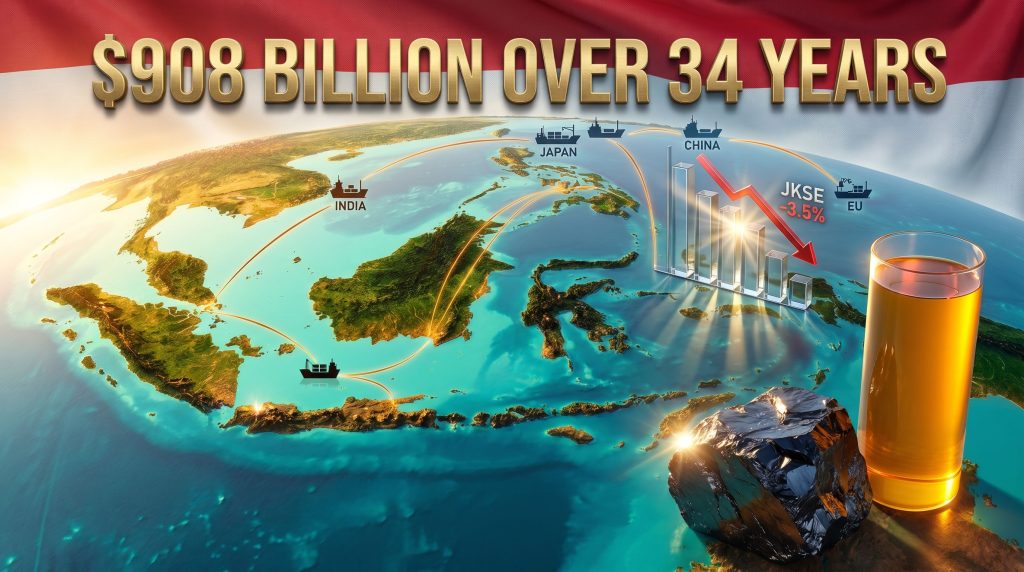
President Prabowo Subianto, in a parliamentary address on 20 May 2026, cited an estimated $908 billion in cumulative revenue losses over 34 years as the consequence of these practices across Indonesia's commodity export base. That figure implies an average annual revenue shortfall of approximately $26.7 billion, a staggering sum for a country whose formal fiscal capacity has repeatedly constrained its social spending ambitions.
It is worth noting that figures of this magnitude are inherently difficult to verify independently. The estimate likely encompasses cumulative opportunity cost rather than direct fraud, and the assumptions used to define what constitutes fair-value pricing significantly influence the result. Nevertheless, the structural reality of transfer pricing and under-invoicing in commodity-rich developing economies is well-documented by the IMF, World Bank, and OECD. Indonesia's challenge is not unique in kind, only in the audacity of its proposed response.
What the Centralisation Policy Actually Proposes
The core of President Prabowo's announcement is straightforward in concept, even if operationally complex: all exports of key commodities, specifically including palm oil and coal, must in future be conducted through a single government-selected state-owned enterprise functioning as the sole export channel. Private producers would no longer be permitted to export directly to international buyers. Instead, they would be required to sell to or through the designated state entity.
This is a qualitatively different proposition from what Indonesia has operated previously. The country already maintains a reasonably sophisticated export governance architecture, including a risk-based licensing model introduced under the Ministry of Trade in 2021 and digital clearance platforms such as OSS (Online Single Submission), INATRADE, and SINSW that are required for regulated commodity exports including tin, forest products, fish, and metal scrap. These systems regulate private exporters without replacing them.
The sole-exporter model eliminates that distinction. Furthermore, private traders are not regulated out of bad behaviour; they are removed from the primary export chain entirely. According to Reuters, the plan involves bringing commodity exports under centralised state control, a move that signals a fundamental restructuring of Indonesia's trade architecture.
As of the announcement date, several critical implementation details remained unresolved:
- The specific state-owned enterprise or enterprises to be designated had not been publicly confirmed
- Pricing mechanisms for determining how the SOE values commodities purchased from private producers had not been defined
- Transition timelines and the treatment of existing long-term export contracts remained unclear
- Compliance frameworks for producers who currently export under bilateral agreements with overseas buyers had not been specified
The formal regulatory instruments required to operationalise the policy were also not yet finalised at the time of the parliamentary address. What was delivered was a policy declaration of significant political weight, but the machinery of implementation remains to be constructed.
Indonesia's Commodity Weight in Global Markets
The reason this announcement generated immediate international attention lies in Indonesia's extraordinary position within two of the world's most consequential commodity markets.
| Commodity | Indonesia's Global Rank | Primary Buyer Markets | Key Use Cases |
|---|---|---|---|
| Thermal Coal | Largest exporter globally | Japan, China, India, South Korea | Power generation, industrial use |
| Palm Oil | Largest exporter globally | India, China, EU, Pakistan | Edible oils, biodiesel, food manufacturing |
| Nickel | Major producer | China, EU, US | Stainless steel, EV batteries |
| Tin | Major producer | Global electronics | Solder, packaging |
Indonesia's thermal coal exports are a structural input for Asian power utilities operating under long-term supply contracts. Any disruption to the reliability, pricing, or volume of Indonesian coal exports creates immediate pressure on electricity generation costs across the region.
For palm oil, the stakes are equally significant: Indonesia and Malaysia together account for the overwhelming majority of global supply, and Indonesian palm oil flows into food manufacturing supply chains, biodiesel mandate compliance programmes in the European Union, and cooking oil markets across South and Southeast Asia. A sole-exporter model concentrating both of these commodity streams through a single government entity consequently represents a structural shift in how global commodity markets receive price signals and supply commitments.
Market Reaction: What the JKSE Sell-Off Reveals
Financial markets rarely wait for official confirmation before pricing in political risk. Rumours about the centralisation plan began circulating ahead of President Prabowo's parliamentary speech, and investor reaction was swift. Jakarta's main equity benchmark, the JKSE, declined approximately 3.5% on Tuesday before the official announcement, followed by a further decline of close to 2% on Wednesday as the policy was confirmed.
The sell-off reflects a specific cluster of investor concerns rather than generalised panic:
- Pricing mechanism uncertainty: Without knowing how the SOE will price commodities relative to international benchmarks such as the Argus thermal coal index or the Malaysian Palm Oil Board reference price, commodity producers cannot model their revenue outlook
- Trader margin compression: Private Indonesian commodity traders and international trading houses with Indonesia exposure face potential exclusion from a market they currently operate in freely
- Regulatory execution risk: The gap between a presidential declaration and a functioning regulatory framework creates a prolonged period of uncertainty during which investment decisions are effectively frozen
- Contract continuity risk: Overseas buyers under existing long-term supply agreements face uncertainty about whether their counterparty relationships survive the transition
Disclaimer: Past market movements are not indicative of future performance. The analysis presented here reflects conditions at the time of the announcement and should not be construed as investment advice.
Comparing Indonesia's Approach to Other Resource Nationalism Models
Indonesia is not operating in a historical vacuum. Governments have experimented with various degrees of state control over commodity exports for decades, and the outcomes of those experiments offer useful, if imperfect, precedents. Indeed, the broader mining geopolitical landscape has increasingly been defined by resource-rich nations reasserting control over export flows.
| Governance Model | Mechanism | Revenue Outcome | Investment Impact |
|---|---|---|---|
| Export Tax and Quota (China rare earths) | Volume and price controls within permitted limits | Moderate revenue gains | Reduced foreign investment, WTO disputes |
| State Trading Enterprise (OPEC members) | National oil company as primary seller | High revenue capture | Dependent on SOE operational quality |
| Processing Mandate (Indonesia nickel ban) | Export ban on raw ore, forcing domestic processing | Significant downstream FDI | Short-term disruption, medium-term gain |
| Full Nationalisation (Bolivia lithium) | State ownership of resource and export chain | Variable, politically driven | Foreign investor exit |
| Sole Exporter Model (Indonesia proposed) | SOE as exclusive export channel | Theoretically high capture | High uncertainty during transition |
Indonesia's own experience with the nickel export ban, which prohibited raw nickel ore exports and successfully attracted significant foreign direct investment into domestic processing facilities, is the template most frequently cited by the current administration. Indonesia's nickel strategy demonstrated that aggressive resource nationalism, when executed with sufficient political will and regulatory consistency, can catalyse genuine structural economic change rather than simply deterring investment.
Whether the sole-exporter model for palm oil and coal can replicate that outcome is a separate and more complex question. Nickel processing is capital-intensive and geographically anchored. Commodity trading and export intermediation are information-intensive and relationship-driven. The operational capabilities required of a state enterprise as a nickel smelter are fundamentally different from those required of a credible counterparty in global palm oil or thermal coal markets.
The next major ASX story will hit our subscribers first
The WTO Dimension: Legal Complexity and Trade Obligations
Indonesia's membership in the World Trade Organization creates a significant legal overlay on the proposed policy. Article XVII of the General Agreement on Tariffs and Trade (GATT) governs state trading enterprises and requires that they operate on commercial principles, meaning their purchasing and selling decisions should be guided by market considerations rather than political directives.
A sole-exporter model that systematically underprices exports to favoured buyers, discriminates among international purchasers, or operates with pricing mechanisms that diverge materially from international benchmarks could attract formal WTO dispute proceedings. Indonesia has already navigated WTO challenges related to its nickel export restrictions, and the outcome of those disputes has shaped how the current administration calibrates its resource nationalism policies.
Beyond WTO obligations, Indonesia's bilateral free trade agreements and its standing as a G20 member create additional diplomatic constraints. Major commodity buyers, particularly Japan, South Korea, and India, have significant leverage in bilateral negotiations and could use commodity access concerns as a point of pressure in broader trade discussions. This dynamic is not unlike the export controls strategy employed by other major resource powers seeking to reshape the terms of global commodity trade.
Three Scenarios for Policy Outcome
Given the significant implementation uncertainties, investors and market participants should consider a range of possible outcomes rather than treating the presidential announcement as a fait accompli.
| Scenario | Description | Key Enabling Conditions |
|---|---|---|
| Full Implementation | SOE becomes operational sole exporter within 12 to 18 months | Strong political will, regulatory capacity, industry compliance |
| Partial Implementation | Framework applies to select commodities; private participation retained in others | Industry lobbying, WTO constraints, buyer pressure |
| Policy Revision | Centralisation model modified to state-supervised trading with private participation | Market disruption, investment flight, legal challenges |
The constitutional grounding of the policy in Article 33 of the Indonesian Constitution, which establishes that the earth, water, and natural resources are controlled by the state for the benefit of the people, gives the administration significant domestic legal authority to proceed. The political framing of the initiative as a patriotic obligation creates additional domestic headwinds for organised industry opposition.
However, political will and operational capacity are distinct variables. The critical question is not whether Indonesia has the legal authority to implement this model, but whether the designated state entity will possess the commercial sophistication, logistics infrastructure, and buyer relationship networks required to maintain Indonesia's position in competitive international commodity markets without disruption.
What Investors and Market Participants Should Monitor
For those with exposure to Indonesian commodity producers, regional power utilities, shipping companies, or palm oil supply chains, the following milestones represent the most significant information events in the coming months:
- Publication of the formal government regulation, which will define commodity scope, designated SOE, pricing methodology, and compliance timeline
- SOE designation, revealing which entity inherits the export mandate and what operational capacity it brings
- Commodity scope clarification, particularly whether the framework extends to nickel, bauxite, copper, or other strategic minerals beyond the initially named palm oil and coal
- Reactions from major trading partners, especially Japan, China, India, and the European Union, which collectively absorb the majority of Indonesian commodity exports
- Domestic industry response, including whether existing exporters seek judicial review, lobby for carve-outs for value-added products, or begin restructuring operations in anticipation of the new framework
- Pricing mechanism disclosure, which will determine whether the SOE functions as a transparent market intermediary or as a politically directed entity with opaque pricing
The distinction between whether the regulation applies to raw commodity exports only or extends to domestically processed and value-added exports is particularly significant. A framework that exempts downstream-processed products from the sole-exporter requirement would create strong incentives for accelerated domestic processing investment, replicating the structural logic of the nickel ban in new commodity categories.
The Broader Signal for Emerging Market Commodity Investment
Indonesia commodity export centralised control is best understood not as an isolated policy experiment but as a leading indicator of where resource nationalism is heading across the developing world. The combination of elevated commodity prices, post-pandemic fiscal pressure, and growing political salience of resource sovereignty has created conditions in which governments across Africa, Latin America, and Southeast Asia are revisiting the terms on which they share their natural wealth with international markets.
The critical minerals demand surge globally has, furthermore, intensified the leverage that resource-rich nations hold over importing countries, making ambitious interventions like the sole-exporter model more politically viable than in previous decades. In addition, the recent strategic minerals deal between Ukraine and the United States underscores just how central resource access has become to great-power competition.
For investors, the lesson from Indonesia's announcement is that the risk premium attached to commodity assets in resource-nationalist jurisdictions requires continuous reassessment. The policies that define the operating environment for commodity producers are not static, and the gap between a licensing regime and a sole-exporter model can close faster than conventional risk models anticipate.
This article is intended for informational purposes only and does not constitute financial or investment advice. Forward-looking statements and scenario projections involve inherent uncertainty and should not be relied upon as predictions of future outcomes. Readers should conduct independent due diligence before making investment decisions.
Want to Stay Ahead of Major Mineral Discoveries Before the Broader Market Does?
Discovery Alert's proprietary Discovery IQ model delivers real-time alerts on significant ASX mineral discoveries, turning complex commodity data into actionable investment insights for both short-term traders and long-term investors. Explore how historic discoveries have generated substantial returns on Discovery Alert's dedicated discoveries page, and begin your 14-day free trial today to secure a market-leading advantage.