
May 20, 2026
The Hidden Mechanics Behind Oil's Sensitivity to Hormuz Transit Signals
Energy markets do not wait for certainty. They price probability. And nowhere is that dynamic more visible than in the crude oil futures market's response to shipping developments along one of the world's most strategically loaded waterways. When reports confirmed that approximately 30 vessels had crossed the Strait of Hormuz within a compressed timeframe in mid-May 2026, oil prices dip after Iran says dozens of vessels are crossing Hormuz became a defining market headline, even as the broader geopolitical situation remained unresolved. Understanding why requires a deeper look at how risk premiums are built, maintained, and unwound in global energy markets.
When big ASX news breaks, our subscribers know first
How Geopolitical Risk Gets Priced Into Crude Oil Futures
Crude oil futures are never priced purely on supply and demand fundamentals. Embedded within every barrel's market price is an invisible layer of uncertainty compensation — what traders and analysts refer to as the geopolitical risk premium. This premium inflates when supply routes face credible threats and deflates when those threats appear to recede, even partially. The geopolitical risk landscape affects far more than just oil, however, as commodities across the board respond to the same pressure points.
How Do Futures Positions Drive Price Moves?
The mechanics work through futures positioning. When institutional traders and hedge funds anticipate potential supply disruption, they accumulate long positions in Brent and WTI contracts, pushing prices higher. A single credible signal that disruption risk is declining — such as confirmed vessel crossings — triggers partial unwinding of those positions. The result is a price decline that can occur within hours of a news report, well before any physical barrel of oil has changed course.
What makes energy markets uniquely sensitive to these signals is the asymmetric nature of supply shocks. The global oil market operates with relatively thin spare capacity buffers. When those buffers are already under pressure from accelerating inventory drawdowns, as the International Energy Agency assessed was occurring at an unprecedented pace heading into 2026, even modest disruption signals carry disproportionate weight.
"Thin inventory buffers transform routine geopolitical noise into significant price events. When the system has no slack, every supply signal matters more."
The Strait of Hormuz: Geography as Market Infrastructure
The Strait of Hormuz is, at its narrowest point, only approximately 33 kilometres wide. Yet this sliver of water between Iran and the Omani exclave of Musandam serves as the exit channel for the vast majority of Persian Gulf crude exports. Estimates consistently place the volume of crude oil, condensates, and petroleum products transiting through Hormuz at between 17 and 21 million barrels per day, representing roughly one-fifth of total global oil consumption and approximately 20 percent of global oil trade.
No fully viable alternative exists for most Persian Gulf exporters. Saudi Arabia operates the East-West Pipeline, which can carry roughly 5 million barrels per day to Red Sea terminals, but this represents a fraction of total Gulf export capacity. The UAE has developed a pipeline bypassing Hormuz to the port of Fujairah, but combined alternative capacity across all workarounds falls far short of replacing the strait's function entirely.
Historical Precedents That Moved Markets
Historical precedents reinforce just how capable Hormuz-related developments are of moving markets. Furthermore, the oil price volatility trends observed over recent years consistently trace back to activity around this critical chokepoint:
- The 1980s Tanker War between Iraq and Iran saw insurance premiums for Gulf-bound tankers spike dramatically, elevating global freight costs and contributing to oil price volatility throughout the decade.
- In 2019, a series of tanker attacks in Gulf waters pushed Brent crude up by more than 14 percent in a single session at one point — one of the largest single-day moves in years.
- The closure of Hormuz following the outbreak of the Iran conflict at the end of February 2026 created sustained upward pressure on crude prices, with the market establishing new elevated baselines.
What the Price Data Reveals: A Measured, Not Panicked, Reaction
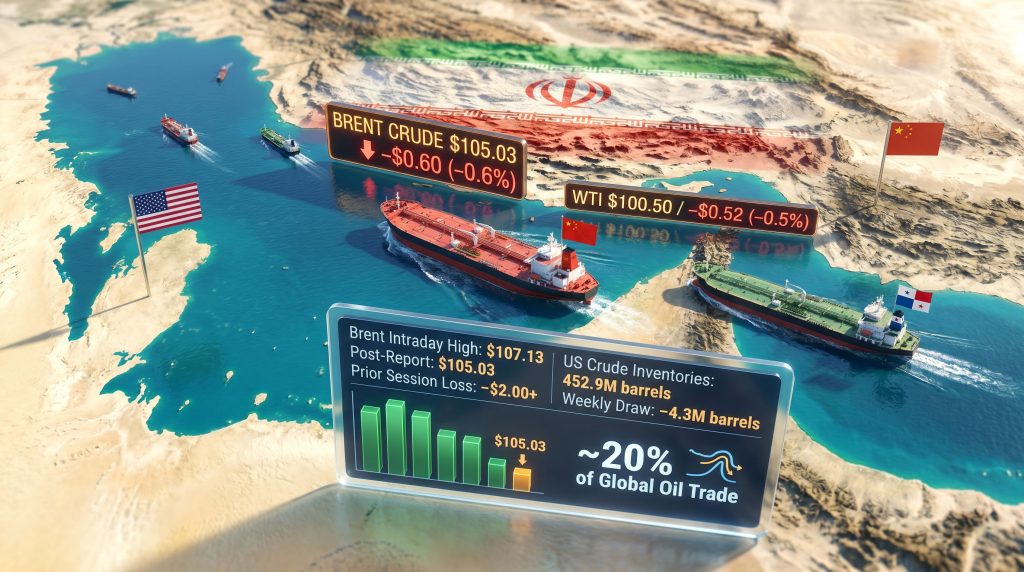
The market reaction on 14 May 2026 was instructive precisely because of its restraint. Rather than a dramatic collapse in crude prices, markets exhibited the kind of calibrated adjustment that reflects partial, not complete, removal of risk. According to reporting from Arab News, prices dipped modestly as vessel transit news filtered through to traders.
| Metric | Value |
|---|---|
| Brent Crude Intraday High | $107.13 per barrel |
| Brent Crude Post-Report Level | $105.03 per barrel |
| Brent Decline (Day) | $0.60, or 0.6% |
| WTI Futures Level | $100.50 per barrel |
| WTI Decline (Day) | $0.52, or 0.5% |
| Prior Session Brent Loss | More than $2.00 per barrel |
| Prior Session WTI Loss | More than $1.00 per barrel |
The two-session pattern tells a more complete story. Wednesday's losses of more than $2.00 per barrel in Brent were driven by interest rate anxiety, with elevated fuel prices feeding inflationary concerns that raised the prospect of tighter monetary policy. Thursday's more modest decline reflected the Hormuz transit news. Together, the moves suggest a market navigating multiple, sometimes competing, forces simultaneously.
Critically, both contracts remained significantly elevated relative to pre-conflict trading ranges. This residual premium reflects the market's recognition that a report of 30 vessel crossings is not the same as a formal, unrestricted reopening of the strait. The distinction between selective transit permissions and full normalisation is one that experienced energy market participants treat with considerable caution.
The Vessels That Moved Markets: A Logistical Breakdown
Two specific transits were particularly significant in the sequence of events that shifted market sentiment.
The Chinese Supertanker
The first involved a Chinese supertanker carrying approximately 2 million barrels of Iraqi crude, which completed its passage through the strait on Wednesday after having been stranded in the Gulf for more than two months. The scale of the cargo alone made this a symbolically important event: a single vessel holding enough crude to supply a mid-sized refinery for weeks was now moving.
The Japan-Linked Vessel
The second confirmed transit involved a Panama-flagged crude oil tanker managed by Japanese refining group Eneos, according to ship-tracking data from LSEG. This represented the second Japan-linked vessel to make it through — a data point that suggested the transit permissions, while selective, were extending beyond a single national fleet.
Iran's semi-official Fars news agency cited sourcing indicating that Iran had begun extending transit permissions specifically to certain Chinese vessels. Meanwhile, Iran appeared to be managing its control over the strait through bilateral energy arrangements with neighbouring states including Iraq and Pakistan, covering both crude oil and liquefied natural gas flows. This points to a sophisticated diplomatic strategy rather than a simple reopening.
"Selective transit permissions function as geopolitical currency. Iran is not reopening the strait; it is choosing who gets access and when, which preserves leverage while reducing the international pressure that a complete closure generates."
The US-China Diplomatic Layer: Why Great Power Alignment Matters
The market significance of the vessel transit reports was amplified by a concurrent diplomatic development. Following discussions between US President Donald Trump and Chinese President Xi Jinping, the White House confirmed that both leaders had agreed on the principle that the Strait of Hormuz must remain open for the free flow of energy. The broader context of US-China trade tensions has, however, complicated the diplomatic picture considerably throughout this period.
This alignment carries outsized market significance for several reasons. The US and China are the world's two largest energy consumers and, frequently, geopolitical rivals. When both governments publicly commit to the same position on a critical maritime chokepoint, it reduces the probability of the most extreme disruption scenarios — specifically those in which great power competition might compound a regional conflict.
China's vulnerability to Hormuz disruptions is structural. The country has historically sourced a large proportion of its crude imports from Persian Gulf producers, making any sustained closure of the strait a direct economic threat. This structural exposure helps explain why Xi reportedly expressed interest in purchasing more US crude oil as a supply diversification measure to reduce China's dependence on Hormuz transit routes.
| Factor | Detail |
|---|---|
| US Crude Import Tariff on China | 20% |
| Last Chinese Import of US Crude | May 2025 |
| Reported Chinese Interest | Purchasing more US oil to reduce Hormuz reliance |
| Strategic Benefit for China | Supply chain diversification away from single chokepoint |
China has not imported US crude since May 2025, when a 20 percent import tariff imposed during the trade dispute period made such purchases economically unviable. The prospect of resuming those flows — driven by supply security logic rather than price arbitrage alone — represents a potentially meaningful shift in global crude trade geography. Consequently, the trade war impact on oil markets continues to shape decisions well beyond simple tariff calculations.
The next major ASX story will hit our subscribers first
Global Supply Fundamentals: Why This Environment Amplifies Every Signal
The sensitivity of oil prices to Hormuz developments does not exist in isolation. It is magnified by the broader supply-demand environment in which these events are occurring. Indeed, understanding the full crude oil market dynamics at play helps explain why even modest transit signals produce outsized price reactions.
The International Energy Agency assessed, as of mid-May 2026, that global oil supply would fall short of total demand, with inventories being drawn down at a pace described as unprecedented. This kind of structural tightness means the global oil market has less capacity to absorb supply shocks than it would in a period of ample buffer stock.
US crude inventory data released by the Energy Information Administration reinforced this picture. For the week ending 8 May, US crude inventories declined by 4.3 million barrels to reach 452.9 million barrels, with rising export volumes cited as the primary driver. The one counterpoint was distillate stockpiles, which rose contrary to market expectations of a draw, partially offsetting the bullish sentiment from the crude drawdown.
When inventories are tight and supply routes are uncertain, the interaction between these two variables creates a feedback loop of heightened price sensitivity. A relatively modest piece of geopolitical news — such as 30 vessels crossing a strait — produces price moves that would have been considered outsized in a more comfortable supply environment.
Scenario Modelling: Three Pathways From Here
| Scenario | Condition | Likely Brent Direction |
|---|---|---|
| Full Normalisation | Unrestricted transit restored, diplomatic resolution achieved | Significant downward correction from elevated levels |
| Managed Partial Access | Selective transit continues under geopolitical oversight | Moderate risk premium maintained, gradual easing |
| Renewed Disruption | Escalation resumes, transit suspended again | Sharp upward spike beyond recent highs |
The central scenario — managed partial access — is arguably the most likely near-term outcome based on current evidence. Iran has demonstrated both the capability and the willingness to use transit permissions as a diplomatic instrument, suggesting a full, unconditional reopening is not imminent. At the same time, the confirmed crossings and great power diplomatic alignment reduce the probability of an abrupt return to complete closure.
For energy market participants, this middle path is in some ways the most complex to navigate. It requires continuous monitoring of vessel tracking data, diplomatic signals, and inventory statistics simultaneously — with each data point capable of shifting the risk premium in either direction. Reuters coverage via TradingView has noted that oil prices remained flat through much of this uncertainty, underscoring just how finely balanced market sentiment has become.
Frequently Asked Questions
Why do oil prices fall when vessels cross the Strait of Hormuz?
Confirmed vessel crossings reduce the perceived probability of near-term supply disruption. The geopolitical risk premium embedded in crude futures partially unwinds as a result, causing prices to decline even without any change in physical supply volumes.
How much oil transits through Hormuz each day?
Between 17 and 21 million barrels of crude oil and petroleum products pass through the Strait of Hormuz daily, representing approximately one-fifth of global oil consumption.
What is the difference between Brent and WTI crude oil?
Brent crude, priced in the North Sea, serves as the international benchmark for approximately two-thirds of global oil contracts and tends to be more sensitive to Middle Eastern supply disruptions. WTI, or West Texas Intermediate, is the US domestic benchmark. Both respond to geopolitical events but from different pricing bases.
Can China reduce its Hormuz dependency by buying US crude?
In principle, yes. US crude sourced from Gulf of Mexico or Atlantic coast terminals does not require Hormuz transit, eliminating that chokepoint risk entirely. However, economic viability depends on import tariff levels, freight costs, and refinery configuration compatibility.
Key Takeaways for Energy Market Observers
- Price asymmetry is structural: negative supply signals drive prices up faster than positive signals bring them down, reflecting the inherent risk aversion embedded in energy futures markets.
- Selective transit is not normalisation: Iran's calibrated approach to vessel permissions preserves geopolitical leverage and means the risk premium will persist until unrestricted commercial shipping is confirmed.
- Great power diplomatic alignment provides a meaningful backstop: US-China agreement on Hormuz access reduces tail-risk scenarios but does not eliminate the underlying geopolitical uncertainty.
- Tight inventories amplify every signal: with global oil stockpiles being drawn down at historically rapid rates, even minor transit developments carry greater market weight than they would in a well-supplied environment.
- Ship-tracking data has become front-line market intelligence: platforms providing near-real-time vessel positioning data, such as LSEG, now function as primary market-moving information sources, not just operational tools.
This article contains forward-looking assessments and scenario analysis based on publicly available information as of mid-May 2026. Energy market conditions are subject to rapid change. Nothing in this article constitutes financial or investment advice.
Want to Capitalise on the Next Major Resource Discovery Before the Market Reacts?
Just as energy markets price probability ahead of certainty, Discovery Alert's proprietary Discovery IQ model delivers real-time notifications on significant ASX mineral discoveries the moment they are announced — transforming complex resource data into actionable insights for investors at every level. Explore how historic mineral discoveries have generated substantial returns and begin your 14-day free trial today to position yourself ahead of the broader market.