
August 6, 2026
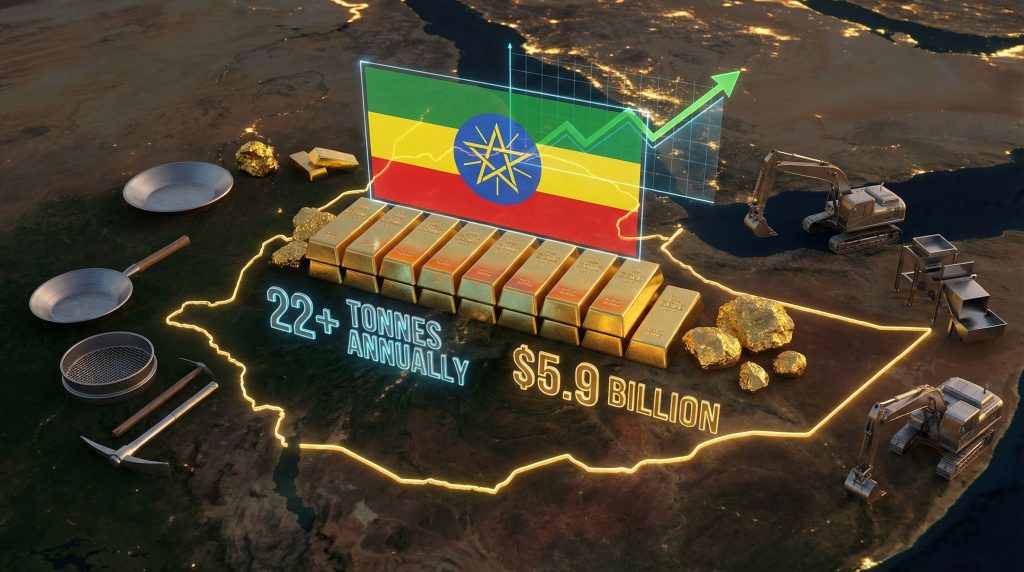
Ethiopian economic transformation accelerates as the country leverages abundant mineral resources to reshape its development trajectory. The nation's mining industry evolution exemplifies how African economies can harness geological endowments to drive sustainable growth. Furthermore, Ethiopia gold exports now represent a cornerstone of this strategic transformation, generating unprecedented foreign exchange earnings.
This transition represents more than simple resource extraction; it embodies sophisticated economic strategy deployment across multiple dimensions of national development. Countries with substantial mineral wealth now implement integrated approaches combining immediate foreign exchange generation with long-term industrial capacity building.
Ethiopia's emergence as a significant gold producer exemplifies these broader continental dynamics, where strategic resource development intersects with macroeconomic stabilisation objectives and regional competitiveness considerations.
Economic Transformation Through Strategic Mineral Development
Ethiopia's pivot toward mining-driven growth reflects fundamental shifts in how African economies approach development financing and export diversification. The country's mining sector has evolved from marginal contributor to cornerstone of foreign exchange strategy, generating substantial hard currency inflows that support macroeconomic stability.
Recent performance metrics demonstrate the scale of this transformation. Ethiopia's total export earnings reached $5.9 billion during the current fiscal period, according to data from the Ethiopian Ministry of Trade and Regional Integration. This figure reflects unprecedented growth in mining sector contributions, with gold exports exceeding 22 tonnes within an eight-month period.
The mining sector's expansion has fundamentally altered Ethiopia's export composition. Where agricultural commodities historically dominated foreign exchange generation, mineral exports now contribute over 95% of mining-related foreign currency inflows. This shift provides natural hedging against agricultural commodity price volatility whilst creating more predictable revenue streams for government planning.
Key Economic Impact Indicators:
• Foreign Exchange Generation: Mining exports provide crucial hard currency supporting birr stability
• Government Revenue Enhancement: Tax and royalty collections from mining operations exceed historical agriculture-based contributions
• Employment Creation: Direct and indirect job creation across rural and urban areas
• Infrastructure Development: Mining operations catalyse transportation and power infrastructure investments
The transformation extends beyond simple commodity substitution. Ethiopia's approach integrates artisanal production methods with emerging industrial operations, creating a dual-track system that maximises both immediate employment and long-term production capacity. This model differs substantially from foreign investment-dominated approaches employed elsewhere across the continent.
When big ASX news breaks, our subscribers know first
Comparative Regional Mining Strategies and Market Positioning
Ethiopia's mining development strategy occupies a unique position within East Africa's competitive landscape. Unlike neighbouring countries that rely heavily on large-scale foreign mining corporations, Ethiopia has cultivated an indigenous capacity-building approach that emphasises local control and community participation.
Regional Production Comparison Analysis:
| Country | Primary Strategy | Annual Production | Workforce Model | Government Control |
|---|---|---|---|---|
| Ethiopia | Community + Industrial | 22+ tonnes | Artisanal-dominant | High state involvement |
| Tanzania | Industrial-focused | 40-50 tonnes | Corporate employment | Foreign investment priority |
| Ghana | Mixed operations | 60-80 tonnes | Diversified workforce | Balanced public-private |
| Mali | Large-scale mining | 60+ tonnes | Industrial workforce | Foreign corporation reliance |
Ethiopia's artisanal mining sector employs approximately 1.5 million workers, representing roughly 74% of the total mining workforce according to ministry estimates. This employment structure creates significant economic multiplier effects across rural communities whilst maintaining national ownership of production processes.
The economic implications of this approach extend far beyond employment metrics. Artisanal operations contribute an estimated 65% of mining foreign exchange earnings, demonstrating that small-scale production can achieve substantial aggregate impact when properly organised and supported through government infrastructure.
Strategic Advantages of Ethiopia's Model:
• Rapid Capital Mobilisation: Artisanal operations require minimal foreign investment for expansion
• Community Economic Integration: Mining activities directly support rural livelihoods and local commerce
• National Value Retention: Profits and wages remain within domestic economy rather than flowing to foreign shareholders
• Flexible Production Scaling: Operations can expand or contract based on global price conditions without major capital commitments
This model creates natural competitive advantages during periods of gold price volatility. When international prices rise, artisanal operations can rapidly increase production to capitalise on favourable conditions. Conversely, during price declines, operations can scale back without the fixed cost burdens associated with large industrial facilities.
Global Gold Price Dynamics and Revenue Optimisation
Ethiopia gold exports demonstrate significant correlation with international precious metals pricing trends, creating both opportunities and vulnerabilities for national economic planning. Current gold prices trading within the $2,100-$2,200 per troy ounce range have generated exceptionally favourable conditions for Ethiopian producers across all operational scales.
The revenue impact of price movements creates substantial multiplier effects throughout Ethiopia's economy. Mathematical analysis demonstrates that each $100 increase in gold prices generates approximately $70 million in additional annual revenue for Ethiopia, based on current production volumes of 22+ tonnes annually.
Price Impact Calculation Framework:
- Annual production: 22 tonnes = 707,070 troy ounces
- Revenue per $100 price increase: 707,070 oz × $100 = $70.7 million
- Current price levels support annual revenues exceeding $1.4 billion from gold alone
This price sensitivity creates both strategic opportunities and risk management requirements for Ethiopian policymakers. During the 2020-2025 elevated price period, sustained gold prices above $1,900 per ounce provided extraordinary revenue generation that supported broader economic reform initiatives and foreign exchange reserve accumulation. The historic gold price surge has fundamentally altered the economics of African mining operations.
Historical Price Context:
- 2016 Lows: Gold traded near $1,050 per ounce
- 2020 Peak: Reached approximately $2,050 per ounce
- 2023-2025 Sustained Highs: Maintained above $1,900 consistently
- Current Environment: Trading between $2,100-$2,200 supports optimal revenue generation
The pricing environment creates natural currency protection mechanisms for Ethiopia. As a birr-denominated economy exporting dollar-priced commodities, Ethiopia gold exports provide automatic hedging against currency devaluation pressures. This relationship has proven particularly valuable during periods of domestic inflation or external balance of payments challenges.
Ethiopia's gold sector offers investors and policymakers a natural hedge against currency devaluation whilst providing inflation protection during periods of global economic uncertainty.
Major Production Operations and Capacity Analysis
Ethiopia's gold production landscape features a strategic combination of established operations and emerging projects positioned to expand national output significantly over the medium term. The production base demonstrates both operational diversity and geographic distribution that enhances sector resilience.
Primary Production Centres and Capacity:
Large-Scale Industrial Operations
• Midroc Legedembi Operation
- Annual production capacity: 5 tonnes
- Share of national output: 38% of total production
- Infrastructure: Fully integrated processing facility with modern extraction technology
- Economic significance: Primary contributor to formal sector foreign exchange generation
• Shakisso Gold Project
- Current annual output: 3.5 tonnes (3,500 kg)
- Operational status: Active production phase with expansion potential
- Technology deployment: Modern processing equipment and environmental controls
- Strategic value: Contributes to production base diversification
Emerging Development Projects
• Tulu Kapi Development Project
- Total investment commitment: $340 million ($240M debt financing, $100M equity)
- Projected annual production: 164,000 ounces (approximately 4.6 tonnes)
- Expected production timeline: Commercial operations commencing 2027
- Strategic impact: Positions Ethiopia among top regional gold producers
• Segele Mine Complex
- Operator: Akobo Minerals consortium
- Technical specifications: Advanced processing infrastructure deployment
- Resource quality: High-grade ore deposits with premium recovery rates
- Market positioning: Targets premium international markets
The production capacity analysis reveals that identified industrial operations account for approximately 13 tonnes of annual capacity, whilst Ethiopia's total production exceeds 22 tonnes. This indicates that artisanal and small-scale operations contribute roughly 9 tonnes annually, demonstrating the critical importance of community-based mining to national production totals.
Production Distribution Analysis:
- Industrial Operations: ~59% of total production (13 tonnes)
- Artisanal/Small-Scale: ~41% of total production (9 tonnes)
- Future Capacity with Tulu Kapi: Potential increase to 26+ tonnes by 2027
Artisanal Mining's Economic Development Impact
Artisanal and small-scale mining operations form the foundation of Ethiopia's gold export economy, providing immediate employment opportunities and sustainable income generation across rural communities that have historically depended on subsistence agriculture.
The 1.5 million workers employed in artisanal mining represent one of Africa's largest organised small-scale mining workforces. This employment structure creates profound economic multiplier effects that extend far beyond direct mining activities into local commerce, transportation, equipment supply, and community services.
Community Economic Benefits:
• Income Diversification: Rural families gain access to cash income independent of agricultural seasons
• Local Commerce Stimulation: Mining communities support expanded retail, service, and transportation sectors
• Skills Development: Workers acquire technical skills in extraction, processing, and quality assessment
• Infrastructure Investment: Mining areas receive improved road access, communication networks, and basic services
The government's formalisation initiatives for artisanal mining create structured pathways for small-scale operators to contribute to national export revenues whilst maintaining community-based production models. Licensed producers selling through official channels ensure quality control and international compliance whilst providing miners with fair pricing and technical support.
Formalisation Programme Components:
- Licensing Systems: Legal frameworks for small-scale operation registration
- Technical Training: Skills development in safety, extraction, and environmental management
- Market Access: Direct selling relationships with National Bank of Ethiopia export channels
- Financial Services: Access to credit, equipment financing, and business development support
This approach contrasts sharply with foreign corporation-dominated models where local communities often receive minimal direct benefits from resource extraction occurring on their traditional lands. Ethiopia's emphasis on community participation ensures that mining wealth contributes directly to poverty reduction and rural development objectives.
The 65% contribution of artisanal operations to mining foreign exchange earnings demonstrates that small-scale production can achieve substantial national economic impact when properly organised and supported through government infrastructure and market access programmes. This success has attracted attention from international development experts studying mining investment strategies across developing economies.
Export Diversification and Macroeconomic Stabilisation
Ethiopia's mining sector expansion represents a fundamental transformation in export composition that reduces historical dependence on agricultural commodities whilst building resilience against external economic shocks and climate-related production variabilities.
Traditional Export Base Comparison:
Historical Agricultural Exports
- Coffee: Primary export commodity with volatile international pricing
- Oilseeds: Secondary agricultural export subject to weather dependency
- Horticulture: Emerging sector with refrigerated transportation requirements
- Livestock: Regional trade focus with limited international market access
Mining Sector Integration Impact
- Gold: Dominant mineral export generating 95%+ of mineral revenues
- Processing Infrastructure: Domestic value-addition capacity development
- Technology Transfer: Advanced extraction and refining capabilities
- Industrial Linkages: Equipment manufacturing and mining services development
The diversification strategy creates multiple macroeconomic benefits that extend beyond simple export revenue increases. Current account improvement through enhanced export earnings reduces pressure on foreign exchange reserves whilst providing greater flexibility for essential import financing.
Macroeconomic Stabilisation Benefits:
• Foreign Exchange Reserve Accumulation: Sustained hard currency inflows support monetary stability
• Import Capacity Enhancement: Reduced foreign exchange constraints enable capital goods imports for industrial development
• Debt Service Capacity: Improved export earnings enhance sovereign debt sustainability metrics
• Economic Shock Absorption: Diversified export base provides resilience against single-commodity price volatility
The transformation also supports broader industrialisation objectives through mining equipment local assembly and technical expertise development. As domestic capacity grows, Ethiopia can capture increasing shares of mining sector value-added activities rather than simply exporting raw materials.
The next major ASX story will hit our subscribers first
Security Challenges and Operational Risks
Despite strong export performance metrics, Ethiopia's gold sector faces significant structural challenges that threaten sustainable growth without targeted policy interventions and enhanced security measures across key production regions.
Security and Governance Constraints:
• Illicit Mining Operations: Unregulated extraction in conflict-affected regions undermines official production channels
• Cross-Border Smuggling: Trafficking networks divert production to neighbouring countries, reducing national export revenues
• Regulatory Enforcement Gaps: Limited government capacity to monitor remote mining areas enables parallel market activities
• Community Conflicts: Competition for mining areas creates localised tensions that disrupt production
These security challenges create substantial opportunity costs for national economic development. Estimates suggest that illicit gold outflows may represent 20-30% of potential national production, translating to hundreds of millions in lost foreign exchange earnings annually.
Infrastructure and Capacity Development Needs:
• Processing Facility Limitations: Insufficient domestic refining capacity forces export of partially processed materials
• Transportation Infrastructure: Poor road networks in remote mining areas increase operational costs and security risks
• Technical Expertise Shortages: Limited availability of qualified mining engineers and processing specialists
• Financial Sector Constraints: Banks lack specialised mining project financing capabilities and risk assessment expertise
The infrastructure challenges particularly impact artisanal operations, which often lack access to modern processing equipment and quality testing facilities. Understanding mining permitting insights becomes crucial for addressing these operational complexities.
Risk Mitigation Strategies:
• Security Force Deployment: Enhanced military and police presence in key mining regions
• Technology Integration: GPS tracking and digital documentation systems for production monitoring
• Community Engagement: Stakeholder partnerships that align local interests with national development objectives
• Regional Cooperation: Cross-border agreements to combat smuggling and harmonise mining regulations
According to Ethiopia's gold sector analysis, illicit mining activities have exacerbated regional conflicts, highlighting the urgent need for comprehensive governance reforms.
Regional Trade Integration and Market Access Enhancement
Ethiopia's strategic positioning within evolving East African trade networks creates multiple pathways for optimising gold export revenues whilst developing sustainable competitive advantages in regional and global precious metals markets.
Regional Integration Opportunities:
• East African Community Trade Facilitation: Harmonised customs procedures reduce export processing times and costs
• Infrastructure Development Projects: Regional transportation networks improve market access for remote mining operations
• Regulatory Framework Harmonisation: Standardised mining codes facilitate cross-border investment and technical cooperation
• Financial Integration: Regional payment systems enable more efficient export transaction processing
The regional approach offers particular advantages for artisanal mining operations, which can benefit from economies of scale in processing, transportation, and international marketing without requiring major capital investments in individual community operations.
Asian Market Development Strategy
Ethiopia's emerging partnerships with Asian economies create substantial opportunities for market diversification beyond traditional European and North American precious metals markets.
• Chinese Market Access: Belt and Road Initiative partnerships facilitate direct export relationships with Asian gold refineries
• Indian Jewellery Manufacturing: Growing demand from India's gold jewellery sector creates premium market opportunities
• Middle Eastern Trading Hubs: Dubai and other regional centres provide alternative market access routes
• Technology Transfer Agreements: Asian mining companies provide advanced extraction and processing technologies
These partnerships offer advantages beyond simple market access. Technology transfer arrangements enable Ethiopia to develop domestic technical capabilities whilst financing partnerships provide capital for infrastructure development without traditional Western development finance conditions.
The diversified market approach also creates pricing advantages. Rather than depending on single market relationships, Ethiopia can optimise export timing and buyer selection based on global price differentials and demand conditions across multiple regions.
Investment Landscape and Capital Development Opportunities
Ethiopia's gold mining sector presents diverse investment opportunities across the complete value chain, from grassroots exploration projects to advanced processing infrastructure and export logistics systems.
Large-Scale Mining Development Opportunities:
• Greenfield Exploration Projects: Underexplored geological regions with high-potential ore deposits
• Production Facility Expansion: Capacity increases at existing operations like Midroc Legedembi and Shakisso
• Processing Infrastructure Modernisation: Technology upgrades to improve recovery rates and environmental compliance
• Mining Equipment Manufacturing: Local assembly operations for extraction and processing equipment
The $340 million Tulu Kapi project demonstrates the scale of investment opportunities available for international and domestic investors. Similar projects across Ethiopia's mineral-rich regions could potentially double national production capacity over the next decade.
Infrastructure and Support Services Investment:
• Transportation Networks: Road and rail infrastructure connecting remote mining areas to export facilities
• Power Generation Projects: Reliable electricity supply for processing operations and community development
• Water Management Systems: Sustainable water supply and treatment facilities for mining operations
• Technical Training Facilities: Educational institutions specialising in mining engineering and geological sciences
The infrastructure investment requirements create opportunities for both domestic and international investors, particularly in public-private partnership arrangements that combine government policy support with private sector efficiency and innovation.
Technology and Innovation Investment:
• Digital Mining Technologies: Automated extraction systems and remote operation capabilities
• Environmental Monitoring Solutions: Real-time environmental impact assessment and mitigation systems
• Supply Chain Management Platforms: Integrated systems connecting artisanal producers with export markets
• Financial Technology Services: Digital payment systems and micro-financing for small-scale operations
These technology investments offer particular value in Ethiopia's context, where the combination of large artisanal workforce and emerging industrial operations creates unique requirements for integrated solutions that serve multiple operational scales simultaneously.
Recent reports indicate that Ethiopia secured $4.2 billion in mining agreements to develop iron, potash, and gold resources, demonstrating growing international confidence in the sector's potential.
Production Growth Projections and Economic Impact Analysis
Ethiopia's gold sector trajectory through 2030 indicates substantial expansion potential driven by new project development, infrastructure improvements, and enhanced government support for comprehensive mining sector growth. Furthermore, gold price forecast insights suggest favourable market conditions will continue supporting sector expansion.
Production Capacity Expansion Timeline:
• 2027: Tulu Kapi project adds 4.6 tonnes annual capacity
• 2028-2029: Additional exploration projects enter production phase with estimated 3-5 tonnes combined capacity
• 2029-2030: Artisanal sector formalisation programmes increase productivity by 15-20%
• 2030: Domestic processing facility development reduces value-loss from raw material exports
Conservative projections suggest Ethiopia could achieve 30-35 tonnes annual production by 2030, representing a 40-50% increase from current levels. This expansion would position Ethiopia among Africa's top five gold producers and significantly enhance regional market influence.
Revenue Impact Scenarios:
Conservative Growth Scenario
- Annual Production: 30 tonnes by 2030
- Export Revenue: $2.0-2.5 billion annually (assuming $2,000-2,500 gold prices)
- Economic Contribution: 20-25% of total national export earnings
Optimistic Development Scenario
- Annual Production: 35+ tonnes by 2030
- Export Revenue: $2.5-3.5 billion annually with value-added processing
- Economic Contribution: 25-30% of total national export earnings
- Regional Market Share: 15-20% of East African gold production
The revenue projections assume sustained global gold prices within current elevated ranges. However, even with price moderation to $1,800-2,000 per ounce, expanded production volumes would maintain substantial foreign exchange generation supporting broader economic development objectives.
Strategic Positioning Goals for 2030:
• Regional Production Hub Status: Establishment as East Africa's second-largest gold producer after Tanzania
• Value-Added Processing Capacity: Domestic refining facilities capturing 60-80% of production value rather than raw material exports
• Technical Expertise Development: National mining engineering and geological services capabilities
• Sustainable Development Integration: Environmental and social standards that support long-term community development
The 2030 vision extends beyond simple production increases to encompass comprehensive sector transformation that positions mining as a cornerstone of Ethiopia's industrial development strategy. This integrated approach ensures that mineral wealth translates into sustained economic development rather than temporary resource extraction.
Economic Multiplier Effects:
The projected mining sector expansion would create substantial indirect economic impacts across multiple sectors:
• Manufacturing Development: Local production of mining equipment and supplies
• Service Sector Growth: Financial, legal, and technical services supporting mining operations
• Infrastructure Investment: Transportation and power systems serving mining regions and broader economic development
• Human Capital Development: Technical education and training programmes building national expertise
These multiplier effects suggest that mining sector growth could contribute 4-6% to national GDP growth annually through direct and indirect channels, making it one of Ethiopia's most significant economic development drivers through the remainder of the decade.
Disclaimer: This analysis presents projections and scenarios based on current industry trends and government policy directions. Actual outcomes may vary significantly due to commodity price volatility, political developments, global economic conditions, and unforeseen operational challenges. Readers should conduct independent research and risk assessment before making investment or policy decisions based on this analysis.
Are You Looking to Capitalise on African Mining Opportunities?
Discovery Alert's proprietary Discovery IQ model delivers real-time alerts on significant ASX mineral discoveries, providing investors with immediate insights into actionable opportunities across mining markets. Begin your 14-day free trial today to secure your market-leading advantage ahead of the broader market.