June 23, 2026
Europe's Energy Dependency Is a Strategic Vulnerability, Not Just a Climate Problem
For decades, the dominant assumption embedded in European energy policy was that imported fossil fuels represented an acceptable tradeoff: reliable supply at market prices, with climate concerns addressed through carbon pricing and gradually expanding renewable targets. That assumption has been fundamentally dismantled. The EU AccelerateEU clean energy plan, formally presented on April 22, 2026, reflects a strategic reckoning that goes far beyond environmental ambition. It is an acknowledgment that energy dependency is a geopolitical liability, an economic fragility, and an industrial competitiveness risk all at once.
Understanding why this plan exists requires looking not at a single policy decision but at the compounding pressures that made the status quo untenable.
When big ASX news breaks, our subscribers know first
The Structural Vulnerability Europe Can No Longer Afford
A Decade of Insufficient Investment Meets a New Geopolitical Reality
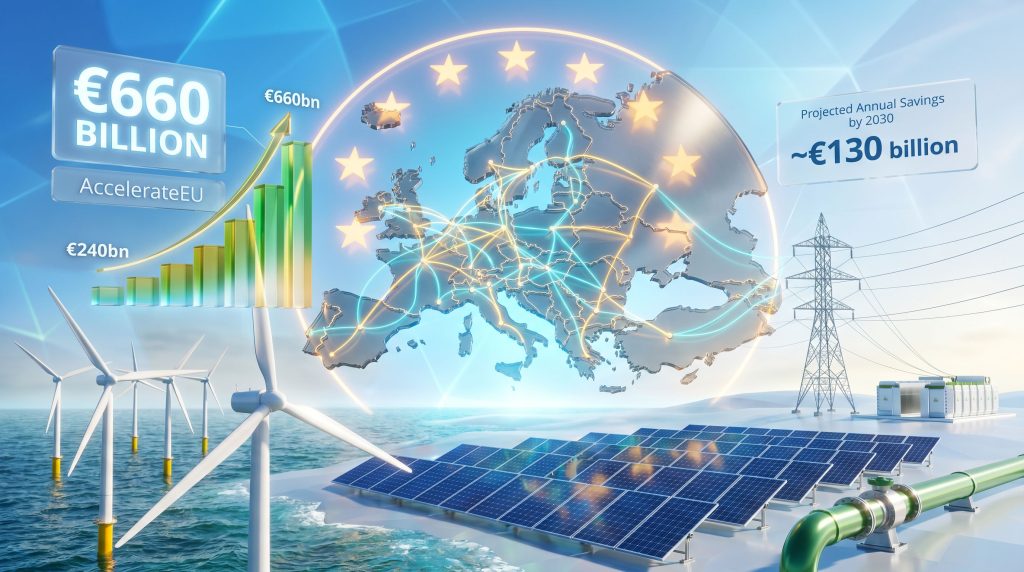
Europe's energy system was not underfunded in absolute terms during the 2011 to 2021 period. Annual investment of approximately €240 billion is not a trivial figure. However, it was structurally misaligned with the demands of an economy attempting to electrify at scale, integrate distributed renewables, and reduce the systemic exposure created by import dependency.
The problem crystallised in early 2026 when geopolitical tensions across the Middle East triggered a sharp escalation in fossil fuel import costs. According to the European Commission, the EU absorbed an estimated €24 billion in additional energy expenditure within just a few months, without receiving any additional supply in return. This was not a supply shortage. It was a pure price shock, and it was entirely beyond the reach of any domestic European policy response.
That episode made the underlying numbers impossible to ignore:
| Metric | Value |
|---|---|
| Share of EU energy from imported fossil fuels | ~57% |
| EU fossil fuel import bill (2025) | ~€340 billion |
| Additional costs from 2026 geopolitical shock | ~€24 billion |
| Projected annual savings from clean energy transition by 2030 | ~€130 billion |
The €340 billion annual fossil fuel import figure functions, in the Commission's framing, as a chronic structural tax on the European economy. Every year, that capital leaves the bloc with no domestic value-add, no reinvestment multiplier, and no insulation from commodity market volatility. The Commission's core strategic argument is straightforward: the long-run cost of maintaining this dependency exceeds the upfront capital requirements of accelerating the transition.
Furthermore, the intersection of critical minerals and energy security adds another layer of strategic complexity, since clean energy infrastructure depends heavily on sourcing materials that are themselves subject to geopolitical supply risks.
The European Commission's position is that fossil fuel import expenditure represents a structural drag on European economic performance. The projected €130 billion in annual savings by 2030 is not a climate benefit but a financial one, and it is central to the investment case underpinning AccelerateEU.
What distinguishes this moment from prior EU energy strategies is the explicit linkage of climate objectives to economic resilience and geopolitical autonomy. These are no longer treated as separate policy streams. They are presented as inseparable.
What the EU AccelerateEU Clean Energy Plan Actually Is
Five Interconnected Pillars, Not a Single Spending Programme
A common misreading of the EU AccelerateEU clean energy plan is to treat it as a stimulus package. It is more accurately understood as a strategic architecture, built around five interconnected pillars designed to address the energy transition simultaneously from a supply, demand, infrastructure, financing, and governance perspective.
-
Enhanced EU-wide coordination on gas storage management, oil stock releases, and energy market monitoring, including a new Fuel Observatory tracking transport fuels such as jet fuel and diesel.
-
Domestic clean energy expansion through aggressive renewable deployment, barrier removal across transport, industry, and buildings, and a committed Electrification Action Plan to be released by summer 2026.
-
Modernisation of energy system architecture, including full implementation of existing market efficiency frameworks, accelerated negotiation of the EU Grids Package proposed in December 2025, and advancement of designated Energy Highways connecting member states.
-
Maximising renewable capacity through tax differentiation between electricity and fossil fuels, wind farm repowering programmes, offshore wind expansion, and hydropower optimisation.
-
Mobilising investment at scale, targeting approximately €660 billion annually through 2030, rising to €695 billion per year between 2031 and 2040, supported by the European Investment Bank's commitment of €75 billion over three years.
What makes this architecture technically significant is the recognition embedded throughout: public capital cannot close the investment gap alone. The Recovery and Resilience Facility's €219 billion available for clean energy deployment, combined with the EIB allocation, represents meaningful but insufficient public firepower relative to the annual targets. The strategy's credibility therefore hinges on its capacity to attract institutional private capital through de-risking mechanisms, improved project financing access, and stable long-term policy signals.
The €660 Billion Investment Target: What It Means in Practice
Tripling the Investment Baseline Across an Entire Decade
The headline figure of approximately €660 billion (~$711 billion USD) per year in required clean energy investment deserves careful unpacking, because the scale is easily misunderstood.
| Investment Period | Required Annual Investment |
|---|---|
| 2011 to 2021 (historical average) | ~€240 billion |
| 2026 to 2030 (AccelerateEU target) | ~€660 billion |
| 2031 to 2040 (extended projection) | ~€695 billion |
This is not simply additional spending layered on top of what Europe was already investing. It represents a fundamental reallocation of capital flows, from fossil fuel import expenditure toward domestic infrastructure with long-term economic returns. The investment destinations span a wide range of asset classes and risk profiles:
- Renewable power generation including onshore wind, offshore wind, and solar PV
- Electricity grid modernisation covering transmission capacity, smart grid infrastructure, and cross-border interconnectors
- Battery and long-duration energy storage to support grid stability as variable renewables scale
- Energy efficiency retrofits across buildings, industrial facilities, and public infrastructure
- Electric vehicle charging networks to support the electrification of transport
- Green hydrogen projects targeting industrial decarbonisation and seasonal energy storage
- Industrial electrification programmes replacing combustion-based manufacturing processes
This diversity is not accidental. Different technologies require fundamentally different financing structures. Utility-scale renewables suit infrastructure funds seeking long-duration, stable cash flows. Residential building retrofits require household financing products and government incentive schemes. Grid upgrades typically rely on regulated asset base models with long-term return certainty. Industrial electrification is largely driven by corporate balance sheet decisions shaped by relative energy costs.
The heterogeneity of AccelerateEU's investment universe reflects a sophisticated understanding that there is no single capital source or financing model capable of delivering €660 billion annually across such a range of asset types and project sizes.
The Grid Investment Imperative: A Dimension Often Underestimated
Of all the investment categories within the EU AccelerateEU clean energy plan, grid modernisation may be the most consequential and the least visible to general audiences. Europe's electricity grids were engineered for a fundamentally different energy system: one defined by large, centralised fossil fuel generators operating at predictable output levels, feeding relatively stable demand patterns.
That paradigm has inverted. Wind and solar generation are geographically dispersed, output-variable, and increasingly located far from demand centres. AI-driven data centre power consumption is adding continuous, high-density baseload demand in concentrated locations. Mass EV adoption is creating distributed, time-sensitive charging loads that existing grid architecture was never designed to absorb.
The EU Grids Package, proposed in December 2025, is specifically designed to address this mismatch through upgraded cross-border transmission capacity and improved interoperability between national systems. The strategic logic is direct: without adequate grid infrastructure, renewable capacity cannot be efficiently deployed or utilised, regardless of how much generation capacity is installed.
BloombergNEF estimates that global power grid investment will need to exceed $21 trillion by 2050 to support net-zero pathways worldwide. Europe's share of this requirement is significant, and grid investment is increasingly being characterised by industry analysts as one of the defining infrastructure themes of the decade.
| Demand Driver | Impact on Grid Requirements |
|---|---|
| Electric vehicle fleet expansion | Distributed, time-sensitive charging load |
| AI and data centre growth | Continuous, high-density baseload demand |
| Industrial electrification | Large-scale conversion from gas-fired processes |
| Heat pump adoption in buildings | Seasonal peak demand shifts |
Europe's Renewable Progress and the Hard-to-Abate Challenge
Where the EU Stands and Where the Remaining Gaps Lie
Europe has made measurable advances in renewable capacity deployment. Renewables and nuclear energy collectively met approximately 71% of EU electricity needs in the most recent reporting period, up from roughly 60% in 2022. Renewable electricity generation increased by approximately 15% compared with 2025 levels. Solar remains the fastest-growing energy source globally, with record capacity additions recorded in 2025 according to the International Renewable Energy Agency.
However, electricity generation represents only part of the energy picture. Fossil fuels remain deeply embedded in:
- Industrial heating processes for cement, steel, and chemical manufacturing
- Commercial and residential heating infrastructure across much of central and eastern Europe
- Long-haul aviation and maritime transport, where direct electrification remains technically constrained
These are the sectors where AccelerateEU's electrification agenda and clean fuels strategy must perform. The Commission's Sustainable Transport Investment Plan targets both sustainable aviation fuel and low-carbon maritime fuel solutions, while the broader industrial electrification programme addresses process-level decarbonisation in energy-intensive manufacturing.
In addition, the broader context of renewable energy in mining illustrates how the transition extends across the entire industrial supply chain, not merely the power sector. Small modular nuclear reactors have also been identified within the AccelerateEU framework as a next-generation technology eligible for investment support, reflecting recognition that the path to climate neutrality requires low-carbon firm power, not only variable renewables.
The Commission's climate architecture connects these near-term actions to longer-term binding targets:
- 2030: Minimum 55% reduction in net greenhouse gas emissions relative to 1990 levels (Fit for 55)
- 2040: Provisional agreement supporting a 90% net emissions reduction target
- 2050: Full climate neutrality across the EU economy
How the Plan Addresses Energy Affordability Without Distorting Markets
Targeted Relief Over Blunt Instruments
A strategically important dimension of the EU AccelerateEU clean energy plan is its approach to household and industrial energy affordability. The Commission has explicitly chosen targeted relief instruments over broad market interventions, a design choice with significant implications for private capital confidence.
Consumer-facing measures under AccelerateEU include:
- Income support mechanisms for energy-vulnerable households
- Energy voucher programmes targeting lower-income demographics
- Reduced excise duties on electricity consumption
- Tax relief for electricity-intensive industrial sectors
What the plan deliberately avoids:
- Blanket energy price caps, assessed as market-distorting and likely to suppress investment incentives
- Windfall profit taxes on energy producers, avoided to protect the return environment for clean energy infrastructure investors
This design logic is not incidental. The Commission's credibility with private capital markets depends on demonstrating that the policy environment will not arbitrarily reassign returns away from investors once assets are deployed. Targeted consumer relief achieves the social and political objectives of affordability without undermining the investment case that €660 billion in annual private capital mobilisation requires.
The tax differentiation proposal, which would structurally lower electricity taxation relative to fossil fuels, simultaneously addresses affordability and investment economics, making clean energy progressively cheaper for consumers while strengthening the relative economics of electrification for industry. Consequently, the economic benefits of decarbonisation extend well beyond environmental outcomes, reinforcing the long-term financial case for accelerated transition.
The next major ASX story will hit our subscribers first
The Geopolitical Dimension: Energy Security as Strategic Independence
Clean Energy Is Now a Tool of Foreign Policy
Perhaps the most significant conceptual shift embedded in the EU AccelerateEU clean energy plan is the explicit repositioning of renewable energy deployment as a geopolitical instrument. For most of the past two decades, EU climate policy operated primarily within an environmental and regulatory frame. The question was how to reduce emissions in the most cost-effective manner consistent with economic competitiveness.
That framing has been superseded. European Commission President Ursula von der Leyen articulated the updated strategic rationale in terms of crisis preparedness and geopolitical resilience when presenting the plan, emphasising that accelerating the shift to domestically produced clean energy will deliver both energy independence and improved capacity to manage external geopolitical pressures. Executive Vice-President Teresa Ribera has similarly emphasised that economic stability and energy security represent dual, inseparable objectives underpinning the package.
| Strategic Dimension | AccelerateEU Response |
|---|---|
| Fossil fuel import dependency | Domestic renewable scaling and electrification |
| Price volatility from geopolitical shocks | Reduced exposure to global commodity markets |
| Industrial competitiveness vs. global peers | Clean energy cost reduction and grid modernisation |
| Energy poverty and social cohesion | Targeted consumer relief and affordability legislation |
The convergence of climate, economic, and security objectives within a single policy framework represents a maturation of EU strategic thinking. Furthermore, Europe's critical minerals supply chain plays a central role in determining whether renewable infrastructure targets can be met without trading one form of import dependency for another. It also creates a more durable political coalition behind clean energy investment than climate objectives alone could sustain, since energy security commands cross-partisan support in ways that emissions reduction targets historically have not.
Implementation Roadmap and Key Milestones
From Strategy to Execution: What Comes Next
The plan is not a distant aspiration. Its implementation timeline is specific, with near-term milestones that will test the Commission's capacity to translate strategic ambition into deployed capital.
| Milestone | Expected Timing |
|---|---|
| AccelerateEU strategy formally presented | April 22, 2026 |
| Clean Energy Transition Investment Forum | May 2026 |
| Electrification Action Plan release | Summer 2026 |
| Clean Energy Investment Summit | Later in 2026 |
| EU Grids Package finalisation | Ongoing (proposed December 2025) |
| Annual investment target active | 2026 to 2030 |
| Extended investment phase | 2031 to 2040 |
| EU 55% emissions reduction target | 2030 |
| EU 90% net emissions reduction target | 2040 |
| EU climate neutrality | 2050 |
The summer 2026 Electrification Action Plan is particularly consequential. This document is expected to establish binding electrification targets across transport, buildings, and industry, alongside coordinated financing pathways for the technology transitions required in each sector. The European Commission's full strategy documentation provides further detail on the regulatory and legislative steps underpinning each milestone.
Can Europe Actually Execute at This Scale?
Assessing the Plan's Credibility Against Real Implementation Constraints
The EU AccelerateEU clean energy plan is credible in its strategic logic and significant in its financial commitments. However, execution at the required scale involves genuine structural challenges that no policy document eliminates.
Factors supporting successful execution:
- A strong institutional architecture through the EIB, Recovery and Resilience Facility, and cohesion funds
- Demonstrated renewable energy momentum, with 71% of EU electricity from renewables and nuclear, up from 60% in 2022
- A clear political mandate reinforced by energy security imperatives following geopolitical shocks
- Growing institutional investor appetite for clean energy infrastructure as a long-duration asset class
Structural risks and implementation challenges:
- The required scale of private capital mobilisation is unprecedented in European energy history and depends on policy stability that future political cycles may not guarantee
- Grid modernisation timelines face permitting, regulatory, and cross-border coordination hurdles that cannot be resolved by Commission policy alone
- Member state divergence on energy mix preferences, particularly around nuclear and gas phase-out timelines, could complicate unified implementation
- Industrial competitiveness concerns may generate political resistance to rapid electrification mandates in energy-intensive manufacturing sectors
In addition, the development of a dedicated critical raw materials facility represents a parallel effort to secure the upstream inputs that clean energy infrastructure demands, without which even the most ambitious investment targets face material bottlenecks.
The financial case for the plan rests on a core long-run cost calculus: projected savings of approximately €130 billion annually by 2030 represent the compounding return on front-loaded clean energy investment. If that savings trajectory materialises, the transition pays for itself in reduced import expenditure within a relatively short window of time.
This article is intended for informational purposes only and does not constitute financial or investment advice. Projections, forecasts, and savings estimates referenced are sourced from European Commission documentation and third-party research. Actual outcomes may differ materially from projected scenarios based on geopolitical, regulatory, and market conditions.
Want to Stay Ahead of the Mineral Discoveries Powering Europe's Clean Energy Transition?
The shift away from fossil fuel dependency is driving unprecedented demand for critical minerals, and Discovery Alert's proprietary Discovery IQ model delivers real-time ASX alerts the moment significant discoveries are announced — explore historic discoveries and their returns to see why early positioning matters, and begin your 14-day free trial today to gain an immediate market edge.