June 23, 2026
The Geology That Humbles Economics: Why Venezuela's Oil Story Is More Complex Than Any Political Transition
Few energy narratives in modern history illustrate the gap between geological fortune and economic reality more starkly than Venezuela's oil sector. The country sits atop more proven reserves than any other nation on Earth, yet by 2024 it ranked only 20th among global crude producers. That contradiction did not emerge overnight. It accumulated across decades of institutional erosion, policy reversals, and commercial conflict, leaving behind a sector that now requires extraordinary effort simply to recover ground it once held with relative ease.
Understanding the Venezuela post-Maduro oil investment thesis demands more than a surface reading of recent legislative changes or production uptick headlines. It requires a layered analysis of geology, legal history, infrastructure reality, and the political uncertainty that still shadows every capital allocation decision in this market.
When big ASX news breaks, our subscribers know first
Why Venezuelan Crude Is Structurally Harder to Monetise Than Most Investors Realise
The starting point for any serious assessment of Venezuelan oil is geology, and the geological reality is more commercially constraining than headlines about world-record reserves typically suggest.
Venezuela's reserves are concentrated in the Orinoco Belt, a vast accumulation of heavy, extra-heavy, and sour crude that behaves fundamentally differently from the light, sweet grades that dominate global benchmarks. Heavy crude oils are composed of longer carbon chain molecules, making them denser and far more viscous than conventional oil. This physical characteristic creates a cascade of commercial consequences:
- Heavy crude cannot flow through standard pipelines or be processed by conventional refineries without prior treatment
- Before export, Venezuelan crude must be blended with diluents, lighter hydrocarbon fluids that reduce viscosity sufficiently for transport and processing
- This blending requirement adds approximately $15 per barrel to production costs, a structural disadvantage that does not diminish regardless of how efficiently extraction is managed
- The pool of refineries capable of processing Venezuelan grades is limited globally, concentrating Venezuela's viable export markets primarily around the United States and India
- The combination of processing complexity and limited buyer diversity suppresses the price premium Venezuela can command relative to lighter crude benchmarks
This geological constraint is not a temporary challenge that investment can solve. It is a permanent feature of Venezuela's resource base that must be priced into any investment model from the outset. The $15 per barrel cost premium for diluents alone represents a meaningful earnings drag across even the most optimistic production recovery scenarios. For a broader oil geopolitics analysis, this structural disadvantage is frequently underestimated by market commentators.
A Legislative History That Explains Everything About the Current Moment
The commercial tensions now defining Venezuela post-Maduro oil investment did not originate with Maduro. They were set in motion by legislation introduced a quarter of a century ago and amplified by a series of policy escalations that progressively narrowed the space for foreign capital.
The Chávez Foundation and Its Compounding Consequences
In 2001, President Hugo Chávez introduced the Organic Hydrocarbons Law, establishing full state ownership over all hydrocarbon deposits. While resource nationalism of this type was not unique to Venezuela, the 2007 escalation was more commercially disruptive. A national decree that year capped foreign company stakes at a maximum of 40%, effectively subordinating international operators to PDVSA in every joint venture structure.
The consequences unfolded rapidly and with lasting effect:
- Operators who declined to restructure under the 40% cap faced expropriation, including ExxonMobil and ConocoPhillips, both of which pursued international arbitration
- Companies that did negotiate to remain, most notably Chevron, found during the 2010s that PDVSA chronically failed to meet its financial obligations within joint venture frameworks, leaving foreign partners effectively subsidising state participation
- The combination of expropriation risk and partner default created an environment where even the most commercially pragmatic operators could not reliably plan or fund long-term capital programmes
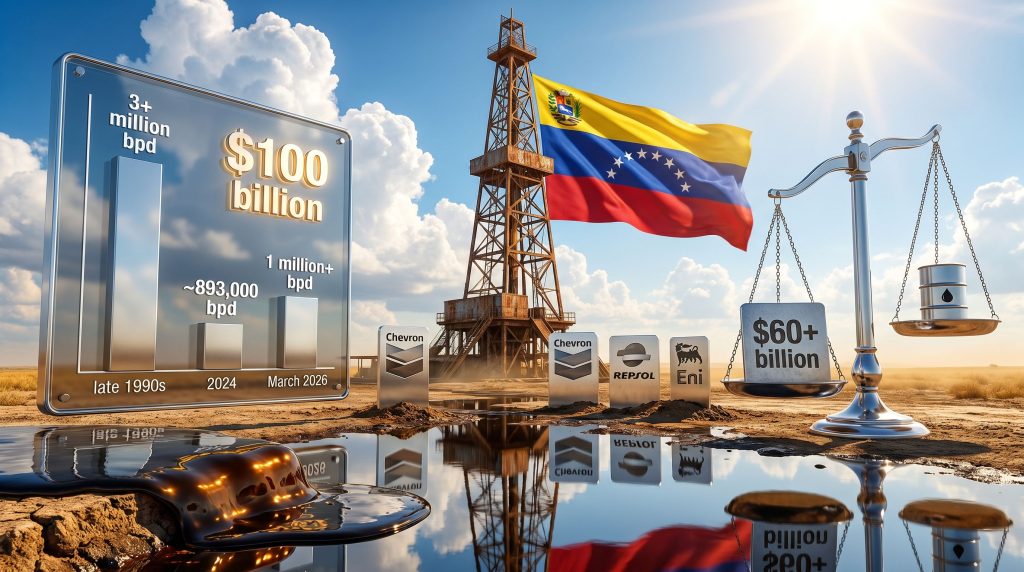
The financial wreckage of this era now sits on the balance sheets of international legal institutions as more than $60 billion in unresolved arbitration claims, a figure that functions as the single most important barrier to a genuine new investment cycle. Furthermore, the U.S. policy on PDVSA has evolved significantly in response to this legal and commercial backdrop, adding further complexity to the operating environment.
What the January 2026 Amendment Actually Changed
The reform to the Organic Hydrocarbons Law enacted in January 2026 is historically significant, but its practical implications are more nuanced than initial coverage suggested.
The state retains ownership of all hydrocarbon deposits. What changed is the structural requirement: private parties can now operate outside of majority state-controlled joint ventures for the first time in nearly two decades. This directly addresses the operational constraint that drove ExxonMobil and ConocoPhillips out of the country during the 2007 restructuring wave.
What the amendment does not resolve is the legal credibility gap created by $60 billion in outstanding arbitration claims, the absence of institutional independence in Venezuela's judiciary, or the physical deterioration of infrastructure that has accumulated across more than a decade of underinvestment.
The reform is a necessary precondition for investment revival. It is not sufficient on its own to trigger one.
The Production Numbers: Reading the Recovery Accurately
One of the most important distinctions for investors analysing Venezuela post-Maduro oil investment is the difference between asset reactivation and a new investment cycle. The production data illustrates why this distinction matters.
| Period | Production / Export Level | What This Represents |
|---|---|---|
| Late 1990s to early 2000s | 3+ million bpd | Historical peak under open investment conditions |
| 2024 average | ~893,000 bpd | Baseline at time of political transition |
| 2025 average | 900,000 to 1.02 million bpd | Incremental recovery, primarily asset reactivation |
| March 2026 | 1 million+ bpd exports | First time exceeding this threshold since September 2024 |
| Near-term projected ceiling | ~1.5 million bpd | Maximum achievable without major new capital commitment |
The trajectory from 893,000 bpd to approximately 1 million bpd represents operators restarting dormant assets that were built and paid for years ago. It does not represent new capital flowing into greenfield or brownfield expansion. Bridging the gap from 1.5 million bpd to the historical peak of 3+ million bpd would require an estimated $100 billion in investment over a timeframe likely exceeding a decade, according to sector analysts. The Venezuela oil market impact of this recovery trajectory has, however, already begun to register across global pricing benchmarks.
Who Is Operating in Venezuela Now, and on What Basis?
The Active Players and Their Distinct Positions
Chevron occupies the most advanced position of any international operator currently active in Venezuela. The company holds a significant stake in the Petroindependencia joint venture and has secured new exploration rights in the Orinoco Belt under a specific U.S. government licence. Its continued presence through the Maduro era, despite PDVSA's chronic failure to fund its JV obligations, positioned Chevron to move faster than competitors when operating conditions began to improve.
Repsol has announced intentions to recommence operations, though specific capital commitments and project timelines remain limited in public disclosures. The company's re-entry represents interest rather than confirmed large-scale commitment.
Eni is among the operators reactivating existing assets rather than pursuing new project development, consistent with the broader pattern of the current recovery phase.
The common thread across all three is that their current activity involves restarting what they previously built, not funding what has never existed. This is an important distinction for assessing the scale and durability of the current recovery. For additional context on Venezuela's oil sector recovery, independent analysis highlights that the post-Maduro investment landscape presents challenges well beyond the legislative sphere.
The Four Structural Barriers That Prevent a Full Investment Cycle
The $60 Billion Legal Overhang
Corporate capital allocation committees at major energy companies operate under a straightforward institutional constraint: they will not authorise the scale of irreversible expenditure required to restore Venezuelan production capacity while more than $60 billion in legacy arbitration awards from the Chávez-era expropriation wave remain unresolved. The risk that new revenues could be intercepted through legal enforcement mechanisms to satisfy these legacy claims makes long-term capital commitment structurally irrational without a comprehensive settlement framework in place.
Executive Order 14373, titled Safeguarding Venezuelan Oil Revenue for the Good of the American and Venezuelan People, attempts to address this by requiring that revenues from Venezuelan natural resources or diluents be directed into designated foreign government deposit funds, providing a degree of protection against private arbitration claimants. This is a partial measure, not a resolution.
Infrastructure Deterioration Beyond Routine Repair
The physical state of Venezuela's oil and gas infrastructure represents a dimension of the investment challenge that statistical production figures do not fully capture. Reports consistently indicate that extraction and upgrading facilities have deteriorated well beyond what routine maintenance spending could address.
This reality was illustrated vividly at meetings held in Caracas in April 2026, where equipment providers gathered to explore grid reconstruction opportunities. According to a Reuters report from May 2026, an executive for an equipment provider who had previously worked with PDVSA described returning deeply sceptical from the visit, noting that Venezuelan power plants had gone without proper maintenance for a decade, that the scope of infrastructure need was effectively limitless, and that no clear mechanism existed for guaranteeing payment to contractors. This combination of unlimited need and uncertain payment represents a commercial environment that most infrastructure capital providers are not equipped to navigate.
Workforce Depletion and the Brain Drain Dimension
Venezuela's economic collapse under Maduro drove an estimated eight million people out of the country, disproportionately affecting the young, technically skilled workforce that any oil sector recovery depends upon. The human capital dimension of Venezuela's reconstruction challenge receives less analytical attention than the legal or financial barriers, but it is no less structurally significant. Rebuilding an operational workforce for a technically demanding heavy crude extraction industry cannot be accomplished quickly regardless of how much capital is deployed.
The Governance Credibility Gap
Long-term energy investment demands enforceable legal frameworks, predictable regulatory application, and institutional independence. Venezuela currently possesses none of these at a level that major capital allocators would consider sufficient. The January 2026 legislative reforms are, as of mid-2026, entirely untested. No significant body of case law exists to validate their practical application. A change in government could trigger further legislative revision, and the combination of untested regulations and unresolved political succession creates a dual uncertainty premium that rational capital allocators must price into every decision.
The next major ASX story will hit our subscribers first
How U.S. Policy Is Shaping the Investment Environment
The Policy Architecture Enabling Current Recovery
| Policy Instrument | Core Purpose | Investment Impact |
|---|---|---|
| General Licence 50A | Enables re-entry without individual transaction licences | Lowers operational barriers for qualified operators |
| Sanctions relief on financial entities | Restores U.S. dollar flows and international banking access | Essential prerequisite for commercial viability |
| Executive Order 14373 | Directs revenues into protected funds, shielding from arbitration claimants | Partially addresses legacy legal risk |
| Organic Hydrocarbons Law amendment | Removes mandatory majority-state JV structure | Structural reform enabling independent operation |
The sanctions relief dimension carries particular significance. By the end of 2025, Venezuela's local currency had experienced approximately 500% inflation, making dollar access not merely commercially useful but an absolute prerequisite for any viable investment structure. Beyond enabling bilateral commercial transactions, sanctions relief opens the pathway for Venezuela to access recovery credits from the International Monetary Fund and the World Bank, institutional financing that would be indispensable for any large-scale infrastructure reconstruction programme.
Consequently, the interplay between sanctions and oil trading dynamics elsewhere offers instructive parallels for how quickly relief measures can alter capital flows — and how rapidly reversals can suppress them again.
The Political Uncertainty Overhang: The Risk That Cannot Be Modelled Away
Venezuela's long-term political trajectory remains genuinely unresolved, and this creates a regulatory change risk that compounds every other uncertainty in the investment case.
Opposition leader María Corina Machado holds significant political legitimacy and broad popular support, but the conditions under which she could safely return to Venezuela and the policy implications of any eventual transition she might lead remain unclear. The more fundamental question for capital allocators is whether Venezuela's current trajectory leads toward genuine institutional reform capable of supporting long-term foreign investment, or whether it represents a recalibrated version of prior governance, adjusted sufficiently to satisfy U.S. geopolitical interests without delivering the institutional depth that major capital commitments require.
This question does not have a near-term answer, and the absence of an answer is itself a cost that investors must incorporate into their risk-adjusted return calculations. Indeed, this situation echoes concerns about the broader oil price shock that has prompted energy executives globally to reassess long-term capital deployment strategies.
Three Scenarios for Venezuela's Oil Investment Future
Scenario 1: Comprehensive Legal and Institutional Reform
A structured settlement programme resolves the $60+ billion in legacy arbitration claims. An independent judiciary and autonomous energy regulator are established with demonstrated operational credibility. Under this scenario, major long-term capital commitments become rational, and a pathway toward 2+ million bpd production within a decade becomes feasible. Probability assessment: Low in the near term; possible over a 5-10 year horizon.
Scenario 2: Partial Settlement with Incremental Operational Recovery
A formal claims registry provides partial legal clarity. Existing operators expand reactivated assets incrementally, and production stabilises in the 1.2 to 1.5 million bpd range. New entrants remain limited, but the sector avoids regression. Probability assessment: Moderate; most consistent with current trajectory.
Scenario 3: Political Reversal or Governance Regression
Leadership transition produces policy reversal or new restrictions on foreign operators. U.S. sanctions are partially reinstated in response to deteriorating governance. Production recovery stalls and operators revert to minimal-footprint positions. Probability assessment: Non-negligible; cannot be dismissed given the untested nature of current reforms.
Reactivation Is Not Recovery: The Strategic Conclusion
The current momentum in Venezuela's oil sector, while genuine, represents the easier phase of what would need to be a generational reconstruction effort. Restarting dormant assets built before the expropriation era requires operational competence and some capital. Funding the $100 billion investment programme needed to close the gap between today's output and historical production peaks requires something far more demanding: legal finality, institutional credibility, and political stability.
Three conditions would signal that a genuine investment cycle has begun rather than an asset reactivation phase:
- Establishment of a formal claims registry or comprehensive settlement framework addressing the legacy arbitration backlog
- Demonstrated operational independence of regulatory and judicial institutions under the post-Maduro governance structure
- Sustained production above 1.5 million bpd driven by identifiable new capital expenditure rather than reactivated legacy assets
Until these markers are visible, Venezuela post-Maduro oil investment remains a sector to watch closely rather than enter at scale. The geological endowment is beyond dispute. The institutional and legal framework required to monetise it at the level the reserves theoretically support remains, as of mid-2026, a work in progress. Those seeking further context on the broader revenue and governance questions can find a detailed account of Venezuelan oil revenues and where they have historically flowed — a critical backdrop for any investor conducting due diligence in this market.
This article contains forward-looking assessments and scenario analysis based on publicly available information as of mid-2026. It does not constitute investment advice. Investors should conduct independent due diligence and consult qualified financial advisers before making any investment decisions related to Venezuelan energy assets or associated markets.
Want to Stay Ahead of the Next Major Resource Discovery Before the Broader Market Catches On?
While Venezuela's oil sector navigates a complex web of legal, geological, and political barriers, significant mineral discoveries on the ASX are being made right now — and timing is everything. Discovery Alert's proprietary Discovery IQ model delivers real-time alerts the moment significant ASX mineral discoveries are announced, turning complex data across more than 30 commodities into clear, actionable insights for both traders and long-term investors. Explore why historic discoveries generate extraordinary returns and begin your 14-day free trial to position yourself ahead of the market.