
June 22, 2026
Carbon Borders and Clean Metal: How the EU's Emissions Levy Is Testing New Zealand's Aluminium Trade Position
Global trade is entering a new era, one where the carbon intensity of a product matters as much as its price. For decades, industrial exporters competed primarily on cost, logistics, and quality. Today, a third dimension has entered the equation: the embedded carbon footprint of everything crossing an international border. The EU carbon border levy and New Zealand aluminium exports are now inextricably linked, as the European Union's Carbon Border Adjustment Mechanism introduces both measurable risk and a genuinely underappreciated competitive opportunity.
When big ASX news breaks, our subscribers know first
What the EU Carbon Border Adjustment Mechanism Actually Does
CBAM is not a conventional import tariff. It functions as a carbon equalisation instrument, designed to ensure that goods arriving into the EU carry an equivalent carbon cost to those produced within the bloc under the EU Emissions Trading System (EU ETS).
Under the EU ETS, European manufacturers must purchase allowances for every tonne of CO2 they emit. CBAM extends this logic across borders. EU importers of covered goods are now required to purchase CBAM certificates corresponding to the embedded emissions in the products they bring in. The certificate price is directly linked to the prevailing EU ETS allowance price, which has historically traded significantly above most non-European carbon markets.
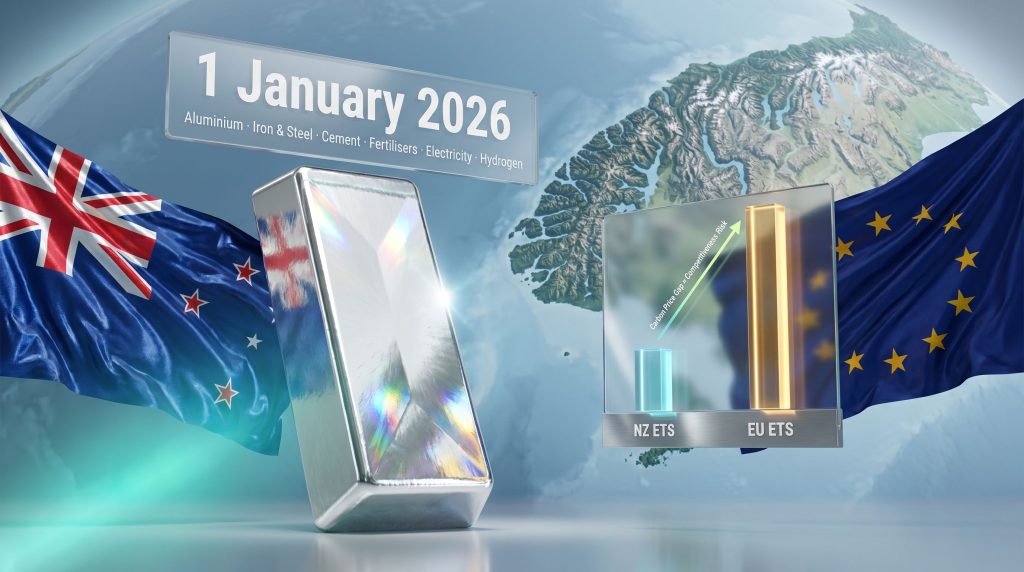
From 1 January 2026, the full compliance phase has been in effect. The sectors covered in this first wave include:
- Aluminium
- Iron and steel
- Cement
- Fertilisers
- Electricity
- Hydrogen
The mechanism is explicitly structured to neutralise what the EU terms "carbon leakage," the risk that European manufacturers face an unfair competitive disadvantage against producers from countries with weaker or no carbon pricing. Green transition policy frameworks globally are increasingly converging around this logic, furthermore making CBAM a template rather than an anomaly.
Where New Zealand Aluminium Sits Within the CBAM Framework
New Zealand's aluminium industry is, in practice, concentrated at a single facility: the New Zealand Aluminium Smelter at Tiwai Point in Southland, one of the largest industrial operations in the country. Any discussion of New Zealand's CBAM exposure is fundamentally a discussion about Tiwai Point's export pathways into European markets.
The table below summarises the core CBAM parameters relevant to New Zealand aluminium producers:
| Export Factor | Detail |
|---|---|
| CBAM Coverage Status | Aluminium included from 1 January 2026 |
| Legal Cost Obligation | Falls on EU importer at point of entry |
| Contract Pass-Through Risk | EU buyers can renegotiate to shift cost burden to NZ exporters |
| NZ ETS Carbon Price Offset | Carbon costs already paid under NZ ETS reduce CBAM liability |
| National Export Concentration | Impact focused on a narrow industrial segment, not economy-wide |
While the EU importer holds the formal legal obligation to purchase CBAM certificates, commercial reality frequently means these costs are renegotiated back through supply chain contracts. This is a critical distinction: the financial burden may originate in Brussels, but it can land in Invercargill.
How Do Aluminium Trade Pressures Compound the Risk?
Aluminium trade pressures from multiple directions are compounding the CBAM challenge. Exporters navigating tariff regimes in parallel with carbon compliance obligations face a considerably more complex commercial environment than either measure would create in isolation.
The Carbon Price Gap: Where the Real Competitiveness Risk Lives
The central risk variable for New Zealand aluminium exporters is not CBAM itself, but the spread between the New Zealand ETS carbon price and the EU ETS allowance price. CBAM is specifically designed so that carbon costs already paid in a third country reduce the certificate liability for EU importers. This means the net CBAM cost is the gap, not the total EU carbon price.
The problem is that this gap has been persistently wide. The New Zealand ETS carbon price has traded at a fraction of EU ETS levels. EU carbon allowances have at various points exceeded NZ$100 per tonne, while the NZ ETS has historically cleared well below this level, often sitting in the NZ$50 to NZ$75 range under its price ceiling mechanisms.
The competitiveness risk is proportional. The wider the carbon price differential between Wellington and Brussels, the larger the effective penalty placed on New Zealand aluminium entering European markets, regardless of the product's actual environmental credentials.
This spread creates a structural headwind that cannot be resolved through efficiency improvements alone. It requires either a convergence in carbon pricing frameworks over time, a premium pricing strategy based on low-emission credentials, or a diversification away from European markets where CBAM costs are prohibitive. Consequently, monitoring the CBAM implementation progress over its first year offers valuable signals for how these pressures may evolve.
New Zealand's Hydroelectric Advantage: A Genuine Structural Edge
Here is where the narrative becomes genuinely more complex, and where New Zealand's position is frequently underestimated in global commentary on CBAM.
Aluminium smelting is extraordinarily electricity-intensive. Globally, the smelting process accounts for roughly 14 to 16 megawatt-hours of electricity per tonne of aluminium produced, making the carbon intensity of the power supply the single largest determinant of a smelter's embedded emissions profile.
Most global aluminium production relies on coal-fired or gas-fired electricity. Chinese smelters, which account for the majority of global output, have historically operated with some of the highest embedded carbon intensities in the industry, in many cases exceeding 10 to 14 tonnes of CO2 equivalent per tonne of aluminium.
Tiwai Point is powered by hydroelectric generation from the Manapouri Power Station. This means the embedded carbon intensity of New Zealand aluminium is dramatically lower than the global average. Under CBAM, lower embedded emissions translate directly into fewer certificates required per tonne exported, reducing the absolute cost burden.
This creates a significant commercial differentiator:
- Fewer CBAM certificates required per shipment
- Lower effective cost to EU importers relative to high-emission alternatives
- A credible premium positioning story in European markets increasingly driven by green procurement mandates
The critical caveat is that this advantage is only commercially valuable if it can be verified to EU standards, which brings its own set of challenges. In addition, broader aluminium decarbonisation efforts across the region illustrate how competitive the race to establish clean credentials has become.
Compliance Architecture: Why Reporting Is as Challenging as the Cost
A widely underappreciated dimension of CBAM is that the compliance burden is not purely financial. It is deeply operational. The EU prescribes its own embedded emissions calculation methodology, and this methodology does not automatically align with how New Zealand producers currently report under the NZ ETS.
There are three core compliance obligations that exporters must satisfy:
- Embedded Emissions Reporting — Calculated using EU-prescribed methodology, applied at the production level, not the national framework level.
- Independent Third-Party Verification — Emissions data must be verified by an accredited independent body recognised under EU standards, not simply self-reported or domestically audited.
- Importer Registration — EU buyers must be formally registered within the CBAM system before any transaction can be processed under the mechanism.
Producers should not assume that existing compliance with New Zealand's domestic emissions framework satisfies EU CBAM requirements. The two systems use different calculation boundaries, scope definitions, and verification standards. Gaps between them can result in default emission intensity values being applied, which are typically set conservatively high, increasing cost exposure above actual production levels.
This creates a scenario where a genuinely low-emission producer could face a higher-than-warranted CBAM cost burden purely due to a reporting methodology mismatch. For Tiwai Point, investing in EU-aligned emissions measurement infrastructure is not optional; it is a prerequisite for capturing the competitive advantage the facility's clean power supply should theoretically provide. Exporters seeking practical guidance on navigating EU carbon regulations will find that early preparation materially reduces compliance risk.
The next major ASX story will hit our subscribers first
Strategic Responses Available to New Zealand Exporters
Facing CBAM as a structural trade reality rather than a temporary measure, New Zealand aluminium exporters have several strategic levers available:
- Build EU-compliant emissions reporting capability from the production floor up, not retrofitted from existing domestic frameworks
- Engage EU buyers early to align on verification timelines, registration obligations, and how CBAM costs will be allocated in future contracts
- Leverage clean production credentials proactively in commercial negotiations, positioning Tiwai Point's hydro-powered output as a premium product in European green procurement contexts
- Review and renegotiate supply contracts to clearly allocate CBAM cost responsibilities before they become a source of commercial dispute
- Monitor the NZ ETS price trajectory relative to EU ETS, as convergence over time would mechanically reduce the net CBAM liability gap
Furthermore, a low-carbon aluminium strategy at the corporate level, rather than a purely reactive compliance posture, positions exporters to capitalise on European premium markets rather than simply absorb additional cost.
How CBAM's Scope Is Expected to Evolve Before 2030
One of the less-discussed dimensions of CBAM is its built-in expansion mechanism. The current first-phase coverage is not a ceiling. The EU has committed to reviewing CBAM's scope before 2030, with explicit consideration of extending coverage to downstream products and potentially agricultural commodities.
| CBAM Phase | Sectors Covered | Timeline |
|---|---|---|
| Phase 1 (Operational) | Aluminium, Iron and Steel, Cement, Fertilisers, Electricity, Hydrogen | From 1 January 2026 |
| Potential Phase 2 | Downstream aluminium products, select agricultural commodities | Pre-2030 review |
| Long-Term Scope | Under ongoing EU policy evaluation | Post-2030 |
The potential inclusion of downstream aluminium products is particularly significant. Currently, a sheet or extrusion fabricated from New Zealand aluminium falls outside CBAM's scope. If downstream products are added, the coverage expands dramatically in terms of trade volume and value affected.
For a trade-exposed economy like New Zealand, the agricultural inclusion question carries its own strategic weight, potentially touching dairy, meat, and horticultural export streams that currently operate entirely outside carbon-linked trade measures.
New Zealand Versus Other Non-EU Aluminium Producers Under CBAM
Context matters enormously when assessing CBAM's competitive impact. New Zealand is not assessed in isolation; it competes against other non-EU aluminium producers, many of whom face a far more adverse CBAM position.
- China: High embedded carbon intensity from coal-dominated power, no equivalent domestic carbon pricing at comparable levels, maximum exposure to CBAM certificates
- Russia: Rusal's Siberian hydro-powered smelters have low emission profiles, but face separate EU trade restrictions
- Australia: Partial overlap with NZ in terms of having a policy-level carbon awareness, though current domestic carbon pricing structures differ meaningfully
- Gulf producers: Low electricity costs but increasingly fossil-fuel based generation, moderate to high embedded emissions
New Zealand's established ETS infrastructure gives it a structural reporting and offset advantage over producers from countries with no domestic carbon pricing whatsoever. The CBAM credit mechanism explicitly rewards prior carbon payment, meaning NZ producers start from a better net position than most competing exporters. The green metals transition underway across the broader sector, however, means this advantage must be actively maintained rather than assumed.
What CBAM Signals for the Future of Carbon-Linked Trade Policy
The EU's CBAM is not an isolated experiment. It represents the leading edge of a global policy shift toward carbon-linked trade measures. Canada, the United Kingdom, and other economies are at various stages of developing equivalent mechanisms. The logic is politically durable: domestic carbon pricing loses its effectiveness if it simply redirects production to unpriced jurisdictions.
For export-oriented industries globally, the strategic implication is clear. Decarbonisation is no longer solely an environmental obligation or a domestic regulatory requirement. It is becoming a prerequisite for market access in the world's largest trading blocs. Industries that front-run this transition, investing in clean production credentials and verified emissions reporting infrastructure, will hold a durable competitive advantage over those that treat carbon compliance as a cost to minimise rather than a capability to build.
New Zealand's aluminium sector, underpinned by one of the cleanest production profiles in the world, is genuinely well-positioned to navigate this transition, provided it makes the operational and reporting investments necessary to turn that physical advantage into verified, commercially exploitable value.
Frequently Asked Questions: EU CBAM and New Zealand Aluminium Exports
Does the EU Carbon Border Levy Apply to All New Zealand Exports?
Currently, the EU carbon border levy and New Zealand aluminium exports represent the most directly relevant intersection for New Zealand's industrial profile. The economy-wide impact remains concentrated rather than broad-based across the six covered sectors.
Who Bears the Legal Obligation to Purchase CBAM Certificates?
The formal obligation sits with the EU importer. However, commercial contracts frequently shift this cost burden back to the exporting producer through pricing adjustments, making it a practical concern for New Zealand exporters regardless of the legal structure.
Does New Zealand's Hydroelectric-Powered Aluminium Production Reduce CBAM Exposure?
Yes, materially. Lower embedded emissions resulting from clean electricity inputs mean fewer certificates are required per tonne exported. This is one of New Zealand's most tangible structural advantages under the mechanism, though it must be verified to EU standards to be commercially recognised.
Can Existing NZ ETS Reporting Satisfy CBAM Compliance Requirements?
Not automatically. The EU applies its own calculation methodology and verification standards. Producers must specifically build or adapt reporting systems to meet EU requirements, independent of their existing domestic compliance frameworks.
What Happens if CBAM Scope Expands Before 2030?
If downstream aluminium products or agricultural commodities are included in future phases, the trade impact on New Zealand would broaden significantly beyond the current industrial concentration at Tiwai Point. Exporters across multiple sectors should monitor EU policy reviews closely.
This article contains forward-looking analysis and references to policy frameworks that remain subject to change. It does not constitute financial or investment advice. Readers should conduct independent due diligence and consult qualified advisers before making trade or investment decisions based on evolving carbon border policy.
Want to Identify the Next Major Mineral Discovery Before the Broader Market Does?
Discovery Alert's proprietary Discovery IQ model scans ASX announcements in real time, instantly converting complex mineral data across 30-plus commodities into clear, actionable insights for both short-term traders and long-term investors — explore historic discovery returns that demonstrate the scale of opportunity, and begin your 14-day free trial at Discovery Alert to position yourself ahead of the market.