July 22, 2026
When Operational Success Meets Governance Failure: A Framework for Mining Investors
There is a pattern in resource sector investing that repeats across market cycles: a company delivers operationally exceptional results at precisely the moment its institutional credibility comes under the most pressure. This dynamic, where strong cash flow coexists with governance uncertainty, creates one of the most psychologically complex investment environments an ASX shareholder can navigate. Understanding how to separate the signal from the noise in these situations is what distinguishes investors who capitalise on dislocations from those who are caught off-guard by them.
Mineral Resources CEO uncertainty has become the defining narrative around ASX: MIN in 2026, even as the company posts some of the strongest financial results in its operating history. This tension between operational recovery and leadership instability is not unique to this company, but the scale of both the financial turnaround and the governance challenge makes it a particularly instructive case study for ASX resource investors.
When big ASX news breaks, our subscribers know first
The Governance Investigation That Changed Everything
What Triggered the Board Review
The internal investigation at Mineral Resources centred on concerns relating to undisclosed revenue streams connected to offshore entities and the personal use of company resources by founder and managing director Chris Ellison. These findings escalated beyond internal review, drawing attention from the Australian Taxation Office and broader governance oversight bodies.
What distinguishes this situation from typical executive departure scenarios is the compounding nature of the governance fallout. Multiple directors with governance-focused mandates resigned from the board during the review period, a pattern that institutional investors and ratings agencies treat as a leading indicator of deeper structural dysfunction rather than isolated personnel decisions. The Mineral Resources governance lawsuit further compounded the reputational pressure already building around the company.
Chair Mal Bundey has publicly confirmed that the search for a new chief executive is actively underway, though no firm timeline has been communicated to the market. This absence of a defined endpoint is itself a material risk factor, because ambiguity in leadership transitions historically amplifies uncertainty across a mining company's relationships with lenders, joint venture partners, and major customers simultaneously.
The 18-Month Window and What It Actually Means
Reports indicate that Ellison could remain in the managing director role for a period of up to 18 months while a suitable successor is identified and onboarded. Further reporting suggests he may stay through to the completion of a significant operational milestone in 2027 before departing, effectively leaving the timeline open-ended and linked to project execution rather than a fixed calendar date.
This approach to succession planning carries specific risks that are often underappreciated by retail investors:
- Lender confidence can erode during undefined transition windows, particularly where the departing executive was the primary relationship manager with debt providers
- Joint venture counterparties often pause co-investment decisions until leadership clarity is established
- Key management personnel below the CEO level may begin evaluating external opportunities, creating secondary talent retention risk
- Strategic project timelines can slip as decision-making authority becomes unclear during extended transition periods
In capital-intensive mining businesses, the chief executive is not simply an operational figurehead. They are often the central node in a network of banking relationships, offtake agreements, and strategic partnerships that took years to build. Disrupting that node without a clear replacement timeline carries cascading risks that financial metrics alone cannot capture.
How Moody's Responded and Why Credit Signals Matter
The Negative Outlook Revision Explained
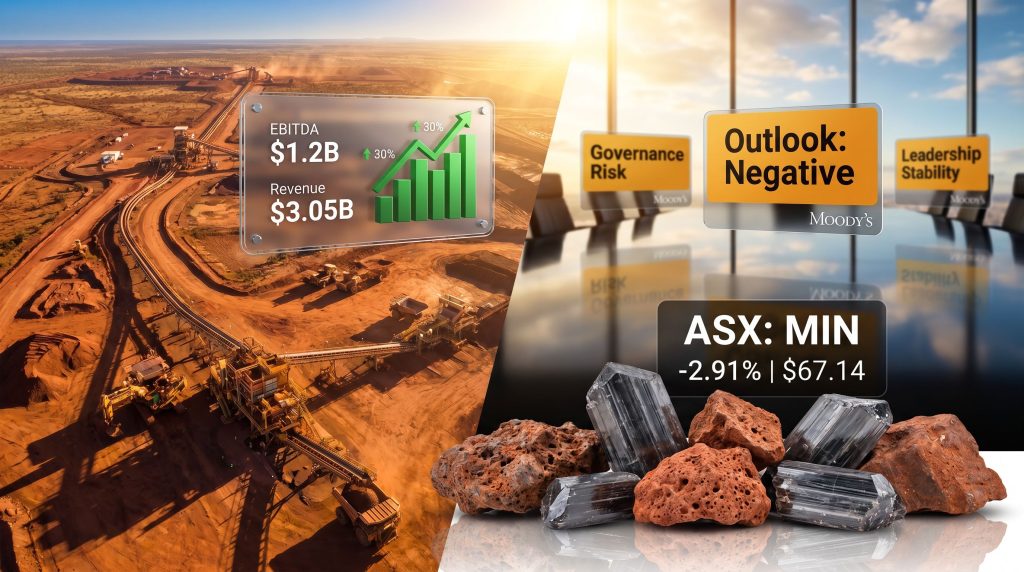
Moody's formally revised its credit outlook on Mineral Resources to negative in response to the leadership disruption. For investors who primarily track share price movements, credit agency outlook revisions can appear to be a secondary concern. In practice, they are often a leading indicator of more significant financial consequences.
A negative credit outlook from Moody's does not signal imminent financial distress. What it does signal is that the ratings agency believes the risk of a downward ratings action has increased, and that lenders and institutional counterparties should recalibrate their risk assessments accordingly.
The specific concerns Moody's identified spanned multiple dimensions:
| Risk Category | Moody's Concern Level | Practical Investor Impact |
|---|---|---|
| Strategic Direction | High | Uncertainty over capital allocation priorities |
| Financial Policy | High | Dividend and debt reduction targets at risk |
| Customer Relationships | Moderate | Contract renewal confidence weakened |
| Joint Venture Partners | Moderate | Co-investment appetite may soften |
| Lender Confidence | High | Refinancing terms and covenant flexibility at risk |
Why Board Composition Matters as Much as the CEO Role
A lesser-understood dynamic in mining sector governance is that director-level exits during a governance review carry different market signals than ordinary board refreshes. When directors who specifically hold governance, audit, or risk committee mandates depart in quick succession, it indicates that those individuals assessed the governance environment as incompatible with their own fiduciary obligations.
This creates a compounding confidence deficit. Moody's negative outlook, combined with visible board instability, creates a narrative that institutional investors find difficult to look through, even when underlying operational performance is improving. Investors alert to management red flags in ASX mining stocks will recognise this pattern as a well-documented precursor to extended valuation discounts.
Onslow Iron: The Engine Behind the Financial Recovery
Understanding the Project's Strategic Significance
The Onslow Iron project represents one of the more ambitious iron ore logistics solutions developed in Western Australia in recent years. Unlike traditional Pilbara iron ore operations that rely on dedicated rail infrastructure, Onslow Iron utilises a transhipment model in which ore is transported by road to a marine facility and loaded onto vessels offshore. This approach reduced the capital intensity of the project significantly compared to a conventional rail-based operation, though it introduced its own operational complexity during the ramp-up phase.
The project experienced a difficult start-up period, including a notable Onslow Iron project halt, before reaching its current annualised throughput rate of 35 million tonnes. The pathway to 40 million tonnes per annum within approximately two years represents a meaningful production increment that would materially strengthen the company's free cash flow profile. Furthermore, the recent Onslow Iron transhipper expansion signals continued confidence in scaling the operation toward that target.
The Financial Recovery in Numbers
The contrast between Mineral Resources' current financial performance and its position twelve months ago is significant enough to warrant careful examination:
| Financial Metric | Reported Result |
|---|---|
| EBITDA (Half-Year) | $1.2 billion (record) |
| Revenue (Half-Year) | $3.05 billion |
| Net Profit | $573 million |
| Iron Ore EBITDA Contribution | $519 million |
| Net Debt | $4.9 billion |
| Free Cash Flow (Half-Year) | $292 million |
The net profit of $573 million represents a dramatic reversal from a substantial loss recorded in the prior corresponding period. Iron ore contributed $519 million in EBITDA, while the lithium segment benefited from a partial recovery in spodumene spot prices following one of the most severe price downturns in that commodity's modern history.
The financial recovery is real and measurable. However, markets are actively applying a governance discount to these results, a dynamic that has historically created both meaningful risk and genuine opportunity for long-term investors in the resources sector depending on how the governance situation ultimately resolves.
Spodumene Price Recovery and the Lithium Segment
One aspect of the MIN financial recovery that receives less attention than the Onslow Iron turnaround is the contribution from the lithium segment. Spodumene, the lithium-bearing mineral concentrated at MIN's operations, experienced a price collapse from peak levels above USD $8,000 per tonne in 2022 to levels below USD $800 per tonne at the trough. The partial recovery in spodumene prices that has contributed to the improved half-year result remains fragile and is closely linked to electric vehicle demand trajectories and downstream lithium chemical inventory cycles in China.
For investors evaluating MIN, understanding that the company's earnings profile spans two structurally different commodity cycles — iron ore and lithium — is important context for assessing earnings sustainability. In addition, monitoring iron ore price trends remains essential given how significantly they influence MIN's near-term cash flow generation.
Share Price Performance and the Dual Narrative
The Numbers Behind the Market Movement
Despite a decline of approximately 2.91% to $67.14 at the time of the most recent market update, Mineral Resources shares remain approximately 23% higher year-to-date in 2026 and roughly 220% above their level from twelve months earlier. That twelve-month appreciation reflects the scale of the operational turnaround from a period when the company's financial position was considerably more stressed.
The current market debate around MIN essentially involves two competing narratives:
Bull case:
- Record EBITDA validates the Onslow Iron investment thesis
- Improving free cash flow creates a pathway to debt reduction and dividend reinstatement
- Lithium segment optionality provides leverage to a commodity price recovery
- Governance issues are identifiable and time-limited rather than structurally permanent
Bear case:
- CEO succession timeline remains undefined, creating persistent uncertainty
- Moody's negative outlook may affect refinancing terms as debt facilities mature
- Net debt of $4.9 billion provides limited financial flexibility in a commodity downturn
- Founder-exit dynamics in mining companies frequently create management instability at multiple levels
Dividend Reinstatement: Conditions and Catalysts
Mineral Resources suspended dividend payments in 2024 as the company redirected available cash toward debt reduction and balance sheet stabilisation. Management has indicated that dividend payments could resume if specific liquidity and leverage targets are achieved, though no formal thresholds have been publicly defined in precise terms.
Free cash flow of $292 million for the half-year period represents meaningful progress toward the financial conditions that would support a dividend case. The indicators worth monitoring include:
- Net debt trajectory: Any sustained reduction below $4.9 billion would signal improving balance sheet health
- Free cash flow consistency: Quarterly FCF remaining above $200 million would strengthen the dividend reinstatement argument
- Onslow Iron ramp-up progress: Reaching 40 million tonne annualised capacity would materially increase the FCF base
- Leverage ratio milestones: Management-defined internal targets remain the formal conditions for any payout decision
- Credit outlook stabilisation: A return to a stable Moody's outlook would signal improving lender confidence and reduce refinancing risk
The next major ASX story will hit our subscribers first
Governance Lessons for ASX Resource Sector Investors
Founder-Led Companies and Concentrated Leadership Risk
Mineral Resources CEO uncertainty reflects a structural pattern that recurs across ASX-listed resource companies with founder-centric leadership models. Founder-managed mining businesses frequently carry concentrated leadership risk that is systematically underpriced during periods of strong operational performance because the founder's vision and relationships are perceived as value-creating rather than risk-concentrating.
Governance reviews triggered by related-party dealings are not exclusive to any single company. They represent a recurring feature of the ASX mining landscape, particularly in businesses where the founder has operated with significant autonomy over an extended period and where board oversight structures have not kept pace with the company's growth in scale and complexity. Proactive Investors has documented how the company has since announced governance reforms in direct response to this pressure.
A Practical Framework for Evaluating Leadership Risk in ASX Mining Stocks
- Assess board independence ratios: The proportion of genuinely independent directors relative to executive and founder-aligned board members is a primary indicator of governance quality
- Review related-party transaction disclosures: Annual report footnotes frequently contain early warning signals of related-party dealings that have not yet attracted regulatory scrutiny
- Evaluate succession planning disclosures: Companies with documented CEO succession frameworks carry measurably lower leadership transition risk
- Monitor credit agency signals: Moody's, S&P, and Fitch outlook revisions frequently precede equity market repricing events by weeks or months
- Track director tenure and turnover patterns: Elevated resignation rates among independent and governance-focused directors during review periods are a leading indicator of deeper structural concerns
- Understand the commodity earnings mix: Companies exposed to multiple commodity cycles carry earnings volatility that is more complex to model than single-commodity producers
A negative credit outlook from a major ratings agency does not automatically indicate that a company is approaching financial distress. What it does indicate is that institutional counterparties are recalibrating their risk assessments, which carries practical consequences for refinancing costs, covenant flexibility, and co-investment appetite that compound over time.
Frequently Asked Questions: Mineral Resources CEO Uncertainty
Why is Chris Ellison stepping down from Mineral Resources?
Ellison is departing following an internal board investigation that identified governance concerns, including undisclosed revenue connected to offshore entities and the personal use of company resources. The findings prompted scrutiny from the Australian Taxation Office and broader governance oversight bodies.
How long will Chris Ellison remain in the role?
Reports indicate he could remain as managing director for up to 18 months during the transition period. Additional reporting suggests he may stay through the completion of a major operational milestone in 2027 before departing, leaving the timeline effectively open-ended.
What did Moody's say about Mineral Resources?
Moody's revised its credit outlook on the company to negative, citing concerns that the leadership disruption could affect strategic direction, financial policy consistency, customer relationships, joint venture arrangements, and lender confidence.
Is Mineral Resources financially strong despite the leadership issues?
The company recorded its strongest half-year financial result on record, with EBITDA of $1.2 billion and revenue of $3.05 billion. Net debt remains elevated at $4.9 billion, and the governance overhang continues to weigh on investor sentiment despite the operational improvement.
Will Mineral Resources pay dividends again?
Management has indicated dividends could resume if internal liquidity and leverage targets are met. No formal declaration has been made, but free cash flow of $292 million for the half-year period suggests the company is making progress toward those conditions.
What is the Onslow Iron project?
Onslow Iron is a major iron ore project that uses a transhipment model rather than conventional rail infrastructure. It is currently operating at an annualised rate of 35 million tonnes and is targeting 40 million tonnes within approximately two years, making it the primary driver of MIN's recent financial recovery.
What Should Investors Weigh Before Taking a Position in MIN?
The investment case for Mineral Resources in the current environment involves holding two genuinely conflicting assessments at the same time. Operationally, the company is performing at its highest level in its history. Governance-wise, it is navigating its most complex period. Neither assessment cancels the other out, and that tension is precisely what creates the analytical challenge.
The key considerations for investors evaluating MIN right now include:
- Operational recovery is confirmed and backed by audited financial results, not analyst projections
- Governance risk remains unresolved and the CEO transition timeline is the single largest uncertainty overhang on the investment thesis
- Debt remains a material constraint with $4.9 billion in net debt limiting financial flexibility until Onslow Iron cash flows scale further toward the 40 million tonne target
- Dividend reinstatement is a genuine potential catalyst but remains conditional on targets that have not yet been formally met
- The Moody's negative outlook is a risk signal, not a verdict and warrants monitoring rather than panic, particularly given the improved operational cash flow trajectory
For long-term investors, the gap between MIN's documented operational recovery and its current governance discount may represent a valuation consideration worth examining. That opportunity, if it exists, is available only to those with sufficient risk tolerance and time horizon to hold through what remains an uncertain and extended leadership transition period.
This article contains general information only and does not constitute financial advice. Past performance is not indicative of future returns. Investors should consider their own financial circumstances and seek professional advice before making investment decisions.
Want to Spot the Next Major ASX Mineral Discovery Before the Market Does?
Discovery Alert's proprietary Discovery IQ model delivers real-time alerts on significant ASX mineral discoveries, instantly turning complex mineral data into actionable insights for investors at every experience level — start your 14-day free trial today and gain a market-leading edge, or explore historic discovery returns to understand just how transformative major finds can be.