
July 22, 2026
When Major Miners Take Minority Stakes: What Strategic Shareholding Reveals About Critical Minerals Conviction
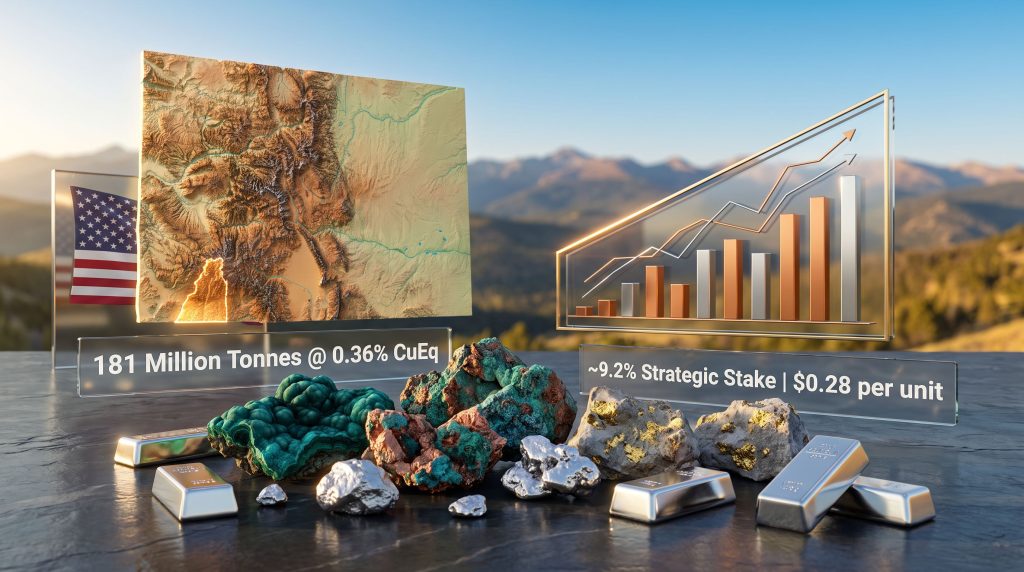
In the world of resource exploration, few signals carry as much weight as a major miner choosing to deploy fresh capital into a junior explorer, not because of a new discovery or a takeover ambition, but simply to avoid being diluted. This behaviour, quiet and procedural on the surface, often reveals more about long-term strategic thinking than headline-grabbing acquisitions. When Newmont acquires shares in Metallic Minerals to hold its position steady at approximately 9.2%, it communicates something important: the world's largest gold producer sees enough value in a Colorado polymetallic project to write another cheque.
Understanding why requires looking beyond the transaction itself and into the geology, the macro forces shaping critical minerals demand, and the financial architecture that governs how major miners maintain optionality in exploration-stage assets.
When big ASX news breaks, our subscribers know first
The Structured Relationship Behind the Transaction
How Participation Rights Work in Practice
The July 2026 transaction, in which Newmont acquired 3,224,700 units of TSX-V listed Metallic Minerals Corporation at $0.28 per unit for total gross proceeds of $902,916, did not emerge from opportunism. It was executed under a formal Investor Rights Agreement originally established on May 18, 2023, which grants Newmont contractual participation rights.
Participation rights, sometimes called pre-emptive or anti-dilution rights, are a foundational tool in structured mining investment. They allow a defined shareholder to purchase newly issued shares in proportion to their existing stake whenever the company raises capital. The key distinction is that these rights provide an option, not an obligation. Exercising them is a deliberate choice.
"When a strategic investor chooses to deploy additional capital specifically to maintain its ownership percentage, this is fundamentally different from passive holding. It represents an active vote of confidence in the asset's direction."
| Term | Plain-English Meaning |
|---|---|
| Participation Rights | Right to buy new shares pro-rata to avoid dilution |
| Non-Brokered Private Placement | Shares sold directly without an investment bank intermediary |
| Unit Structure | One common share plus one-half of a share purchase warrant |
| Warrant Strike Price | $0.40 per share, exercisable for three years from closing |
Transaction Snapshot: Key Numbers
| Metric | Detail |
|---|---|
| Transaction Type | Non-brokered private placement |
| Units Acquired | 3,224,700 |
| Price Per Unit | $0.28 |
| Total Capital Invested | $902,916 |
| Warrant Strike Price | $0.40 per share |
| Warrant Duration | 3 years from closing |
| Post-Transaction Ownership | ~9.2% of Metallic Minerals Corporation |
| Governing Agreement | Investor Rights Agreement, May 18, 2023 |
The non-brokered structure is also noteworthy. By bypassing an investment bank intermediary, Metallic Minerals reduced its transaction costs and conducted the placement within a pre-existing trust relationship. This approach is particularly common where the investor is strategic rather than purely financial, and where the terms have already been defined contractually. For further context on Newmont's participation rights exercise, the official announcement provides additional detail.
La Plata: More Than the Numbers Suggest
A Polymetallic System With Geological Depth
La Plata, located in La Plata County, Colorado, is not a single-metal story. The project targets copper, silver, gold, and platinum group metals (PGMs), and its current inferred mineral resource estimate of 181 million tonnes grading 0.36% copper-equivalent positions it as a meaningful exploration-stage asset within the North American critical minerals landscape. Notably, Metallic Minerals' project overview outlines the full breadth of assets under active development.
La Plata Resource Breakdown
| Metal | Contained Resource |
|---|---|
| Copper | 1.3 million pounds |
| Silver | 17 million ounces |
| Platinum (within 45 Mt PGM subset) | 91,000 oz |
| Palladium (within 45 Mt PGM subset) | 121,000 oz |
| Gold (within 45 Mt PGM subset) | 60,000 oz |
What makes the La Plata project particularly compelling to sophisticated observers is not its current inferred resource, but what surrounds it. The project hosts 20 developing surface exploration targets, each potentially representing a separate porphyry centre. This distinction matters enormously from a geological standpoint.
Why Porphyry Systems Command Premium Attention
Porphyry copper deposits are the planet's most significant source of copper production, accounting for roughly 75% of global copper supply. They form through magmatic-hydrothermal processes, typically at depths of one to five kilometres, and are characterised by broad, low-to-moderate grade mineralisation that extends across very large volumes of rock. What they lack in grade richness, they compensate for in scale.
The identification of multiple discrete surface targets at La Plata, each potentially representing its own porphyry centre, suggests the project may be sitting above a mineralised system far larger than its current resource boundary implies. Exploration-stage porphyry projects with district-scale footprints are exceptionally rare, particularly within the continental United States where permitting environments and infrastructure access are comparatively mature. Furthermore, the copper supply crunch intensifies the strategic appeal of any large-scale domestic copper discovery.
"Porphyry systems rarely occur in isolation. When geologists identify one centre, the presence of additional targets in the same structural corridor can suggest a broader mineralised district, which is precisely the scenario unfolding at La Plata."
The Allard Resource Expansion: Proof of Productive Collaboration
One of the less-discussed aspects of the Newmont and Metallic Minerals relationship is the existence of a joint technical committee through which both parties have collaborated on exploration planning and geological interpretation. This committee has already contributed to expanding the Allard resource zone within the La Plata project, demonstrating that the strategic relationship is operationally active, not merely a financial arrangement.
This kind of technical cooperation between a major miner and an explorer is uncommon at the junior exploration stage. Majors typically withhold their geological expertise until they have acquired a controlling interest. The fact that Newmont is contributing technical resources at a 9.2% non-controlling stake suggests a deeper level of engagement and a higher degree of confidence in the project's underlying geology.
Critical Minerals, Domestic Supply, and the Copper Deficit
Structural Demand Forces Reshaping Metal Priorities
The global energy transition has fundamentally altered how institutional capital thinks about metal exposure. Copper sits at the centre of this transformation, serving as the essential conductor in electric vehicle motors, grid-scale battery storage, solar panel wiring, and offshore wind infrastructure. Estimates from major investment banks and commodity research groups consistently project that copper demand will outpace available supply well into the 2030s, with the supply gap widening as existing mines deplete and few large new projects advance to production.
PGMs present a more nuanced picture. While internal combustion engine demand for platinum and palladium in autocatalysts faces long-term headwinds from EV adoption, hydrogen fuel cell technology is emerging as a significant new demand vector, particularly for platinum. Industrial applications in electronics, chemicals, and high-temperature processing also provide baseline demand support.
Both copper and PGMs have been formally designated as critical minerals within US national supply chain security frameworks. This reflects government concern about import dependency for materials essential to economic and industrial resilience. La Plata's Colorado location positions the project as a potential domestic source of both metal categories, a geopolitical characteristic that adds a layer of strategic value beyond pure project economics.
Why Would a Gold Major Hold Copper and PGM Optionality?
Newmont's decision to maintain exposure to a copper-PGM-silver-gold explorer through a structured minority stake reflects a broader strategic logic that is becoming more visible across the largest copper mines and major miner landscape. Gold-focused companies face a fundamental challenge: their primary commodity, while performing strongly in recent years with gold trading above $4,100 per ounce in mid-2026, does not participate in energy transition demand growth in the same way base and technology metals do.
Maintaining a non-controlling minority position in a district-scale critical minerals explorer offers several advantages without the capital intensity or operational risk of a full acquisition:
- Optionality preservation: A 9.2% stake can be converted to a larger position if exploration success justifies increased commitment.
- Capital efficiency: Approximately $903,000 maintains meaningful strategic exposure compared to the hundreds of millions a controlling acquisition would require.
- Asymmetric upside via warrants: The warrant component creates a mechanism to increase ownership at a pre-agreed price if the share price appreciates.
- Technical intelligence: The joint technical committee provides ongoing geological intelligence about an emerging copper district.
- Portfolio diversification: Exposure to copper and PGMs provides partial hedging against gold-specific market dynamics.
The Warrant Structure: Deferred Commitment With Built-In Logic
Understanding the Financial Architecture
Each of the 3,224,700 units acquired includes one-half of a common share purchase warrant, meaning Newmont received 1,612,350 full warrants from this transaction. Each warrant entitles Newmont to purchase one additional Metallic Minerals share at $0.40, representing a 42.9% premium over the $0.28 placement price.
This structure embeds a clear logic. The warrants are currently out-of-the-money, meaning they only become economically rational to exercise if Metallic Minerals' share price rises meaningfully above the $0.40 strike. The three-year exercise window is calibrated to allow sufficient time for exploration results, resource updates, and market re-rating to potentially push the share price to levels where warrant exercise makes financial sense.
If all warrants were eventually exercised at $0.40, Metallic Minerals would receive an additional ~$644,940 in proceeds, capital that would further fund drilling and resource expansion across La Plata's 20-plus surface targets.
"The warrant mechanism functions as a deferred capital commitment with a built-in performance threshold. Newmont only increases its position if the market validates La Plata's progress through share price appreciation, aligning both parties' incentives around exploration success."
How Metallic Minerals Will Deploy the Capital
Exploration Advancement as the Primary Objective
The $902,916 raised through this placement will be directed toward two primary objectives:
- Advancing exploration and development at the La Plata copper, silver, gold, and PGM project, with particular focus on systematically testing the 20-plus developing surface targets that may represent additional porphyry centres.
- Working capital and general corporate purposes, ensuring operational continuity as the exploration programme progresses.
For an exploration-stage company operating in a capital-intensive environment, securing funding from a strategic investor through a non-brokered process carries reputational weight beyond the dollar amount. It signals to the broader market that a major with significant technical resources and geological experience continues to view the project favourably. In addition, the pathway from these exploration results toward a definitive feasibility study remains a key milestone for the project's long-term development.
The next major ASX story will hit our subscribers first
Frequently Asked Questions
Why Does Maintaining a 9.2% Stake Require a New Investment?
When a company issues new shares through a capital raise, every existing shareholder's percentage ownership automatically decreases unless they purchase shares in the new offering. Newmont's participation rights exercise was specifically designed to counter this dilution, purchasing enough of the new placement to keep its total ownership steady at approximately 9.2%.
Is This Transaction a Signal of an Impending Takeover?
Not based on available information. A 9.2% non-controlling minority stake is structurally and legally distinct from a controlling position. There is no disclosure associated with this transaction suggesting Newmont intends to launch a takeover bid for Metallic Minerals. However, the mining industry consolidation trend means such relationships are worth monitoring over time.
What Does the $0.28 Placement Price Tell Market Observers?
Private placement pricing in the junior mining sector often functions as an informal valuation reference point. A strategic investor of Newmont's calibre participating at $0.28 per unit provides a data point that the market can use to contextualise the asset's perceived value at the time of the transaction, though this should not be interpreted as a formal valuation or price guarantee.
What Is Copper-Equivalent Grading and Why Is It Used?
When a deposit contains multiple metals, geologists convert all metal content into a single equivalent grade using prevailing metal prices and recovery assumptions. A 0.36% copper-equivalent grade at La Plata means the combined economic value of copper, silver, gold, and PGMs per tonne of rock is equivalent to what 0.36% pure copper would represent. This metric allows multi-metal projects to be compared with single-metal benchmarks.
Key Takeaways for Investors Tracking This Story
- Strategic continuity matters: Newmont acquires shares in Metallic Minerals under a formal contractual framework established in 2023, not as a one-time opportunistic move. Repeated participation in capital raises within a structured agreement is a durable signal of sustained conviction.
- The geology has district-scale implications: Twenty-plus developing surface targets at La Plata, each potentially representing a separate porphyry centre, means the current 181-million-tonne inferred resource may represent only an early view of a much larger mineralised system.
- Warrant optionality creates aligned incentives: The half-warrant structure benefits both parties. Metallic Minerals gains access to future capital if exploration succeeds; Newmont gains the right, but not the obligation, to increase its position at a defined price.
- Domestic US critical minerals positioning adds strategic value: La Plata's location in Colorado, combined with its copper and PGM profile, places it within a supply chain context that transcends pure exploration economics.
- Technical collaboration is rare at this scale: The joint technical committee between a global major and a junior explorer at the 9.2% ownership level is an unusual arrangement that suggests the relationship carries operational depth beyond financial investment.
Disclaimer: This article is intended for informational purposes only and does not constitute financial or investment advice. Mineral resource estimates, financial projections, and exploration outcomes are subject to significant uncertainty. Investors should conduct their own due diligence and consult qualified financial advisers before making investment decisions.
Want to Know When the Next Major Mineral Discovery Hits the ASX?
Discovery Alert's proprietary Discovery IQ model delivers real-time alerts the moment significant mineral discoveries are announced on the ASX, transforming complex geological data into clear, actionable insights for investors at every level — explore Discovery Alert's discoveries page to see the historic returns major discoveries have generated, and begin your 14-day free trial today to position yourself ahead of the broader market.