
July 22, 2026
When Markets Overshoot: Reading the PGM Selloff as a Valuation Event
Commodity markets have a well-documented tendency to overcorrect. When macro headwinds converge with institutional outflows and deteriorating sentiment, prices frequently collapse past levels that underlying fundamentals can justify. This behavioural pattern, familiar to seasoned resources investors, is precisely what appears to be unfolding across platinum group metals equities in mid-2026. The question worth examining is not whether conditions are difficult, but whether the degree of difficulty has been accurately priced, or whether the market has dramatically overshot to the downside, creating the kind of asymmetric opportunity that only emerges during periods of peak pessimism.
Understanding this distinction is the central challenge for investors navigating platinum stocks after the PGM selloff.
When big ASX news breaks, our subscribers know first
The Mechanics Behind the 2026 PGM Basket Collapse
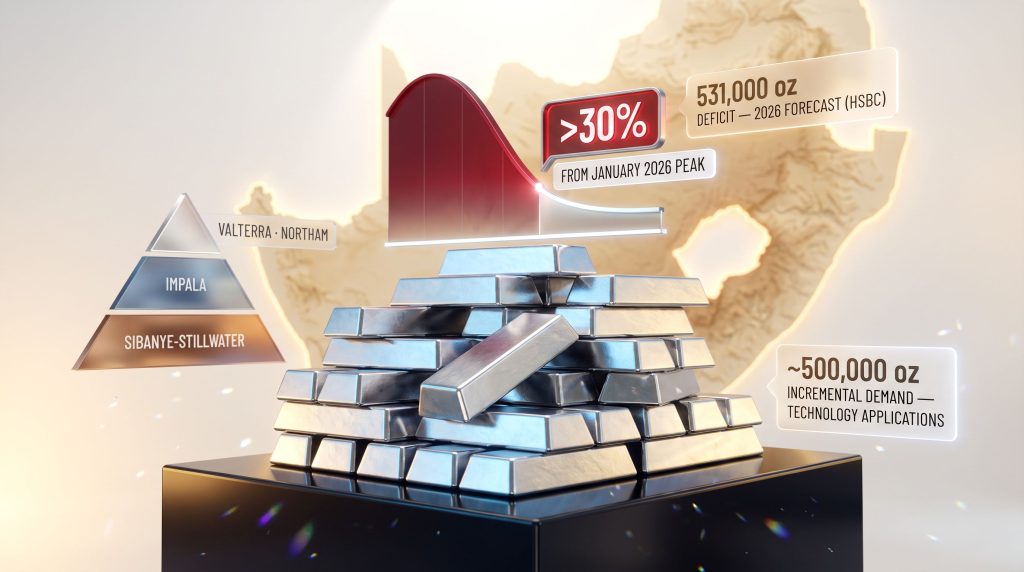
The PGM basket price, which represents the blended revenue per ounce that producers earn across platinum, palladium, and rhodium in proportions specific to each operation, has fallen by more than 30% from its January 2026 peak. That is a severe compression by any historical measure, and its causes are layered rather than singular.
Geopolitical instability in the Middle East elevated inflation expectations across major economies. Higher anticipated inflation has, counterintuitively, weighed on non-yielding commodity positions by raising the probability of interest rate increases. Institutional investors responded by rotating away from metals that generate no yield, and the effect was immediate and measurable.
The data tells a clear story:
- Platinum ETF holdings contracted by approximately 574,000 ounces from their January 2026 peak
- Nymex-tracked platinum holdings declined by roughly 288,000 oz over the same period
- This unwinding was not driven by deteriorating fundamentals but by macro-linked repositioning
Compounding the institutional outflow, original equipment manufacturers (OEMs) began revising production and procurement schedules in response to higher energy input costs and the prospect of elevated borrowing costs. This created a secondary wave of selling pressure on PGM equities, as investors questioned whether automotive demand, historically the largest single source of platinum group metals consumption through catalytic converter applications, was facing a temporary pause or a more structural deterioration.
RMB Morgan Stanley analysts Brian Morgan and Christopher Nicholson have indicated that OEM metal buying risk remains skewed to the downside in the near term, with further price weakness expected across the three primary PGMs through the second half of 2026. Furthermore, understanding the broader platinum and palladium market dynamics is essential context for interpreting just how significant these institutional shifts have been.
Equity Valuations Have Fallen Further Than the Fundamentals Warrant
A critical insight emerging from multiple analyst teams is that share price declines have been disproportionately large relative to the actual erosion in business fundamentals. UBS analyst Steve Friedman has noted in recent research that the weakness in platinum equity valuations has been more pronounced than the deterioration in underlying business performance, creating increasingly differentiated opportunities across the sector.
This divergence is central to the investment thesis. Consider the structural data points that the market appears to be discounting:
| Metric | Data Point |
|---|---|
| PGM basket decline from January 2026 peak | Greater than 30% |
| Platinum ETF outflows from peak | Approximately 574,000 oz |
| Nymex holdings decline | Approximately 288,000 oz |
| HSBC 2026 platinum supply/demand deficit forecast | 531,000 oz |
| Ruthenium deficit as percentage of total demand | Approximately 14% |
| Incremental PGM demand from technology sector (past 2 years) | Approximately 500,000 oz |
Nedbank Securities analyst Arnold van Graan has argued that the market has already absorbed a deeply pessimistic scenario into current equity prices. His position is that a stabilisation in the PGM basket, without requiring any bullish catalyst or price surge, could be sufficient to trigger a rapid re-rating of platinum equities. The market, in his assessment, is currently pricing in outcomes that are considerably worse than the evidence supports.
In addition, investors seeking undervalued mining stocks in adjacent commodities are finding that the same valuation disconnects visible in gold equities are now equally apparent across the PGM sector.
Tiered Resilience: Not All Platinum Stocks Are Equally Exposed
One of the most useful frameworks for navigating platinum stocks after the PGM selloff is a tiered resilience model that distinguishes producers by their cost position, balance sheet strength, and sensitivity to further price weakness. Treating the sector as homogeneous misses the highly differentiated risk-reward profiles that currently exist.
Tier 1: Quality Balance Sheets and Lower-Cost Operations
Valterra Platinum and Northam Platinum represent the highest-quality positions within the sector by analyst consensus. Both companies demonstrate the balance sheet depth and cost discipline needed to absorb additional price pressure without reaching cash-neutral territory.
- Basket prices would need to fall a further 20 to 25% from current levels before either company reaches cash neutrality, excluding working capital movements
- Northam recently achieved a new PGM output record alongside surging chrome production, demonstrating operational momentum even in a soft price environment
- Valterra's management has highlighted that new metal supply agreements are being signed at a high level of contractedness, with robust ongoing demand from automotive, industrial, and jewellery customers
Van Graan has reiterated an overweight sector stance with a clear quality bias toward Valterra and Northam, citing their balance sheet strength and lower-cost positioning as the primary justifications.
Tier 2: Higher Operational Leverage, Greater Recovery Sensitivity
Impala Platinum currently trades at approximately a 40% discount to Valterra and Northam on certain valuation metrics. RMB Morgan Stanley analysts have suggested the market may be overestimating Impala's operating leverage, creating a potential mispricing that could correct sharply if basket prices stabilise.
A recovery in PGM prices would likely produce a sharper equity response for Impala than for the Tier 1 names, given its higher operational leverage. UBS's Friedman recommends stock-selective exposure rather than broad sector positioning, specifically noting the differentiated opportunity that Impala represents relative to current pricing. For those researching the sector further, ASX platinum stocks offer a useful comparative lens on how different markets are pricing similar operational risks.
Tier 3: Most Sensitive to Continued Weakness
Sibanye-Stillwater carries the highest sensitivity to further price deterioration across the major producers. An aggregate decline of just 13% across gold, PGM, and lithium prices would push the company back to breakeven territory. This makes it the highest-risk, highest-reward position in the sector.
Van Graan has noted that a recovery in PGM prices would create a more compelling opportunity in Sibanye, Impala, and Tharisa, where higher operational leverage could drive a sharper equity response. Tharisa has also indicated that it sees price support despite recent chrome weakness, suggesting some resilience in its broader commodity mix.
The Supply Side: Why Production Isn't Coming to the Rescue
A dimension of the PGM story that receives insufficient attention in bearish market narratives is the structural inflexibility of supply. South African deep-level PGM mining cannot respond rapidly to price signals. The geology is complex, the capital intensity is extreme, and mine development cycles span years rather than months.
Northam's operations, described in recent industry coverage as a mine without end given the extraordinary depth and longevity of its resource base, exemplify the long-duration nature of PGM supply infrastructure. This structural inflexibility means that even as prices compress, production does not fall away quickly, and crucially, new supply cannot be brought online rapidly to meet demand recovery.
HSBC analyst James Steel forecasts that platinum will remain in a supply/demand deficit of 531,000 oz in 2026, and that palladium deficits will widen modestly through 2026 and into 2027. Even with the ongoing structural transition away from internal combustion engine vehicles, RMB Morgan Stanley analysts place platinum and rhodium in deficit for much of the remainder of the decade.
The slower-than-anticipated adoption of fully electric vehicles across key markets extends the autocatalyst demand runway significantly. Hybrid vehicles, which still require PGM-based catalytic converters, represent an underappreciated demand bridge that many bearish forecasts fail to adequately model. Moreover, PGM supply constraints rooted in South African geology are unlikely to ease regardless of near-term price signals.
The Technology Demand Vector Most Investors Haven't Priced In
Beyond autocatalysts, an emerging demand story is reshaping the medium-term investment case for PGMs in ways that traditional frameworks are not yet fully capturing.
Iridium and ruthenium, produced as minor by-products of primary PGM mining operations, are experiencing accelerating demand from data infrastructure, AI hardware rollout, optical networking, and semiconductor fabrication. These are not trace demand sources. The World Platinum Investment Council estimates that approximately 500,000 oz of incremental PGM demand was generated over just the past two years from data storage, optical networks, and semiconductor manufacturing processes alone.
BMO Capital Markets analysts George Heppel and Helen Amos have identified technology sector demand as the next major frontier for PGM producers, noting that as green hydrogen applications have failed to materialise at the pace once anticipated, the sector is pivoting its demand narrative toward technology-driven consumption. This aligns closely with the broader critical minerals demand story unfolding across the energy transition, where niche metals are gaining strategic importance well beyond their traditional applications.
The supply picture for minor metals amplifies this demand story:
| Metal | Primary Technology Application | 2026 Supply/Demand Outlook |
|---|---|---|
| Platinum | Semiconductors, fuel cells, autocatalysts | Deficit of 531,000 oz forecast |
| Palladium | Electronics, hydrogen sensors, autocatalysts | Deficits widening modestly |
| Iridium | Data storage, optical networks, AI hardware | Deficit expected to increase year-on-year |
| Ruthenium | Semiconductor fabrication, data infrastructure | Deficit remains at approximately 14% of demand |
Investec analyst Nkateko Mathonsi has noted that the iridium deficit is expected to increase on a year-on-year basis in 2026, while the ruthenium deficit, though narrowing slightly, remains substantial at roughly 14% of total demand. Because iridium and ruthenium are produced in relatively small quantities as by-products of primary PGM mining, supply cannot be meaningfully increased without also increasing primary production, creating a structural tightness that is independent of platinum or palladium price dynamics.
The next major ASX story will hit our subscribers first
What Would Trigger a Re-Rating of Platinum Equities?
The conditions for a valuation recovery do not require an optimistic scenario. Multiple analyst teams converge on a similar conclusion: stabilisation is sufficient.
The three key catalysts worth monitoring are:
- Basket price stabilisation, which removes the primary driver of institutional outflows and allows equity valuations to close the gap with underlying fundamentals
- OEM demand confirmation, specifically evidence that automotive procurement is not deteriorating further beyond current revised schedules
- Sentiment normalisation, as speculative positions built around the debasement trade narrative have already been largely unwound, the remaining investor base is arguably of higher quality and more fundamentally anchored
The clearing of debasement-linked speculative positioning from platinum markets may paradoxically strengthen the price floor, as the remaining holders are less likely to exit on macro noise alone.
Scenario Framework for Platinum Equity Recovery
| Scenario | Basket Price Direction | Likely Equity Outcome |
|---|---|---|
| Bull Case | Stabilisation plus modest recovery | Rapid sector re-rating; high-leverage names outperform sharply |
| Base Case | Sideways movement with ongoing volatility | Quality names preserve value; discounted names partially recover |
| Bear Case | Additional 13 to 25% decline | Tier 3 names approach breakeven; Tier 1 names remain cash generative |
Investment Psychology and the "Priced for Despair" Moment
There is a specific psychological dynamic at work in heavily sold-off commodity sectors that experienced investors recognise. When an entire sector enters what analysts describe as seeing too many ghosts, the bearish consensus becomes self-reinforcing until a catalyst interrupts the narrative. At that point, re-rating can be rapid and disproportionate to the actual improvement in conditions.
This is precisely the environment that multiple investment bank research teams are describing across PGM equities in mid-2026. The near-term outlook carries genuine uncertainty around geopolitical developments, OEM procurement decisions, and interest rate trajectories. However, the structural case for PGMs, anchored in constrained South African supply, persistent supply/demand deficits, and growing technology-sector demand, remains intact.
For investors with a medium-to-long-term horizon, the current environment offers a meaningfully different entry point than existed at the January 2026 peak. Understanding how commodity prices and miners interact during periods of compression is essential to appreciating why platinum stocks after the PGM selloff may represent a rare valuation opportunity. The fundamental thesis has not broken. It has reset.
Furthermore, for those seeking a broader view of how global platinum producers are being evaluated in this environment, platinum group metal stocks from international producers provide a useful reference point for comparative valuation analysis.
Disclaimer: This article is intended for informational purposes only and does not constitute financial or investment advice. All forecasts, analyst views, and price projections referenced reflect the stated opinions of named third-party research institutions and are subject to change. Commodity markets carry significant risk, and past performance is not indicative of future results. Investors should conduct their own due diligence and consult a licensed financial adviser before making investment decisions.
Ready to Identify the Next Major Mineral Discovery Before the Broader Market?
Discovery Alert's proprietary Discovery IQ model delivers real-time alerts on significant ASX mineral discoveries, transforming complex commodity data into actionable investment insights for both short-term traders and long-term investors — explore historic examples of exceptional discovery returns to understand the scale of opportunity, then begin your 14-day free trial at Discovery Alert to position yourself ahead of the market.