June 28, 2026
When Climate Policy Punishes the Greenest Option
Industrial decarbonisation rarely follows a straight line. Across Europe, policymakers have spent years constructing regulatory frameworks designed to incentivise cleaner production, reward efficiency, and accelerate the transition away from carbon-intensive manufacturing. Yet within the aluminium sector, an uncomfortable paradox is emerging: the very process that produces metal at a fraction of the carbon footprint of conventional smelting is now facing a growing compliance burden under the EU's flagship carbon pricing mechanism.
The EU ETS impact on aluminium recycling in Europe has become a critical policy concern, as the upcoming 2026-2030 compliance phase exposes the sector's most efficient operators to escalating costs with limited ability to adapt or respond. Understanding why requires a closer look at how the ETS actually works in practice, and where its design assumptions diverge from industrial reality.
When big ASX news breaks, our subscribers know first
The Benchmark Gap: Why Recyclers Are Being Measured by the Wrong Standard
At the heart of the EU ETS is a system of product benchmarks. These values determine how many free carbon allowances each industrial installation receives annually. The logic is straightforward: installations that emit less than the benchmark receive sufficient free allowances, while those that emit more must purchase the shortfall on the open market.
For the system to function fairly, benchmark values must reflect the actual emissions profile of each industrial process. This is where the ETS framework has a critical structural gap when it comes to aluminium recycling.
Secondary aluminium production, which involves melting down recovered scrap to produce new metal, does not have a dedicated product benchmark under the current ETS design. Instead, recyclers are assigned to fallback benchmark calculations, which are generic calculations derived from heat and fuel consumption rather than process-specific emissions data.
As Commerzbank analyst Norman Liebke has noted, no specific product benchmark values are set for aluminium recycling or alumina refining, meaning the fallback approach becomes the default. This matters enormously because fallback benchmarks were not designed with the specific characteristics of recycling operations in mind.
The practical consequence: recyclers are allocated fewer free allowances than their actual emissions performance would warrant under a properly calibrated system, forcing them to purchase additional allowances from the carbon market at considerable cost.
The 34% Reduction: A Structural Shock to Recycler Economics
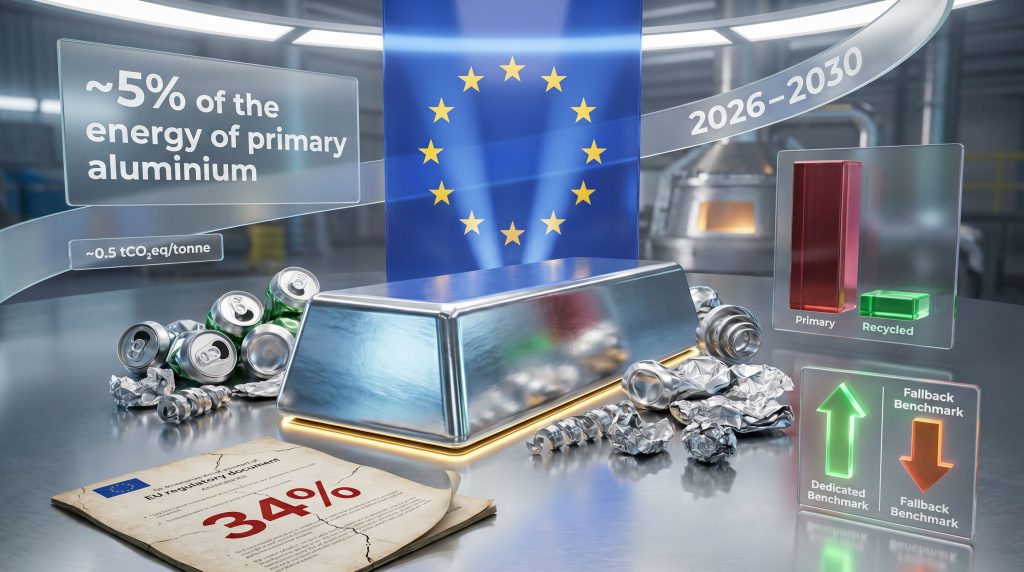
The problem is being significantly compounded in the next ETS compliance phase. Fallback benchmark values are projected to decline by approximately 34% during the 2026-2030 period compared to the 2021-2025 cycle, according to analyst assessments cited by AL Circle. This reduction is not a marginal adjustment. For an industry already operating on narrow margins, it represents a structural cost shock.
| Factor | Dedicated Benchmark | Fallback Benchmark |
|---|---|---|
| Allocation accuracy | Proportional to actual process emissions | Generalised, not process-specific |
| Free allowance volume | Higher, reflecting real efficiency | Lower, penalises efficient operators |
| Carbon leakage exposure | Reduced | Elevated |
| Investment signal | Supports recycling capacity | Discourages new recycling capex |
As the table illustrates, the absence of a dedicated benchmark does not merely affect accounting: it actively distorts the investment signal facing recyclers at precisely the moment when Europe needs to be scaling up circular materials capacity.
Liebke has warned that profitability in the recycling segment could be massively impacted under the revised framework, raising concerns that higher carbon-related compliance costs may deter investment in recycling operations across the continent. With aluminium prices determined by international commodity markets rather than regional cost structures, European producers face a fundamental constraint: they cannot pass elevated compliance costs through to customers without losing business to lower-cost competitors.
The Biomass Assumption: A Technical Incompatibility at the Core of ETS Design
The structural unfairness of the fallback benchmark reduction deepens when examined against its underlying design logic. The 34% tightening is calibrated against a decarbonisation pathway that assumes industrial installations can substitute fossil fuels with biomass. This assumption is reasonable for many sectors, including certain heat-intensive processes in food production, paper manufacturing, and chemical refining.
For aluminium scrap remelting, it is not feasible.
The process temperatures required for aluminium recycling operations are incompatible with biomass fuel sources. The ETS benchmark reduction is therefore measuring recyclers against a standard they are physically unable to achieve, creating a compliance burden that reflects a policy design assumption rather than genuine operational inefficiency.
This technical incompatibility is not a minor footnote. It means that recyclers, who already emit a fraction of the carbon produced by primary aluminium smelters, are being penalised against a decarbonisation lever that does not apply to their operations. No amount of process optimisation or capital investment will resolve this mismatch because the constraint is physical, not operational.
Carbon Leakage: The Unintended Environmental Consequence
Regulatory overreach in carbon pricing does not simply raise costs for affected industries. When compliance burdens become economically irrational, production migrates. In the ETS context, this phenomenon is known as carbon leakage: the relocation of industrial activity from regulated regions to jurisdictions with weaker environmental standards, resulting in no net global emissions reduction.
For European aluminium recyclers, the carbon leakage risk is not hypothetical. If operating under the revised ETS framework makes European recycling capacity economically unviable, the global emissions outcome could be worse than if no ETS tightening had occurred at all. The environmental rationale for the reform collapses if the practical effect is simply to offshore carbon-intensive production rather than eliminate it.
The Environmental and Economic Case for Secondary Aluminium
The irony of the current regulatory trajectory becomes starker when the environmental performance of aluminium recycling is examined against primary production. Furthermore, the decarbonisation benefits of scaling secondary production are well-documented, yet current policy design actively works against them.
Recycled aluminium production requires only approximately 5% of the energy consumed in primary aluminium smelting from bauxite ore. On a lifecycle emissions basis, secondary production generates roughly 0.5 tonnes of CO₂ equivalent per tonne of metal produced on a gate-to-gate basis, compared to primary production figures that remain substantially higher in most configurations.
| Metric | Primary Aluminium | Recycled Aluminium |
|---|---|---|
| Relative energy consumption | 100% | ~5% |
| Approximate CO₂ emissions | High (grid-dependent) | ~0.5 tCO₂eq/tonne |
| Dependence on imported inputs | High | Low (domestic scrap) |
| Circular economy alignment | Low | High |
| Domestic supply chain resilience | Weak | Strong |
The scale of the opportunity is equally significant. Industry analysis suggests that expanding aluminium recycling across the EU could reduce sectoral CO₂ emissions by up to 39 million tonnes per year by 2050, representing a potential 46% reduction in sectoral emissions. This would be achieved primarily by substituting carbon-intensive primary aluminium imports with domestically recovered post-consumer scrap.
Beyond the environmental benefits, the economic contribution is material. Aluminium recycling already accounts for approximately 36% of total aluminium metal supply across Europe, and scaling this share could generate annual economic value of up to €6 billion for the European economy while simultaneously reducing import dependence.
Three Overlapping Pressures Compressing Recycler Margins
The EU ETS impact on aluminium recycling in Europe does not exist in isolation. European aluminium recyclers are simultaneously navigating two additional regulatory and market pressures that compound the compliance cost burden into a genuinely threatening combination.
Pressure 1: ETS Fallback Benchmark Deterioration
The 34% reduction in fallback benchmark values during 2026-2030 directly reduces the volume of free allowances allocated to recyclers. The shortfall must be covered through open-market carbon purchases, structurally increasing the cost base for every tonne of recycled metal produced regardless of how efficiently the operation runs.
Pressure 2: CBAM's Compounding Exposure
The Carbon Border Adjustment Mechanism introduces a second layer of complexity. Free allowance allocations for installations producing goods covered by CBAM face reductions of approximately 48.5%. For secondary aluminium producers who already lack a dedicated ETS benchmark, this creates a compounding cost disadvantage that further erodes competitiveness. The combined effect of ETS tightening and CBAM-related allocation reductions creates a regulatory cost stack with no equivalent in most other industrial sectors.
Pressure 3: Structural Input Cost Inflation
European recyclers already contend with elevated scrap procurement costs, a consequence of growing global competition for post-consumer aluminium feedstock. Consequently, persistently high regional energy prices driven by the structural transformation of European energy markets add further strain. European Aluminium has described this as a triple squeeze capable of deterring new recycling investment across the continent, directly contradicting the EU's circular economy and industrial resilience objectives.
Where EU Policy Contradicts Itself
The tension between ETS reform and recycling sector viability is particularly difficult to reconcile given the breadth of European policy frameworks that explicitly prioritise secondary aluminium production as a strategic and environmental asset.
| EU Policy Framework | Stated Objective | ETS Reform Impact |
|---|---|---|
| Circular Economy Action Plan | Maximise recycling rates | Discourages recycling investment |
| Clean Industrial Deal | Low-carbon competitive manufacturing | Increases recycler cost burden |
| Critical Raw Materials Act | Domestic supply chain resilience | Weakens secondary supply chain |
| Steel and Metals Action Plan | Strategic metals self-sufficiency | Erodes recycler margins |
| EU Taxonomy | Reward low-carbon processes | Penalises lowest-carbon pathway |
The contradiction embedded in this table is not a matter of interpretation. The EU's Circular Economy Action Plan explicitly positions recycling as a cornerstone of sustainable industrial strategy. In addition, the critical raw materials framework identifies aluminium as requiring domestic supply chain security. The Clean Industrial Deal targets competitive, low-carbon European manufacturing as a strategic imperative.
Each of these frameworks implicitly depends on a healthy, investment-ready aluminium recycling sector. Yet the ETS reform trajectory, as currently structured, undermines the economic conditions required to maintain and expand that sector.
A Structural Context That Makes the Stakes Higher
Europe's strategic vulnerability in aluminium is already pronounced. The continent has lost approximately 36% of its primary aluminium smelting capacity since 2008, with the supply gap filled almost entirely by imports, predominantly from China. In this context, secondary production is the primary remaining lever for maintaining any degree of domestic aluminium supply chain sovereignty.
The broader aluminium supply chain across Europe is under increasing pressure, and weakening the recycling sector through regulatory miscalibration would increase both import dependence and overall sectoral emissions, producing the worst possible outcome across industrial, environmental, and strategic dimensions simultaneously.
The next major ASX story will hit our subscribers first
What a Corrected Policy Framework Would Look Like
The path to resolving this misalignment does not require abandoning the ETS framework. It requires calibrating it accurately against industrial reality. A structurally sound reform approach for aluminium recycling would include the following components:
-
Introduce a dedicated ETS product benchmark for aluminium recycling, constructed from actual measured emissions data for secondary production processes rather than generalised fallback calculations.
-
Strengthen carbon leakage protections for secondary aluminium producers, formally recognising their technical inability to adopt biomass-based decarbonisation pathways as a factor in benchmark design.
-
Develop positive incentive instruments within the ETS that actively reward demonstrably low-carbon recycling activity, rather than subjecting it to the same compliance logic as higher-emission processes.
-
Defer indirect emissions inclusion under CBAM for secondary aluminium until the EU electricity grid achieves near-complete decarbonisation, projected post-2035, to avoid penalising low-carbon production with costs tied to grid carbon intensity rather than process emissions.
The investment signal implications of getting this right are substantial. Without policy correction, the financial logic facing European recyclers points toward capacity preservation at best and contraction at worst. Higher compliance costs, combined with CBAM exposure and structural input inflation, reduce the return on investment for new recycling infrastructure below commercially viable thresholds.
Frequently Asked Questions: EU ETS and Aluminium Recycling
What is the EU ETS and how does it affect aluminium recyclers?
The EU Emissions Trading System requires industrial operators to hold allowances covering every tonne of CO₂ they emit. For aluminium recyclers, the critical issue is that they depend on fallback benchmark calculations rather than a dedicated recycling-specific benchmark to determine their free allowance allocation. As these fallback values are tightened, recyclers must purchase more allowances from the open market, directly increasing production costs.
Why is the 34% benchmark reduction particularly damaging for secondary aluminium?
The reduction is calibrated against a decarbonisation pathway involving biomass substitution, which is technically incompatible with aluminium scrap remelting processes. Recyclers are effectively being measured against a standard they cannot achieve, resulting in disproportionate compliance costs relative to their genuine emissions performance.
How does CBAM interact with ETS for aluminium recyclers?
The Carbon Border Adjustment Mechanism reduces free allowance allocations for installations producing CBAM-covered goods by approximately 48.5%. For secondary aluminium producers who already lack a dedicated ETS benchmark, this creates a compounding cost disadvantage that further erodes competitiveness against third-country producers not subject to equivalent regulatory requirements.
What is carbon leakage and why does it matter here?
Carbon leakage occurs when industrial production relocates from regulated regions to jurisdictions with weaker emissions controls, resulting in no net global emissions reduction. For European aluminium recyclers, unrealistic ETS benchmarks increase the risk that recycling investment migrates outside the EU, potentially increasing global emissions while hollowing out European industrial capacity.
How much CO₂ could aluminium recycling save in the EU by 2050?
Industry analysis indicates that scaling up aluminium recycling across Europe could reduce sectoral CO₂ emissions by up to 39 million tonnes per year by 2050, representing a 46% reduction, primarily achieved through substituting carbon-intensive primary aluminium imports with domestically recovered post-consumer scrap.
A Correction Europe Cannot Afford to Delay
The EU ETS impact on aluminium recycling in Europe places the continent in the unusual position of penalising its most carbon-efficient industrial process through a framework theoretically constructed to reward exactly that performance. Secondary aluminium production, operating at roughly 5% of primary production's energy intensity and generating a fraction of its emissions, should be the intended beneficiary of an ambitious climate pricing mechanism, not its casualty.
A dedicated recycling benchmark is not a request for preferential treatment or a subsidy by another name. It is a structural correction that would align regulatory design with measurable environmental reality. The data supporting such a benchmark already exists. What is currently missing is the regulatory willingness to apply it.
Furthermore, European supply chains for critical materials depend increasingly on the health of secondary production as primary smelting capacity continues its long-term structural decline. The consequences of failing to correct ETS benchmark design extend beyond the aluminium industry itself: they touch on industrial competitiveness, climate performance, strategic materials security, and the credibility of a policy framework that cannot afford to undermine the transition it was designed to accelerate.
Achieving cleaner industrial production at scale ultimately requires policy frameworks that reward the processes already delivering the lowest emissions, rather than subjecting them to the same blunt regulatory logic applied to far more carbon-intensive operations.
This article contains references to forecasts, industry projections, and analyst assessments. These represent forward-looking perspectives and are subject to change based on regulatory developments, market conditions, and policy outcomes. Nothing in this article constitutes financial, investment, or regulatory advice.
Want to Track the ASX Companies Shaping the Future of Critical Minerals?
As Europe's industrial policy debates intensify around aluminium, energy, and circular supply chains, the demand signals for critical materials continue to reshape global markets — and Discovery Alert's proprietary Discovery IQ model instantly identifies significant ASX mineral discoveries as they happen, turning complex data across 30-plus commodities into clear, actionable insights. Explore why major mineral discoveries have historically delivered substantial returns on Discovery Alert's dedicated discoveries page, and begin your 14-day free trial today to position yourself ahead of the market.