
August 24, 2026
The Architecture of a Resource Boom: What Mozambique's FDI Surge Really Tells Us
When a single sector accounts for more than nine in every ten dollars of foreign capital flowing into a developing economy, it raises questions that go far beyond headline investment figures. The mechanics of how natural gas transforms from an offshore geological formation into a multi-billion-dollar annual revenue stream involve decades of capital accumulation, geopolitical alignment, security calculus, and market timing. Mozambique's position in 2025 reflects all of these forces converging simultaneously, producing one of the most concentrated Mozambique LNG FDI inflow profiles recorded in sub-Saharan Africa during the current energy cycle.
Understanding why this matters requires stepping back from the raw numbers and examining the structural conditions that make this particular investment story both compelling and inherently fragile.
When big ASX news breaks, our subscribers know first
From $3.5 Billion to $5.6 Billion: Unpacking the Acceleration
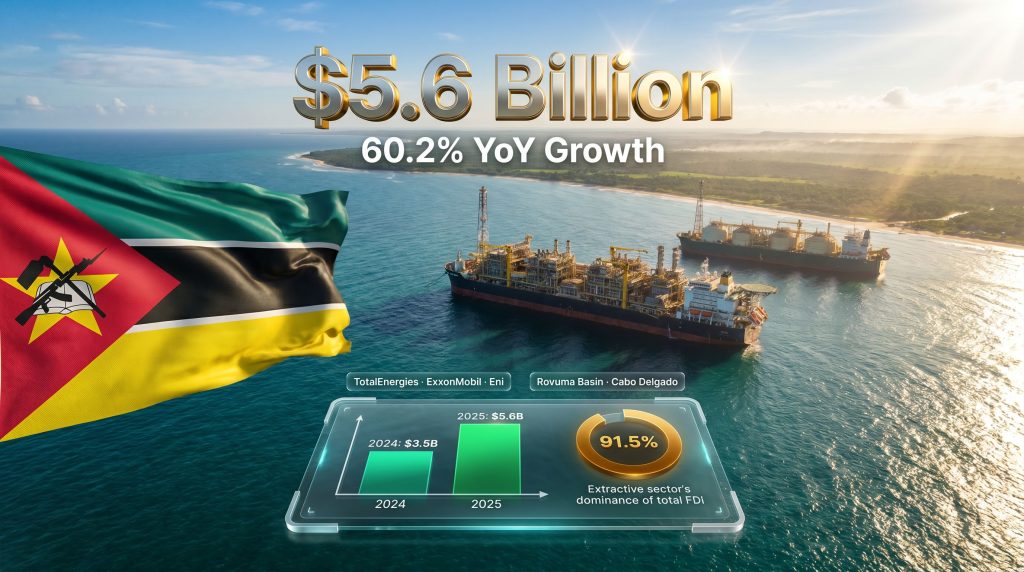
Foreign direct investment into Mozambique reached $5.6 billion in 2025, representing a 60.2% year-on-year increase from $3.5 billion recorded in 2024, according to data published by the Bank of Mozambique. The scale of this acceleration stands out within the African energy investment landscape, where most FDI growth stories unfold over multi-year cycles rather than within a single calendar year.
The extractive industry was the overwhelmingly dominant recipient, absorbing $5.2 billion, which equates to 91.5% of all FDI inflows recorded during the year. Within that figure, extractive sector investment itself grew 68.2% year-on-year, outpacing the already-strong headline growth rate. Oil and gas projects alone captured approximately $3.6 billion during the January through September 2025 window, suggesting full-year hydrocarbon FDI likely exceeded $4.5 billion when the final quarter is included.
The remaining capital was distributed across sectors that tell a different story entirely:
- Manufacturing: $121 million, down 10.4% year-on-year, reflecting the structural difficulty of attracting non-resource industrial investment
- Real estate: $66 million, up 17.9% year-on-year, likely tied to upstream workforce accommodation and project logistics infrastructure
- Other sectors: approximately $361 million collectively, representing roughly 6.5% of total inflows
The extreme concentration of capital in a single extractive sector is not inherently problematic during a construction and development phase, but it does create a binary risk profile: if major project timelines slip, the entire FDI story slips with them.
Furthermore, when considered alongside the broader picture of Australia's resource energy exports and the role of oil in the global economy, Mozambique's concentrated extractive FDI profile is part of a wider structural pattern reshaping how emerging economies integrate into global energy supply chains.
The Rovuma Basin: Geology as Investment Thesis
The physical foundation underpinning this Mozambique LNG FDI inflow story lies beneath the floor of the Indian Ocean. The Rovuma Basin, straddling northern Mozambique's Cabo Delgado province and extending into Tanzanian offshore territory, contains recoverable natural gas reserves estimated between 65 and 100 trillion cubic feet, placing it among the largest offshore discoveries made globally during the past three decades.
For context, this positions the basin on a comparable geological tier to established LNG export powerhouses including Qatar's North Field and several major Australian offshore projects. The global LNG supply environment has, consequently, become increasingly attentive to the Rovuma Basin's development trajectory.
What makes the Rovuma Basin commercially distinctive is not reserve size alone, but rather the combination of:
- Reservoir quality: High-permeability sandstone formations enabling strong well productivity
- Water depth: Predominantly deep-water conditions suited to floating LNG (FLNG) technology, reducing the need for large-scale onshore processing facilities
- Geographic proximity: Direct Indian Ocean access positions Mozambique within competitive shipping distances to both European and Asian import terminals
- Concentration: Multiple large gas accumulations in relatively close proximity, enabling shared infrastructure and economies of scale across projects
The Four Projects Defining Mozambique's LNG Trajectory
The following table summarises the major LNG developments anchoring the country's investment profile:
| Project | Operator | Estimated Capital Value | Current Status | Nameplate Capacity |
|---|---|---|---|---|
| Afungi LNG Complex | TotalEnergies | $20 billion+ | Post-FID, awaiting construction restart | 13 MTPA (expandable to 43 MTPA) |
| Rovuma LNG | ExxonMobil | ~$30 billion | Awaiting Final Investment Decision | TBC |
| Coral South FLNG | Eni | Operational | Active since 2022 | ~7 MTPA |
| Coral Norte FLNG | Eni | $7.2 billion | Development phase | Expected 2028 commencement |
Sources: Business Insider Africa (May 2026); project operator disclosures
Eni's Coral South FLNG facility represents the critical proof-of-concept for the entire basin. Having commenced commercial production in 2022 with capacity of approximately 7 million tonnes per annum, it demonstrated that Rovuma Basin gas could be successfully extracted, processed, and exported at commercial scale. This operational track record has materially de-risked the investment thesis for subsequent projects.
The combined estimated value of TotalEnergies and ExxonMobil's pending projects approaches $50 billion, making these two developments alone among the largest single-country energy infrastructure commitments anywhere in Africa. Both projects remain in pre-production phases, navigating financing structures and security condition assessments before construction can formally resume or commence.
Who Is Deploying Capital and Through What Channels
The geographic origin of FDI flows reveals as much about corporate structures as it does about national investment interests. The breakdown for 2025 shows a highly concentrated source profile:
| Country of Origin | Share of Total FDI |
|---|---|
| Netherlands | 41% |
| Italy | 22% |
| Mauritius | 17% |
| South Africa | 14% |
| Other | 6% |
The Netherlands' dominant 41% share is a function of European holding company architecture rather than direct Dutch capital deployment. Both TotalEnergies and Eni route significant portions of their African upstream operations through Dutch-registered special purpose vehicles, which is standard practice within the European energy sector for tax efficiency and capital structuring purposes.
Italy's 22% share maps directly onto Eni's operational activity, spanning both the producing Coral South facility and ongoing Coral Norte development expenditure. Mauritius functions as a regional financial hub for African investment vehicles, and its 17% contribution reflects the routing of various project financing instruments through Mauritius-domiciled entities. South Africa's 14% participation represents regional infrastructure, logistics, construction services, and supply chain investment linked to LNG facility development.
The Global LNG Demand Cycle and Its Intersection With Mozambique
The timing of Mozambique's FDI acceleration is not coincidental. It reflects the convergence of several structural shifts in global gas markets that have elevated the commercial urgency of bringing new LNG supply to market. In addition, shifting natural gas price trends have further sharpened investor focus on locking in long-term offtake agreements before spot market volatility erodes project economics.
Post-2022 European energy reorientation has fundamentally altered the demand landscape. European nations actively building diversification away from pipeline gas dependency have created durable, long-term demand for Atlantic and Indian Ocean basin LNG supply. Long-term offtake contracts, rather than spot market exposure, provide the revenue certainty that multi-decade LNG infrastructure projects require before lenders will commit capital.
Asian demand growth adds a second structural pillar. Japan, South Korea, India, and several Southeast Asian emerging importers have been expanding their LNG import infrastructure and extending their long-term purchase agreements. Mozambique's Indian Ocean location positions it favourably for Asian supply routes, with voyage times to key Asian import terminals comparable to Australian project shipping distances.
When considered against competing African LNG projects, Mozambique maintains a meaningful first-mover advantage over Tanzania, where comparable Rovuma Basin reserves on the Tanzanian side of the maritime boundary remain largely stranded by unresolved development frameworks. Nigeria, as an established LNG exporter, faces domestic gas demand competition and aging infrastructure constraints that limit meaningful capacity expansion.
Risk Architecture: The Variables That Could Disrupt the FDI Story
No analysis of Mozambique's investment trajectory is complete without a structured assessment of the risks that have previously frozen capital and could do so again.
Security Conditions in Cabo Delgado
The 2017–2021 insurgency in Cabo Delgado province, concentrated in the Mocimboa da Praia area proximate to LNG infrastructure, forced TotalEnergies to declare force majeure on the Afungi LNG complex in April 2021, halting construction and triggering years of project delay. Regional stabilisation efforts involving Rwandan military forces and Southern African Development Community (SADC) deployments have progressively restored operational conditions across large portions of the province.
However, residual security risk remains a central variable in ExxonMobil's FID calculus. The $30 billion Rovuma LNG commitment cannot be made until lenders, insurers, and the operator itself are satisfied that workforce and infrastructure security can be maintained over a multi-decade project life. This single variable may be the most consequential determinant of whether Mozambique's FDI trajectory continues its upward path or plateaus.
Structural Vulnerabilities and Sovereign Risk
Three additional structural risk factors warrant investor attention, particularly given the evolving geopolitical risk landscape affecting resource-dependent emerging markets globally:
- Revenue concentration risk: An economy where more than 91% of FDI flows into a single sector is simultaneously positioned for significant upside and meaningful vulnerability to project delays, commodity price cycles, or operator decisions
- Historical debt management challenges: Mozambique's so-called "tuna bonds" scandal of the mid-2010s, involving undisclosed state-guaranteed debt, created lasting reputational friction with multilateral lending institutions and continues to influence financing terms available to the sovereign
- Infrastructure deficit in northern Mozambique: The Cabo Delgado region lacks the port capacity, road networks, power infrastructure, and skilled workforce base needed to support full-scale LNG construction without substantial parallel capital investment in enabling infrastructure
Energy Transition Pressures
A longer-horizon risk involves the narrowing window of global fossil fuel investment appetite. Development finance institutions have progressively tightened their criteria for fossil fuel project financing, and long-term LNG demand projections begin to show divergence after 2030 depending on the speed of global decarbonisation. Mozambique must monetise its gas endowment within a commercially optimal window before structural demand erosion becomes a material pricing factor.
Mozambique faces a classic resource monetisation dilemma: the geology is exceptional, the market opportunity is real, but the timeline for converting reserves into sustained revenue is constrained by factors that exist far outside the country's control.
The next major ASX story will hit our subscribers first
Economic Multipliers Beyond the FDI Headline
The developmental significance of Mozambique's LNG investment cycle extends meaningfully beyond raw capital inflow numbers. Several mechanisms translate project investment into broader economic activity:
- Direct employment: Construction phases for large LNG facilities typically employ tens of thousands of workers, with operational phases sustaining several thousand permanent positions
- Local procurement obligations: Development agreements for Mozambique's major LNG projects contain local content requirements that stimulate Cabo Delgado's private sector and create SME supply chain opportunities
- Technical skills transfer: International operators are contractually required to invest in training programmes for Mozambican nationals, building human capital that persists beyond individual project life cycles
- Co-investment in enabling infrastructure: LNG developers funding road upgrades, port improvements, and utility connections create assets with productive value extending well beyond the project fence line
On the fiscal revenue side, Mozambique's National Hydrocarbon Company (ENH) holds equity stakes in the major LNG projects, creating a direct state revenue channel that operates independently of royalty and taxation streams. If both TotalEnergies' Afungi complex and ExxonMobil's Rovuma LNG project eventually reach full operational capacity, annual LNG export revenues could plausibly exceed $10–15 billion at prevailing spot price ranges, representing a transformational fiscal windfall for a country with current GDP of approximately $18 billion.
The Botswana model provides an instructive historical parallel. Botswana's management of diamond revenues through the Debswana partnership structure and subsequent sovereign wealth mechanisms demonstrates how a small, resource-dependent developing economy can translate concentrated extractive FDI into generational fiscal stability when institutional management frameworks are sufficiently robust.
Key Milestones That Will Define the 2026 FDI Outcome
The Bank of Mozambique projects FDI reaching $5.8 to $6.0 billion in 2026, representing continued momentum from the 2025 baseline. This projection is contingent on several decision points that investors and analysts should monitor closely:
- ExxonMobil's FID on Rovuma LNG: A positive final investment decision would represent the largest single capital commitment event in Mozambique's economic history, potentially adding tens of billions in committed capital over the construction phase
- TotalEnergies Afungi construction restart: Security clearance milestones and project financing closing conditions remain the primary gating factors for resuming what would be Africa's largest onshore LNG processing facility
- Eni Coral Norte FLNG engineering progress: As the most advanced near-term capital deployment project with a defined 2028 target commencement, Coral Norte's development expenditure will contribute meaningfully to 2026 FDI figures
- Post-election political stability: Mozambique's domestic political environment following its recent election cycle will influence investor confidence in regulatory framework consistency and contract sanctity
This article contains forward-looking projections based on Bank of Mozambique forecasts and analyst estimates. These figures are subject to change based on project development timelines, commodity price movements, security conditions, and macroeconomic factors. Nothing in this article constitutes investment advice.
Frequently Asked Questions: Mozambique LNG FDI Inflow
What drove Mozambique's FDI surge to $5.6 billion in 2025?
Accelerated capital deployment into Rovuma Basin LNG projects was the primary driver, with TotalEnergies, ExxonMobil, and Eni collectively accounting for the majority of the $5.2 billion that flowed into the extractive sector. Improving security conditions in Cabo Delgado province and structural global LNG demand growth created both commercial urgency and investor confidence necessary for capital commitments to proceed.
Which country contributes the most FDI to Mozambique?
Based on 2025 figures, the Netherlands accounts for approximately 41% of total FDI inflows, reflecting European corporate holding structures used by major LNG operators. Italy follows at 22%, attributable primarily to Eni's capital deployment across both its operational and development-stage projects.
Is Mozambique already exporting LNG commercially?
Yes. Eni's Coral South FLNG facility has been in commercial production since 2022 with capacity of approximately 7 MTPA, representing Mozambique's first active LNG export stream. The larger projects operated by TotalEnergies and ExxonMobil have not yet reached commercial production as of the time of writing.
What FDI level is projected for Mozambique in 2026?
The Bank of Mozambique forecasts FDI reaching approximately $5.8 to $6.0 billion in 2026, driven by continued LNG development expenditure, potential ExxonMobil FID progression, and expanded activity in coal and mineral sands sectors.
What are the key risks to Mozambique's LNG investment outlook?
Residual security instability in Cabo Delgado remains the most immediate risk, followed by global energy transition pressures that could compress long-term LNG demand projections, infrastructure deficits in northern Mozambique, historical sovereign debt challenges affecting multilateral financing access, and the binary nature of FID-dependent capital flows.
Readers seeking ongoing coverage of African energy market developments can explore reporting from Business Insider Africa at africa.businessinsider.com.
Want To Stay Ahead of the Next Major Resource Discovery?
While Mozambique's LNG boom illustrates how transformative large-scale mineral and energy discoveries can be, Discovery Alert's proprietary Discovery IQ model delivers real-time ASX alerts the moment significant discoveries are announced — turning complex resource data into actionable investment insights before the broader market catches on. Explore historic examples of major discovery returns on Discovery Alert's discoveries page and begin your 14-day free trial today to position yourself ahead of the next big find.