May 14, 2026
The Silent Supply Chain Threat That Western Governments Can No Longer Ignore
For decades, the global technology sector operated under a convenient assumption: that the raw materials powering its most sophisticated products would always be available, sourced from somewhere on the planet at acceptable cost. That assumption began unravelling in August 2023, when Chinese export controls imposed restrictions on germanium and gallium, two metalloid elements that underpin everything from military-grade thermal imaging systems to the fibre optic cables carrying global internet traffic. The shock was immediate, and the lesson was stark. Western nations had allowed a dangerous concentration of critical mineral supply to develop, and the consequences were now measurable in disrupted procurement pipelines and elevated spot prices across semiconductor supply chains.
It is against this backdrop that the cooperation agreement between Titan Mining Corporation and Teck Resources, focused on Titan and Teck germanium recovery at Empire State Mines in upstate New York, deserves serious examination. Not merely as a corporate partnership announcement, but as a case study in how the mining industry is beginning to reimagine resource recovery, supply chain resilience, and the strategic value buried within operational waste streams.
When big ASX news breaks, our subscribers know first
What the Titan-Teck Cooperation Agreement Actually Involves
The framework established in May 2026 is fundamentally an evaluation arrangement. Both parties have agreed to assess whether germanium can be commercially extracted from material that already moves through Titan's Empire State Mine processing operation in Gouverneur, New York, without requiring any expansion of the mine's existing footprint or any new drilling activity.
This distinction matters enormously from a capital efficiency standpoint. Traditional critical mineral development follows a well-worn and expensive path: exploration, resource definition, permitting, feasibility studies, infrastructure construction, and eventually production, often spanning a decade or more and consuming hundreds of millions of dollars before a single saleable unit reaches market. The ESM model sidesteps this entire sequence by treating existing waste process streams as the orebody.
Empire State Mine operates as an active zinc concentrate producer, and it is within the processing streams associated with that zinc production that germanium is believed to be present in commercially meaningful concentrations. Germanium's geochemical behaviour means it frequently associates with zinc sulphide mineralisation, substituting into the sphalerite crystal lattice at trace levels. During zinc flotation processing, germanium partitions selectively into certain concentrate and tailing fractions, creating recoverable concentrations in material that would otherwise be classified as operational waste.
The critical insight here is that Empire State Mine does not need to change what it mines. It needs to change what it does with the material it already processes. That subtle shift in operational philosophy is the foundation of the entire partnership.
Quantifying the Recovery Potential and Its Economic Implications
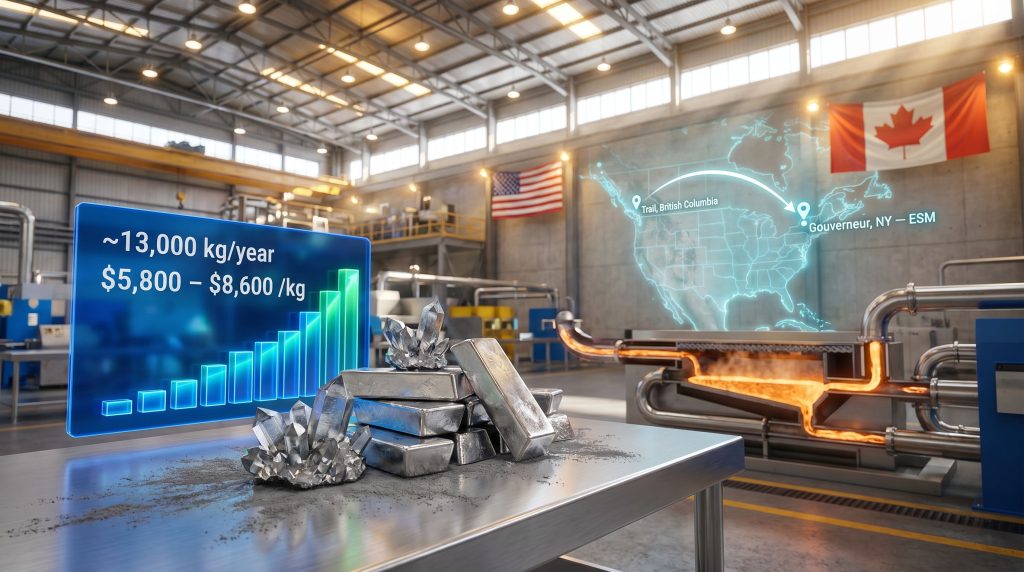
The cooperation agreement has identified existing ESM process streams as potentially containing approximately 13,000 kilograms of germanium per year. At current U.S. warehouse spot pricing, which has been cited in the range of $5,800 to $8,600 per kilogram, the gross contained value of that annual output could reach between $75 million and $112 million.
| Metric | Estimated Value |
|---|---|
| Annual germanium recovery target | ~13,000 kg/year |
| U.S. warehouse spot price range | $5,800 – $8,600 per kilogram |
| Low-end gross annual value | ~$75 million |
| Mid-range gross annual value (at ~$7,200/kg) | ~$93.6 million |
| High-end gross annual value | ~$112 million |
| Additional mining required | None |
| Feedstock source | Existing ESM waste process streams |
Several important caveats apply to these figures. They represent gross theoretical contained value, not net cash flow. Commercial reality introduces a series of deductions that investors and analysts must account for:
-
Payability rates: Industry-standard agreements for minor element byproducts typically compensate producers at 85–92% of contained value, reflecting processing costs and commercial risk sharing between parties.
-
Recovery efficiency: Even technically sophisticated germanium recovery operations achieve 85–95% extraction rates. Actual recovery from ESM's specific waste streams will depend on germanium's mineral associations, grain size distribution, and the presence of deleterious elements that can interfere with hydrometallurgical extraction.
-
Logistics costs: Moving germanium-bearing concentrate from Gouverneur, New York to Teck's Trail Operations in British Columbia represents an approximately 2,000-mile transport distance. Mineral concentrate logistics typically cost $500 to $1,200 per tonne, representing a real deduction from gross revenue.
-
Processing fees: Trail Operations' germanium recovery infrastructure will require compensation for processing third-party feedstock, reducing net returns to Titan.
It is also worth noting that germanium pricing has historically been highly volatile. Before China's 2023 export restrictions reshaped market dynamics, pricing ranged from approximately $700 to $1,500 per kilogram over the preceding decade. The elevated pricing environment of 2025 to 2026 reflects supply disruption premiums that may or may not persist through the project's operational life.
Why Germanium's Industrial Profile Makes This Partnership Strategically Significant
Germanium occupies a peculiar position in the critical minerals landscape. It is not produced in large volumes globally (estimated annual production is in the range of 100 to 150 tonnes per year), yet its applications span some of the most strategically sensitive manufacturing sectors in the world. The U.S. Geological Survey classifies germanium as a critical mineral, as does the European Commission, reflecting both its supply concentration risk and its technological irreplaceability. Furthermore, the critical minerals demand surge in recent years has only intensified focus on supply alternatives such as this.
The application profile explains why Western governments have grown increasingly concerned about supply chain exposure:
-
Semiconductor substrates: Germanium wafers serve as the growth platform for high-frequency and high-efficiency compound semiconductor devices, including those used in telecommunications infrastructure and defence electronics. Silicon does not meet the performance specifications required for these applications.
-
Infrared optics: Germanium is the dominant lens material in thermal imaging systems, including military-grade night-vision equipment, missile guidance systems, and border surveillance platforms. Its transparency across the 8 to 12 micron infrared wavelength band is unmatched by cost-competitive alternatives.
-
Fibre optic production: Germanium tetrachloride is used as a chemical vapour deposition precursor to produce the germanium dioxide-doped core of optical fibres, modifying the refractive index to guide light transmission. This application alone accounts for approximately 30% of global germanium consumption.
-
Concentrator photovoltaics: Multi-junction solar cells used in space applications and concentrating terrestrial systems use germanium substrates to achieve efficiency levels impossible with conventional silicon technology.
-
Electronic warfare and radar: Germanium-based components appear in phased array radar systems, electronic countermeasure platforms, and signals intelligence infrastructure across NATO member nations.
China accounts for an estimated 60 to 70% of global germanium production. When Beijing implemented export licensing requirements for germanium and gallium in August 2023, it demonstrated that Western technology supply chains had developed a single-point-of-failure vulnerability that strategic planners had long underestimated.
The Role of Teck's Trail Operations: North America's Only Commercial-Scale Germanium Recovery Facility
Understanding why Teck is the natural partner in this arrangement requires appreciating the unique position of its Trail Operations facility in British Columbia. Trail is not simply a zinc smelter. It is the only commercial-scale germanium recovery operation in North America, having developed germanium extraction capability as a byproduct of its zinc processing activities over many decades.
The germanium recovery methodology at Trail follows an established hydrometallurgical pathway that extracts germanium from zinc processing intermediates through selective leaching, precipitation, and refining stages. The facility produces refined germanium metal at purities exceeding 99.999%, meeting the specifications required by semiconductor and infrared optics manufacturers.
This operational precedent makes Trail the logical processing destination for ESM's germanium-bearing material. The official press release outlines the five-stage pathway from ESM feedstock to refined product as follows:
-
Feedstock qualification: ESM's process streams are sampled and assayed to confirm germanium grade, volume, and mineralogical characteristics. The presence of elements that interfere with germanium recovery, such as arsenic or antimony, would require specific assessment.
-
Commercial terms development: Both parties negotiate volume commitments, pricing mechanisms (typically referenced to published spot prices with payability adjustments), and logistics arrangements covering the cross-border transport of germanium-bearing concentrate.
-
Offtake agreement structuring: Long-term offtake arrangements, typically spanning five to ten years in the mining industry, are developed to provide revenue certainty for Titan and feedstock security for Teck's processing operations.
-
Processing and recovery integration: ESM's germanium-bearing material is incorporated into Trail's processing schedule, potentially requiring modifications to receiving or initial processing stages to accommodate the New York feedstock's specific characteristics.
-
Market delivery: Refined germanium produced at Trail enters North American supply chains through Teck's commercial channels, reducing the region's dependence on Chinese-sourced material.
Technical and Commercial Hurdles That Must Be Resolved
The cooperation agreement is currently in its evaluation phase, and several critical variables remain unresolved. Investors and industry observers should understand the specific technical and commercial questions that will determine whether this partnership advances to commercial production.
Technical Assessment Variables
-
Germanium grade and distribution: Germanium concentrations in zinc processing waste streams typically range from 5 to 50 parts per million, but this varies significantly depending on the primary ore source and flotation circuit design. ESM's specific grade profile requires direct measurement and cannot be assumed from analogous operations.
-
Mineral associations: How germanium is chemically bound within ESM's waste material affects which recovery methods will work and at what efficiency. Germanium associated with organic carbon phases, for example, responds differently to hydrometallurgical treatment than germanium within sulphide mineral lattices.
-
Deleterious element content: The presence of elements that interfere with Trail's recovery chemistry must be characterised and managed, as certain impurity profiles can significantly reduce achievable recovery rates or require additional processing steps.
Commercial and Regulatory Considerations
-
Cross-border material movement: Shipping germanium-bearing concentrate from New York to British Columbia requires compliance with U.S. Environmental Protection Agency regulations governing the classification and transport of processing residues, as well as Canadian import standards for foreign mineral concentrates.
-
Regulatory review of processing modifications: Any changes to ESM's processing circuit to upgrade or concentrate germanium-bearing streams before shipment may require review under New York State environmental permitting frameworks.
-
Pricing mechanism design: The parties must agree on how germanium pricing is referenced in the commercial agreement, whether through spot price formulas, fixed pricing, or hybrid mechanisms, each carrying different risk profiles for both parties.
Key Risks to Monitor:
| Risk Factor | Nature of Risk | Mitigation Pathway |
|---|---|---|
| Germanium price volatility | Compressed project economics if prices decline | Price floor mechanisms in offtake terms |
| Chinese export restriction reversal | Supply normalisation depresses Western pricing | Diversified customer base for refined product |
| Recovery rate variance | Actual yields below theoretical projections | Pilot-scale testing before commercial commitment |
| Logistics cost escalation | Cross-border transport costs erode margins | Optimised concentrate upgrading at ESM before shipment |
| Permitting delays | Process modifications trigger regulatory review | Early engagement with regulators during assessment phase |
The next major ASX story will hit our subscribers first
The Capital Efficiency Model and Its Broader Industry Implications
One of the most intellectually compelling aspects of the Titan and Teck germanium recovery initiative is what it demonstrates about the evolving economics of critical mineral supply. Traditional resource development demands enormous capital commitment and accepts long lead times before production commences. The ESM waste-stream model inverts this calculus entirely.
By treating existing operational infrastructure as the production platform and classifying previously unmonetised waste material as the orebody, both companies are pursuing a framework that delivers several simultaneous advantages. This approach to mining waste revaluation is increasingly attracting attention across the broader industry as a model for unlocking stranded critical mineral value.
-
Compressed development timelines: The assessment-to-production pathway for waste-stream recovery projects is typically measured in months to a few years, not the decade-plus timelines associated with greenfield mining development.
-
Lower capital intensity: The absence of exploration drilling, resource definition work, mine construction, and new processing plant development dramatically reduces the capital commitment required to reach production.
-
Reduced environmental footprint: No new land disturbance is required. The mining has already occurred, and the waste material being targeted is already within the operational boundary. This reduces permitting complexity and community engagement requirements.
-
Improved ESG profile: Recovering value from what would otherwise be classified as operational waste reduces the long-term volume of tailings requiring management, creating a measurable environmental co-benefit alongside the commercial opportunity.
This model is not unique to germanium. Other critical minerals including indium, tellurium, rhenium, and scandium are similarly recoverable from base metal processing waste streams where they occur as trace elements not captured by primary extraction circuits. The ESM-Teck initiative may serve as a replicable template for other zinc and base metal operations globally where uncharacterised germanium or other critical mineral content resides in processing residues.
The broader industry implication is significant: mine waste, long viewed primarily as an environmental liability and cost centre, is increasingly being recognised as a secondary orebody with legitimate economic and strategic value.
Where This Fits in the Global Germanium Supply Picture
North America currently contributes an estimated 5% of global germanium production, concentrated almost entirely at Teck's Trail Operations. If the ESM partnership advances to commercial production at its targeted scale of 13,000 kilograms per year, the regional supply contribution would increase meaningfully, though the exact magnitude depends on global production figures that fluctuate year to year.
| Region | Approximate Share of Global Output | Key Production Sources |
|---|---|---|
| China | 60–70% | Multiple state-linked zinc smelting operations |
| Russia | 5–10% | Zinc and coal processing byproduct streams |
| North America (current) | ~5% | Teck Trail Operations, British Columbia |
| North America (potential) | Expanding | Trail Operations plus ESM (subject to assessment outcomes) |
| Rest of World | 15–25% | Belgium, Japan, and other zinc refining operations |
The ESM initiative aligns directly with the objectives of the U.S. CHIPS and Science Act, enacted in August 2022 with $52.7 billion allocated to strengthen domestic semiconductor manufacturing and supply chain resilience. In addition, the broader push for critical minerals for semiconductors has made domestic germanium production a priority across policy circles. Domestic germanium production, particularly from a facility located within U.S. borders, directly addresses the semiconductor supply chain vulnerability that the legislation was designed to reduce. It is important to note, however, that no specific government funding or project designation for the ESM germanium initiative has been confirmed in publicly available information.
Teck Resources' own analysis of the germanium upside from this initiative has attracted broader market commentary, with analysts noting that the strategic value of Trail's processing capability extends well beyond its zinc operations. Consequently, the partnership is attracting attention from investors focused on both the near-term germanium pricing environment and the longer-term structural shift in Western supply chain policy, particularly as energy security concerns continue to drive government and corporate demand for domestically sourced critical materials.
Frequently Asked Questions
What is the Titan and Teck germanium recovery initiative at Empire State Mines?
It is a cooperation agreement announced in May 2026 under which Titan Mining Corporation and Teck Resources are jointly evaluating whether germanium can be commercially recovered from waste process streams at Titan's Empire State Mine zinc operation in Gouverneur, New York, without any expansion of existing mining activities.
Why is germanium classified as a critical mineral?
Germanium is classified as critical by the U.S. Geological Survey and the European Commission due to its concentrated global supply (predominantly in China), its irreplaceability in semiconductor substrates, infrared optics, and fibre optic production, and the absence of cost-competitive substitutes in several high-performance applications.
What annual germanium volumes could the ESM project produce?
The cooperation agreement has identified process streams potentially containing approximately 13,000 kilograms of germanium per year. This figure represents gross theoretical contained volume; actual recoverable production will depend on germanium grade confirmation, recovery efficiency rates, and commercial terms yet to be negotiated.
What is Teck's role in the partnership?
Teck Resources operates the only commercial-scale germanium recovery facility in North America at its Trail Operations facility in British Columbia. Under the agreement, Teck will assess whether ESM's germanium-bearing process streams are suitable feedstock for its established germanium recovery operations, with Trail as the likely processing destination for recovered material.
Is germanium currently being produced at Empire State Mines?
No. Germanium has historically been an unmonetised component of ESM's process streams. The cooperation agreement represents the first structured evaluation of whether commercial recovery is technically and economically viable at the site.
What are the main risks to the project proceeding?
Key risks include germanium grade and distribution uncertainty within ESM's specific waste streams, recovery efficiency variance relative to theoretical projections, logistics cost exposure on the New York to British Columbia transport route, germanium price volatility, and regulatory requirements associated with cross-border movement of germanium-bearing material.
Key Takeaways for Investors and Industry Observers
The Titan and Teck germanium recovery initiative at Empire State Mines is best understood not as a mining project in the traditional sense, but as an exercise in strategic resource efficiency. Several conclusions emerge from a detailed examination of the partnership:
-
The gross economic potential, with 13,000 kg/year at $5,800 to $8,600/kg, translates to $75 to $112 million in theoretical annual germanium value, though net realisations will be materially lower after payability adjustments, logistics, and processing costs.
-
The capital efficiency advantage of the waste-stream recovery model compresses the development timeline from the typical decade-plus for greenfield projects to a potential two-to-three-year pathway from assessment to production.
-
Teck's established germanium recovery expertise at Trail Operations eliminates the need for Titan to develop independent processing capability, reducing technical risk and capital requirements for the ESM side of the partnership.
-
China's 2023 export restrictions on germanium and gallium have permanently altered Western procurement calculus, creating durable demand for non-Chinese germanium sources that did not exist at this intensity before that policy shift.
-
Successful execution of this model has implications beyond germanium alone. The principle of recovering critical minerals from base metal processing waste streams is applicable to multiple elements across multiple operations globally, suggesting a broader industry reorientation toward circular resource recovery as a strategic capability.
This article contains forward-looking analysis and discussion of economic projections that are inherently subject to uncertainty. Revenue estimates represent gross theoretical contained values and should not be interpreted as forecasts of actual financial performance. Readers should conduct independent research and consult qualified financial advisers before making investment decisions based on information discussed herein. All financial and production figures cited are based on publicly available information as at the date of publication and may be subject to revision as technical assessments progress.
Want To Catch the Next Major Critical Mineral Discovery Before the Market Does?
Discovery Alert's proprietary Discovery IQ model scans ASX announcements in real time, instantly identifying significant mineral discoveries across 30+ commodities — including the critical minerals reshaping Western supply chains — and delivers actionable alerts directly to subscribers. Explore how historic mineral discoveries have generated extraordinary returns and begin your 14-day free trial at Discovery Alert to position yourself ahead of the broader market.