
June 21, 2026
The Infrastructure Reality Behind Large-Scale Underground Mining
Building a major underground mine is rarely a linear process. Shaft sinking, in particular, occupies a unique position in the risk hierarchy of deep mining construction: it is slow, technically demanding, highly sensitive to contractor capability, and almost impossible to accelerate once productivity gaps emerge. When dual-shaft infrastructure is required, as it is at South32's (ASX: S32) Taylor project in Arizona, the compounding effect of underperformance on any single shaft can cascade across the entire project timeline. Understanding this mechanical reality is the starting point for interpreting why the South32 Taylor project delayed to H1 2028 announcement carries implications that extend well beyond a single ASX update.
When big ASX news breaks, our subscribers know first
Why Taylor's Revised Parameters Reframe the Investment Thesis
The April 30, 2026 project update from South32 delivered a set of revisions that, read in isolation, appear straightforwardly negative. First production has been pushed back by approximately 12 months to the first half of 2028. Nameplate processing capacity of 4.3 million tonnes of ore per year is now expected by June 2031, delayed from June 2030. Steady-state annual output has been trimmed across all three payable metals.
However, a deeper reading of the revised parameters reveals a more complex picture. The ore reserve base expanded by 52% to 99 million tonnes, up from 65 million tonnes in the June 2025 estimate. Mine life has been extended by approximately five years to around 33 years. Total payable production across the project's initial operating life is now projected at 3.7 million tonnes of zinc, 4.6 million tonnes of lead, and 247 million ounces of silver — figures that represent substantial long-term throughput volumes regardless of the revised annual rates.
Revised Project Parameters at a Glance
| Parameter | Feasibility Study (June 2025) | Revised Guidance (April 2026) | Change |
|---|---|---|---|
| First Production | H1 2027 | H1 2028 | +12 months |
| Nameplate Capacity | June 2030 | June 2031 | +12 months |
| Payable Zinc (annual) | ~132,000 tpy | ~123,000 tpy | -6.8% |
| Payable Lead (annual) | ~163,000 tpy | ~155,000 tpy | -4.9% |
| Payable Silver (annual) | ~8.5M oz/yr | ~8.2M oz/yr | -3.5% |
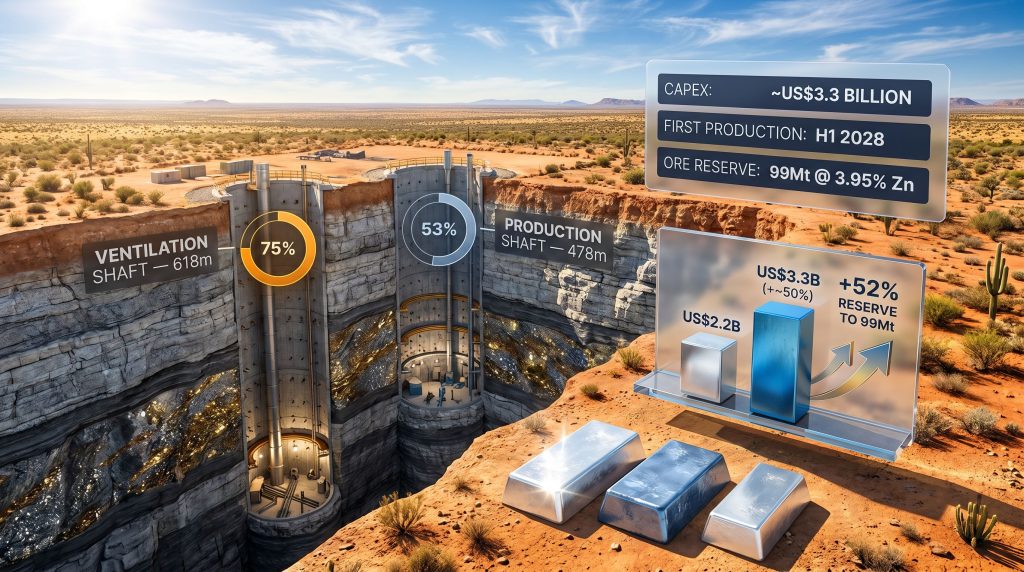
| Capital Expenditure | ~US$2.2 billion | ~US$3.3 billion | +~50% |
| Operating Cost/tonne | ~US$86/t | ~US$100/t | +16% |
| Ore Reserve | 65Mt @ 4.35% Zn | 99Mt @ 3.95% Zn | +52% volume |
| Mine Life | ~28 years | ~33 years | +5 years |
Source: South32 project update, April 30, 2026; Fastmarkets, May 14, 2026
The 52% reserve expansion and five-year mine life extension represent a structural shift in the project's long-run value proposition. Whether short-term market reactions have appropriately priced this distinction is a question that warrants careful analysis.
Dissecting the ~US$1.1 Billion Capital Cost Escalation
The escalation in capital expenditure from approximately US$2.2 billion at the final investment decision to approximately US$3.3 billion represents one of the most significant cost revisions in South32's recent project history. The ~50% increase demands granular interrogation, as its attribution mix determines whether these costs are recoverable through execution improvements or whether they signal deeper structural inflation embedded in the project. Furthermore, understanding the definitive feasibility study assumptions that underpinned the original estimate is essential context for evaluating how far real-world conditions have diverged from modelled parameters.
Key Cost Escalation Drivers
- Contractor underperformance on shaft sinking operations, directly contributing to schedule extension costs
- Engineering and procurement delays across critical project scope items
- Broad inflationary pressures across labour, materials, and energy, attributed at approximately US$500 million of the total increase
- US tariff impacts on imported construction equipment and fabricated components
- Expanded scope, including additional decline development that was not included in the original feasibility study
Of these drivers, the inflationary component is arguably the least recoverable. Construction input cost inflation in North America has been sustained across the 2023 to 2026 period, affecting labour rates, structural steel, electrical components, and diesel fuel simultaneously. The US$500 million attributed to inflation alone represents roughly 45% of the total cost increase, suggesting that even optimal contractor performance would not have prevented a material capex revision.
The remaining approximately US$600 million is attributable to execution deficiencies, scope expansion, and tariff exposure. In addition, changes to US mining permits under the current administration have introduced further compliance costs that project teams must navigate carefully. These factors are, in principle, more addressable through direct owner management and contractor governance improvements.
Shaft Construction: Where the Critical Path Lies
As of late April 2026, South32's disclosure revealed the following shaft construction progress:
- Ventilation shaft: approximately 75% complete at 618 metres depth
- Production shaft: approximately 53% complete at 478 metres depth
The production shaft's slower progress is the primary bottleneck. At 53% completion, the production shaft remains the dominant constraint on the critical path to first ore hoisting and, ultimately, first concentrate production. South32 CEO Graham Kerr confirmed that these delays are execution-related rather than attributable to geological factors such as unexpected water ingress or fault intersections. This distinction carries material weight for long-term project risk assessment.
Mitigation Measures Deployed
South32 has implemented a multi-pronged intervention strategy, including:
- Strengthening contractor leadership structures at the operational level
- Engaging specialist performance advisers with deep shaft sinking expertise
- Transitioning critical construction scope under direct owner management
- Increasing oversight intensity across engineering procurement workflows
South32 has acknowledged these interventions have only partially offset the schedule and cost impacts to date, signalling that execution risk remains elevated through to the revised H1 2028 first production window.
Grade, Volume, and the Economics of the Revised Mine Plan
One of the least discussed but most technically significant aspects of the April 2026 update is the nature of the reserve expansion itself. The ore reserve grew from 65 million tonnes at 4.35% zinc to 99 million tonnes at 3.95% zinc — a volume increase of 52% accompanied by a modest grade reduction of approximately 9% in zinc equivalent terms.
Understanding the Grade-Volume Trade-off
In underground mining economics, this type of reserve evolution typically reflects one of two scenarios:
- Deeper extensions of the ore body carry slightly lower grades but sufficient mineralisation continuity to meet economic cut-off criteria, particularly when infrastructure is already planned
- Mining sequence optimisation has incorporated previously sub-economic material that becomes viable at higher commodity prices or under revised cost assumptions
South32 confirmed that life-of-mine average grades are expected to track at 3.7% zinc, 4.1% lead, and 76 g/t silver, marginally below the feasibility study guidance of 3.9% zinc, 4.3% lead, and 78 g/t silver. Consequently, the company's position is that the larger volume of ore more than compensates for the dilution in average grade. Understanding cut-off grade economics is particularly relevant here, as the decision to include lower-grade material at depth directly shapes both the expanded reserve and the revised operating cost assumptions.
At a processing rate of 4.3 million tonnes per year, even a 9% grade reduction in zinc translates to a meaningful reduction in contained metal per tonne of ore processed. However, the 52% increase in total ore tonnes more than offsets this mathematically, which is why total lifetime payable zinc actually increases on an absolute basis despite lower annual rates.
Operating Cost Revision and Margin Sensitivity
The upward revision in operating costs from approximately US$86 per tonne to approximately US$100 per tonne processed reflects two primary drivers: general input cost inflation and higher assumed energy costs for Arizona operations. At a 16.3% cost increase, the revised operating cost structure introduces meaningful sensitivity to zinc and lead price movements.
| Cost Scenario | Operating Cost/t | Zinc Price Required for Positive Margin |
|---|---|---|
| Feasibility Study Basis | ~US$86/t | Lower threshold |
| Revised Guidance | ~US$100/t | Higher threshold |
| Upside Inflation Risk | US$110–115/t | Elevated breakeven sensitivity |
Note: Margin calculations depend on concentrate grade, payability factors, transport costs, and treatment charges. The above is illustrative only and does not constitute financial advice.
Regulatory Milestones: FAST-41 and Arizona State Permitting
Among the execution challenges at Taylor, the regulatory and permitting trajectory represents one of the project's clearest positive indicators. Hermosa holds the distinction of being the first mining project admitted to the US government's FAST-41 process — a federal framework established under the Fixing America's Surface Transportation Act, Title 41, designed to coordinate and accelerate environmental review processes for critical infrastructure projects.
South32 confirmed that federal permitting under FAST-41 is progressing on schedule. A final Record of Decision and Notice to Proceed are on track for delivery in the second half of 2026. Critically, all state-level approvals required to construct Taylor have already been granted, removing a historically significant source of uncertainty for large-scale US mining developments.
This permitting clarity is notable context for investors weighing execution risk against regulatory risk. While shaft construction remains behind schedule, the project does not face an open permitting frontier — a distinction that meaningfully reduces one category of project risk even as construction challenges persist.
Concentrate Logistics: Dual-Port Export Strategy
Taylor's concentrate marketing strategy involves road transport from the Arizona site to one of two export points:
- Port of Guaymas, Sonora, Mexico — providing proximity to Pacific Basin smelter markets, including major zinc and lead processors in Asia
- Corpus Christi, Texas — offering Atlantic and Gulf Coast export optionality for diversified market access
This dual-port approach is strategically sound in the context of current concentrate market dynamics. Zinc spot concentrate treatment charges, assessed by Fastmarkets at $(20) to $(5) per tonne cif China as of April 24, 2026 (down from $(15) to $(15) per tonne on April 10), are firmly in negative territory. Negative treatment charges indicate that smelters are effectively paying a premium to secure concentrate feedstock rather than charging miners for processing services — a structural inversion that reflects genuine tightness in global zinc concentrate supply. These dynamics are consistent with broader copper supply trends and the wider critical minerals supply squeeze being experienced across base metals markets.
Lead concentrate treatment charges as of April 24, 2026 were assessed at:
- High silver, cif China: $(280) to $(200) per tonne
- Low silver, cif China: $(200) to $(160) per tonne
Taylor's lead concentrates, given the deposit's silver content of approximately 76 g/t in the ore body, are likely to fall into the higher-silver category, which carries more negative TCs, reflecting greater smelter demand for silver-bearing feed.
The next major ASX story will hit our subscribers first
Peake Copper Deposit: Optionality With Caveats
Adjacent to the Taylor mine, South32's Peake copper deposit received an updated mineral resource estimate in the April 2026 announcement. The resource grew by 32% to 33 million tonnes at 0.87% copper, 0.28% zinc, 0.32% lead, and 36 g/t silver, up from the June 2025 estimate of 25 million tonnes at 0.79% copper.
Peake Metallurgical Recovery Profile
| Metal | Recovery Rate | Destination Concentrate |
|---|---|---|
| Copper | 73% | Copper concentrate |
| Zinc | 75% | Zinc concentrate |
| Lead | 85% | Lead concentrate |
| Silver (to lead conc.) | 52% | Lead concentrate |
| Silver (to copper conc.) | 30% | Copper concentrate |
Source: South32 project update, April 30, 2026; Fastmarkets, May 14, 2026
The Taylor process plant has been designed with modular flexibility to accommodate a low-capital copper circuit capable of processing material from both Peake and the deeper Taylor Deeps resource zone. However, a critical caveat must be applied: the entire Peake resource remains classified as Inferred under the JORC Code, the lowest confidence tier, meaning it cannot support mine planning, reserve declarations, or bankable feasibility studies in its current form.
Under the JORC Code, Inferred resources carry insufficient geological continuity data to move directly to Indicated or Measured classification. Significant additional drilling, resource modelling, and metallurgical testwork would be required before Peake could contribute to any formal development plan. South32 has described Peake as a medium to longer term opportunity, and investors should interpret this framing accordingly. For those unfamiliar with how to assess exploration-stage updates of this nature, interpreting drill results from adjacent deposits requires particular caution when resource classifications remain at the Inferred level.
Market Response and the Investor Psychology of Repeated Delays
South32 shares declined by as much as 8.92% intraday following the April 30, 2026 announcement. The severity of the market reaction reflects something beyond simple calculation of revised economics. When a major project experiences a second consecutive timeline delay and a ~50% capex escalation, investor psychology shifts toward what behavioural finance practitioners describe as loss aversion compounding: each successive setback carries disproportionately heavier sentiment weight because it challenges the credibility framework investors had constructed around management guidance.
The Bear-Bull Tension in Taylor's Investment Case
| Perspective | Core Argument |
|---|---|
| Bear Case | Repeated delays signal systemic project management deficiencies; revised US$3.3B capex materially erodes project IRR at current zinc prices |
| Bull Case | Reserve expansion, extended mine life, and copper optionality via Peake represent durable long-term value; execution risks are recoverable with improved contractor governance |
| Neutral Observation | The distinction between execution risk (manageable) and geological or market risk (structural) is central to long-term investor evaluation |
The most important analytical distinction in assessing Taylor is whether the challenges are execution-specific or asset-specific. South32 management has consistently framed the setbacks as the former, and the geological data supports this characterisation. Investors who conflate contractor underperformance with ore body risk may be mispricing the asset in either direction.
Supply Chain Consequences for the Global Zinc and Lead Markets
The South32 Taylor project delayed to H1 2028 announcement carries implications for zinc and lead concentrate markets that extend well beyond South32's own production schedule. Taylor was widely anticipated to contribute meaningfully to Western zinc concentrate supply from 2027 onward, at a time when the global zinc concentrate market is already operating under structural tightness.
Scenario Analysis: Supply Impact by Timeline
| Scenario | First Production | Nameplate Capacity | Annual Zinc Supply |
|---|---|---|---|
| Original Guidance | H1 2027 | June 2030 | ~132,000 tpy from 2030 |
| Revised Guidance | H1 2028 | June 2031 | ~123,000 tpy from 2031 |
| Further Delay Risk | H2 2028+ | 2032+ | Prolonged deficit extension |
The negative zinc concentrate TCs observed in late April 2026 reflect a market where smelters are competing aggressively for available feed. A 12-month delay to first production, combined with a further 12-month delay to nameplate capacity, extends by a full year the period during which this structural tightness persists without Taylor's contribution.
Zinc and lead occupy an increasingly prominent position in critical minerals frameworks globally. Zinc's role in galvanised steel for renewable energy infrastructure, combined with lead's continued relevance in grid-scale energy storage and telecommunications backup systems, means both metals benefit from secular demand tailwinds. Taylor's Arizona location also aligns with US domestic supply chain objectives aimed at reducing Western dependence on Chinese-controlled processing capacity — a dynamic that has become increasingly significant in global metals policy discussions since 2022.
Key Monitoring Metrics for the Road to H1 2028
For investors and market participants tracking Taylor's progress, the following metrics provide the most direct read on whether the project is recovering momentum:
- Production shaft completion rate (currently ~53% at 478m depth) and milestone achievement against internal schedules
- Ventilation shaft final completion (currently ~75% at 618m depth)
- FAST-41 Record of Decision delivery in H2 2026 as a permitting confirmation milestone
- Quarterly capex tracking against the revised US$3.3 billion envelope to detect any further cost creep
- Zinc and lead concentrate TC movements via Fastmarkets assessments as a proxy for ongoing supply tightness in the broader market
Taylor's underlying geological quality is not in question. A 99-million-tonne reserve base, a 33-year mine life, and meaningful silver and copper by-product credits position this as a generationally significant asset in the Western critical minerals landscape. The central challenge between now and H1 2028 is whether South32's intervention measures can translate into measurable shaft construction acceleration before the market's patience with execution uncertainty runs further thin.
Disclaimer: This article is intended for informational purposes only and does not constitute financial advice. All production, cost, and timeline figures are sourced from South32's April 30, 2026 project update as reported by Fastmarkets (May 14, 2026). Forward-looking statements and projections involve inherent uncertainty and should not be relied upon as a basis for investment decisions. Readers should conduct their own due diligence and consult a qualified financial adviser before making any investment decisions.
Want to Be First to Identify the Next Major ASX Mineral Discovery?
While South32's Taylor project highlights the long development timelines involved in large-scale mining, Discovery Alert's proprietary Discovery IQ model delivers real-time alerts the moment significant mineral discoveries are announced on the ASX — converting complex geological data across 30+ commodities into a single, actionable gold-equivalent metric. Explore how historic discoveries have generated extraordinary returns on Discovery Alert's dedicated discoveries page, and begin your 14-day free trial today to position yourself ahead of the broader market.