May 14, 2026
The Hidden Bottleneck That Western Manufacturers Cannot Afford to Ignore
Battery supply chains have a geography problem. Decades of industrial globalisation created a minerals ecosystem where the raw materials for modern technology are extracted on one continent, refined on another, and assembled into finished products somewhere else entirely. For most commodities, this arrangement represents efficient resource allocation. For cobalt, it represents a concentrated strategic vulnerability that defence planners, EV manufacturers, and policymakers are only now beginning to urgently address.
The mineral sits at the intersection of two of the most consequential industrial transitions of the early twenty-first century: the electrification of transportation and the modernisation of defence systems. Cobalt is a critical input in lithium-ion battery cathodes used across electric vehicle platforms, a key component in superalloys used in aerospace turbine blades, and an essential material in certain advanced military hardware. Its unique combination of thermal stability, energy density contribution, and corrosion resistance makes it extraordinarily difficult to substitute at scale in these applications, at least within commercially viable timeframes.
What makes cobalt's supply geography so strategically sensitive is a structural quirk: the overwhelming majority of the world's cobalt ore is extracted from a single country, yet the processing of that ore into usable industrial forms happens predominantly in a different country entirely. The Democratic Republic of Congo resources account for roughly three-quarters of global cobalt mine output, according to reporting by Business Insider Africa. Yet the transformation of raw cobalt hydroxide into battery-grade materials has historically taken place largely in China, which controls the majority of global cobalt production refining capacity despite being a modest producer of raw ore.
This processing bottleneck, not the mining itself, is the source of Western supply chain anxiety. A new agreement signed in Madrid in May 2026 represents a direct attempt to restructure this bottleneck at its foundations.
When big ASX news breaks, our subscribers know first
What the US Cobalt Refinery Supply Deal With Congo Actually Establishes
The Three-Party Framework Signed in Madrid
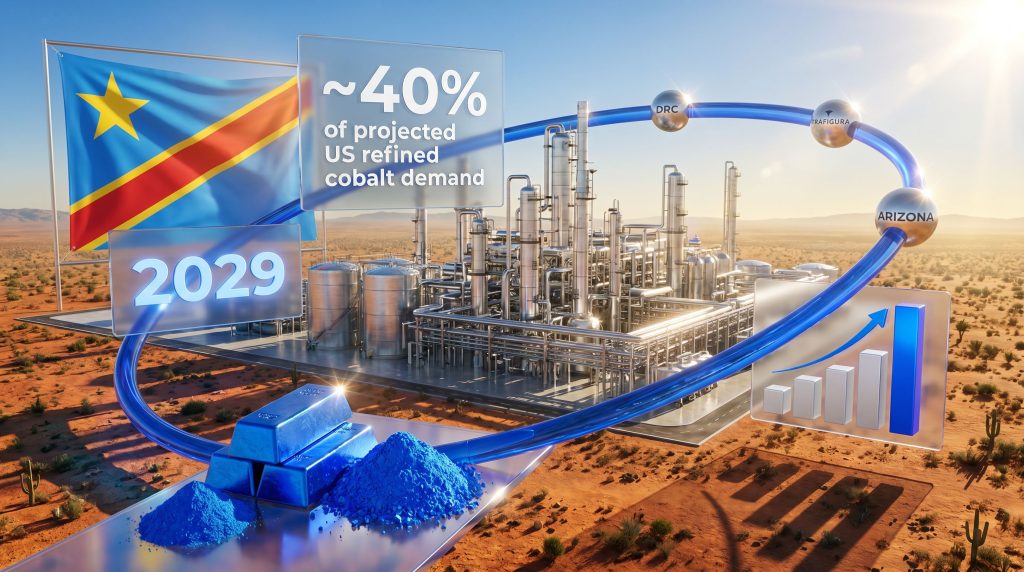
The agreement at the centre of current critical minerals diplomacy brings together three distinct entities: EVelution Energy LLC, a US-based company pursuing what would be the country's first large-scale cobalt processing operation; Enterprise Générale du Cobalt (EGC), the DRC's state-owned cobalt authority; and Trafigura Group, one of the world's largest commodity trading firms. The memorandum of understanding signed by these parties in Madrid sets out a framework for the long-term supply of Congolese cobalt hydroxide to the United States, as reported by Business Insider Africa.
It is important to understand what an MOU is and what it is not. A memorandum of understanding establishes commercial intent and a shared framework for negotiation but does not create binding contractual obligations. The three parties have confirmed they will continue working toward binding long-term commercial agreements in the coming months. This distinction matters for investors and analysts evaluating the deal's near-term significance. What exists today is an architecture of intent rather than a locked-in supply commitment.
That said, MOUs in commodity supply chains serve a critical commercial purpose. They signal to financial markets, potential lenders, and downstream buyers that a project has secured credible supply-side engagement. For a greenfield refinery development, this type of upstream alignment is typically a prerequisite for accessing project finance.
Understanding EGC's Role: The State Monopoly Model
Enterprise Générale du Cobalt occupies a unique structural position in the global cobalt market. As the DRC's state-owned cobalt enterprise, EGC holds a monopoly over the formalisation and commercialisation of artisanal cobalt mining in the country. This is not a minor segment of supply. A significant share of DRC cobalt output comes from artisanal, or hand-dug, mining operations, which historically operated outside formal regulatory oversight.
The EGC formalisation system routes this artisanal production through structured state channels, creating documentation of origin, chain of custody records, and traceability data that Western buyers increasingly require as part of their ESG compliance frameworks. For battery manufacturers supplying automotive OEMs, and for defence contractors subject to conflict minerals reporting requirements, the ability to demonstrate that cobalt is sourced through a formalised, auditable channel is a commercial and regulatory necessity.
This is not simply a humanitarian consideration. The due diligence requirements embedded in European battery regulations and US Dodd-Frank Act reporting obligations create genuine commercial barriers to purchasing cobalt from untracked artisanal sources. EGC's role in the supply agreement therefore addresses a structural demand-side requirement, not merely a goodwill gesture.
Trafigura's Function: Why a Trading Intermediary Is Essential
The involvement of Trafigura Group as logistics and marketing partner reflects a practical reality of global commodity flows. Physically moving cobalt hydroxide from extraction sites in the DRC's Katanga province to a refinery in Arizona requires port access, shipping arrangements, customs documentation, insurance, and financial intermediation across multiple jurisdictions. Trafigura's role is to manage these operational complexities while also supporting commercial arrangements between the producing and consuming sides of the agreement.
An additional dimension of the deal worth noting is the reported discussion around EGC acquiring a minority equity stake in EVelution's Arizona refining infrastructure. Should this materialise, it would represent an unusual structure: a producing nation's state-owned entity holding an ownership position in the refining facility of a consuming nation. This type of bilateral economic alignment, where DRC state interests are embedded in US processing infrastructure, would create a shared commercial incentive that goes beyond a simple buyer-seller relationship.
Inside the Arizona Cobalt Refinery: Project Specifications and Strategic Logic
Core Project Parameters
The following table summarises the confirmed specifications of EVelution's planned Arizona facility, based on reporting by Business Insider Africa:
| Metric | Detail |
|---|---|
| Planned facility location | Arizona, United States |
| Target completion year | 2029 |
| Output products | Cobalt metal and battery-grade cobalt sulfate |
| Projected US demand coverage | Approximately 40% of refined cobalt demand |
| Key end-use sectors | Electric vehicles, aerospace, defence |
| Upstream supply partner | Enterprise Générale du Cobalt (DRC) |
| Logistics and marketing partner | Trafigura Group |
| Allied-nation offtake partner | Mitsui & Co. (Japan) |
The 40% Coverage Target in Context
The stated ambition of meeting roughly 40% of projected US refined cobalt demand is significant on multiple levels. First, it establishes that the facility would be a material contributor to US cobalt supply rather than a token domestic capacity gesture. Second, it implicitly acknowledges that even at full operational capacity by 2029, the United States would still need to source the remaining 60% of its refined cobalt requirements from elsewhere.
This gap is not a flaw in the project's logic but rather a realistic acknowledgement of where the US starts from: a position of near-total absence of domestic refining infrastructure at any meaningful industrial scale. Moving from zero to 40% of national demand through a single facility represents a substantial structural shift. The pathway to filling the remaining 60% will likely require a combination of additional domestic or allied-nation refining capacity, supplementary supply agreements with non-Chinese processing partners, and potentially continued strategic inventory management.
Battery-Grade Cobalt Sulfate vs. Cobalt Metal: Why Both Products Matter
The Arizona refinery's plan to produce two distinct cobalt product forms reflects the differentiated demand structure of its target end markets. These are meaningfully different industrial products:
- Cobalt metal is used in superalloys for aerospace and defence applications, where high-temperature performance and structural integrity are paramount
- Battery-grade cobalt sulfate is the precursor chemical form required for cathode active material production in lithium-ion battery manufacturing
By targeting both output streams, EVelution is positioning the Arizona facility to serve multiple demand pools simultaneously, which reduces concentration risk on any single end market and improves the project's commercial resilience against sector-specific demand fluctuations.
The Diplomatic Architecture Behind the Commercial Agreement
A Broader US-DRC Minerals Partnership
The Madrid MOU did not emerge in a geopolitical vacuum. As reported by Business Insider Africa, the cobalt supply agreement follows approximately five months after the US and the DRC finalised a broader minerals partnership designed to give American investors preferential access to the DRC's critical mineral reserves. Furthermore, the mineral basket covered under this wider framework includes cobalt, copper, lithium, and tantalum, reflecting the full spectrum of battery and advanced technology materials in which the DRC holds significant geological endowment.
The significance of this sequencing is worth emphasising. The commercial agreement between EVelution, EGC, and Trafigura represents the first major private-sector transaction to flow directly from a state-level diplomatic framework. This move from government-level agreement to private commercial execution is not automatic. It requires that the enabling political conditions translate into operational business structures, legal frameworks, and investor confidence at the project level. The May 2026 MOU is the first tangible evidence that this translation is occurring.
Consequently, the US cobalt refinery supply deal with Congo has drawn significant attention as a signal that Washington's critical minerals diplomacy is beginning to generate commercially executable outcomes rather than remaining at the level of policy aspiration.
Japan's Role: Allied-Nation Demand as Commercial Anchor
A detail that deserves more analytical attention than it typically receives in coverage of this deal is EVelution's separate supply agreement with Japan's Mitsui and Co. Under this arrangement, Mitsui will purchase the majority of the Arizona facility's cobalt output over a five-year period.
This structure reveals something important about how US critical mineral projects are being commercially architected: domestic production does not necessarily mean domestic consumption. The primary buyer of cobalt processed in Arizona will be a Japanese trading and industrial conglomerate, reflecting the reality that allied-nation demand is being used to anchor the financial viability of US domestic processing infrastructure.
This is not unusual in industrial commodities. Major resource projects routinely rely on offtake agreements with large-volume international buyers to secure the long-term revenue certainty that project lenders require. What makes this arrangement strategically interesting is that it embeds Japanese industrial interests as a commercial stakeholder in US refining infrastructure, creating a supply chain interdependency that reinforces broader US-Japan critical mineral cooperation within the Indo-Pacific strategic framework.
Evaluating the DRC's Position: Value Capture and Structural Questions
The African Beneficiation Debate
One of the most persistent and legitimate critiques of African mineral agreements is that they replicate a colonial-era economic pattern: raw materials leave the continent at low prices, while the value-adding processing and manufacturing activities that generate high-margin returns occur elsewhere. The cobalt supply agreement raises this question directly.
Under the current structure, cobalt hydroxide, a partially processed form of raw cobalt, will be shipped from the DRC to Arizona for refining into final-grade industrial products. The refining margin, which represents the difference between the price of cobalt hydroxide and battery-grade cobalt sulfate or metal, will accrue to the US operation rather than to Congolese industry.
The reported discussions around developing additional in-country processing capacity within the DRC represent an acknowledgement of this gap. However, discussions and operational reality are separated by considerable distance. Establishing meaningful refining capacity within the DRC requires sustained capital investment, reliable power infrastructure, technical expertise, and a stable regulatory environment, all of which present genuine implementation challenges.
The potential minority equity stake for EGC in EVelution's Arizona facility is a partial response to the beneficiation critique, giving the DRC state entity a financial interest in the processing margin rather than simply a raw material supplier role. Whether this stake materialises and on what commercial terms will be an important signal of how genuinely bilateral the economic structure of this arrangement becomes.
Artisanal Mining: Formalisation's Promises and Persistent Risks
The inclusion of artisanal cobalt in the supply framework through EGC's state monopoly system is commercially pragmatic but ESG-complex. Artisanal and small-scale mining in the DRC has been associated with serious human rights concerns, including child labour, unsafe working conditions, and community displacement. The EGC formalisation model is designed to address these issues by bringing artisanal production into a regulated framework with documentation, safety standards, and income traceability.
The effectiveness of this formalisation in practice remains an ongoing area of scrutiny. Western manufacturers sourcing from these channels face downstream liability if traceability systems fail to adequately screen problematic supply. The commercial imperative of securing cobalt at scale from the DRC creates pressure to accept the formalisation framework as sufficient, while civil society organisations and responsible sourcing auditors apply pressure in the opposite direction.
For investors evaluating companies in this supply chain, the artisanal sourcing dimension represents a reputational and potentially regulatory risk factor that sits alongside, and does not disappear because of, the EGC state oversight structure.
The US vs. China Strategic Comparison: Where the Approaches Diverge
Side-by-Side Strategic Architecture
| Dimension | US Approach (2025-2026) | China's Established Model |
|---|---|---|
| Entry mechanism | State-level MOU followed by private-sector commercial execution | Long-term equity stakes combined with state-backed financing |
| Processing location | Domestic US refinery under development in Arizona | Predominantly China-based refining infrastructure |
| Value chain position | Mine-adjacent supply agreements plus downstream refinery investment | Full vertical integration from ore to cathode precursor |
| DRC state relationship | Commercial partnership with EGC as supply and equity partner | Mixed: joint ventures, independent operations, and offtake agreements |
| Artisanal supply approach | Formalised through EGC state monopoly with traceability documentation | Historically variable regulatory engagement |
| Timeline to operational scale | 2029 target for Arizona facility | Already operating at industrial scale across multiple DRC assets |
Structural Advantages of the US Approach
The US strategy carries several distinctive advantages that China's incumbent model does not easily replicate. In addition, the US-China cobalt rivalry is reshaping how both nations engage commercially with the DRC's critical mineral sector:
- ESG-compliant supply chain architecture: Western EV manufacturers and defence contractors face increasing regulatory pressure to demonstrate responsible sourcing. An EGC-formalised, US-processed supply chain creates documentation and traceability that Chinese-processed cobalt historically has not provided at equivalent levels.
- Allied-nation demand anchoring: The Mitsui offtake agreement demonstrates that US refining infrastructure can attract commercial commitments from allied-nation industrial partners, providing revenue certainty that supports project financing.
- Diplomatic integration: By embedding the commercial arrangement within a broader US-DRC minerals partnership, the approach creates political durability beyond any single administration or corporate relationship.
Execution Risks That Cannot Be Dismissed
The US strategy also carries substantial execution risks that should be weighed carefully:
- China's decade-plus head start in DRC relationships, processing infrastructure, and operational expertise cannot be overcome quickly regardless of diplomatic momentum
- The MOU-to-binding-commercial-agreement conversion remains incomplete, and the timeline to finalisation is uncertain
- Arizona refinery construction at the scale required involves permitting, financing, and technical commissioning challenges with no directly comparable US precedent to draw from
- DRC political instability and the durability of the underlying bilateral framework represent ongoing geopolitical variables that commercial agreements cannot fully hedge
However, the DRC cobalt export ban introduced additional complexity into these calculations, signalling that Kinshasa is prepared to use supply-side leverage as a negotiating instrument in its minerals diplomacy.
The next major ASX story will hit our subscribers first
Market and Investment Implications: What the Deal Signals
Cobalt Market Dynamics and the 2029 Horizon
The cobalt market has experienced pronounced price volatility over recent years, driven by the interplay of DRC production growth, fluctuating EV demand trajectories, and the periodic oversupply conditions that follow major capital investment cycles in mining. A new US refinery coming online by 2029 would introduce a material new Western-aligned processing node into a market that has historically priced cobalt through Chinese refining intermediaries.
The medium-term demand picture for cobalt is shaped by several intersecting forces:
- EV battery technology evolution: Higher-nickel cathode chemistries (NMC 811, NMC 9 series) use less cobalt per kilowatt-hour than earlier NMC 111 formulations, but rising total EV volumes partially offset this per-unit reduction
- Defence and aerospace demand growth: Military modernisation programmes across NATO member states and allied nations are driving increased demand for cobalt-containing superalloys in turbine and structural applications
- Energy storage expansion: Grid-scale battery deployment, while increasingly dominated by lithium iron phosphate chemistry, creates residual cobalt demand in distributed storage applications
Furthermore, the broader battery metals investment landscape is being reshaped by these supply chain realignment dynamics, with capital increasingly flowing toward projects that can demonstrate Western-aligned traceability and processing credentials.
Key Risk Factors for Market Participants
Investors and analysts considering exposure to cobalt supply chain developments should weigh the following risk categories. This section does not constitute financial advice.
- Political risk: The DRC's history of governance instability, armed conflict in eastern provinces, and executive policy changes creates ongoing uncertainty for long-duration supply agreements
- Commercial conversion risk: Until the Madrid MOU converts into binding long-term supply contracts, the project's upstream security remains contingent rather than contractual
- Construction and commissioning risk: Greenfield refinery development in a jurisdiction with no existing cobalt processing template introduces technical execution uncertainty that is difficult to fully price at the prefeasibility stage
- Market price risk: Sustained cobalt price weakness, should oversupply conditions persist through the 2027-2028 period, could pressure project economics and potentially delay investment decisions
The US government has also signalled its intent to backstop elements of the critical minerals transition, with over $1 billion pledged for Congo's critical minerals supply chain, providing a degree of sovereign risk mitigation for private investors entering these structures.
Frequently Asked Questions: US Cobalt Refinery and Congo Supply Deal
What is the US cobalt refinery supply deal with Congo?
The US cobalt refinery supply deal with Congo is a memorandum of understanding signed in Madrid in May 2026 between EVelution Energy LLC, the DRC's state-owned Enterprise Générale du Cobalt, and commodity trading firm Trafigura Group. The framework establishes the basis for long-term supply of Congolese cobalt hydroxide to a planned US refining facility in Arizona.
When will the Arizona cobalt refinery be operational?
EVelution Energy LLC is targeting facility completion by 2029. At that point, the refinery is designed to produce cobalt metal and battery-grade cobalt sulfate, with an ambition to supply approximately 40% of projected US refined cobalt demand.
Why does the DRC matter so much to US cobalt strategy?
The DRC produces roughly three-quarters of global cobalt mine output, making it the indispensable source for any nation seeking meaningful cobalt supply. Securing direct access to Congolese supply through a US-aligned refining pathway is central to reducing dependence on Chinese-controlled processing infrastructure.
What role does Trafigura play in the agreement?
Trafigura Group serves as the logistics and marketing intermediary, managing the physical movement of cobalt hydroxide from DRC mining operations to the US and facilitating commercial arrangements between the producing and consuming parties.
How does the Mitsui deal relate to the Arizona refinery?
EVelution has signed a separate five-year offtake agreement with Japan's Mitsui and Co., under which Mitsui will purchase the majority of the Arizona facility's cobalt output. This allied-nation commercial commitment provides the revenue certainty that underpins the project's financing strategy.
Is artisanal cobalt safe to source from under this agreement?
Artisanal cobalt routed through EGC's state formalisation framework carries improved traceability and oversight compared to informal channel sourcing. However, ESG risks associated with hand-dug mining in the DRC remain an active area of scrutiny. Western buyers sourcing through these channels continue to face reputational and regulatory diligence obligations, and concerns remain that Congolese communities may not fully benefit from these arrangements.
The Road Ahead: Milestones That Will Define the Project's Trajectory
What to Watch Between 2026 and 2029
The Madrid MOU marks the beginning of a complex multi-year execution process rather than a completed transaction. The following milestones will determine whether the US cobalt refinery supply deal with Congo evolves from a framework agreement into operational infrastructure:
- Conversion of the MOU into binding long-term commercial supply contracts between EVelution, EGC, and Trafigura
- Arizona refinery permitting process completion and regulatory approvals
- Financial close on construction financing, potentially involving project finance lenders, export credit agencies, or strategic equity partners
- Determination of whether EGC will take a minority equity stake in EVelution's refining infrastructure, and on what commercial terms
- Progress on DRC domestic processing capacity discussions, which would indicate whether the beneficiation commitment is advancing toward implementation
- Mitsui offtake volume and pricing confirmation as a commercial validation benchmark
A New Industrial Template With Broader Implications
If the Arizona facility reaches operational status by 2029, it would mark the establishment of US-scale domestic cobalt refining capacity for the first time. Beyond its direct commercial significance, the project would serve as a potential template for applying a similar multi-instrument strategy — combining state-level bilateral frameworks, state-entity commercial partnerships, private refinery investment, and allied-nation demand anchoring — to other critical mineral supply chains where comparable vulnerabilities exist.
Lithium, nickel, manganese, and certain rare earth elements all present analogous structural challenges: concentrated extraction geographies, refining bottlenecks in jurisdictions of geopolitical concern, and growing Western industrial demand that cannot be met without supply chain restructuring. The architectural choices being made in the cobalt supply chain today will likely inform how policymakers and private investors approach these adjacent material challenges over the decade ahead.
Whether this model delivers on its strategic promise ultimately depends not on the quality of the framework documents signed in Madrid, but on the disciplined execution of a complex industrial project across multiple jurisdictions, market conditions, and political cycles that no agreement can fully anticipate or control.
Want to Spot the Next Major Critical Minerals Discovery Before the Market Does?
Discovery Alert's proprietary Discovery IQ model scans ASX announcements in real time, instantly identifying significant mineral discoveries across cobalt, lithium, copper, and more than 30 other commodities — turning complex data into actionable investment insights the moment they hit the market. Explore why historic mineral discoveries have generated extraordinary returns and start your 14-day free trial today to position yourself ahead of the broader market.