August 6, 2026
The Minerals Beneath Europe's Energy Anxiety
Every major industrial transition in modern history has carried within it a hidden dependency, a single point of failure that only becomes visible once it is too late to easily correct. Europe learned this lesson through natural gas. The continent's heavy reliance on Russian pipeline supply, built over decades of ostensibly rational commercial logic, became a structural liability the moment geopolitical conditions shifted. The policy response that followed — rapid diversification, emergency procurement, and long-term partnership frameworks — has since been copied almost verbatim and applied to a completely different resource category: critical minerals.
EU investment in South Africa's critical minerals sector represents one of the most consequential chapters in this ongoing story. With China tightening its control over rare earth processing and export flows, and with the clean energy and defence technology industries converging on the same small group of materials, Europe is now placing considerable capital behind a country it has traded with for decades but never fully recognised as a strategic mineral partner.
When big ASX news breaks, our subscribers know first
How China's Export Restrictions Rewired European Resource Strategy
China's position in the global critical minerals landscape is not simply a matter of geology. While the country does hold significant deposits of rare earth elements, its true leverage derives from decades of investment in processing and refining infrastructure. As of the mid-2020s, China controls the refining of an estimated 85 to 90 percent of the world's rare earth elements, along with dominant positions in the processing of cobalt, lithium, and several technology metals.
Beginning in 2023, China progressively tightened export controls on gallium, germanium, graphite, and certain rare earth compounds, citing national security rationale. These restrictions had an immediate chilling effect on European manufacturers in the semiconductor, clean energy, and defence sectors. Furthermore, China's rare earth export restrictions sent a clear signal to Brussels that supply chain vulnerability had moved from theoretical risk to operational reality.
The European Commission's response drew explicitly on the lessons of the Russian gas crisis. Having watched energy dependence transform into political vulnerability, Brussels moved quickly to establish a legal and institutional framework for mineral security. The result was the Critical Raw Materials Act, which came into force in 2024 and set binding targets requiring that no single third country supply more than 65 percent of the EU's annual consumption of any strategic material.
This single regulatory threshold has profound implications. For materials such as dysprosium, terbium, and neodymium, where Chinese supply exceeds 90 percent of global processing output, the compliance gap is enormous. South Africa, with its existing large-scale production of platinum group metals and emerging rare earth projects, consequently became an obvious candidate for deeper engagement.
What the EU–South Africa Clean Trade and Investment Partnership Actually Involves
The formal framework underpinning the current investment push was launched at the Cape Town summit in March 2025. Structured under the EU's Global Gateway initiative — which functions as Europe's infrastructure and investment response to Chinese Belt and Road activity — the partnership channels capital through a combination of grant funding, concessional loans, and blended finance instruments.
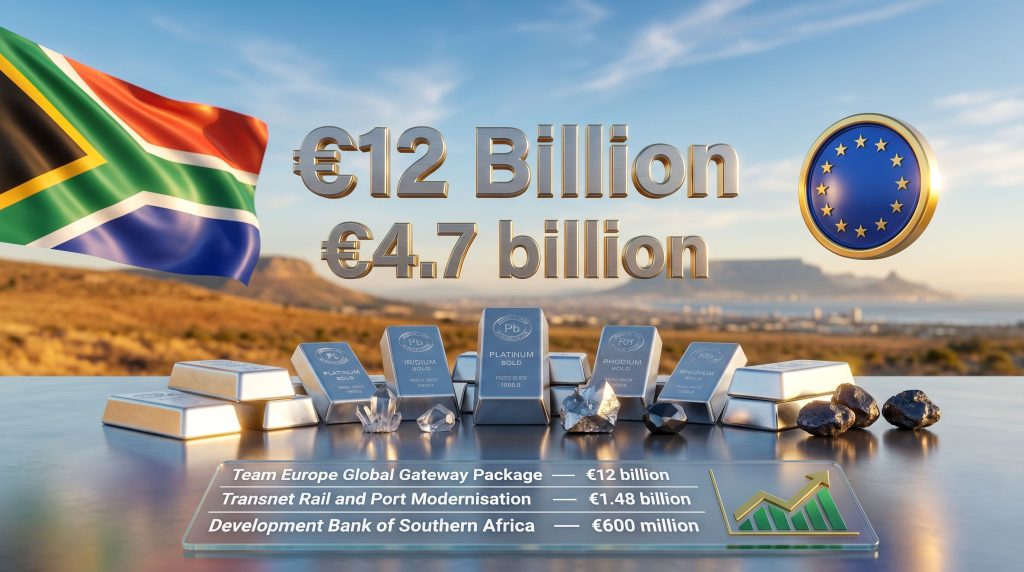
The aggregate Team Europe Global Gateway commitment stands at €12 billion, with a core package of €4.7 billion announced at the Cape Town summit itself. The distinction between these figures matters: the €12 billion encompasses the full range of instruments mobilised across EU member states and multilateral development banks, while the €4.7 billion represents the headline package directly attributable to the summit announcement.
Breaking Down the Financial Architecture
The capital deployment is structured across several discrete instruments, each targeting a different part of the value chain:
| Investment Instrument | Value | Target Area |
|---|---|---|
| Team Europe Global Gateway Package | €12 billion | Just energy transition and linked sectors |
| Global Gateway Core Package (Cape Town) | €4.7 billion | Clean energy and critical minerals |
| DBSA Framework Loan | €600 million | 1,200 MW green energy; 3.6Mt CO₂ reduction |
| Transnet Rail and Port Facility | €1.48 billion | Freight infrastructure and export capacity |
| Critical Raw Materials and Green Hydrogen | €21.5 million | Technical cooperation and project development |
| Minerals and Metals Skills Development | €2 million | Workforce capability and value chain readiness |
The €1.48 billion Transnet facility deserves particular attention because it is often overlooked in coverage that focuses on the minerals dimension alone. South Africa's freight rail system has suffered persistent underperformance over the past decade, with Transnet's operational difficulties contributing to export losses across the mining sector. Without meaningful logistics reform, no amount of new mineral production capacity can reliably reach international markets. The infrastructure investment is not peripheral to the minerals strategy; it is a prerequisite for it.
A trilateral financing mechanism involving Germany's KfW development bank, the European Commission, and South African partners adds another layer of capital targeting downstream processing rather than raw extraction. The structure blends grants, equity, and concessional debt specifically to support beneficiation, reflecting the political reality that South Africa's participation in the partnership is conditional on industrial development commitments.
South Africa's Non-Negotiable: Beneficiation Over Raw Exports
South Africa's Trade and Industry Minister Parks Tau has articulated the country's negotiating position with clarity. The country's stated objective centres on domestic processing, industrialisation, and value-added manufacturing — not the export of unprocessed mineral ore. This stance is embedded in the partnership's structural architecture and represents a departure from earlier generations of African resource agreements that were primarily extraction-focused.
"This insistence on beneficiation conditionality is not merely a political talking point. It reflects a hard-learned economic reality: commodity-exporting nations that allow foreign partners to capture processing margins systematically underperform those that retain more of the value chain domestically."
The contrast with other African mineral partnerships is instructive. In addition, the EU-South Africa strategic partnership represents a notably more balanced model than many of its predecessors on the continent:
| Country | Key Mineral | Partnership Model | Beneficiation Requirement |
|---|---|---|---|
| South Africa | PGMs, rare earths, manganese | EU Clean Trade and Investment Partnership | Explicit, embedded in framework |
| Zimbabwe | Lithium | Various bilateral deals | Partial, export bans on unprocessed ore |
| DRC | Cobalt, copper | Mixed bilateral and multilateral | Limited, primarily extraction-focused |
| Namibia | Uranium, rare earths | EU strategic projects framework | Emerging, processing capacity under development |
South Africa's position at the top of this spectrum reflects both its negotiating leverage as an existing dominant PGM supplier and the institutional sophistication of its trade policy apparatus. European manufacturers that currently depend on South African iridium, rhodium, and ruthenium for hydrogen fuel cells and catalytic converter applications have limited substitution options in the near term, which strengthens Pretoria's hand considerably.
South Africa's Mineral Portfolio: What Europe Actually Needs
The strategic value of EU investment in South Africa's critical minerals sector is grounded in geology as much as geopolitics. South Africa hosts the Bushveld Igneous Complex, a geological formation of extraordinary scale that contains the world's largest known reserves of platinum group metals. This is not a marginal reserve position; South Africa accounts for approximately 70 to 75 percent of global platinum reserves and similarly dominant shares of rhodium and iridium.
The PGM Suite: Industrial Indispensability
Platinum group metals occupy a specific and difficult-to-replicate role across several industrial processes:
- Platinum is essential for hydrogen electrolysers and fuel cells, the core technology for Europe's green hydrogen ambitions
- Rhodium is used in automotive catalytic converters at concentrations that cannot be easily substituted
- Iridium is critical for proton exchange membrane (PEM) electrolysers, where demand is expected to accelerate sharply as green hydrogen infrastructure scales
- Ruthenium is increasingly used in semiconductor manufacturing and data storage technologies
- Palladium remains a key autocatalyst component and plays a growing role in electronics
The green hydrogen connection is particularly significant. Europe's hydrogen strategy targets 10 million tonnes of domestic production by 2030, and PEM electrolysers require iridium as a catalyst. Given that global iridium production is measured in tonnes per year rather than thousands of tonnes, any material scaling of hydrogen infrastructure creates a structurally tight supply picture in which South Africa's production base becomes critically important. This aligns directly with broader critical minerals demand growth driven by the global energy transition.
Rare Earths: The Zandkopsdrift Development
Beyond PGMs, the Zandkopsdrift rare earths project in the Northern Cape province has emerged as a focal point for European interest. In June 2025, the EU designated Zandkopsdrift as one of its first strategic critical minerals projects located outside EU borders. This designation is more than symbolic: it signals access to EU-backed financing mechanisms, potential offtake support structures, and a prioritised engagement pathway within the European Commission's raw materials governance framework.
The Zandkopsdrift deposit is primarily a carbonatite-hosted rare earth occurrence, a geological setting associated with relatively high concentrations of the neodymium and praseodymium that are essential for permanent magnets in electric motors and wind turbines. These so-called magnet rare earths sit at the centre of both the electric vehicle transition and renewable energy capacity expansion, making them the single most strategically contested subset of the rare earth category.
The EU's decision to designate a non-EU project as strategic marks a meaningful evolution in how Brussels approaches supply chain security, shifting from passive trade dependence toward proactive project-level engagement. However, strengthening rare earth supply chains at this level of depth requires sustained institutional commitment over many years, not just headline announcements.
How the EU's Investment Model Differs From China's Approach
Understanding what distinguishes European engagement from Chinese infrastructure investment in Africa requires examining the conditionality structure, not just the headline capital figures.
| Dimension | EU Approach | China's Historical Approach |
|---|---|---|
| Primary instruments | Blended finance, concessional loans, grants | State-backed loans, equity stakes |
| Conditionality | Environmental, governance, beneficiation standards | Typically limited conditionality |
| Infrastructure linkage | Integrated with trade and industrial policy | Often tied to resource extraction rights |
| Local processing emphasis | Explicit policy requirement | Variable, often extraction-focused |
| Geopolitical framing | Supply diversification and strategic autonomy | Resource access and bilateral influence |
EU Ambassador to South Africa Sandra Kramer has described the shift in European engagement as a movement away from a development assistance model toward an investment partnership framework. This reframing carries real implications for how negotiations proceed: South Africa is treated as a strategic economic counterpart with leverage, not as a recipient of development charity.
The competition between these two models for African mineral partnerships will likely intensify through the late 2020s. For resource-rich African governments, the availability of competing offers from Europe, the United States, Japan, South Korea, and China creates genuine negotiating power — something that was largely absent in earlier commodity cycles. Furthermore, Europe's critical minerals supply chain strategy depends heavily on how effectively these partnerships deliver diversified sourcing over the coming decade.
The next major ASX story will hit our subscribers first
The Trade Foundation: €46 Billion in Existing Ties
One factor that differentiates the EU–South Africa relationship from newer entrants into the African minerals space is the depth of existing commercial engagement. Bilateral trade between the EU and South Africa reached €46 billion in 2025, and more than 1,700 European companies currently operate within the country. This institutional familiarity reduces transaction costs, regulatory uncertainty, and the political risks that typically complicate large-scale resource investment in frontier jurisdictions.
The decision to host the EU's first South Africa investment roadshow at the Johannesburg Stock Exchange was deliberate. The JSE is Africa's most sophisticated capital market, and the venue choice signals that Europe is seeking to mobilise private institutional capital alongside public financing commitments. The 2025 Clean Trade and Investment Partnership provides the legal scaffolding that enables private sector participation, by establishing clear frameworks for offtake agreements, dispute resolution, and regulatory engagement.
Risks That Could Constrain the Partnership's Ambitions
Credible analysis of this partnership requires acknowledging the structural constraints that could limit its effectiveness.
Supply-Side Challenges
- South Africa's electricity supply constraints remain a persistent operational risk for energy-intensive mining and processing operations
- Transnet's historical underperformance as a freight logistics operator has cost the South African mining industry billions in foregone export revenue over the past decade, and the scale of reform required is substantial
- Labour relations complexity in the South African mining sector adds production continuity risk to long-term offtake commitments
Demand and Geopolitical Uncertainties
- China could accelerate its own beneficiation capacity and those of strategic partner countries, potentially reducing European demand for African-processed materials
- The pace of Europe's clean energy transition carries genuine uncertainty, which affects near-term mineral demand trajectories
- Beneficiation conditionality, while strategically sound from South Africa's perspective, could delay project timelines and reduce the speed at which Europe achieves supply diversification
Scenario Analysis: Three Trajectories for EU Investment in South Africa's Critical Minerals
Scenario 1: Accelerated Integration (Optimistic)
Infrastructure investment resolves export bottlenecks; beneficiation facilities secure EU offtake agreements; Zandkopsdrift and complementary projects reach production within five years; PGM supply chains deepen materially.
Scenario 2: Measured Progress (Base Case)
PGM and manganese trade deepens incrementally; rare earth development progresses at a slower pace due to financing complexity and processing infrastructure requirements; infrastructure improvements deliver gradual gains over a 7 to 10-year horizon.
Scenario 3: Partnership Stagnation (Pessimistic)
Beneficiation conditionality creates prolonged negotiation delays; South African infrastructure constraints persist despite capital injection; Europe pivots additional capital toward mineral partners in Latin America or Central Asia.
The base case reflects the most historically grounded assessment. Large-scale resource partnerships between sovereign states and multilateral institutions rarely deliver at the pace initial announcements suggest, but they also rarely collapse entirely when the underlying strategic rationale is as strong as it is here.
Frequently Asked Questions: EU Investment in South Africa's Critical Minerals
What is the EU–South Africa Clean Trade and Investment Partnership?
A bilateral framework launched in March 2025 at the Cape Town summit, structuring EU engagement with South Africa across sustainable minerals and metals value chains, clean energy infrastructure, and industrial development. It operates under the broader Global Gateway initiative.
How much is the EU committing to South Africa's minerals sector?
The total Team Europe Global Gateway package is valued at approximately €12 billion, with a core €4.7 billion package announced at the Cape Town summit. Specific instruments include a €600 million green energy loan, a €1.48 billion Transnet infrastructure facility, and a €21.5 million technical cooperation project for critical raw materials and green hydrogen.
Which minerals are most important to Europe from South Africa?
Platinum group metals — particularly iridium, platinum, rhodium, and ruthenium — represent the most immediate strategic priority given South Africa's dominant reserve position. Rare earth elements, manganese, and green hydrogen feedstocks are central to the partnership's medium and long-term objectives.
What is Zandkopsdrift and why has it attracted EU attention?
Zandkopsdrift is a carbonatite-hosted rare earths development project in South Africa's Northern Cape province. The EU designated it in June 2025 as one of its first strategic critical minerals projects outside the EU, providing access to financing support and signalling Europe's commitment to developing non-Chinese rare earth supply chains.
What conditions has South Africa attached to mineral access?
South Africa has embedded explicit requirements for domestic beneficiation, processing, and industrial development in the partnership framework. Access to mineral resources is conditional on partnerships supporting value-added manufacturing rather than the export of raw ore.
Why does Europe prioritise South Africa over other African mineral producers?
South Africa combines proven large-scale mineral production, institutional trade familiarity, a sophisticated financial market in the JSE, established export infrastructure, and decades of EU commercial engagement. This combination substantially lowers the risk profile of large-scale capital deployment relative to frontier mineral jurisdictions elsewhere on the continent. In addition, the role of critical minerals in EU-Africa relations more broadly underscores why South Africa's strategic positioning within this framework carries outsized importance.
Disclaimer: This article contains forward-looking statements and scenario analysis based on publicly available information. It does not constitute investment advice. Mineral project timelines, financing commitments, and geopolitical conditions are subject to change. Readers should conduct independent research before making investment decisions related to any of the sectors or jurisdictions discussed.
Want To Stay Ahead of Critical Mineral Discoveries Before the Broader Market Reacts?
As Europe's demand for platinum group metals, rare earths, and strategic commodities intensifies, the ASX junior exploration sector is increasingly exposed to significant re-rating events — and Discovery Alert's proprietary Discovery IQ model delivers real-time alerts the moment major mineral discoveries are announced, turning complex data across 30-plus commodities into actionable insights for investors at every level. Explore historic discovery returns to understand what is at stake, then start your 14-day free trial at Discovery Alert to position yourself ahead of the market.