July 22, 2026
The Capital Thesis Reshaping Lithium Technology Investment
The lithium industry is undergoing a quiet but consequential structural shift. For years, capital flowed overwhelmingly toward resource discovery, with investors chasing drill results, resource estimates, and geological optionality. Today, a more sophisticated investment thesis is gaining traction — one that targets the process engineering layer of the lithium supply chain rather than the rocks themselves, and the Eurodia Industrie DLE investment is a compelling example of this trend.
This shift reflects a hard-won understanding of where commercial risk actually concentrates in lithium projects. Identifying a lithium-rich brine deposit is no longer the primary bottleneck. Extracting lithium from that deposit efficiently, selectively, and at industrial scale is where most projects struggle — and where technological capability determines whether a resource ever becomes a producing asset.
Direct Lithium Extraction technology, or DLE, sits at the centre of this capability gap. A recent capital raise by French industrial technology firm Eurodia Industrie signals that institutional investors are now placing serious money on the process-engineering firms best positioned to close it.
When big ASX news breaks, our subscribers know first
What Makes DLE Different From Conventional Lithium Recovery?
To understand why the Eurodia Industrie DLE investment of €18 million matters, it helps to understand what makes DLE fundamentally different from the lithium recovery methods that have dominated production for decades.
Conventional lithium brine extraction relies on solar evaporation — a process that concentrates lithium-bearing solutions in large surface ponds over periods of 12 to 24 months, depending on climate and brine chemistry. While the capital cost of evaporation ponds is relatively low, the method carries serious drawbacks:
- Recovery rates are typically capped at 40% to 60% of available lithium in the brine
- The process consumes enormous volumes of water in arid environments already under hydrological stress
- Long processing timelines extend the period between capital expenditure and first revenue
- Evaporation ponds occupy vast land areas in ecologically sensitive Andean plateau ecosystems
- Output quality can vary seasonally, complicating downstream refining
DLE technologies bypass this model entirely. Rather than relying on natural evaporation, DLE systems selectively extract lithium ions directly from brine solutions using physical and chemical mechanisms — including adsorption, ion exchange, solvent extraction, and membrane filtration. Recovery rates for well-engineered DLE systems can exceed 80% to 90%, the processing cycle compresses from months to hours or days, and the water consumption profile improves substantially.
The critical technical challenge in DLE is selectivity. Lithium must be separated from competing ions including sodium, potassium, magnesium, and calcium, which are typically present in much higher concentrations in natural brines. The adsorbent materials and system engineering required to achieve this selectively and repeatably at industrial scale represent the true technological barrier to entry.
Eurodia Industrie: A Multi-Technology Platform Built for Complex Separations
Eurodia Industrie is not a single-technology DLE developer. The company operates a multi-technology platform that combines several industrial separation and purification disciplines into integrated process solutions. This breadth is strategically significant because brine chemistry varies considerably across different geological formations, and no single separation technology is optimal across all environments.
The core technologies within Eurodia's platform include:
- Electrodialysis and bipolar electrodialysis for ion transport across selective membranes using electrical potential
- Adsorption systems designed specifically for lithium-selective extraction from complex brines
- Chromatography for fine separation of dissolved species in industrial streams
- Ion-exchange resins for targeted removal or concentration of specific ionic species
- Membrane filtration across ultrafiltration and nanofiltration ranges for pre-treatment and polishing
This technology stack matters for a reason that is not always appreciated outside specialist circles: DLE projects rarely fail because a single technology is inadequate in isolation. They fail because the integration of separation steps is poorly engineered, leading to brine compatibility issues, adsorbent fouling, inconsistent selectivity, or poor recovery rates when transitioning from pilot to industrial scale.
Eurodia's value proposition is precisely this integration capability. The company designs and delivers complete process systems — not individual components — which positions it as a genuine industrial solutions provider rather than a technology licensor.
The Saint-Gobain Ceramics Partnership: Materials Meets Engineering
One of the less widely discussed aspects of Eurodia's DLE capability is its strategic relationship with Saint-Gobain Ceramics. Saint-Gobain is one of the world's leading advanced materials manufacturers, and its ceramics division produces lithium-selective adsorbent materials derived from lithium manganese oxide and related inorganic frameworks.
The significance of combining lithium-selective adsorbent materials with Eurodia's system engineering expertise lies in what industry practitioners call the materials-process interface problem. Even highly selective adsorbent materials can underperform in real industrial environments if the surrounding process system is not designed to maintain optimal contact time, flow distribution, regeneration chemistry, and temperature control.
By integrating materials development with process engineering, Eurodia and Saint-Gobain aim to reduce the commissioning risk that has derailed several DLE pilot projects when scaling to full industrial throughput. This kind of vertical integration across the materials-to-system boundary is rare among DLE technology providers.
Breaking Down the €18 Million Investment
The funding round announced in July 2026 brings together two distinct capital profiles — a structure that reflects where Eurodia sits in its development trajectory.
| Detail | Information |
|---|---|
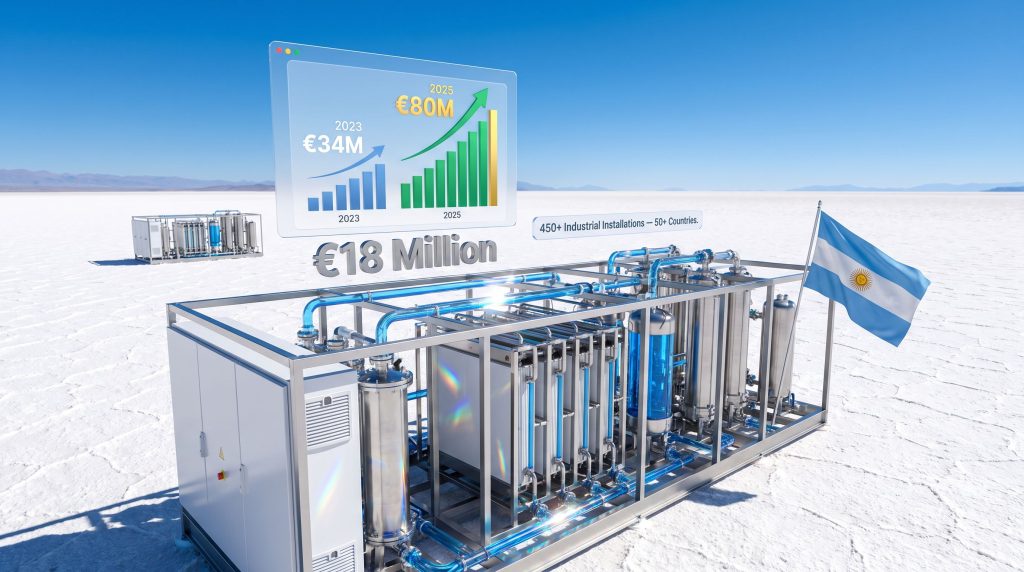
| Total Investment Raised | €18 million |
| Investment Type | Minority equity stake |
| Lead Investors | Starquest Capital (venture capital), Yotta Capital Partners (private equity) |
| Announcement Date | July 2026 |
| Primary Use of Capital | International expansion and industrial project scale-up |
Starquest Capital focuses on high-technology industrial ventures at the intersection of energy transition and advanced manufacturing. Its participation signals that Eurodia's DLE capabilities are being evaluated as a scalable technology platform rather than a project-specific engineering contractor.
Yotta Capital Partners brings private equity discipline to the round, with experience in growing innovative industrial businesses through organisational scaling challenges. Managing Partner Vincent Deltrieu has noted that Eurodia is operating in markets characterised by deep, rapid acceleration, and that the firm's ability to execute complex industrial projects at scale constitutes the company's primary competitive advantage.
The combined venture capital and private equity structure is deliberate. It reflects the dual nature of Eurodia's current position: the company has proven technology and substantial industrial revenue, placing it beyond the early-stage VC profile, but it is also not yet a mature industrial business with predictable steady-state cash flows that would attract pure buyout capital. The blended structure bridges that gap effectively.
What the Capital Will Fund
Eurodia has indicated that the investment will support several strategic priorities:
- Acceleration of its international project deployment pipeline across key lithium-producing jurisdictions
- Expansion of engineering capacity and project delivery infrastructure to handle larger and more complex contracts
- Deepening of DLE-specific technology capabilities and the Saint-Gobain Ceramics partnership
- Transitioning from a project-by-project delivery model toward a more systematised, repeatable industrial platform
That fourth priority deserves particular attention from an investment perspective. The shift from bespoke project engineering to repeatable platform delivery is where industrial technology companies typically experience the most significant margin expansion and valuation re-rating. It is also where execution risk is highest, making the private equity experience of Yotta Capital Partners particularly relevant.
Revenue Trajectory: What the Numbers Reveal
Eurodia's financial profile distinguishes it sharply from the majority of DLE technology companies currently seeking investment. Most DLE developers are pre-revenue or early-revenue businesses, relying on pilot project milestones to validate technology and attract capital. Eurodia, however, is already generating substantial industrial revenue at scale.
| Year | Revenue |
|---|---|
| 2023 | €34 million |
| 2025 | €80 million |
A 135% revenue increase in two years is not a gradual growth story. It reflects a company capturing accelerating demand across multiple industrial sectors simultaneously. The growth has been driven by expanding DLE project pipelines, increasing demand for industrial decarbonisation solutions, and the company's penetration of international markets where conventional industrial separation technologies are being replaced by higher-performance alternatives.
Furthermore, with over 450 industrial installations across more than 50 countries and 80% of revenue sourced internationally, Eurodia's commercial infrastructure already has genuine global reach. The new capital is intended to deepen that reach rather than establish it from scratch, which substantially de-risks the expansion thesis. This positions Eurodia favourably within the broader battery raw materials market as demand for reliable lithium supply chains intensifies.
Large-Scale DLE Deployments: Building the Reference Portfolio
In industrial technology markets, reference projects serve a function that goes well beyond demonstrating technical capability. They are the primary commercial instrument for winning subsequent contracts, because procurement teams at major mining companies place enormous weight on verified large-scale execution when selecting process technology providers. Every successful deployment compounds the value of the next tender.
Eurodia has built what is, by the standards of the DLE sector, an unusually strong reference portfolio.
Rio Tinto's Salar del Rincón: A Landmark DLE Deployment
Rio Tinto's Salar del Rincón project is one of the most significant examples of Argentina lithium brines development in the global lithium industry. The salar's brine chemistry presents meaningful technical challenges, including elevated magnesium-to-lithium ratios that complicate selective extraction and require robust pre-treatment systems to protect downstream separation equipment.
Eurodia's role as DLE systems provider for this project demonstrates the company's capacity to engineer solutions that perform under demanding brine conditions — not just in controlled laboratory environments. Starquest Capital's Mathilde Andrier has described the Salar del Rincón deployment as concrete evidence that European industrial technology can serve as a strategic instrument for securing access to critical materials essential to the energy transition.
Eramet's Centenario-Ratones Project: A Second Major Validation
Eurodia's involvement in Eramet's lithium brine project at Centenario-Ratones in Argentina adds a second distinct geological and operational context to the company's reference portfolio. The two projects sit in different parts of the Argentine lithium-producing region, meaning Eurodia has now demonstrated its systems across varying brine compositions, different operator requirements, and different project scales.
This cross-project validation is technically significant. It suggests that Eurodia's multi-technology integration approach can adapt to variable brine chemistries rather than being optimised for a single geological profile, which substantially broadens the addressable market for future contract wins. Consequently, this track record directly supports battery supply chain growth across Europe and beyond.
For context on technology readiness, DLE projects generally progress through a Technology Readiness Level (TRL) scale from laboratory proof-of-concept (TRL 3-4) through pilot scale (TRL 5-6) to demonstrated commercial deployment (TRL 7-9). Eurodia's two major Argentine deployments place its integrated systems firmly at the commercial end of this scale — a status held by very few DLE technology providers globally.
The next major ASX story will hit our subscribers first
DLE Technology Landscape: How Eurodia's Approach Compares
| Technology Approach | Key Characteristics | Eurodia's Differentiation |
|---|---|---|
| Adsorption-based DLE | High lithium selectivity, batch regeneration cycles | Multi-technology integration with system engineering |
| Ion-exchange DLE | Strong ion selectivity, scalable throughput | Combined with membrane filtration and electrodialysis |
| Solvent extraction DLE | High recovery potential, complex solvent management | Eurodia focuses on adsorption-plus-separation stack |
| Membrane-based separation | Continuous operation, energy-efficient | Integrated as part of broader process architecture |
The competitive differentiator for Eurodia is not any single technology in isolation. It is the system-level engineering capability to combine multiple separation technologies into an integrated process that functions reliably at industrial throughput. This capability is one that chemical engineering expertise and industrial deployment experience confer — and it is not easily replicated by newcomers to the sector.
Beyond Lithium: Eurodia's Circular Economy and Decarbonisation Capabilities
An aspect of Eurodia's business that receives less attention than its DLE credentials is its broader industrial decarbonisation portfolio. The company's technology platform extends beyond lithium extraction to include:
- Recovery of mineral co-products from industrial process streams, improving overall resource efficiency
- Reduction of water, energy, and chemical reagent consumption across separation processes
- Development of CO₂ capture technologies applicable to industrial emitters
- Electrification of chemical processes that have historically depended on fossil fuel-derived heat and reagents
- Solutions for biobased chemistry and lithium recycling from end-of-life battery streams
This portfolio breadth is commercially important because it means Eurodia can engage with industrial clients across multiple value streams rather than competing solely for DLE project contracts. It also positions the company within a broader industrial sustainability narrative that is attracting increasing regulatory attention and capital allocation across European manufacturing.
The Geopolitical Dimension: European Technology in the Critical Minerals Race
The Eurodia Industrie DLE investment carries a geopolitical dimension that is easy to overlook in a purely commercial analysis. Europe's exposure to critical mineral supply chain risks has become a defining strategic concern since the disruptions of the early 2020s exposed the fragility of relying on concentrated geographic sources for battery materials.
The traditional European response to this vulnerability has been to pursue resource access through upstream investment in mining assets. Eurodia's model suggests a different — and arguably more scalable — approach: securing critical material access through technology leadership rather than resource ownership.
By deploying French-engineered DLE systems in partnership with major international mining companies, Eurodia creates a form of strategic presence in critical mineral supply chains that does not require direct resource acquisition. The technology relationship between an industrial solutions provider and a mining operator creates durable commercial dependencies and data advantages that persist across the life of a project.
This approach to critical mineral strategy through industrial technology — rather than upstream resource investment — is likely to attract increasing interest from European industrial policy circles. However, the company's commercial development remains driven by private capital rather than public funding, as noted by analysts tracking the energy transition.
Frequently Asked Questions
What is Eurodia Industrie's core business?
Eurodia Industrie is a French industrial liquid purification and separation technology company. Its platform spans electrodialysis, adsorption, chromatography, ion-exchange resins, and membrane filtration, deployed as integrated solutions for complex industrial separation challenges including DLE, lithium refining, lithium recycling, and industrial decarbonisation.
What is Direct Lithium Extraction and why does it matter?
Direct Lithium Extraction is a family of technologies that selectively remove lithium ions from brine solutions using physical or chemical mechanisms, bypassing the long evaporation pond process used in conventional lithium recovery. DLE systems can achieve recovery rates above 80%, compress processing timelines from months to hours or days, and reduce water consumption. These characteristics make DLE critical to accelerating lithium supply for battery manufacturing at the pace required by electric vehicle adoption forecasts. According to industry research on lithium technologies, DLE is increasingly central to global critical mineral strategies.
How much has Eurodia raised and from whom?
Eurodia secured a €18 million minority equity investment from venture capital firm Starquest Capital and private equity firm Yotta Capital Partners in July 2026.
Which major projects has Eurodia deployed DLE technology on?
- Rio Tinto's Salar del Rincón, Argentina: a landmark large-scale DLE deployment in a technically challenging brine environment
- Eramet's Centenario-Ratones, Argentina: a second major Argentine deployment providing cross-geological validation of Eurodia's systems
What has driven Eurodia's rapid revenue growth?
Revenue grew from €34 million in 2023 to €80 million in 2025 — a 135% increase driven by expanding DLE project pipelines, growing demand for industrial decarbonisation solutions, and international market penetration across more than 50 countries.
How does Eurodia's technology differ from competitors?
Eurodia's primary differentiator is its multi-technology integration capability, combining adsorption, electrodialysis, membrane filtration, and ion exchange into complete process systems tailored to specific brine chemistries. The Saint-Gobain Ceramics partnership further differentiates the company by integrating lithium-selective adsorbent materials with process system engineering, reducing deployment and commissioning risk.
Key Takeaways
- The €18 million Eurodia Industrie DLE investment reflects a maturing institutional view that process-engineering platforms are the critical enabler of DLE commercialisation — not technology licensing alone
- Revenue growth from €34 million to €80 million between 2023 and 2025 confirms Eurodia is already operating as a substantial industrial business, not a pre-revenue technology developer
- Deployments at Rio Tinto's Salar del Rincón and Eramet's Centenario-Ratones give Eurodia one of the strongest large-scale DLE reference portfolios of any process technology provider currently active
- The Saint-Gobain Ceramics partnership addresses the materials-process interface problem that has caused underperformance in multiple DLE scale-up attempts
- Eurodia's multi-technology platform spanning adsorption, electrodialysis, ion exchange, and membrane filtration positions it to serve a wider range of brine chemistries than single-technology DLE providers
- The combined venture capital and private equity investment structure reflects Eurodia's position between early-stage technology validation and mature industrial scale — where organisational and commercial execution becomes the primary competitive determinant
This article contains forward-looking analysis and revenue projections based on publicly available information. It does not constitute financial or investment advice. Readers should conduct their own due diligence before making investment decisions.
Want to Identify the Next Major ASX Mineral Discovery Before the Broader Market?
Discovery Alert's proprietary Discovery IQ model delivers real-time alerts on significant ASX mineral discoveries — instantly translating complex geological and commodity data into actionable investment insights for both short-term traders and long-term investors. Explore historic examples of transformative mineral discoveries and the returns they generated, then begin your 14-day free trial at Discovery Alert to position yourself ahead of the market.