May 12, 2026
The Processing Gap That Threatens European Industry
The global metals industry has spent decades constructing a mental model in which mining is the primary bottleneck in supply chains. Secure the mine, the logic goes, and you secure the metal. But this framework has quietly collapsed under the weight of real-world evidence, and nowhere is that collapse more consequential than across the European continent. The deeper vulnerability is not in ore extraction but in what happens afterward: the smelting, refining, and fabrication stages that convert raw material into the industrial-grade products that factories, grid operators, and manufacturers actually require.
Understanding Europe copper and aluminium import dependence through a processing lens rather than a mining lens fundamentally changes the strategic picture. It explains why securing mining rights in Africa or Latin America does not resolve Europe's supply security challenge, and it explains why premium markets are behaving in ways that defy traditional cyclical analysis.
When big ASX news breaks, our subscribers know first
Why the Security Narrative Has Displaced the Climate Narrative
For most of the past decade, the dominant policy framework for industrial metals was the energy transition. Copper and aluminium were discussed primarily as enablers of electrification, solar infrastructure, and electric vehicle adoption. That framing has undergone a substantive shift, and the change is not merely rhetorical.
At Commodities Trading Week in London on May 6, 2026, a critical minerals panel drew together practitioners from across the metals trading and research community to examine these evolving dynamics. The consensus was unambiguous: supply security and geopolitical resilience have displaced climate-driven electrification as the primary organising logic for metals policy. Amanda Van Dyke, founder of the Critical Minerals Hub, characterised this transition by noting that policy language has moved decisively toward national security frameworks and away from energy transition narratives, with demand remaining structurally strong regardless of which policy lens is applied. [Fastmarkets, May 12, 2026]
This reframing matters because national security frameworks activate different institutional mechanisms, different urgency thresholds, and different funding architectures than climate policy. The practical implication is that metals supply chains are now evaluated through a resilience and sovereignty lens rather than a decarbonisation lens. Furthermore, Europe's critical minerals supply chain faces increasing scrutiny as policymakers grapple with the consequences of decades of underinvestment in domestic processing capacity.
How Deep Is Europe's Copper and Aluminium Import Dependence?
The scale of Europe copper and aluminium import dependence is not easily overstated. More than 70% of the region's refined copper supply originates from outside its borders, with key sources concentrated in Chile, the Democratic Republic of Congo, Russia, and China. Recycled metal contributes approximately 30% of EU copper consumption, which, while meaningful, remains structurally insufficient to offset primary import requirements. [Fastmarkets, May 12, 2026]
Aluminium presents an even more acute picture. European dependence on primary aluminium imports is near-total, with approximately 20% of regional aluminium billet supply sourced specifically from Gulf Cooperation Council members including the United Arab Emirates, Bahrain, and Saudi Arabia. These are value-added products such as extrusion billet, not raw ore, which means any supply disruption in the Gulf region does not simply reduce raw material availability but removes finished, specification-grade products from the European supply chain with little immediate substitution available. [Fastmarkets, May 12, 2026]
The Netherlands and Germany as Barometers of Bloc-Wide Exposure
Dutch data for 2024 reveals that aluminium and copper together account for more than 75% of the country's critical raw materials import value, a proportion that mirrors patterns observed across other major EU economies. Germany, the bloc's largest industrial economy, leads extra-EU imports of both copper and aluminium waste streams, demonstrating that even the most manufacturing-intensive member states are deeply embedded in import-dependent supply arrangements.
| Metal | EU Import Dependence | Recycled Supply Share | Key Import Sources |
|---|---|---|---|
| Copper | Over 70% of refined supply | ~30% | Chile, DRC, Russia, China |
| Aluminium (primary) | Near-total dependence | ~42% secondary | Russia, Middle East, China |
| Aluminium Billet (6063) | ~20% sourced from Gulf | Value-added products | UAE, Bahrain, Saudi Arabia |
A less visible dimension of this exposure involves indirect imports: metals embedded in manufactured components, machinery, and intermediate goods that enter the EU through finished product trade rather than commodity channels. Direct fabrication imports of metals surged approximately 29% between 2015 and 2019, suggesting that Europe's integration into foreign-processed metal supply chains accelerated substantially in the years before the pandemic and the energy crisis. The layered nature of these flows makes supply disruption harder to detect and respond to in real time.
Valery Sikorskiy, trader at Greenwich Metals Inc, articulated the breadth of this exposure at the May 2026 panel: Europe's position as a globally significant importer of metals across virtually every category leaves it acutely sensitive to geopolitical developments, whether originating in the Middle East or, as recent history demonstrated, in Ukraine. [Fastmarkets, May 12, 2026]
What Is Driving the Collapse of Europe's Domestic Metals Processing Capacity?
The hollowing out of European smelting and refining capacity is not a new phenomenon, but it has accelerated dramatically since 2021. The primary driver is structural energy cost disadvantage. Primary aluminium smelting is among the most energy-intensive industrial processes in existence, typically requiring between 12,000 and 15,000 kWh per tonne of metal produced. When European power costs rose sharply following the intensification of geopolitical disruption in 2022, a substantial portion of the continent's remaining aluminium smelting capacity became economically unviable at prevailing metal prices.
The result has been a cascade of closures and curtailments that, taken together, represent a material and partially irreversible reduction in European processing capability. The broader aluminium supply landscape across the continent has consequently shifted in ways that are proving difficult to reverse:
| Year | Facility | Country | Status |
|---|---|---|---|
| 2021 | Aldel smelter | Netherlands | Permanently closed |
| 2021 | Alcoa San Ciprián | Spain | Curtailed (partial) |
| 2022 | Norsk Hydro Slovalco | Slovakia | Offline |
| 2023 | Uniprom KAP | Montenegro | Closed |
| 2023 | Speira Rheinwerk | Germany | Closed |
Approximately 50% of Europe's remaining aluminium smelting capacity has been idled since 2021, with a portion of those closures now considered permanent rather than temporary curtailments. The distinction matters: temporary curtailments can be reversed when economics improve, but permanent closures eliminate physical infrastructure that would require years and substantial capital to rebuild.
Potential restarts at Norsk Hydro's Slovalco facility in Slovakia and a return to full capacity at Alcoa's San Ciprián represent incremental recoveries, but they must be assessed against the cumulative scale of closures. The net position for European smelting capacity remains materially weaker than pre-2021 levels, and the structural energy cost disadvantage that drove closures has not been resolved.
Why Smelting and Refining Are the Real Bottleneck
The conventional supply chain risk framework focuses heavily on mine output. Investors, policymakers, and procurement teams monitor production disruptions at major mining operations and track reserve life at key deposits. This focus, while not irrelevant, systematically underweights the more critical constraint: the conversion of mined material into industrial-grade products.
Richard Holtum, Chief Executive Officer of Trafigura, made this point with notable directness at LME Week 2025, stating that mining is not the critical variable in metals supply chains, but that refining and smelting capacity is the decisive constraint shaping supply security. [Fastmarkets, May 12, 2026]
This reframing has profound strategic implications:
- Mining geography does not determine supply vulnerability. Ore can be extracted in Chile or the DRC and still flow through a handful of processing facilities before becoming tradeable metal.
- China's dominance in copper refining means that a large proportion of global copper concentrate, regardless of where it was mined, passes through Chinese smelters before entering the international market.
- Gulf Cooperation Council producers account for approximately 9% of global aluminium output, with a significant share directed toward value-added products, creating a concentrated and geopolitically sensitive node in the European supply chain. [Fastmarkets, May 12, 2026]
- Europe cannot resolve processing dependence through mining rights acquisition alone. Securing upstream extraction agreements without parallel investment in domestic processing capacity leaves the fundamental vulnerability unaddressed.
Jonathon Sims, Senior Research Analyst at Triland Metals Limited, characterised the cumulative effect of these dynamics as an exposure of the fragility within these markets, with Europe remaining heavily reliant on a small number of nations to convert extracted material into the usable products its industries require. [Fastmarkets, May 12, 2026]
Hypothetical Scenario: A Gulf Billet Supply Disruption
To appreciate the practical consequences of processing dependence, consider a scenario in which a sustained geopolitical disruption across the Middle East reduces Gulf aluminium billet exports to Europe by 30% over a six-month period:
- Immediate impact: European extrusion manufacturers face acute input shortages as Gulf-sourced billet, representing approximately 20% of regional supply, becomes unavailable at contracted volumes.
- Premium escalation: Spot billet premiums rise sharply beyond already elevated levels as available inventory is competed for by multiple end-users.
- Downstream sector pressure: Automotive, construction, packaging, and energy infrastructure producers face both production delays and cost pass-through pressures.
- Policy response constraints: With limited domestic billet production capacity, the available responses are constrained to spot market sourcing at elevated premiums or emergency trade facilitation with alternative suppliers.
- Timeline: Given the lead times involved in redirecting shipping flows and qualifying alternative suppliers for specification-critical applications, meaningful supply replacement would take weeks to months, not days.
How Are Copper and Aluminium Premiums Responding to Supply Tightness?
The premium markets for both copper and aluminium in Europe are not behaving like cyclical price fluctuations. They are behaving like structural adjustments to a fundamental supply-demand imbalance.
Copper: Deficit Trajectory and Tightening Availability
The global copper market is projected to record a supply deficit of approximately 150,000 tonnes in 2026, widening to more than 300,000 tonnes in 2027, according to Fastmarkets analysts. [Fastmarkets, May 12, 2026] This trajectory reflects both demand growth that is outpacing primary supply expansion and disruptions to major producing operations. Indeed, the growing copper supply crunch represents one of the most pressing structural challenges facing European industrial buyers in the near term.
Notably, disruptions at Grasberg in 2025, one of the world's largest copper and gold mines with annual production of approximately 1.7 billion pounds of copper, contributed to near-term supply constraints that amplified the underlying deficit dynamic. [Fastmarkets, May 12, 2026]
Fastmarkets assessed the copper EQ cathode premium, CIF Europe, at $120-150 per tonne on May 5, 2026, reflecting tightening availability in the European market. [Fastmarkets, May 12, 2026]
Aluminium: The Near-Doubling of Billet Premiums
The aluminium premium movements recorded between late February and early May 2026 are among the most striking signals of structural market tightness observed in recent years:
| Product | Late February 2026 | Early May 2026 | Change |
|---|---|---|---|
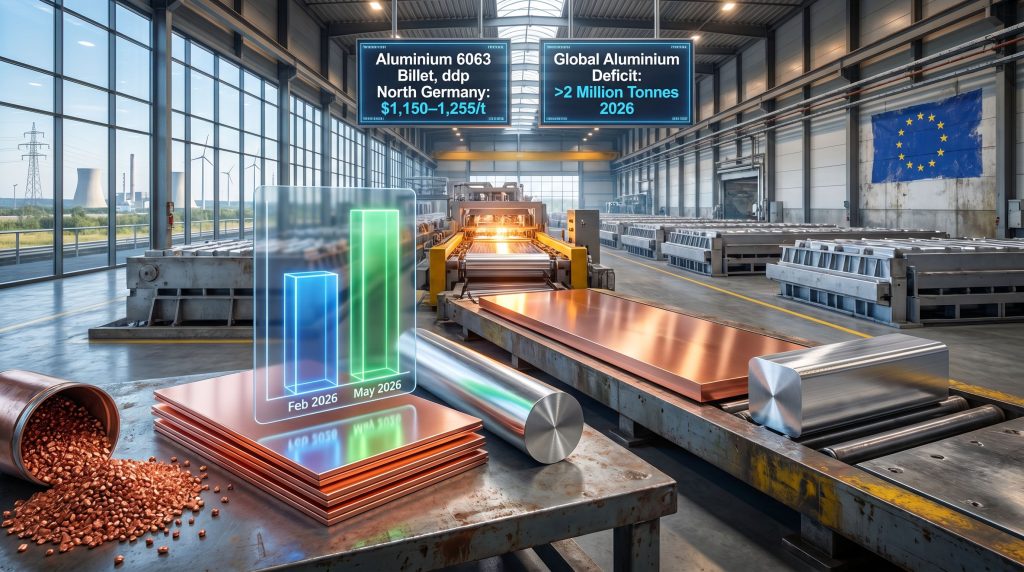
| Aluminium 6063 Extrusion Billet, ddp North Germany (Ruhr) | $560-600/t | $1,150-1,255/t | ~+100% |
| Aluminium P1020A, in-whs Rotterdam | $360-390/t | $580-625/t | ~+60% |
Source: Fastmarkets price assessments, May 8, 2026
The near-doubling of extrusion billet premiums in approximately ten weeks is not a temporary anomaly that will self-correct as logistics normalise. It reflects the convergence of three structural conditions: a projected global aluminium deficit exceeding 2 million tonnes in 2026, approximately 20% of European billet supply sourced from the geopolitically sensitive Gulf region, and the cumulative loss of domestic smelting capacity since 2021. [Fastmarkets, May 12, 2026]
The premium movements recorded in European aluminium markets during early 2026 are a market signal, not a market aberration. They reflect what happens when structural supply gaps collide with rising demand and limited domestic production alternatives.
The next major ASX story will hit our subscribers first
What Role Does Recycling Play in Reducing Europe's Import Dependence?
Secondary supply is a genuine and meaningful counterweight to primary import dependence, but it is not a sufficient one. Recycled metal currently supplies approximately 30% of EU copper consumption, while secondary aluminium contributes a meaningful share of total aluminium demand. In some specialised metals, circular economy mechanisms have achieved substantially higher substitution rates: tungsten recycling within the EU reaches approximately 42%, demonstrating what is achievable when collection infrastructure and processing technology are adequately developed. The question of European critical raw materials supply is, consequently, not solely a mining challenge but equally a recycling and secondary processing challenge.
The Scrap Export Leakage Problem
A paradox has emerged at the intersection of European recycling policy and international trade dynamics. EU aluminium scrap exports reached a record 1.3 million tonnes in 2025, with a significant proportion redirected toward the United States. The driver was tariff arbitrage: US Section 232 tariffs imposed 25% duties on primary metal imports, from which scrap was initially exempt, creating a price incentive for European traders to export secondary raw material rather than feed it into domestic recycling operations.
The consequence is that trade policy designed to protect US manufacturing capacity inadvertently accelerated the depletion of Europe's secondary metal feedstock. Domestic recyclers and secondary smelters, who depend on scrap as their primary input to reduce reliance on imported primary metal, faced tightening feedstock availability precisely when primary import costs were rising. These dynamics are further complicated by steel and aluminum tariff exemptions that have reshaped trade flows in ways that disproportionately affect European secondary material availability.
EU Policy Response: Surveillance and Reciprocal Measures
The European Commission has responded through two primary mechanisms:
- Customs-based surveillance of metal scrap imports and exports, covering steel, aluminium, and copper, implemented since July 2025, enabling systematic monitoring of secondary material flows.
- Proposed Q3 2026 measures including reciprocal scrap trade restrictions targeting nations that impose tariffs on primary metal exports, creating a more symmetrical trade defence architecture.
These measures represent an important recognition that recycling infrastructure is a strategic industrial asset rather than merely an environmental policy instrument. However, their effectiveness depends on enforcement consistency and the willingness of member states to prioritise domestic feedstock retention over short-term export revenue.
How Is EU Policy Evolving to Address Critical Metals Vulnerability?
The European Commission has identified 47 strategic projects aimed at reducing dependence on Chinese and other non-EU sources across the critical minerals supply chain. These span mining, processing, and recycling, reflecting a whole-of-supply-chain policy architecture rather than a narrowly upstream focus. According to the European Commission's critical raw materials framework, these projects represent an integrated response to strategic vulnerability across the full metals value chain.
| Focus Area | Number of Projects | Key Constraint |
|---|---|---|
| Mining and extraction | ~20 | Permitting timelines, community opposition |
| Processing and refining | ~15 | Energy costs, capital intensity |
| Recycling and secondary | ~12 | Scrap supply competition, technology readiness |
On trade defence, tighter steel import quotas are anticipated in the near term, and aluminium safeguard measures are being advanced through EU trade defence processes. US Section 232 tariff updates from April 2026 introduced 25% duties on derivative products containing more than 15% metal content by value, creating indirect pressure on European exporters and reshaping downstream trade flows. The EU is evaluating reciprocal measures to counterbalance these distortions.
A fundamental tension exists within Europe's critical minerals strategy: the ambition to rebuild domestic processing capacity is undermined by the same structural energy cost disadvantage that drove significant smelting capacity offline in the first place. Without concurrent energy market reform, strategic project pipelines risk delivering capacity on paper that is not economically viable in practice.
What Are the Long-Term Demand Drivers Intensifying Europe's Supply Risk?
Even as the policy narrative has shifted toward security framing, the underlying demand drivers from electrification remain fully intact and structurally growing. Electric vehicles, grid infrastructure expansion, renewable energy installation, and building construction all require substantial copper and aluminium inputs at scales that are increasing year over year.
Amanda Van Dyke noted at the May 2026 panel that the global economy's dependence on a consistent and growing supply of metals is not a policy variable, it is a structural condition of modern industrial civilisation. [Fastmarkets, May 12, 2026] Jonathon Sims reinforced this by highlighting that copper supply, particularly on the primary production side, is not keeping pace with the rate at which demand is expanding. [Fastmarkets, May 12, 2026]
| Sector | Primary Metal | Demand Growth Driver |
|---|---|---|
| Electric vehicles | Copper, Aluminium | Battery systems, wiring, lightweighting |
| Grid infrastructure | Copper | Transmission cables, transformers |
| Renewable energy | Aluminium, Copper | Solar frames, wind turbine components |
| Construction | Aluminium | Building facades, structural components |
| Consumer electronics | Copper | Circuitry, connectors |
The simultaneous occurrence of rising demand intensity and contracting European processing capacity is not a manageable cyclical imbalance. It is a compounding structural vulnerability in which each year of inaction widens the gap between what Europe needs and what it can produce or reliably source on favourable terms. Furthermore, as analysts at Mining.com have highlighted, Europe's future metals strategy is being actively hindered by the very crises that make strategic investment most urgent.
Frequently Asked Questions: Europe Copper and Aluminium Import Dependence
Why is Europe so dependent on copper and aluminium imports?
Europe copper and aluminium import dependence reflects a combination of limited domestic ore reserves, the high energy intensity of primary smelting and refining, and decades of industrial capacity rationalisation driven by energy cost disadvantages. The region lacks the processing infrastructure to convert raw materials into industrial-grade metal at the scale required by its manufacturing economy.
Which countries supply most of Europe's copper and aluminium?
For copper, key sources include Chile, the Democratic Republic of Congo, Russia, and China for refined product. For aluminium, Gulf Cooperation Council nations, particularly the UAE, Bahrain, and Saudi Arabia, supply approximately 20% of European aluminium billet, while Russia and China are significant primary aluminium sources.
What is the difference between mining dependence and processing dependence?
Mining dependence refers to reliance on foreign ore extraction. Processing dependence, which is Europe's more acute vulnerability, refers to reliance on foreign smelting, refining, and fabrication capacity to convert raw ore into usable industrial metal. Europe's processing gap is strategically more significant because it cannot be resolved simply by securing upstream mining rights.
How have European aluminium premiums moved in 2026?
Extrusion billet premiums in northern Germany approximately doubled between late February and early May 2026, rising from $560-600 per tonne to $1,150-1,255 per tonne. Rotterdam P1020A premiums rose approximately 60% over the same period, from $360-390 per tonne to $580-625 per tonne. [Fastmarkets, May 8, 2026]
How large is the projected global copper deficit?
The global copper market is projected to record a deficit of approximately 150,000 tonnes in 2026, widening to more than 300,000 tonnes in 2027, based on Fastmarkets analyst projections. [Fastmarkets, May 12, 2026]
What is the EU doing to reduce its metals import dependence?
The EU has identified 47 strategic projects to build domestic critical minerals capacity, implemented customs surveillance of metal scrap exports since July 2025, advanced aluminium import safeguards, and is developing reciprocal trade measures targeting nations imposing tariffs on primary metals. Structural energy cost disadvantages continue to constrain the effectiveness of these interventions.
Navigating a Structural Metals Vulnerability in an Era of Geopolitical Competition
Europe copper and aluminium import dependence is not a cyclical problem with a cyclical solution. It is a structural condition rooted in decades of industrial contraction, energy cost disadvantage, and underinvestment in processing infrastructure. The premium escalation observed across both metals markets in 2026 is a durable market signal reflecting the convergence of tightening global supply, rising structural demand, and a domestic production base that cannot absorb external shocks.
Five priority areas define the strategic response required:
- Processing infrastructure investment: Prioritise smelting and refining capacity restoration over upstream mining rights acquisition, addressing the actual bottleneck in the supply chain.
- Energy cost reform: Resolve the structural power cost disadvantage that makes European primary production uncompetitive relative to Gulf and Asian facilities.
- Scrap retention policy: Strengthen export controls and recycling collection infrastructure to maximise the contribution of secondary supply to domestic needs.
- Supply diversification: Reduce geographic concentration in import sources, particularly for aluminium billet and refined copper, to lower sensitivity to single-region geopolitical disruptions.
- Trade defence alignment: Develop coordinated EU-level responses to tariff-driven trade flow distortions that affect both secondary and primary metal availability.
Without progress across these dimensions, the trajectory is clear. Europe's structural dependence on imported copper and aluminium will deepen as electrification and grid infrastructure investment continues to expand demand. The 47 strategic projects represent genuine policy intent, but the gap between stated ambition and deliverable capacity remains wide, particularly where energy economics continue to penalise domestic production. Markets will continue to price that risk through sustained premium elevation, creating compounding cost pressures for the downstream manufacturers, automotive producers, and infrastructure developers that form the backbone of the European industrial economy.
Disclaimer: This article contains forward-looking projections, market forecasts, and analytical commentary sourced from industry participants and price reporting agencies. Deficit projections, premium assessments, and capacity estimates are subject to change as market conditions evolve. Nothing in this article constitutes financial or investment advice. Readers should conduct independent research and consult qualified advisers before making investment or procurement decisions.
Want to Track ASX Mineral Discoveries Tied to the Metals Driving Europe's Supply Crisis?
As copper deficits widen and aluminium premiums surge, the upstream discovery phase is where significant market opportunities can emerge earliest — Discovery Alert's proprietary Discovery IQ model delivers real-time alerts on significant ASX mineral discoveries, translating complex data across more than 30 commodities into clear, actionable insights for both traders and long-term investors. Explore historic discovery returns on Discovery Alert's dedicated discoveries page and begin a 14-day free trial to position yourself ahead of the next major find.