June 30, 2026
The Metal That Powers Everything Is Running Out of Room to Fall
The global economy has never been more dependent on a single industrial metal than it is on copper right now. Not because of a temporary supply shock or a speculative trading frenzy, but because the physical infrastructure required to support three simultaneous civilisational transitions — electrification, digital intelligence, and decarbonisation — all converge on the same periodic table element: copper, atomic number 29.
Understanding why ASX copper shares riding the boom have delivered some of the strongest returns on the local bourse over the past twelve months requires stepping back from the daily price ticker and examining the structural forces reshaping global commodity demand. When those forces are understood clearly, the current rally looks less like a commodity spike and more like the opening chapter of a prolonged revaluation.
When big ASX news breaks, our subscribers know first
What Copper Is Actually Trading At — And the Road That Got It Here
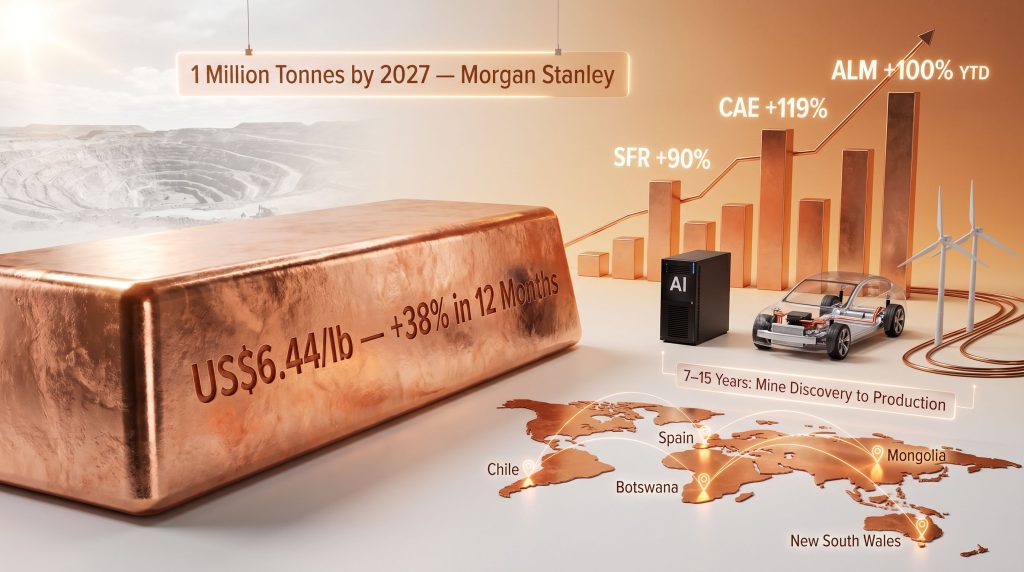
As of May 2026, copper is trading at approximately US$6.44 per pound, according to Trading Economics data on US copper futures. That represents a gain of roughly 38% over the preceding twelve months, a move that has pushed the metal firmly into record territory.
The trajectory of that move is instructive. Copper spent much of 2024 consolidating around the US$4.00 to US$4.50 per pound range before breaking higher as energy transition spending accelerated and AI infrastructure investment began appearing in capital expenditure forecasts at a scale that commodity analysts had not fully priced in. By late 2025, copper had pushed through US$5.09 per pound. By January 2026, COMEX futures tightness combined with a repricing of AI-related demand pushed the metal above US$6.50 per pound. The May 2026 level near US$6.44 per pound reflects sustained structural demand rather than a short-term speculative overshoot.
| Timeframe | Approx. Copper Price | Key Driver |
|---|---|---|
| Late 2024 | ~US$4.00–4.50/lb | Electrification demand building |
| October 2025 | ~US$5.09/lb (US$11,200/t) | Energy transition acceleration |
| January 2026 | ~US$6.50/lb (US$14,000+/t) | COMEX tightness, AI demand repricing |
| May 2026 | ~US$6.44/lb | Sustained structural demand + supply disruption |
| 12-Month Change | +38% | Compounding demand-supply imbalance |
Why the COMEX Market Became a Pressure Point
The COMEX copper futures market, operated by the CME Group in New York, became a critical flashpoint in early 2026 as the spread between futures prices and spot prices widened to historically unusual levels. When futures prices significantly exceed spot prices in a physical commodity market, it typically reflects an expectation that supply will remain tight or tighten further. Traders and physical buyers began aggressively positioning for continued tightness, which amplified upward price pressure beyond what underlying fundamentals alone would have justified in the short term.
Comparing the current cycle to the 2011 copper peak — when prices reached approximately US$4.60 per pound — reveals something important. The 2011 peak was driven primarily by Chinese infrastructure stimulus and post-GFC recovery spending. The current cycle is different in character: it is driven by multiple independent demand sources that are not cyclically linked to each other, which makes a synchronised demand reversal considerably less likely. Understanding the copper price drivers behind this cycle helps clarify why analysts are treating the current rally with such conviction.
The Supply Side: Why More Copper Cannot Simply Be Produced on Demand
One of the most underappreciated dynamics in copper markets is the fundamental asymmetry between demand responsiveness and supply responsiveness. When copper prices rise, demand from end-use sectors does not immediately contract — electrification projects, data centre builds, and EV manufacturing are driven by long-term capital commitments rather than spot price sensitivity. Supply, however, faces structural constraints that prevent any meaningful near-term response.
The core reasons why supply cannot respond quickly include:
- New copper mine development typically requires 7 to 15 years from initial discovery through feasibility studies, permitting, construction, and first production
- No significant new greenfield copper mines are expected to reach production before 2028
- Existing operations face compounding risks from weather events, geotechnical instability, processing failures, and geopolitical disruption
- Ore grades at many of the world's largest copper operations have been declining over decades as the highest-grade mineralisation is progressively extracted
- Capital investment in new mine development was severely curtailed during the low-price environment of 2014 to 2020, creating a pipeline gap that is only now becoming visible in production forecasts
Furthermore, the copper supply crunch unfolding across global markets is expected to intensify as demand from AI infrastructure and electrification accelerates well beyond what current development pipelines can accommodate.
The Grasberg Disruption: A Case Study in Supply Fragility
The Grasberg mine in Indonesia, operated by PT Freeport Indonesia, represents one of the world's largest copper and gold deposits by reserve size. A fatal mudslide at the operation in the prior year interrupted production and set back the timeline for returning to full output capacity. As of May 2026, Reuters has reported that the recovery timeline extends through 2027, with a full return to nameplate capacity remaining uncertain.
The Grasberg situation illustrates a broader point about copper supply fragility that markets frequently underestimate: because so much of global copper production is concentrated in a relatively small number of very large mines, disruption at any single major operation creates disproportionate market impacts. Unlike commodities produced across thousands of diffuse operations, copper supply is highly concentrated geographically and operationally.
The Sulphuric Acid Constraint: The Bottleneck Most Investors Have Never Heard Of
Sulphuric acid is an essential processing input for copper production, particularly in hydrometallurgical extraction methods. The copper leaching process relies heavily on acid availability, and when sulphur supply tightens, copper processing capacity can become constrained independently of mining output. The acid is produced primarily from sulphur, a byproduct of oil and gas processing, and from the smelting of sulphide copper concentrates.
Reports from TradingView and commodity market sources in mid-2026 pointed to tighter sulphur availability linked to disruption in Middle Eastern production regions and China's move to restrict certain sulphur and related chemical exports. This secondary constraint on copper refining capacity is an often-overlooked amplifier of price sensitivity at the refinery level — it means that even when mine production is adequate, the conversion of that production into refined copper can face bottlenecks.
For investors, the sulphuric acid supply chain represents a hidden risk factor that rarely appears in mainstream copper market commentary but can materially affect refined copper output and therefore spot price dynamics.
The Structural Deficit: S&P Global's Long-Range Assessment
S&P Global has forecast copper market deficits extending well beyond 2024, with analysis suggesting the gap between mine supply growth and demand expansion widens progressively through the late 2020s. The central conclusion from multiple independent commodity research houses is that the copper market is entering a period of structural undersupply that cannot be resolved through price signals alone, because the supply response lag is too long relative to the pace of demand growth.
Analysts have increasingly characterised 2026 as potentially representing a generational opportunity for copper exposure, with the structural deficit thesis providing a multi-year investment rationale rather than a cyclical trading narrative.
How Copper Demand Breaks Down Across the Modern Economy
Copper's extraordinary versatility as a conductor of electricity and heat makes it essential across virtually every sector of the modern economy. Understanding the composition of demand helps explain why the current growth trajectory is unusually durable.
| End-Use Sector | Primary Copper Application | Primary Growth Driver |
|---|---|---|
| AI Data Centres | Wiring, cooling systems, power infrastructure | Hyperscaler capital expenditure expansion |
| Electric Vehicles | Motors, battery systems, charging infrastructure | EV adoption acceleration globally |
| Renewable Energy | Solar and wind grid connections, transmission cables | Decarbonisation investment |
| Construction | Plumbing, electrical wiring, HVAC systems | Urbanisation in emerging markets |
| Industrial Equipment | Motors, transformers, industrial machinery | Manufacturing reshoring trends |
| Power Grid Upgrades | High-voltage transmission, substations | Grid modernisation worldwide |
Why AI Emerged as the Demand Driver That Caught Markets Off Guard
Of all the forces driving copper demand higher, artificial intelligence infrastructure was the one that commodity analysts most significantly underestimated. The scale of physical copper embedded in modern data centre construction is substantial: each facility requires extensive internal wiring, liquid cooling infrastructure with copper heat exchangers, backup power systems, and connections to electricity transmission networks that themselves require significant copper deployment.
Morgan Stanley has projected that AI data centres alone could consume approximately 1 million tonnes of copper annually by 2027, equivalent to roughly 2.1% of total global demand in 2026. This is a demand category that was effectively negligible a decade ago. For 2026 specifically, data centre copper consumption forecasts approach 740,000 tonnes, a figure that represents an entirely new and rapidly growing demand source layered on top of already accelerating electrification and EV-related demand.
The compounding effect is critical to understand: every new data centre does not simply require copper within its own walls. The power draw of large-scale AI computing facilities necessitates grid upgrades, new substations, and expanded transmission capacity in the surrounding region — all of which are copper-intensive infrastructure investments in their own right.
The Green Energy Multiplier
Electric vehicles contain approximately three to four times more copper than conventional internal combustion engine vehicles. Wind turbines, particularly offshore installations, require substantial copper in their generators, cabling, and connection infrastructure. Solar installations require copper wiring throughout. The energy transition is therefore not simply adding one new source of copper demand — it is fundamentally changing the copper intensity of the global economy's energy system, creating a structural multiplier effect on baseline demand.
Which ASX Copper Shares Are Positioned to Benefit
ASX copper exposure spans a wide spectrum of risk, return potential, and actual copper price sensitivity. Understanding these distinctions is essential for constructing appropriate portfolio exposure. Consequently, ASX copper shares riding the boom have attracted growing attention from both institutional and retail investors seeking direct commodity leverage.
Not all copper stocks respond equally to copper price movements. A company generating 20% of its revenue from copper will behave very differently from one generating 95% of its revenue from a single high-grade copper mine. Clarifying this distinction before allocating capital is one of the most important steps an investor can take.
Tier 1: Large Diversified Miners With Copper Exposure
BHP Group Ltd (ASX: BHP) gained 2.83% to $59.98 on the day copper hit recent record levels in May 2026. BHP has publicly identified copper as a priority growth metal for the coming decade, with ongoing investment in copper assets and strategic positioning around the metal's long-term demand profile. However, copper is one segment within a broader portfolio that includes iron ore and other commodities. BHP's year-to-date performance as of early 2026 was down approximately 20%, reflecting the drag of other commodity exposures on the overall earnings picture.
Rio Tinto Ltd (ASX: RIO) gained 3.05% to $185.27 on the same day. Rio's copper exposure includes the Oyu Tolgoi operation in Mongolia, one of the world's largest copper-gold deposits by proven reserve, which is now in underground production ramp-up. Like BHP, Rio's earnings are not solely copper-driven, and the company's year-to-date performance was down approximately 14% as of early 2026.
The key insight for investors in these names is that diversification buffers downside risk but simultaneously dilutes the upside leverage that copper-focused investors are seeking. Both stocks provide copper exposure with significant earnings diversification, which may suit certain risk profiles but will underperform pure-play producers in a sustained copper bull market.
Tier 2: Pure-Play and Near-Pure-Play ASX Copper Producers
Sandfire Resources Ltd (ASX: SFR) is widely regarded as the ASX's most direct large-cap copper proxy, having delivered approximately +90% over 12 months to reach a market capitalisation in the AU$4.7 billion to AU$8 billion range. The company's key assets are the Motheo copper mine in Botswana and the MATSA copper operations in Spain, providing geographic diversification across politically stable jurisdictions. Sandfire's share price gained 2.81% to $19.05 on the day of copper's record push in May 2026.
MAC Copper Ltd (ASX: MAC) operates the CSA copper mine in New South Wales, one of Australia's highest-grade copper operations. The mine's grade profile of approximately 4.1% copper is significantly above the global average for operating copper mines, which provides a meaningful cost and margin advantage relative to lower-grade peers. MAC is targeting annual production of 50,000 tonnes with quarterly output of approximately 8,600 tonnes, at a market capitalisation of approximately AU$758 million.
Grade is one of the most important and least discussed factors in copper mining economics. A mine operating at 4% copper grade produces substantially more copper per tonne of rock processed than a mine at 0.5% copper grade, with significantly lower energy, water, and processing costs per unit of output. Higher-grade operations therefore benefit disproportionately from rising copper prices.
Aeris Resources Ltd (ASX: AIS) operates the Tritton copper mine in New South Wales and the Jaguar base metals operation in Western Australia. Annual production guidance for FY2025 is approximately 25,000 tonnes copper equivalent, with forecast profit of approximately AU$80 million at current copper prices. The market capitalisation sits in the AU$174 million to AU$190 million range. The primary risk to watch is mine life extension — current operational life estimates without reserve additions are in the 4 to 5 year range, making ongoing exploration success a material variable for long-term value.
Tier 3: Junior and Exploration-Stage ASX Copper Names
Smaller copper stocks can deliver exceptional short-term returns during commodity rallies but carry proportionally higher risks, including exploration uncertainty, ongoing capital requirements, shorter mine lives, and significantly greater share price volatility. These stocks are not appropriate for all investors, and position sizing discipline is critical.
29Metals Ltd (ASX: 29M) demonstrated the leverage potential of smaller copper names by jumping +10% in a single trading session on copper's record day in May 2026, substantially outperforming the larger diversified miners.
AIC Mines Ltd (ASX: A1M) and FireFly Metals Ltd (ASX: FFM) represent Queensland and exploration-stage copper exposure respectively at the junior end of the ASX copper universe, offering higher speculative upside with correspondingly higher risk.
Cannindah Resources Ltd (ASX: CAE) holds a resource of 14.5 million tonnes at 1.09% copper equivalent that carries particular strategic significance: Codelco, one of the world's largest copper producers by output, has been involved in validating the resource. Third-party validation from a major global operator is a meaningful signal in junior exploration markets, as it reduces geological uncertainty. Cannindah delivered approximately +119% in the first quarter of 2026.
Alma Metals Ltd (ASX: ALM) is advancing the Briggs copper project with scoping studies flagging potential copper recovery rates of up to 95%, which if realised in production would represent an unusually efficient recovery profile. At a market capitalisation of approximately AU$21 million and year-to-date performance of approximately +100%, Alma exemplifies the extreme leverage available in the junior copper segment.
Cobre Ltd (ASX: CBE) has assembled a multi-jurisdiction copper portfolio including the Sierra Atacama acquisition in Chile, which was generating approximately 400 tonnes per month of copper production at acquisition. Additional exploration assets in Botswana and Western Australia provide optionality. The market capitalisation of approximately AU$96 million and year-to-date performance of approximately +60% position Cobre as a mid-point between pure exploration plays and producing junior companies.
ASX Copper Share Performance Comparison
| Company (ASX Code) | Category | Approx. Market Cap | Performance | Copper Price Sensitivity | Risk Level |
|---|---|---|---|---|---|
| BHP Group (BHP) | Diversified Major | Large-cap | -20% YTD (2026) | Low-Moderate | Low |
| Rio Tinto (RIO) | Diversified Major | Large-cap | -14% YTD (2026) | Low-Moderate | Low |
| Sandfire Resources (SFR) | Pure-Play Producer | ~AU$4.7–8B | +90% (12 months) | High | Moderate |
| MAC Copper (MAC) | Pure-Play Producer | ~AU$758M | Moderate | High | Moderate |
| Aeris Resources (AIS) | Producer | ~AU$174–190M | Positive | Very High | Moderate-High |
| 29Metals (29M) | Small Producer | Small-cap | +10% (single day) | Very High | High |
| Cobre (CBE) | Junior/Multi-Asset | ~AU$96M | +60% YTD | Extreme | High |
| Alma Metals (ALM) | Junior/Explorer | ~AU$21M | +100% YTD | Extreme | Very High |
| Cannindah Resources (CAE) | Junior/Explorer | Small-cap | +119% (Q1 2026) | Extreme | Very High |
The next major ASX story will hit our subscribers first
What ASX Investors Should Ask Before Buying Copper Exposure
The breadth of copper-related investment options on the ASX means that not all copper exposure is created equal. Before allocating capital to any copper share, investors should work through a structured set of questions. In addition, reviewing available copper investment strategies can help frame how different risk profiles align with different parts of the copper market.
- What percentage of company revenue actually comes from copper? A diversified miner with 20% copper revenue behaves very differently from a pure-play with 95% copper revenue.
- What is the mine life, and how are reserve extensions funded? A company with 4 years of mine life and no funded exploration program carries materially different long-term risk than one with 15 years of reserves.
- What is the sovereign risk profile of operating jurisdictions? Australia, Botswana, and Spain carry materially lower sovereign risk than operations in some other copper-producing nations.
- Is the company cash flow positive at current copper prices, or does it require ongoing capital raises? Explorers and developers dilute existing shareholders through equity issuance, which can offset commodity price gains.
- What is the historical correlation between the share price and copper spot prices? Some copper names move more on company-specific news than on copper price movements, making them less effective as commodity proxies.
Understanding Operational Leverage
Operational leverage is the relationship between a change in revenue and the resulting change in earnings. In copper mining, a company with high fixed costs and thin margins at lower copper prices can see earnings multiply dramatically when prices rise above breakeven thresholds. This is why junior copper producers with high-grade assets can generate extraordinary share price returns in a rising price environment — their earnings leverage to copper price is exponentially higher than that of large diversified miners. The inverse is also true: when copper prices fall, highly leveraged operators face disproportionate earnings compression.
Portfolio Construction Considerations
A structured approach to ASX copper exposure might combine complementary positions across the risk spectrum. A core allocation to a pure-play producer like Sandfire provides direct copper price leverage with moderate operational risk. A smaller allocation to a junior explorer with validated resource quality provides high-upside optionality. Furthermore, thoughtful copper project capital allocation across the risk spectrum can meaningfully improve risk-adjusted returns for investors with a multi-year time horizon. For instance, an optional allocation to a diversified major like BHP provides copper exposure with portfolio stability and dividend income. No single approach suits every investor, and concentration in a single commodity sector carries its own risks regardless of the commodity's fundamental outlook.
The Outlook: How Long Can the Bull Market Last?
The structural argument for sustained elevated copper prices rests on the interplay between supply lead times and demand growth velocity. New mines that begin feasibility work today will not produce first copper until the early-to-mid 2030s at the earliest. Meanwhile, demand from AI infrastructure, electrification, and renewable energy deployment is growing annually. The arithmetic of this mismatch points toward deficits persisting well beyond 2028 by most credible industry assessments.
Morgan Stanley's projection of 1 million tonnes of annual copper demand from AI data centres alone by 2027 represents a single demand source of extraordinary scale. Adding that to existing EV, renewable energy, and grid infrastructure demand creates a cumulative demand growth trajectory that available mine development pipelines cannot match.
For context, Southern Copper Corporation, one of the world's largest copper producers by market capitalisation, delivered approximately +54% during a comparable rally period. Several ASX mid-tier and junior copper names significantly exceeded this benchmark during the same timeframe, illustrating the structural leverage advantages available to investors willing to accept higher company-specific risk. For those monitoring which top ASX copper stocks are best positioned for the next phase of the cycle, the interplay between grade quality, jurisdiction, and mine life remains central to any credible assessment.
The scenario in which the copper bull market resolves quickly would require either a dramatic acceleration in mine development globally, a significant demand shock from a major economic contraction, or a technological substitution for copper in key applications. None of these scenarios appears likely over the next three to five years, though investors should incorporate scenario analysis rather than treating any commodity forecast as a certainty.
Key Takeaways
- Copper has risen approximately 38% over 12 months, reaching record levels above US$6.40 per pound in 2026, as confirmed by Trading Economics futures data
- The rally is driven by structural demand from AI data centres, EV adoption, and renewable energy deployment rather than short-term speculation
- Supply cannot respond quickly — new mines take 7 to 15 years to develop, and existing operations face compounding disruption risks including geotechnical events and processing input constraints
- The sulphuric acid supply chain represents an underappreciated processing bottleneck that can amplify copper price sensitivity independently of mining output
- ASX investors access copper exposure across three distinct risk tiers: diversified majors, pure-play producers, and junior explorers, each with different earnings leverage profiles
- Pure-play producers like Sandfire Resources have delivered substantially stronger returns than diversified majors during this rally, reflecting higher copper price sensitivity
- Junior copper stocks including Cannindah Resources, Alma Metals, and Cobre have produced extraordinary short-term returns but carry proportionally higher risks
- Ore grade quality is a critical and often overlooked variable — MAC Copper's 4.1% grade profile represents a meaningful competitive advantage over lower-grade global peers
- Morgan Stanley forecasts data centre copper demand alone reaching 1 million tonnes by 2027, a demand source that was negligible a decade ago
- S&P Global and multiple commodity research houses broadly describe the copper market as entering a multi-year structural deficit with no near-term supply-side resolution
This article contains general information only and does not constitute personal financial advice. Commodity markets and individual company shares involve significant risks, including potential loss of capital. Past performance is not indicative of future returns. Investors should seek independent financial advice tailored to their personal circumstances before making any investment decisions.
Want to Catch the Next Major ASX Copper Discovery Before the Market Does?
Discovery Alert's proprietary Discovery IQ model scans ASX announcements in real time, instantly identifying significant mineral discoveries — including copper — and delivering actionable insights directly to subscribers before the broader market has time to react. Explore why major mineral discoveries have historically generated extraordinary returns on Discovery Alert's dedicated discoveries page, and begin your 14-day free trial today to position yourself ahead of the next major find.