May 12, 2026
Block Cave Mining and the Economics of Recovery: What Grasberg's Disruption Reveals About Copper Supply Risk
The global copper market has long carried a structural vulnerability that receives far less attention than demand-side narratives around electrification and energy transition: the extraordinary concentration of supply in a small number of technically complex underground operations. When any one of these tier-one assets falters, the ripple effects extend far beyond a single company's earnings report. They reshape commodity pricing, recalibrate supply forecasts, and expose the fragility of an industrial metal supply chain that modern economies increasingly cannot function without.
Nowhere is this dynamic more visible right now than at the Grasberg mine in Papua, Indonesia, where Freeport-McMoRan's ongoing recovery from a September 2025 underground mudflow event has become one of the most consequential supply stories in the copper market today. The Freeport Grasberg recovery 2027 forecast sits at the centre of an active debate between corporate guidance, operational conservatism, and market interpretation. Understanding the mechanics behind that debate requires more than a surface reading of press releases, particularly given broader copper supply crunch dynamics already at play across the industry.
When big ASX news breaks, our subscribers know first
Why Grasberg Occupies a Category of Its Own in Global Copper Supply
Grasberg is not simply a large mine. It occupies a structurally unique position in the global copper supply chain by virtue of its scale, its geology, and its dual role as both the world's second-largest copper reserve base and the largest gold mine by reserve globally. That combination of metals output from a single operation is extraordinary and shapes how markets respond to any disruption there.
The mine sits in the Sudirman Mountain Range at elevations that create significant logistical complexity. What began as an open-pit operation transitioned over years into a series of large-scale underground block cave mining panels. This method extracts ore by allowing overlying rock to cave progressively into a series of extraction points called drawpoints, through which broken ore is removed. Block caving is one of the most productive mass-mining methods available, but it is also one of the least forgiving when disrupted.
The geometry of a cave in progress cannot be easily paused and restarted. Drawpoint sequencing, cave propagation rates, and the stress redistribution across the ore column are all interdependent variables that require continuous management.
The ownership structure adds another layer of complexity. Indonesian government entities hold a 51.24% controlling interest in PT Freeport Indonesia (PTFI), the operating entity, while Freeport-McMoRan retains 48.76% and manages day-to-day operations from its Phoenix, Arizona headquarters. This dual-principal arrangement, where the majority owner is a sovereign stakeholder and the minority partner is the operational manager, creates a governance dynamic with no clean parallel in conventional listed mining companies.
The September 2025 Mudflow: What Happened Underground and Why It Matters
On September 8, 2025, an underground mudflow event within the Grasberg Block Cave (GBC) section triggered a sequence of consequences that would reshape the mine's production trajectory for years. Seven workers were killed, and all underground operations were suspended immediately. The scale of wet material displaced, estimated at approximately 800,000 tonnes, was sufficient to compromise the structural integrity of the primary production zone in the GBC, which represents the highest-volume extraction section in the entire operation.
Understanding why this particular incident is so difficult to remediate requires some familiarity with how block cave drawpoints function. In a conventional block cave operation, drawpoints are underground openings through which fragmented ore flows by gravity after the overlying rock mass caves. When excess moisture infiltrates these points — either from groundwater ingress or from wet material displaced by an event like a mudflow — it creates what the industry terms wet drawpoints.
These are not simply damp workings. They represent extraction points where the rheological behaviour of the material changes, where flow control becomes unpredictable, and where both equipment and personnel safety risks increase substantially.
Crucially, wet drawpoint remediation cannot be rushed without risking further geotechnical instability. The modification process involves drainage works, structural reinforcement, and a managed reintroduction of draw scheduling, all of which must be sequenced against the ongoing dynamics of the cave itself. This is why Grasberg's recovery timeline extends well beyond what might be expected for other types of underground mining incidents.
Not all sections of the operation were equally affected. The Deep Mill Level Zone (MLZ) and Big Gossan, two distinct production blocks within the Grasberg underground complex, were partially unaffected by the initial mudflow and were able to begin partial restarts in the fourth quarter of 2025 and into early 2026. The GBC, however, required a more extended remediation period before any restart could be attempted.
| Production Zone | Status Post-Incident | Restart Timeline |
|---|---|---|
| Grasberg Block Cave (GBC) | Fully halted | Partial restart: April 2026 |
| Deep Mill Level Zone (MLZ) | Partially unaffected | Partial restart: Q4 2025 |
| Big Gossan | Partially unaffected | Partial restart: Q4 2025 / Early 2026 |
| Production Block 1 (GBC) | Under active repair | Completion target: Early 2027 |
Where Recovery Stands in Mid-2026 and Why the Targets Shifted
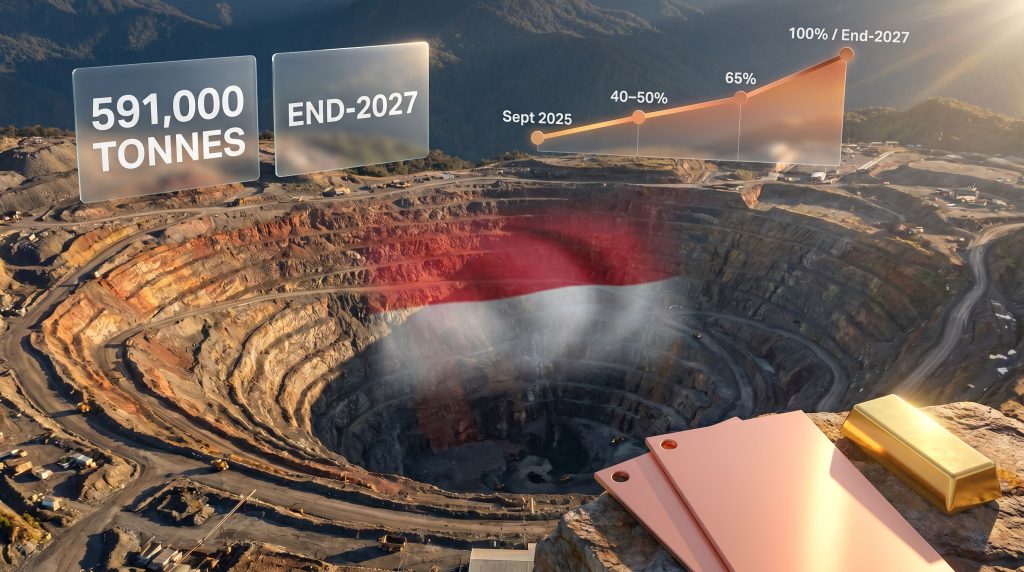
By April 2026, a partial GBC restart marked the first meaningful inflection point in the recovery trajectory. As of May 2026, overall operating capacity sits at approximately 40 to 50% of pre-incident levels, with the partial reactivation of GBC contributing alongside the continued output from MLZ and Big Gossan.
What is particularly instructive for copper market participants is the revision to Freeport's near-term recovery forecast. The company originally projected that 85% of production capacity would be restored by the second half of 2026. That target was revised downward in late April 2026 to 65%, a reduction that reflects the technical complexity of wet drawpoint modification rather than any fundamental change to the mine's long-term recovery path.
This kind of mid-course guidance revision is not uncommon in block cave mining, where recovery from geotechnical disruption is inherently non-linear. The cave system's behaviour during a ramp-up phase is difficult to model precisely because it depends on how the rockmass responds to changing draw rates, how moisture migrates through the fragmented ore column, and whether secondary caving events occur as extraction resumes.
The revised production outlook reflects a staged ramp-up approach:
| Recovery Milestone | Target Timeline | Capacity Level |
|---|---|---|
| Partial GBC Restart | April 2026 | ~40-50% overall |
| H2 2026 Ramp Target | Second Half 2026 | ~65% capacity |
| Pre-Full Production Phase | Mid-2027 | ~80% capacity |
| Wet Drawpoint Modifications Complete | March 2027 | Key technical prerequisite |
| Full Capacity Restoration | End-2027 (FCX) / Early 2028 (PTFI) | 100% |
The 2026 annual production impact is significant. Against an original target of approximately 1.7 billion pounds of copper and 1.6 million ounces of gold, the disruption has reduced expected 2026 output by roughly 35% compared to pre-incident plans. Estimated insurance coverage of up to $1 billion provides a partial financial buffer, though it addresses earnings impact rather than the physical supply gap, which is what commodity markets price most directly.
The 2027 Versus 2028 Debate: Governance, Communication, and Market Interpretation
The most market-moving development in this story did not come from an unexpected operational setback. It came from a communication gap between two different principals within the same asset structure.
In early May 2026, the Indonesian head of PT Freeport Indonesia indicated publicly that full production restoration could extend into 2028, a statement that sent copper prices to a three-month high as markets interpreted it as a new supply shock disclosure. The reaction was swift and significant: Freeport's shares subsequently gained 5% on May 12, 2026, closing at $64.75, as copper prices advanced more than 2.5%, once the corporate guidance position was reaffirmed.
Freeport's response was unambiguous. The company stated that PTFI's revised mine plans and ramp-up progress had already been disclosed on April 23, 2026, in connection with Freeport's earnings release, and that media coverage was presenting already-public information as though it were new. The company further clarified that any genuine delay beyond the 2027 timeline would have triggered a formal market alert, and the absence of such an alert was itself informative.
Freeport's quarterly update filed with US regulators on May 9, 2026 explicitly reiterated the end-2027 target, providing a formal regulatory record to anchor the guidance position.
CEO Kathleen Quirk was scheduled to address Grasberg operations directly during the Bank of America Global Metals, Mining and Steel Conference on May 13, 2026, providing an additional venue for clarification.
The divergence between Freeport's 2027 corporate guidance and PTFI's operational-level 2028 signal is less a contradiction than a reflection of different probability thresholds. Corporate guidance represents a formally disclosed, legally significant commitment. Operational-level statements from local management often reflect conservative engineering estimates built around worst-case sequencing scenarios rather than the central case underpinning investor guidance.
This distinction matters enormously for investors. In dual-principal mining structures where a sovereign entity holds majority ownership and an international operator provides management, the potential for communication asymmetry is structural, not accidental.
What the Communication Gap Reveals About Dual-Principal Mining Governance
The Grasberg situation offers a rare live example of how governance architecture can generate conflicting market signals from the same operational reality. When Indonesian government entities hold 51.24% of an operating company and a US-listed corporation holds 48.76% while managing the asset, there is no single communication channel. There are at minimum two, each accountable to different stakeholders and operating under different disclosure obligations.
For investors in copper markets, this has practical implications:
- Statements from operating subsidiary leadership in majority-government-owned structures carry operational weight but may not reflect the parent company's formal guidance position
- The parent company's SEC filing and earnings release carry the highest formal weight for investors in listed entities
- Price-sensitive market reactions to subsidiary-level statements may create short-term dislocations that reverse once corporate guidance is reaffirmed
- Investors monitoring dual-principal mining assets should develop a framework for weighting different communication sources rather than treating all statements as equivalent disclosures
Block Cave Geology and Why Wet Drawpoint Modification Is the Critical Path Item
For readers less familiar with underground mass-mining methods, the technical terminology in Grasberg's recovery updates can obscure what is actually happening underground and why the timelines are what they are.
Block caving works by undercutting a large ore body at depth, allowing gravity and the weight of overlying rock to progressively fragment and cave the ore column above. Extraction points — the drawpoints — are arranged in a regular grid pattern below the caving column. Ore flows through these points and is collected, transported underground, and hoisted to surface. The method is extraordinarily efficient at scale, capable of processing tens of thousands of tonnes per day from a single cave, but it depends entirely on the controlled, predictable flow of fragmented ore through those extraction points.
When a mudflow event saturates portions of the cave column and drawpoint infrastructure with wet, viscous material, several problems emerge simultaneously:
- Flow behaviour becomes unpredictable, with wet material at risk of surging or blocking draw points irregularly
- Geotechnical stability of the drawpoint openings is compromised by the weight and pressure of saturated material
- Draw scheduling, the carefully managed sequence by which different drawpoints are activated and loaded, must be suspended and recalibrated from scratch
- Equipment operating in proximity to wet drawpoints faces significantly elevated risk of entrapment or damage
The modification program required to address these conditions involves drainage infrastructure installation, drawpoint structural reinforcement, and a carefully managed reintroduction of draw loading that monitors cave behaviour in real time. With the wet drawpoint modification program targeted for completion by March 2027, this represents the single most critical path item in Grasberg's recovery schedule.
The next major ASX story will hit our subscribers first
Copper Market Implications: When Concentrated Supply Meets Structural Demand Growth
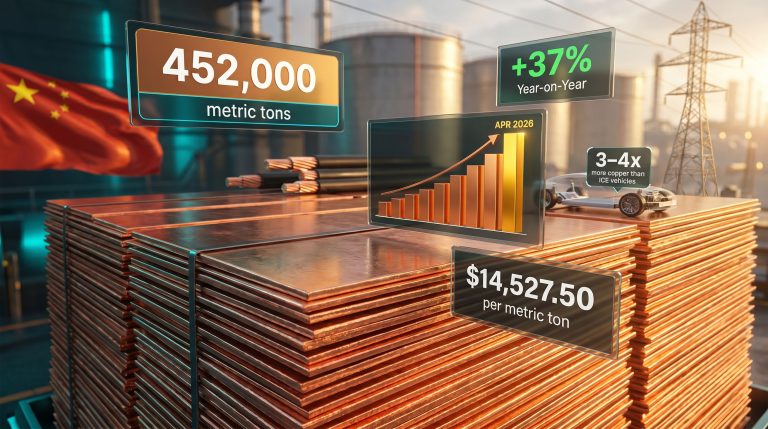
The Grasberg disruption does not exist in a vacuum. It is unfolding against a backdrop of broadly acknowledged structural tightness in global copper supply, driven by a combination of demand growth from electrification, energy transition infrastructure, and EV manufacturing, and supply constraints that extend well beyond Grasberg to other major operations globally. Furthermore, understanding the copper price growth drivers at play helps contextualise just how consequential this single asset's disruption can be.
Copper's physical properties make it irreplaceable in the applications driving demand growth. Its conductivity, malleability, and durability give it a central role in:
- Electric vehicle powertrains and charging infrastructure, where copper content per vehicle is substantially higher than in internal combustion equivalents
- Grid modernisation programs across North America, Europe, and Southeast Asia, where aging transmission infrastructure requires replacement and expansion
- Renewable energy generation, where both solar and wind installations are copper-intensive per unit of installed capacity
Against this demand context, cumulative output losses from the Grasberg incident are estimated at approximately 591,000 tonnes through the end of 2026. In a global refined copper market where annual supply and demand are broadly in balance, a loss of that magnitude from a single asset is not a rounding error. It is a structural supply event that puts upward pressure on prices and potentially accelerates investment decisions in alternative supply sources.
The insurance coverage of up to $1 billion addresses Freeport's financial exposure. It does nothing for the physical copper supply gap, which falls entirely on a market that is already facing competing claims on available inventory. Indeed, the largest copper mines globally are under increasing scrutiny as investors assess where the next production shortfall may emerge.
What Investors Should Take From the Grasberg Recovery Story
The Freeport Grasberg recovery 2027 forecast, and the debate around whether it slips to 2028, is ultimately a proxy for a broader question about how the copper market prices geotechnical and governance risk at concentrated supply assets. Consequently, projects such as the Reko Diq copper-gold project in Pakistan are attracting renewed attention as potential long-term supply alternatives. In addition, those evaluating copper investment strategies must weigh single-asset concentration risk as a core variable in portfolio construction.
Several observations are worth carrying forward:
- Market price reactions to subsidiary-level statements at dual-principal mining operations can be sharp but may reverse quickly once parent company guidance is formally reaffirmed, as the May 12, 2026 trading session illustrated
- Block cave mining incidents carry inherently longer recovery curves than open-pit disruptions because the underground cave system must be managed continuously, and wet material events require remediation timelines measured in months to years rather than weeks
- The critical path item at Grasberg remains the wet drawpoint modification program, and any investor monitoring the Freeport Grasberg recovery 2027 forecast should track progress on this specific technical prerequisite rather than overall capacity utilisation as the primary leading indicator
- Insurance coverage provides earnings protection but does not replace physical production, and commodity markets correctly price the physical supply gap rather than the financial hedge
- Copper supply concentration risk is not evenly distributed across the global reserve base. A disproportionate share of near-term producible supply is held within a small number of large underground operations, each of which carries its own geotechnical and jurisdictional risk profile
According to Channel NewsAsia's reporting on the production timeline, the divergence between PTFI's local guidance and Freeport's corporate position reflects precisely these dual-principal dynamics, underscoring the importance of identifying which disclosure carries formal regulatory weight.
The above analysis contains forward-looking elements based on publicly disclosed corporate guidance and operational reporting as of May 2026. Production timelines, capacity restoration targets, and market price movements are subject to change. This article is intended for informational purposes and does not constitute financial or investment advice. Independent financial advice should be sought before making investment decisions.
For ongoing coverage of global copper supply dynamics and major mining operations, Mining Weekly provides continuous reporting on sector developments at miningweekly.com.
Want to Catch the Next Major Copper Discovery Before the Market Does?
Discovery Alert's proprietary Discovery IQ model scans ASX announcements in real time, transforming complex mineral data into actionable insights the moment significant discoveries are made — exactly the kind of early intelligence that matters when copper supply concentration risk is this acute. Explore historic discoveries and their market returns to understand the opportunity, then start your 14-day free trial to position yourself ahead of the broader market.