June 19, 2026
The Architecture of Dependency: Why Europe's Critical Mineral Crisis Is Now a Procurement Emergency
For decades, the dominant assumption in European industrial policy was that global commodity markets would always self-correct. If one supplier became unreliable, another would emerge. If one processing hub became too dominant, market forces would redistribute capacity. That assumption has now been systematically dismantled. China controls an estimated 85 to 90 percent of global rare earth element (REE) refining capacity, and the structural reality this creates for European battery manufacturers, wind turbine producers, and electric vehicle assemblers is not theoretical risk — it is an active operational constraint reshaping supply chain strategy at the highest levels of policy.
The search for credible alternatives has accelerated dramatically, and one nation has emerged as a structurally compelling candidate: Brazil. The phrase Europa targets four critical mineral projects in Brazil has begun circulating in industry intelligence circles, and understanding what sits beneath that headline requires unpacking three interconnected layers — Brazil's geological endowment, the diplomatic scaffolding the EU has constructed to access it, and the project-level realities that will determine whether cooperation translates into actual supply chain security.
When big ASX news breaks, our subscribers know first
Europe's Raw Materials Vulnerability: A Structural Problem, Not a Cyclical One
The EU's exposure to critical mineral import dependency is not a recent development. What has changed is the political willingness to quantify it publicly and act on it. The EU Critical Raw Materials Act (CRMA), which entered force in 2024, establishes three benchmarks for the bloc's annual consumption by 2030:
- 10% sourced from domestic EU extraction
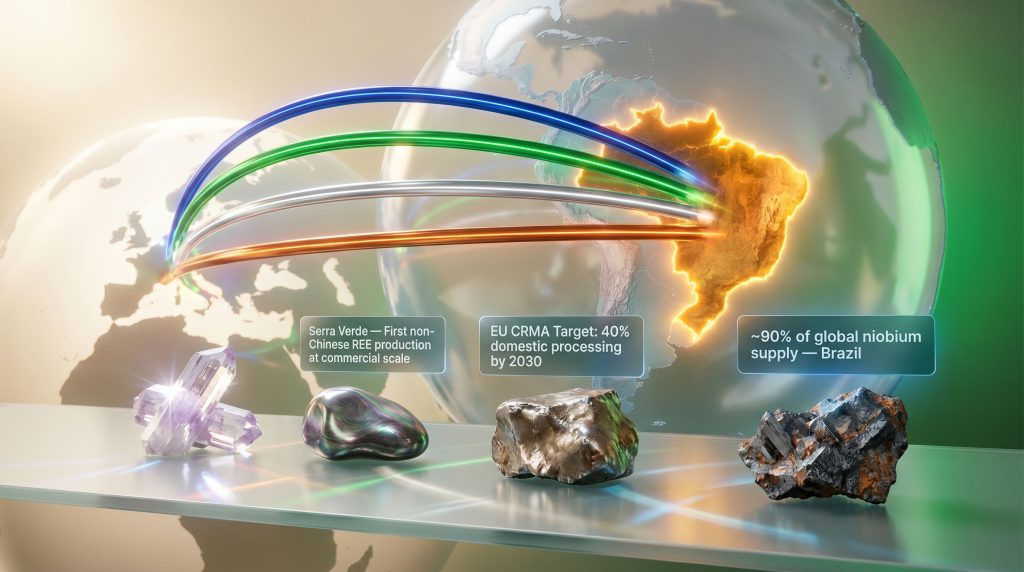
- 40% processed domestically within the EU
- 25% recovered through recycling streams
Meeting even the extraction threshold without strategic external partnerships is considered operationally implausible by most industry analysts. European lithium deposits exist but are insufficient in scale. European REE resources are negligible relative to demand. Furthermore, the processing infrastructure gap is even more pronounced, with refining capacity for battery-grade nickel, lithium hydroxide, and separated rare earth oxides concentrated overwhelmingly outside EU borders.
Europe's critical minerals supply chain faces a particularly acute challenge when it comes to the critical raw materials facility capacity needed to process these inputs at scale.
The CRMA does not eliminate EU import dependency — it creates a structured framework for managing where that dependency is placed, and under what conditions.
This reframing is critical for investors. The CRMA is not a self-sufficiency mandate. It is a supply chain diversification mandate, and Brazil sits at the centre of the EU's response to it. According to the European Parliament's briefing on critical raw materials, the structural dependency on single-source suppliers poses systemic risks that go well beyond pricing volatility.
Why Brazil's Geology Makes It an Irreplaceable Partner
Most nations that feature in critical mineral partnership discussions are single-commodity stories. Australia dominates lithium and REE narratives. Indonesia commands the nickel conversation. Chile and Argentina anchor lithium brine supply chains. Brazil, however, is different because its geological endowment spans nearly every category of mineral the EU needs simultaneously.
| Mineral | Brazilian Significance | Primary EU Application |
|---|---|---|
| Lithium | Hard-rock spodumene deposits, Minas Gerais (Lithium Valley) | EV batteries, grid-scale storage |
| Rare Earth Elements | Ionic clay and carbonatite deposits, Goiás and Minas Gerais | Permanent magnets, wind turbines, EV motors |
| Nickel | Large laterite belts, Piauí and Pará states | NMC battery cathodes |
| Manganese | Among the world's largest producers | Battery cathode materials, steel alloys |
| Niobium | Brazil controls approximately 90% of global supply | High-strength steel, superconductors |
| Vanadium | Emerging production base | Vanadium redox flow batteries, grid storage |
| Copper | Significant reserves in Pará and Bahia | EV wiring systems, grid infrastructure |
What makes this breadth strategically significant is the consolidation benefit it offers European policymakers. Sourcing multiple critical minerals from a single bilateral partner reduces regulatory complexity, unifies ESG monitoring obligations, and simplifies logistics coordination. No other nation under active EU partnership consideration offers this multi-commodity coverage under a single democratic governance framework.
Why Deposit Type Matters for the Rare Earth Supply Chain
A lesser-known geological factor worth understanding is the distinction between Brazil's REE deposit types. The country hosts both carbonatite-hosted REE deposits (typically higher in light REEs such as cerium and lanthanum, which have more limited demand-side pull) and ionic clay deposits (which tend to be enriched in the more commercially valuable heavy REEs, including dysprosium and terbium).
This distinction matters enormously for European buyers, whose demand is driven primarily by the four magnetic rare earths — neodymium, praseodymium, dysprosium, and terbium — used in permanent magnets for EV drivetrains and wind turbine generators. Consequently, not all Brazilian REE projects are created equal in this respect, and deposit mineralogy should be a primary due diligence consideration for any European offtake partner. The broader rare earth supply chain implications of this distinction are significant for long-term European sourcing strategy.
The Four Projects Under European Review: A Sector-by-Sector Assessment
Industry reporting has identified four specific Brazilian operations that are under active consideration within EU-Brazil critical mineral cooperation discussions. These are not formally announced EU selections, but rather projects that have emerged through the structured review process established under the bilateral Hannover Cooperation Framework. Each represents a distinct stage of development and a distinct risk-return profile.
Serra Verde (Goiás State): Rare Earths at Commercial Scale
Serra Verde is arguably the most strategically significant of the four projects for European REE supply chain security. It is reported to be the first operation outside China producing all four magnetic rare earths at commercial scale simultaneously — neodymium, praseodymium, dysprosium, and terbium. That combination, from a single non-Chinese source, is exceptionally rare in the current global production landscape.
The project is in active commercial production, meaning it does not carry development timeline risk. For European automakers and wind energy manufacturers seeking near-term supply chain diversification away from Chinese-processed magnetic REEs, Serra Verde represents a genuinely available option rather than a future promise.
Viridis Mining, Poços de Caldas (Minas Gerais): Pipeline Depth for REE Supply
Viridis Mining adds medium-term supply optionality to Brazil's REE offering, with first extraction targeted for 2028. That timeline, while carrying execution risk, aligns deliberately with the EU CRMA's 2030 benchmarks, creating a window for early offtake structuring by European buyers who need to demonstrate supply chain compliance under the EU Battery Regulation.
The Poços de Caldas region of Minas Gerais has a long history of mineral extraction, including previous rare earth and niobium production at the site level. This established geological understanding reduces exploration risk, though processing infrastructure and environmental permitting remain variables.
Brazilian Nickel, Piauí State: Battery-Grade Supply via Heap Leach
Battery-grade nickel is a critical input for NMC (nickel manganese cobalt) lithium-ion chemistries that dominate European EV manufacturing. The Brazilian Nickel project in Piauí State processes laterite nickel ore using heap-leach technology, a method well-suited to the oxide-dominated mineralogy typical of Brazilian laterite deposits.
| Feature | Detail |
|---|---|
| Location | Piauí State, Brazil |
| Commodity | Battery-grade nickel |
| Processing Method | Heap leach (laterite ore) |
| Operational Status | Active commercial production |
| EU Supply Chain Fit | NMC battery cathode manufacturing |
Heap leach processing for nickel laterites is distinct from the High-Pressure Acid Leach (HPAL) technology used at many Indonesian operations. It carries a lower capital intensity profile but requires careful management of acid consumption and tailings chemistry. The project's active status removes development uncertainty, though remote logistics in Piauí State represent an ongoing operational consideration.
AMG Lithium, Minas Gerais: Value Chain Expansion in Active Production
AMG Lithium operates within the Minas Gerais Lithium Valley, a geological corridor that hosts some of the highest-grade hard-rock spodumene deposits in the world. The project is in active extraction with a refining capacity expansion underway, moving it progressively up the value chain toward lithium hydroxide production — the form most directly usable by European battery cell manufacturers.
This value-add trajectory is significant because it addresses a structural tension in EU-Brazil mineral relations. In addition, European buyers prefer processed intermediates, while Brazil's industrial policy increasingly pushes for in-country downstream processing to capture economic value. AMG's model partially reconciles this tension within a single project framework. The advancement of lithium extraction technologies more broadly will also shape how quickly project economics can improve across the sector.
The Hannover Framework and Global Gateway: From Diplomacy to Capital Deployment
The diplomatic scaffolding for EU-Brazil mineral cooperation is more developed than most public reporting acknowledges. The Hannover Cooperation Framework established a structured mechanism for identifying priority investment targets and facilitating financing discussions between EU institutions and Brazilian project operators.
This connects to the EU's Global Gateway initiative, a €300 billion infrastructure and investment strategy positioned as the EU's answer to China's Belt and Road Initiative. Critical minerals feature prominently in Global Gateway's sectoral priorities, and Brazilian projects that achieve alignment with EU strategic partnership criteria become eligible for co-financing consideration through instruments such as the European Investment Bank (EIB) and the European Fund for Sustainable Development Plus (EFSD+).
The EU-Mercosur trade agreement, ratified in principle after more than two decades of negotiation, creates an additional commercial pathway. It reduces tariff friction on mineral exports from Mercosur member states to EU markets, and establishes regulatory alignment expectations that Brazilian project operators will need to meet to access preferential treatment. For further context on how Brazil is positioning itself, the Brazilian Mineral Industry Association's policy framework offers valuable insight into the country's strategic direction.
Key Risks That Investors and Policymakers Cannot Ignore
The EU-Brazil critical mineral partnership narrative carries genuine strategic logic, but several risk categories deserve rigorous attention rather than optimistic dismissal.
Regulatory and Environmental Permitting
Brazil's mining permitting framework, administered by the National Mining Agency (ANM), operates in parallel with state-level environmental licensing through agencies such as IBAMA. Projects operating in biodiversity-sensitive regions face multi-year permitting timelines that can materially affect production schedules. Indigenous land consultation obligations under Brazilian law add further procedural complexity that cannot be accelerated without legal risk.
Brazil's Multi-Alignment Foreign Policy
The Lula administration has pursued diplomatic relationships across Western, BRICS, and Global South frameworks simultaneously. This creates genuine ambiguity around the exclusivity of EU mineral partnerships. Brazil has simultaneously deepened engagement with Chinese investors across its mining sector, and the risk that Chinese capital outcompetes European offtake structuring at the project level is not negligible.
EU Battery Regulation Compliance
The EU Battery Regulation, phasing in compliance requirements from 2024 through 2027, demands supply chain due diligence and carbon footprint disclosure from battery manufacturers. This creates a traceability requirement that Brazilian project operators must actively build into their operational systems — not simply assert in partnership documentation. Rising critical minerals demand across the energy transition will only intensify these compliance pressures over time.
| Risk Category | Specific Concern | Projects Most Exposed |
|---|---|---|
| Development Timeline | 2028 first production target may face delays | Viridis Mining |
| Refining Bottlenecks | Processing capacity limiting value-add | AMG Lithium |
| Price Cycle Exposure | Lithium and nickel price volatility | AMG Lithium, Brazilian Nickel |
| Traceability Compliance | EU Battery Regulation reporting requirements | All four projects |
| Remote Infrastructure | Logistics costs and access in Piauí | Brazilian Nickel |
| Geopolitical Ambiguity | Parallel Chinese investment in Brazilian assets | All four projects |
The next major ASX story will hit our subscribers first
What This Means for Capital Allocation and Strategic Positioning
For investors tracking the EU-Brazil mineral cooperation theme, the four projects under review present meaningfully different risk-return profiles that should not be treated as a homogeneous category.
- Producing assets (Serra Verde, Brazilian Nickel) offer lower development risk but may carry lower upside optionality relative to cost of entry, since commercial scale operation is already priced into counterparty expectations.
- Development-stage assets (Viridis Mining) carry timeline and permitting risk but offer offtake structuring opportunities at earlier cost points, with meaningful leverage to EU CRMA compliance timelines if execution is achieved.
- Capacity-expansion assets (AMG Lithium) sit in an intermediate zone: operational risk is reduced, but refining expansion introduces capital execution risk alongside the strategic upside of higher-value product positioning.
Disclaimer: This article is intended for informational purposes only and does not constitute financial advice. Investors should conduct independent due diligence before making any investment decisions. Forward-looking statements involve inherent uncertainty and actual outcomes may differ materially from projections.
The Deeper Strategic Signal: Supply Chain Architecture Is Now a Political Act
The fact that Europa targets four critical mineral projects in Brazil as specific, named operations rather than maintaining a generalised partnership dialogue signals a maturation in European supply chain strategy. This is no longer horizon scanning — it is project-level architecture, with financing instruments, trade frameworks, and regulatory alignment mechanisms being deployed in coordination.
For Brazilian project operators and their investors, the practical implications include enhanced bankability, access to EU-backed de-risking instruments, and elevated credibility with European battery manufacturers navigating their own regulatory compliance obligations. For European industry, furthermore, it represents the beginning of a multi-year supply chain reorientation that will require sustained capital commitment, ESG discipline, and geopolitical patience.
Brazil's combination of geological breadth, democratic governance, Mercosur trade integration, and existing EU diplomatic engagement gives it a structural advantage that few competing jurisdictions can match. Whether that advantage is converted into durable supply chain security will depend not on diplomatic frameworks alone, but on the execution discipline of individual projects, the speed of Brazilian regulatory reform, and the willingness of European capital to commit at the scale and timeline the opportunity genuinely requires.
Want to Track the Next Major Mineral Discovery Before the Market Does?
Discovery Alert's proprietary Discovery IQ model delivers real-time alerts on significant ASX mineral discoveries — turning complex mineral data into actionable insights for investors at every level — so explore Discovery Alert's discoveries page to understand how historic finds have generated substantial returns, and begin your 14-day free trial today to position yourself ahead of the market.