May 18, 2026
The Industrial Transformation That Cannot Be Bought With Announcements Alone
Across the history of heavy industry, few transitions have demanded the simultaneous redesign of energy systems, logistics networks, and production chemistry at the scale that green steelmaking now requires. The pivot from coal-fired blast furnaces to hydrogen-based direct reduction is not a technology upgrade in any conventional sense. It is the wholesale replacement of a production paradigm that has remained structurally unchanged for over a century. And yet, despite the ambition written into European climate policy and the billions of euros committed to flagship projects, a structural bottleneck is quietly widening beneath the surface of industry press releases. The Europe green steel hydrogen wall is not a future risk. It is a present reality, and understanding its dimensions is essential for anyone tracking the industrial economics of the continent's decarbonisation agenda.
When big ASX news breaks, our subscribers know first
Steel's Unique Position in the Decarbonisation Hierarchy
Not all industrial sectors face the same difficulty in reducing their carbon footprint. Power generation can be transformed through renewable capacity additions. Transport can be electrified incrementally. But steelmaking occupies a distinct and particularly exposed position in the decarbonisation landscape, one where there is no simple substitute waiting to be deployed at scale.
Steel production is responsible for approximately 7 to 9% of global CO₂ emissions, placing it among the most emissions-intensive industries on the planet. More critically, the carbon released during conventional steel production is not an inefficiency to be engineered away. It is the intended chemical output of a reaction between iron ore and carbon-based reductants. Replacing that chemistry requires a fundamentally different process, not a cleaner version of the existing one.
European integrated steelmakers face a compounding set of pressures that distinguish their situation from steel producers elsewhere:
- Carbon pricing through the EU Emissions Trading System (EU ETS) directly penalises conventional blast furnace operations, adding cost to every tonne of steel produced through legacy routes
- Import competition from producers in regions without equivalent carbon costs continues to squeeze margins on European-made steel
- European industrial electricity prices remain structurally two to four times higher than equivalent costs in the United States and China, according to Fastmarkets analysis, creating a persistent energy cost disadvantage that directly undermines the economics of hydrogen-based production
This convergence of financial pressures creates what might be described as a decarbonisation squeeze: existing assets are becoming increasingly costly to operate while new green assets struggle to achieve economic viability. The capital requirements for transitioning a single integrated steel plant to hydrogen-based production are substantial, and the commercial case for doing so rests on a fragile combination of carbon pricing continuity, hydrogen cost trajectories, and green steel premium sustainability.
Carbon Pricing as an Investment Switch
The EU ETS functions as a financial forcing mechanism that places direct cost pressure on high-emission production routes. When European Union Allowance (EUA) prices sit at elevated levels, operating conventional blast furnace-basic oxygen furnace (BF-BOF) routes becomes increasingly punishing in economic terms. According to Fastmarkets research, carbon costs now represent a material proportion of total production costs for conventional steelmakers operating under the ETS framework.
The challenge is that this investment signal operates as a double-edged constraint. Elevated EUA prices justify the premium that green steel producers need to charge to recover their higher production costs. But if EUA prices decline significantly, the economic rationale for investing in green steelmaking capacity weakens proportionally. This dynamic makes green steel one of the rare industrial sectors where a single policy variable can determine whether a multi-billion-euro capital commitment becomes a viable asset or a stranded one.
The EUA price trajectory functions as the primary on/off switch for green steel investment viability, a dependency unlike almost any other industrial decarbonisation pathway.
How Hydrogen-Based Steelmaking Actually Functions
Understanding why the Europe green steel hydrogen wall exists requires a clear grasp of the production architecture being deployed. The hydrogen iron ore reduction process is not a single technology but an integrated sequence of distinct industrial steps, each carrying its own cost structure and supply chain dependency.
The process unfolds in three stages:
-
Green hydrogen production: Electrolysers powered by renewable electricity split water into hydrogen and oxygen. This hydrogen replaces metallurgical coal as the chemical agent that strips oxygen from iron ore.
-
Direct reduced iron (DRI) production: Hydrogen gas reacts with iron ore pellets inside a shaft furnace, producing a solid intermediate product known as sponge iron. This step can reduce CO₂ emissions by up to 95% compared with conventional blast furnace ironmaking when operated on green hydrogen.
-
Electric arc furnace (EAF) melting: The sponge iron is fed into an EAF, where electrical energy melts it into liquid steel ready for downstream processing and rolling.
BF-BOF vs DRI-EAF: The Energy Intensity Divide
| Metric | BF-BOF (Conventional) | DRI-EAF (Hydrogen-Based) |
|---|---|---|
| Energy use per tonne of steel | ~0.05 MWh | ~0.45 MWh |
| Primary reductant | Metallurgical coal/coke | Green hydrogen |
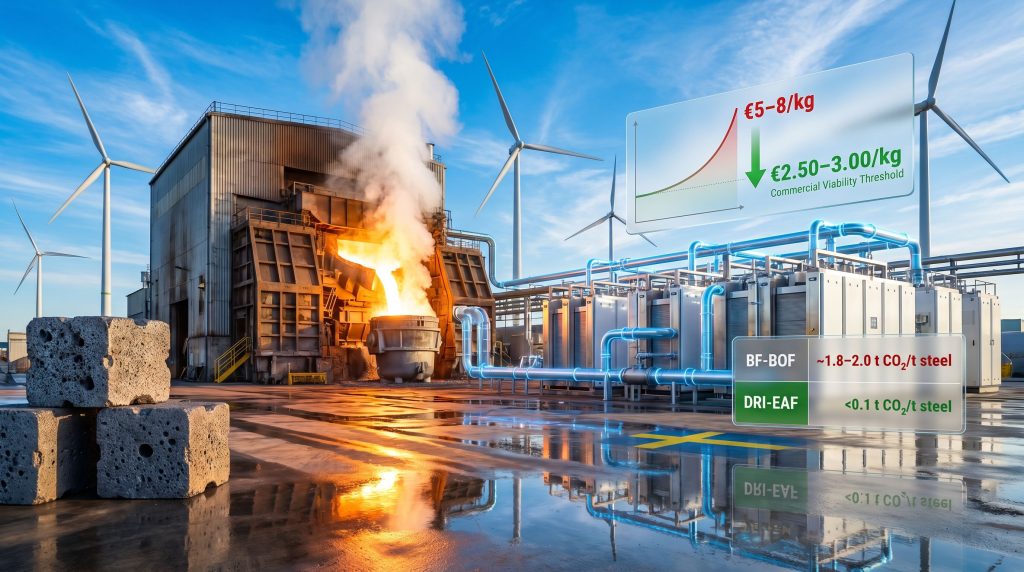
| CO₂ intensity | ~1.8–2.0 t CO₂/t steel | <0.1 t CO₂/t steel |
| Fuel flexibility | Low | High (H₂/natural gas switchable) |
| ETS exposure | Severe | Minimal with green inputs |
Source: Fastmarkets analysis, May 2026
A figure from the Fastmarkets analysis is particularly striking here: while conventional BF-BOF facilities consume approximately 0.05 MWh per tonne of steel produced, EAF-based installations require roughly 0.45 MWh per tonne. That represents an energy intensity approximately nine times greater, and it sits at the core of Europe's hydrogen competitiveness problem. Every kilowatt-hour of electricity consumed in hydrogen production carries a cost that is structurally two to four times higher in Europe than in competing regions.
This energy intensity differential is not a temporary feature awaiting a technological fix. It reflects the fundamental thermodynamics of the hydrogen production and reduction process, meaning that European producers will remain exposed to electricity cost disadvantages for as long as European industrial power prices remain elevated relative to global benchmarks.
Where Europe's Green Steel Projects Are Concentrated
The geographic distribution of hydrogen-based steelmaking projects across Europe is not random. According to Fastmarkets research, these projects cluster tightly in regions where three specific conditions align simultaneously: access to low-cost renewable electricity, proximity to deep-water ports for ore logistics, and access to supportive co-investment frameworks.
Sweden (Boden): Stegra's Boden facility represents the most advanced large-scale hydrogen steel project in Europe. The plant incorporates an electrolyser capacity exceeding 690 MW, hydrogen-based DRI production, and EAF capacity, with an ambition to reach 5 million tonnes per year by 2030. At full operation, the project is projected to eliminate approximately 7 million tonnes of CO₂ annually. According to Fastmarkets analysis, this single facility accounts for approximately 35% of European steel-sector hydrogen demand under a partial decarbonisation scenario by 2035, an extraordinary concentration of strategic dependency in a single project.
Sweden (SSAB): SSAB's transition programme leverages Sweden's low-carbon electricity grid and established industrial infrastructure, positioning it as a complementary pillar of Northern European green iron production capacity.
Finland (Blastr): Blastr's planned facility is designed to exploit Northern European renewable power advantages in a region where both wind and hydroelectric resources provide relatively affordable clean electricity.
France (GravitHy): This standalone hydrogen-DRI project is notable because it represents a decoupled approach, focusing on the ironmaking stage rather than attempting to operate a fully integrated steel mill. Its existence highlights the broadening of the green steel value chain into distinct, tradeable commodity steps.
Spain (Hydnum Steel): Operating with access to Iberia's growing renewable energy capacity, Hydnum Steel advances the geographic diversification of European hydrogen steelmaking beyond the Nordic cluster. Furthermore, the use of green transition materials across these projects remains a critical enabling factor for the entire supply chain.
The Complexity Hidden Inside Each Project
What distinguishes projects like Stegra's Boden facility from conventional industrial investments is their layered operational complexity. These are not simply steel mills. They function simultaneously as large-scale green hydrogen production facilities, direct reduction iron plants, and electric steelworks — three distinct industrial operations with different engineering requirements, regulatory frameworks, and supply chain dependencies.
This tripartite complexity multiplies capital requirements, permitting timelines, and execution risk. First-of-kind industrial buildouts at this scale carry inherent schedule uncertainty. Initial operational targets for Boden have been set for late 2025, with ramp-up extending into 2026, reflecting the challenging nature of commissioning multiple industrial firsts within a single integrated facility.
The Hydrogen Wall: Five Dimensions of a Structural Bottleneck
The term used increasingly across European steel industry discussions is the hydrogen wall — a phrase that captures the widening gap between the volume of green hydrogen that European steel decarbonisation requires and the volume that European energy markets can actually deliver at commercially viable prices within any realistic timeframe.
This is not a single problem. It has at least five interlocking dimensions, each of which would represent a serious challenge independently. Together, they form a compounding constraint that threatens to delay the Europe green steel hydrogen wall from being breached by years beyond current industry forecasts.
1. Electricity Cost Asymmetry
Power represents 60 to 70% of total green hydrogen production costs, according to Fastmarkets. European industrial electricity prices are structurally two to four times higher than equivalent costs in the United States and China. This gap reflects continued dependence on imported energy and exposure to gas-price volatility. It is not a cyclical disadvantage that will resolve through market normalisation. It is a structural feature of Europe's energy system that requires deliberate policy intervention to narrow.
2. The Commercial Viability Price Threshold
Current European green hydrogen prices sit at approximately €5 to €8 per kilogram. Industry sources quoted by Fastmarkets indicate that hydrogen must reach approximately €2.50 to €3.00 per kg to become commercially viable for steelmaking applications. That gap between current reality and required economics is substantial and shows limited sign of closing rapidly under present market conditions.
To appreciate the scale of hydrogen demand involved, consider this figure reported by Fastmarkets from a mill source: a single 2 million tonne-per-year DRI module requires approximately 140,000 to 150,000 tonnes of hydrogen annually. At current prices, the cost of supplying that hydrogen volume renders the economics of the entire facility uncompetitive against both natural gas DRI and conventional blast furnace routes.
3. Accelerating Project Cancellations and Retreats
The list of project retreats documented by Fastmarkets is striking in its breadth:
- Thyssenkrupp indefinitely postponed its Duisburg green-hydrogen tender in 2025
- Salzgitter delayed its green hydrogen expansion programme by three years
- Iberdrola reduced its 2030 green hydrogen production target by approximately two-thirds
- Repsol scaled back its equivalent target by approximately 63%
- Shell cancelled its planned Aukra Hydrogen Hub in Norway
- Equinor similarly retreated from hydrogen commitments in Norway
Each of these decisions represents not merely a corporate strategy adjustment but a reduction in the total available hydrogen supply infrastructure that green steel projects will depend upon through the 2030s.
4. The Global Supply Pipeline Shortfall
European low-emission steel production could require up to 0.5 million tonnes of green hydrogen by 2030, according to Fastmarkets projections. Against this demand, BloombergNEF data cited by Fastmarkets indicates that only approximately 2.7 million tonnes of green hydrogen capacity globally has reached Final Investment Decision (FID) stage. When the European steel sector's demand is placed in context against this global FID pipeline, the structural inadequacy of committed supply becomes apparent.
5. Infrastructure and Logistics Lag
Even where green hydrogen production capacity is committed, the infrastructure required to transport, store, and distribute hydrogen at industrial scale across Europe remains substantially underdeveloped. Permitting timelines for large-scale electrolysis facilities and their associated grid connections continue to extend beyond initial projections, adding further delay risk to an already constrained supply picture.
The convergence of project cancellations, elevated electricity costs, and a global FID shortfall creates a compounding supply risk that could delay European green steel deployment by years beyond current industry timelines.
Hydrogen Price Sensitivity and What It Means for Steel Production Economics
The financial implications of the hydrogen wall extend directly into the cost structure of EAF-based steel production, with consequences that are measurable and significant.
According to Fastmarkets analysis, hydrogen-based DRI contributes over 30% of total EAF production costs in the near term, making it the single largest variable cost driver in the green steel production model. While this cost share is expected to moderate as efficiency improves and hydrogen costs potentially decline, it remains the dominant source of uncertainty through the 2030s.
The sensitivity of this relationship is particularly pronounced when hydrogen price scenarios are compared across a ten-year horizon. Fastmarkets research indicates that by 2035, the spread between low- and high-hydrogen price assumptions produces an approximately 11% divergence in total EAF production costs. At the margins that characterise commodity steel production, an 11% cost gap is not a rounding error. It can be the difference between a facility generating returns and one operating at a structural loss.
Hydrogen Price Scenarios and Their Steel Cost Implications
| Hydrogen Price Scenario | Approximate H₂ Cost (€/kg) | Impact on EAF Cost Competitiveness |
|---|---|---|
| Current market (2025–2026) | €5–8/kg | Uncompetitive vs. natural gas DRI and BF-BOF |
| Commercial viability threshold | €2.50–3.00/kg | Breakeven with gas-based DRI in favourable power regions |
| Optimistic long-term (2035+) | <€2.00/kg | Competitive with conventional routes under carbon pricing |
Source: Fastmarkets, May 2026
In response to this cost uncertainty, most European producers outside the dedicated hydrogen hubs are adopting flexible DRI-EAF configurations — systems engineered to switch between natural gas and hydrogen depending on prevailing market conditions. This optionality reduces stranded asset risk but also introduces an important caveat for hydrogen demand forecasts: actual hydrogen consumption will be substantially lower than theoretical maximum demand under most near-term scenarios, because flexible plants will default to natural gas whenever it is cheaper to do so.
The next major ASX story will hit our subscribers first
Regional Specialisation as an Emerging Market Structure
One of the more significant structural shifts documented in Fastmarkets research is the accelerating decoupling of DRI production from downstream steelmaking. As hydrogen cost constraints persist, the fully integrated model — where a single site produces green hydrogen, reduces iron ore, and makes finished steel — is giving way to a geographically fragmented value chain that more closely resembles existing global commodity trade flows.
Under this emerging architecture:
- Low-cost renewable regions such as Northern Europe and MENA are positioned to become competitive production hubs for green DRI
- Downstream steelmaking centres across Central and Southern Europe are expected to import competitively produced DRI rather than attempting to replicate the full hydrogen-to-steel chain domestically
- Trade-driven green steel supply chains will increasingly determine which producers can access competitive input costs and which cannot
This represents a profound structural shift in how European steel production is organised. Rather than each major steelmaking centre internalising the full green hydrogen supply chain, the industry is evolving toward a model where hydrogen cost advantages are captured at the production stage and then transported as a processed intermediate commodity (DRI) to steelmaking facilities that lack the renewable energy endowment to produce hydrogen economically themselves.
The China Dimension
This regional specialisation trend does not occur in a geopolitical vacuum. The China steel market is actively developing low-carbon steelmaking capabilities, including hydrogen-based DRI activity, raising the competitive stakes for European producers navigating the transition. If European green steel cannot achieve cost parity with Chinese low-carbon alternatives within the protective window provided by the Carbon Border Adjustment Mechanism (CBAM), the strategic rationale for domestic green production weakens over time.
CBAM imposes carbon costs on steel imports that do not meet EU emissions standards, providing a degree of protection to European green producers against conventional imports from less regulated markets. However, CBAM's effectiveness is directly tied to EUA price levels and implementation pace, both of which carry political risk and remain subject to ongoing policy evolution. In addition, the EU steel action plan represents a further layer of policy architecture designed to support producers navigating these pressures.
Three Scenarios for Europe's Green Steel Transition Through 2035
The ultimate shape of Europe's green steel landscape through 2035 is not predetermined. It will be shaped by hydrogen cost trajectories, EUA price stability, infrastructure development, and the pace of electrolyser scale-up. Three distinct pathways are credible, each with materially different implications for producers, investors, and industrial policymakers.
Scenario 1: Accelerated Transition (Optimistic)
Green hydrogen costs fall below €2.50/kg by 2030 through electrolyser manufacturing scale-up and renewable energy cost reductions. Flagship projects at Boden, SSAB, Blastr, and GravitHy reach full operational capacity broadly on schedule. Regional DRI-to-steel trade flows establish a functional and competitive green steel supply chain. EUA prices remain elevated, sustaining green steel premiums and providing sufficient revenue to support investment returns.
Scenario 2: Fragmented Transition (Base Case)
Hydrogen costs remain above commercial viability thresholds through 2030, limiting dedicated hydrogen-DRI facilities to locations with the most advantaged renewable energy access. Flexible DRI-EAF configurations dominate new capacity additions, with hydrogen blending increasing gradually from 2028 as infrastructure matures. Regional specialisation accelerates, with MENA and Northern Europe supplying green DRI to Central European steelmakers. Green steel premiums persist but remain insufficient to justify fully integrated hydrogen-to-steel models outside flagship projects.
Scenario 3: Stalled Transition (Downside)
Project cancellations continue and the hydrogen supply shortfall widens as FID activity remains subdued. Declining EUA prices reduce the carbon cost penalty on conventional BF-BOF routes, weakening the financial case for green production. Chinese low-carbon steel gains market share in European end-use sectors under CBAM implementation gaps. European integrated steelmakers extend natural gas DRI timelines, delaying net-zero commitments by a decade or more.
What Needs to Change for the Hydrogen Wall to Come Down
The structural bottleneck that defines the Europe green steel hydrogen wall is not insurmountable, but it will not dissolve through announcements or policy declarations alone. Specific, measurable changes are required across multiple dimensions simultaneously.
- Electrolyser manufacturing must scale to drive hydrogen production costs below the €2.50/kg commercial viability threshold needed to make DRI-EAF production genuinely competitive
- European electricity market reform must narrow the structural power cost gap with the US and China, without which hydrogen production economics in Europe will remain fundamentally challenged
- EUA pricing continuity must provide the long-duration investment signals that capital-intensive green steel projects require to justify multi-decade asset commitments
- Hydrogen transport and DRI trade infrastructure must be developed in parallel with production capacity, not sequentially, to avoid supply chain bottlenecks that delay operational ramp-up
- Global FID activity for green hydrogen projects must accelerate well beyond current levels to build the supply base that European steel demand projections require
The competitive stakes extend beyond climate policy objectives. Europe's green steel transition is fundamentally a question of industrial competitiveness — one that will determine whether European steelmakers retain relevance in global markets through the 2030s and beyond. The automotive, construction, and defence supply chains that depend on domestically produced European steel are watching this transition closely, aware that its pace and success will shape their own strategic options in ways that reach far beyond the steel sector itself.
The hydrogen wall is real. Its dimensions are measurable. And the distance between current market conditions and the conditions required to breach it defines the most critical industrial policy challenge in Europe today.
This article is intended for informational purposes only and does not constitute financial or investment advice. Forecasts, projections, and scenario analyses referenced throughout are drawn from Fastmarkets research and represent possible future outcomes, not guaranteed results. Readers should conduct independent analysis before making investment or procurement decisions.
Want To Track The Next Major Mineral Discovery Before The Market Moves?
Discovery Alert's proprietary Discovery IQ model scans ASX announcements in real time, instantly converting complex mineral data across 30-plus commodities into clear, actionable insights — giving subscribers the edge to identify significant opportunities as soon as they are announced. Explore how historic discoveries have generated substantial returns on Discovery Alert's dedicated discoveries page, and begin your 14-day free trial today to position yourself ahead of the broader market.