May 18, 2026
The Economics of Doing Nothing: Why Ghana's Aluminium Opportunity Keeps Getting Deferred
There is a quiet pattern running through the economic histories of resource-rich developing nations. The ore gets extracted, loaded onto ships, and sent to facilities in countries with the infrastructure and energy capacity to transform it into something far more valuable. The original country receives a royalty, perhaps a handful of jobs at the mine gate, and the promise that one day the processing will happen locally. Senyo Hosi Ghana bauxite and aluminium growth sits at the centre of a debate about whether that pattern is finally changing.
Ghana is not immune to this dynamic. It sits on significant bauxite reserves, possesses an institutional framework in the Ghana Integrated Aluminium Development Corporation (GIADEC) designed to change the equation, and has now graduated from an IMF Extended Credit Facility Programme that was, for several years, the primary lens through which the country's economic story was told. The fiscal chapter is largely written. The industrial chapter remains almost entirely blank.
Understanding why requires moving past the surface narrative of untapped resources and examining the structural, energetic, and policy conditions that actually determine whether a country moves up the aluminium value chain or stays anchored at its least valuable rung.
When big ASX news breaks, our subscribers know first
The Value Chain That Ghana Is Not Climbing
From Rock to Revenue: How the Aluminium Ladder Works
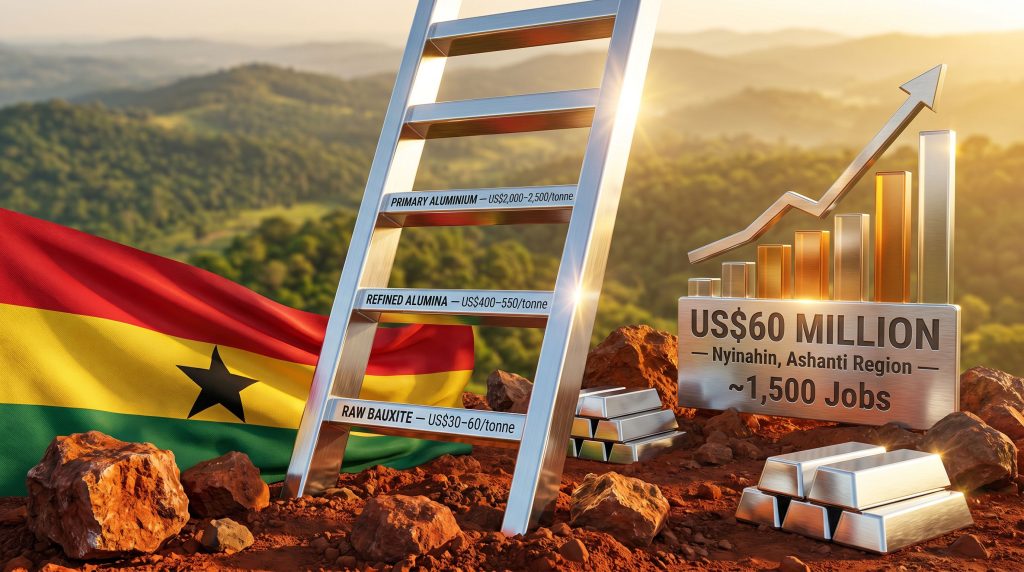
The aluminium industry operates as a sequential value-addition process, and the economic gulf between each stage is significant. Bauxite, the raw ore, is essentially an industrial commodity priced on bulk volume. Alumina, produced through the Bayer refining process, commands a multiple of that price per tonne. Primary aluminium, produced through electrolytic smelting, commands a multiple again. Fabricated and engineered aluminium products sit at the top of the ladder, valued not by weight but by function.
The numbers that frame this ladder are striking:
| Value Chain Stage | Approximate Revenue per Tonne | Ghana's Current Position |
|---|---|---|
| Raw Bauxite Export | US$30–60 | Active |
| Alumina Refining | US$300–400 | Nascent / Planned |
| Primary Aluminium | US$2,000–2,500 | Not yet operational |
| Fabricated Products | US$3,000–8,000 | Minimal |
Note: Figures are indicative industry benchmarks for illustrative comparison purposes only and are subject to market fluctuation.
At present, Ghana operates almost exclusively at the base of this table. The country exports bauxite and imports the downstream products. That structural inefficiency is not unique to Ghana, but it is particularly stark given the scale of domestic reserves and the strength of the institutional mandate assigned to GIADEC. The bauxite production leaders globally demonstrate just how significant the gap between raw export and processed output can be.
The Beneficiation Gap in Concrete Terms
The Bayer process for alumina refining requires roughly 4 to 5 tonnes of bauxite to yield 2 tonnes of alumina. The subsequent Hall-Héroult electrolytic smelting process converts approximately 2 tonnes of alumina into 1 tonne of primary aluminium. Each conversion step destroys mass but creates value, which is precisely why integrated producers with access to cheap energy earn margins that raw bauxite exporters cannot approach.
Ghana's absence from these conversion stages is not accidental. It reflects decades of infrastructure underinvestment, energy constraints, and a policy environment that has historically favoured resource monetisation over resource transformation. The question now is whether that pattern is genuinely changing.
Senyo Hosi, Ghana Bauxite and Aluminium Growth: The Productivity Framework
Shifting the Conversation From Stability to Output
As Ghana exited the IMF Extended Credit Facility Programme, Ghanaian financial analyst Senyo Hosi offered a perspective that reframes what economic success should now mean for the country. Speaking on Channel One TV's The Big Issue on May 16, 2025, Hosi positioned the programme's conclusion not as an endpoint but as a starting condition for something more demanding: building genuine industrial productivity.
His core argument is that macroeconomic stability and national prosperity are not the same thing. Stability is a precondition, not an outcome. A country can achieve low inflation, a managed exchange rate, and a reduced fiscal deficit while its productive capacity stagnates and its citizens remain underemployed in low-value activities. The IMF programme addressed the first set of conditions; the harder work addresses the second.
Hosi's analytical lens centres on the private sector as the primary engine of employment generation and economic diversification. He specifically emphasised the role of small and medium enterprises (SMEs) as the structural foundation of this model, arguing that an enabling business environment is the prerequisite for the kind of firm-level productivity that translates into broad-based economic development.
"The distinction between macro-level stability and micro-level productivity is more than semantic. A country can stabilise its balance sheet while its industrial base hollows out. Ghana's post-IMF challenge is to ensure that fiscal discipline becomes the foundation for industrial ambition rather than a substitute for it."
Why Bauxite Is Central to the Productivity Argument
Hosi explicitly connected Ghana's untapped bauxite reserves to his broader productivity thesis. His framing is instructive: the mineral asset is not valuable in itself. Its value is realised through the supply chains it generates when processed domestically. A functioning aluminium industry creates demand for metallurgical engineering services, equipment maintenance, chemical supply, transport logistics, fabrication, and component manufacturing. Each of those activities is a potential SME opportunity.
He described Ghana's aluminium and related industries as representing an enormous untapped opportunity, arguing that the country possesses nearly all the necessary ingredients and that the challenge is one of unlocking rather than discovering. On the bauxite question specifically, Hosi noted that developing those reserves into functioning supply chains would drive economic diversification and structural transformation in ways that commodity export alone cannot achieve.
His emphasis on infrastructure development and cost-of-doing-business reduction as government responsibilities completes the framework: the public sector creates the enabling conditions; the private sector and SME ecosystem generate the output. Furthermore, Senyo Hosi's calls for SME prioritisation align directly with this industrial logic.
What Is Actually Happening on the Ground: Recent Deal Activity
The Nyinahin Hills Project and the US$60 Million Facility
GIADEC has executed a US$60 million facility agreement with Metalloid Resources Investment and GIBDLC targeting bauxite development at Hills 1–3 in the Nyinahin area of the Ashanti Region. The project is projected to support approximately 1,500 direct jobs, which represents a material near-term employment impact in the local economy.
The project parameters in summary:
| Parameter | Detail |
|---|---|
| Facility Value | US$60 million |
| Location | Hills 1–3, Nyinahin, Ashanti Region |
| Institutional Lead | GIADEC |
| Partner Entities | Metalloid Resources Investment / GIBDLC |
| Projected Direct Employment | ~1,500 jobs |
The critical analytical question this project raises is whether it represents a genuine step toward in-country beneficiation or whether it replicates the historical pattern of raw ore extraction for export. Deal value and employment projections are encouraging signals, but the strategic test is whether downstream processing commitments are embedded in the project structure or remain aspirational.
Community Expectations and the Ownership Question
Local communities in the Nyinahin area have been vocal about the need for greater Ghanaian participation and domestic ownership in bauxite projects operating within their regions. This reflects a pattern increasingly common across African resource communities, where the terms of engagement with extractive industries are being renegotiated from the bottom up.
The demands are consistent: local employment, skills transfer, downstream business creation, and meaningful community ownership stakes. Without explicit commitments to these outcomes, community opposition risk becomes a tangible constraint on project timelines and social licence to operate.
This is not a peripheral concern. In several recent African mining contexts, community pushback has delayed or derailed projects that were technically and financially ready to proceed. Managing this dimension proactively is as much a strategic necessity as securing financing.
The Structural Barriers That Cannot Be Assumed Away
Energy: The Non-Negotiable Constraint
Aluminium smelting is among the most electricity-intensive industrial processes that exists. Producing one tonne of primary aluminium typically requires between 13 and 15 megawatt-hours of electrical energy. At current energy costs and reliability levels in Ghana, that requirement creates an economic viability problem that cannot be resolved through policy statements alone. Consequently, renewable power for mining operations is increasingly being examined as part of the long-term solution.
Countries that have built competitive aluminium industries share one characteristic above all others: access to abundant, low-cost, and reliable baseload electricity. Iceland draws on geothermal and hydroelectric resources. Canada leverages large-scale hydroelectric capacity. The UAE engineered a gas-to-power model that delivered consistent industrial energy at rates that made smelting economically attractive to international investors.
For Ghana to attract smelting investment, it must present a credible, costed, and bankable energy solution. Without that, the value chain will remain truncated at the refining stage at best, and the primary aluminium and fabrication opportunities will continue to be captured elsewhere. The energy transition demand globally only intensifies the urgency of resolving this constraint domestically.
Transport Infrastructure: The Western Rail Line Imperative
Bulk ore transportation is a logistics challenge that determines unit economics at the mine level. Moving bauxite from inland Ashanti Region deposits to coastal processing or export facilities via road transport carries a significant cost and operational penalty compared to dedicated rail freight.
The Western Rail Line has been identified as a strategically important logistics corridor for the bauxite sector. Rail-based ore movement reduces per-tonne transportation costs, lowers maintenance requirements on road infrastructure, and enables the scale of throughput needed to make large-scale processing economically viable. Progress on this corridor is a material variable in the overall feasibility picture for Ghana's aluminium ambitions.
The Awaso Refinery and the Path to Alumina Production
Plans for a new alumina refinery at Awaso through Ghana Bauxite Company represent the most concrete near-term pathway to moving up the value chain from raw ore to processed product. The Western Region's Awaso area has historical significance in Ghana's bauxite sector, and a functional refinery at this location would mark a genuine inflection point in the country's industrial development.
Analysts familiar with Ghana's bauxite sector have suggested that a developed and strategically managed bauxite industry could potentially support 4 to 6 million tonnes of annual alumina refining capacity over the long term, which would reposition Ghana as a significant contributor to global metals demand. This figure requires qualification: it represents a long-term strategic target contingent on substantial capital investment, energy infrastructure development, and logistics improvements, not a near-term operational projection.
The SME Multiplier: Why Industrial Policy Must Think Beyond the Smelter
Supply Chain Economics and Employment Generation
Hosi's argument about SME productivity connects to a well-documented pattern in industrial economics: mature manufacturing sectors generate employment not primarily at the flagship production facility but throughout the supply chain that serves it.
A functioning aluminium industry creates sustained demand across a range of upstream and downstream service categories:
- Equipment maintenance and repair services
- Chemical and reagent supply for refining operations
- Specialised transport and logistics providers
- Fabrication workshops for aluminium component manufacturing
- Packaging and materials handling businesses
- Engineering consultancy and technical services
- Environmental monitoring and compliance services
Each of these represents an SME opportunity. In more developed aluminium economies, the ratio of indirect to direct employment in the sector is substantial. If Ghana were to develop aluminium production capacity of meaningful scale, the associated supply chain could support employment multiples of the direct workforce. The exact ratio depends on domestic versus imported supply of these services, which is itself a policy question about procurement requirements and local content frameworks.
Building the Enabling Environment: The Policy Checklist
Translating Hosi's enabling environment concept into operational priorities produces a specific agenda:
- Industrial energy tariff reform to reduce input costs for energy-intensive processing operations
- Streamlined business registration and permitting to reduce friction for SMEs seeking to enter aluminium supply chains
- Targeted financing mechanisms for SMEs with demonstrated capacity to supply the aluminium sector, addressing the capital access constraint that limits participation
- Technical and vocational training programmes aligned to metallurgical, chemical, and engineering competencies required by the sector
- Local content requirements in mining and processing agreements that mandate Ghanaian participation thresholds and skills transfer obligations
- Infrastructure investment coordination between transport, energy, and industrial development agencies to ensure that the enabling conditions develop in parallel rather than sequentially
The next major ASX story will hit our subscribers first
Ghana's Aluminium Opportunity in Continental Context
Africa's Broader Beneficiation Shift
Ghana's ambitions do not exist in isolation. Across the continent, the policy conversation has moved decisively toward domestic value addition as both an economic development imperative and a condition of responsible resource governance. Several African nations have introduced or signalled export restrictions on unprocessed minerals specifically to force downstream investment. Guinea, which holds the world's largest bauxite reserves, has been explicit about requiring domestic alumina refining as a condition of continued bauxite development.
This continental trend creates a competitive dynamic that Ghana must navigate carefully. If West Africa's bauxite exporters collectively shift toward requiring domestic processing, international aluminium industry leaders will need to engage with refining partnerships in the region rather than simply sourcing raw ore. Ghana's institutional readiness, through GIADEC and the existing framework for sector development, positions it to attract this investment if the enabling conditions are credible.
Global Demand Dynamics: The Clean Energy Tailwind
Aluminium's role in the global energy transition provides a favourable long-term demand backdrop for Ghana's development ambitions. The metal is a critical input for:
- Electric vehicle manufacturing (battery casings, structural components, heat management systems)
- Solar panel framing and mounting systems for utility-scale renewable installations
- Wind turbine components requiring lightweight, high-strength alloys
- Power transmission infrastructure where aluminium conductors are increasingly preferred over copper for overhead lines
- Lightweight construction in commercial and residential buildings seeking to reduce embodied carbon
This demand profile suggests that aluminium pricing and volume requirements will remain structurally supported over the medium to long term, improving the investment case for processing capacity in countries with significant bauxite endowments.
Frequently Asked Questions: Ghana Bauxite and Aluminium
What are Ghana's primary bauxite deposit locations?
Ghana's most significant bauxite deposits are concentrated in two main areas. The Ashanti Region's Nyinahin deposits, including the Hills 1–3 area currently being developed under the GIADEC-facilitated agreement, represent a major resource base. The Western Region's Awaso area, where Ghana Bauxite Company has historically operated, provides a second significant resource zone and the planned location for alumina refining development.
What is GIADEC and what mandate does it hold?
The Ghana Integrated Aluminium Development Corporation is the government-established institution responsible for coordinating the development of Ghana's integrated aluminium industry. It serves as the primary vehicle for structuring investment agreements, attracting international partners, and advancing Ghana's strategic objective of transitioning from raw bauxite export to full value-chain aluminium production. GIADEC's role spans project facilitation, sector coordination, and strategic planning across all stages of the aluminium value chain.
Why is energy such a critical barrier to aluminium smelting in Ghana?
Aluminium smelting through the Hall-Héroult electrolytic process consumes approximately 13 to 15 megawatt-hours of electricity per tonne of aluminium produced. This makes energy cost and reliability the primary determinants of smelting economics. Countries that have built globally competitive aluminium smelting industries have done so by securing access to large quantities of low-cost, reliable baseload power. Ghana's current energy infrastructure presents both cost and reliability challenges that would need to be resolved before large-scale smelting investment becomes economically attractive.
What is the difference between bauxite, alumina, and aluminium?
- Bauxite is the sedimentary rock from which aluminium is ultimately derived, priced roughly at US$30–60 per tonne at export
- Alumina (aluminium oxide, Al₂O₃) is produced by refining bauxite through the Bayer process, yielding approximately 2 tonnes of alumina from 4–5 tonnes of bauxite and valued at roughly US$300–400 per tonne
- Primary aluminium is produced by smelting alumina through the Hall-Héroult electrolytic process, converting approximately 2 tonnes of alumina into 1 tonne of aluminium valued at US$2,000–2,500 per tonne
How many jobs could a developed Ghanaian aluminium industry support?
The US$60 million Nyinahin Hills project currently projects approximately 1,500 direct jobs. A fully developed integrated aluminium industry encompassing mining, refining, smelting, and downstream fabrication would generate substantially greater direct employment. When SME supply chain multiplier effects are included across logistics, engineering, maintenance, fabrication, and services, the total employment impact of a mature aluminium sector could reach tens of thousands of roles across the economy. These figures are indicative estimates contingent on the scale and pace of sector development.
The Road Ahead: What Ghana Needs to Get Right
Near-Term Milestones That Will Signal Genuine Progress
Several developments over the 2025–2027 period will provide meaningful signals about whether Ghana's aluminium ambitions are advancing on substance or remaining at the level of announcement:
- Financing confirmation and construction commencement for the Awaso alumina refinery
- Operational milestones and beneficiation commitments at the Nyinahin Hills 1–3 mining project
- Concrete government announcements on industrial energy infrastructure investment with costed timelines
- Visible progress on Western Rail Line development with freight capacity targets
- GIADEC's deal pipeline activity and the terms of any new international partnership agreements, specifically regarding domestic processing obligations
The Coherence Test: Assembling the Policy Architecture
The countries that have successfully built aluminium industries share one characteristic beyond energy access: policy coherence over time. Iceland, Canada, and the UAE each sustained the industrial policy commitment required to attract and retain the capital-intensive investments that underpin their aluminium sectors. None of those transformations happened quickly.
Ghana has the mineral foundation. It has an institutional vehicle in GIADEC. It has a post-IMF moment that creates political space for a new economic narrative. What the analysis of Senyo Hosi Ghana bauxite and aluminium growth reveals is that the missing ingredient is not another announcement or another feasibility study. It is the disciplined, sustained, and coordinated execution of an enabling environment that makes domestic aluminium production economically superior to raw bauxite export for every participant in the value chain.
The IMF programme, in Hosi's framing, should be understood as a credibility foundation rather than an endpoint. If Ghana uses that foundation to attract the long-term foreign direct investment that aluminium infrastructure requires, the fiscal discipline of the past several years will have served its highest purpose. However, if it does not, the bauxite will continue to leave Ghanaian ports in the same unrefined form it always has, and the economic value of the aluminium industry will continue to be realised somewhere else.
Disclaimer: This article contains forward-looking statements, indicative financial benchmarks, and long-term scenario projections. These should not be construed as investment advice. All figures presented are for illustrative or comparative purposes unless otherwise stated. Readers should conduct independent research and consult qualified financial or industry advisors before making decisions related to the aluminium sector or Ghanaian resource industries.
Want to Track the Next Major Mineral Discovery Before the Broader Market Does?
Discovery Alert's proprietary Discovery IQ model delivers real-time alerts on significant ASX mineral discoveries across more than 30 commodities — instantly translating complex geological data into actionable investment insights for traders and long-term investors alike. Explore how major discoveries have historically generated substantial returns on Discovery Alert's dedicated discoveries page, and begin a 14-day free trial to position yourself ahead of the market.