
May 18, 2026
The Structural Disconnect at the Heart of Indonesia's Aluminium Strategy
Across the global minerals economy, the fastest-growing industrial supply chains are rarely constrained by geology. They are constrained by the gap between what exists in the ground and what can realistically be extracted, processed, and delivered on the timelines that downstream investment demands. Indonesia is living through precisely this tension in real time. The Indonesia bauxite demand challenge has attracted billions of dollars in alumina refining and aluminium smelting investment, driven by one of the world's most consequential resource nationalism experiments. Yet the foundational raw material that makes all of this possible — bauxite — is not scaling at anywhere near the same pace as the facilities being built to consume it.
This is not simply a production shortfall. It is a structural misalignment between two halves of the same industrial vision, one moving fast, one moving slow, with consequences that ripple far beyond Indonesia's borders. Furthermore, understanding this dynamic requires looking closely at both regulatory and geographic constraints that compound the problem.
When big ASX news breaks, our subscribers know first
How Big Is Indonesia's Bauxite Demand Problem — And Why Does It Matter Now?
The 2036 Aluminium Vision: What Indonesia Is Actually Building
Indonesia's industrial strategy rests on a three-tier value chain: bauxite mining feeding alumina refining, which in turn supplies aluminium smelting and downstream fabrication. The logic is compelling. Rather than exporting raw ore, Indonesia captures successive layers of value domestically, building industrial employment, technology transfer, and higher-margin export products along the way.
The policy lever that set this chain in motion was a raw bauxite export ban, progressively tightened through a series of presidential regulations, which forced international buyers to invest in domestic processing facilities if they wanted access to Indonesian bauxite reserves. The strategy worked in attracting downstream capital. Major foreign entities, including Chinese and other Asian industrial groups, have committed to large-scale alumina refinery projects across multiple Indonesian provinces.
The volume of foreign capital flowing into Indonesian aluminium infrastructure has been substantial, with the total investment pipeline across the value chain estimated to require upward of USD 30 billion at full buildout. However, what the policy did not fully resolve was the upstream side of the equation.
Quantifying the Demand Gap: Key Figures to Understand
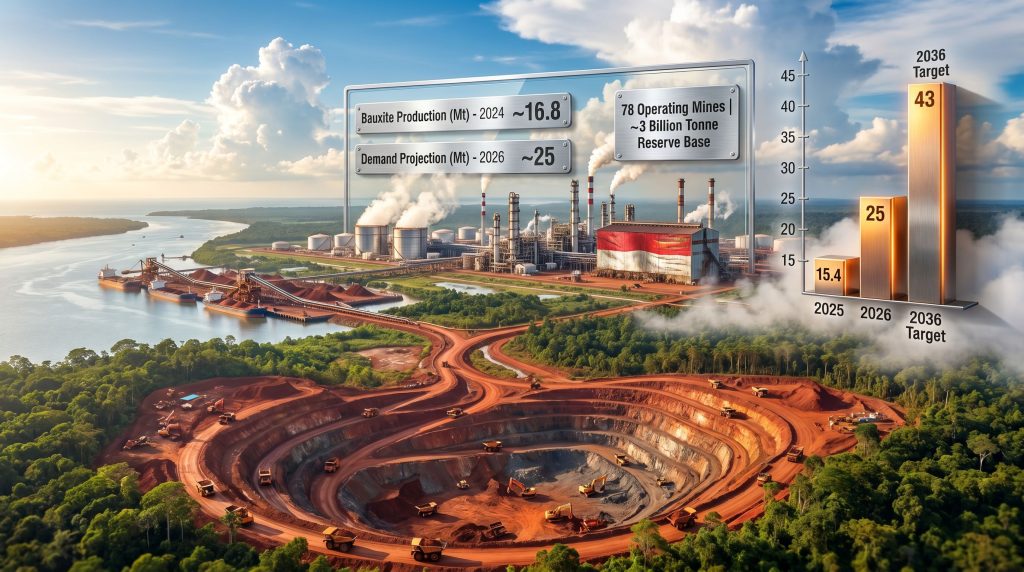
The numbers tell a stark story. Consider the trajectory of supply versus demand across the near-term window:
| Metric | 2024 Actual | 2025 Estimate | 2026 Projection |
|---|---|---|---|
| Bauxite Mine Production | ~16.8 Mt | ~18 Mt | ~18.5 Mt |
| Domestic Bauxite Demand | — | ~15.4 Mt | ~25 Mt |
| Alumina Refining Capacity (Target) | — | — | 14.2 Mt |
| Operating Bauxite Mines | 78 | — | — |
| Proven Bauxite Reserves | ~3 billion tonnes | — | — |
The critical figure here is the demand jump from approximately 15.4 million tonnes in 2025 to roughly 25 million tonnes in 2026, a near 62% single-year surge driven almost entirely by new alumina refineries beginning operations. Against this, mine production is expected to grow by only around 0.5 million tonnes over the same period. That is not a rounding error. It is a structural gap with real operational consequences.
When extended across the full buildout scenario targeting Indonesia's 2036 aluminium production objectives, annual bauxite demand could reach approximately 43 million tonnes under a measured development trajectory, or as high as 94 million tonnes if all planned projects proceed simultaneously. Current production capacity covers less than half of even the conservative figure. Insights from analysis of Indonesia's bauxite supply outlook confirm that this gap is widely recognised across the industry.
The 43 Mt demand figure does not represent a single year's consumption target. It reflects the cumulative feedstock requirement associated with Indonesia's stated aluminium production ambitions for the decade ending 2036, making it a long-range planning benchmark rather than an immediate operational threshold.
What Is Causing the Supply-Side Lag in Indonesian Bauxite Mining?
The RKAB Quota System: A Regulatory Bottleneck Explained
Central to understanding Indonesia's production constraints is the RKAB system, an abbreviation for Rencana Kerja dan Anggaran Biaya, which translates broadly as the Annual Mining Work Plan and Budget. Under this framework, every bauxite mining operation must obtain annual government approval for its production quota before mining activities can proceed or expand. Approvals are granted by the Ministry of Energy and Mineral Resources and involve review of environmental compliance records, financial capability assessments, and alignment with national production targets.
In principle, this system exists to prevent the kind of reckless over-extraction that has historically damaged mineral-dependent economies. In practice, when downstream demand is accelerating rapidly, the RKAB process creates a structural friction point. Reports indicate that processing times for 2026 approvals have extended considerably beyond historical averages, with some applications taking up to nine months compared to a typical three-to-four month window.
For a refinery scheduled to begin operations in mid-2026, a nine-month quota approval delay is not an administrative inconvenience — it is an existential feedstock problem. The broader issue is that quota-based systems are designed for stability, not for rapid scaling. When an industrial policy explicitly aims to accelerate production several-fold within a decade, the administrative infrastructure governing that production needs to evolve at a comparable pace.
Geographic Concentration Risk in West Kalimantan
A lesser-appreciated dimension of Indonesia's supply challenge is its geographic character. The overwhelming majority of the country's 78 operating bauxite mines are concentrated within West Kalimantan province on the island of Borneo. This geographic clustering creates a range of logistical constraints that compound the regulatory ones.
Road networks in West Kalimantan were not engineered to handle the volumes that Indonesia's refining ambitions now demand. Estimates suggest that upgrading regional transport infrastructure to accommodate 25 million tonnes of annual throughput would require approximately USD 1.2 billion in capital expenditure and 18–24 months of construction. Port facilities at key terminals including Tanjung Tabalong and Ketapang have estimated maximum throughput capacities that would need substantial expansion beyond their current limits.
Seasonal factors add further complexity. Heavy rainfall during Indonesia's wet season regularly disrupts road transport of ore, creating periodic supply interruptions that are difficult to predict and manage within annual quota frameworks. Consequently, a supply chain concentrated in a single geographic region is inherently more vulnerable to both weather disruptions and localised infrastructure failures than one spread across multiple provinces.
Why 3 Billion Tonnes of Reserves Does Not Automatically Mean Accessible Supply
Indonesia's 3 billion tonne reserve base is frequently cited as evidence that long-term supply security is assured. The reality, however, is considerably more nuanced. Reserve figures in the mining industry represent geological estimates of ore that exists in the ground. They say nothing about how quickly that ore can be brought into production, at what cost, or whether it meets the quality specifications required by modern processing facilities.
Three distinct constraints reduce the practical significance of Indonesia's headline reserve number:
-
Quality variation: Indonesian bauxite deposits vary significantly in alumina content and silica levels. Modern Bayer process refineries operate most efficiently with ore carrying 45–55% alumina content and reactive silica below 4–6%. A meaningful portion of Indonesia's reserve base falls outside these parameters, requiring blending or more expensive processing approaches.
-
Permitting timelines: From initial exploration through environmental assessment, community consultation, and final production approval, establishing a new Indonesian bauxite mine typically requires 36–48 months. This timeline is structurally longer than the 24–36 months needed to build a new alumina refinery, meaning downstream facilities consistently reach operational readiness before new upstream supply can be commissioned.
-
Economic recoverability: Detailed analysis of Indonesia's deposits suggests that only approximately 60% of the 3 billion tonne reserve base meets the quality specifications required by modern refineries, effectively reducing the practically accessible reserve to roughly 1.8 billion tonnes.
Geological reserve figures represent a ceiling, not a floor. The number of tonnes that can realistically be mined, processed, and delivered to operating refineries within commercially viable timeframes is always considerably smaller than the headline reserve figure suggests.
How Many Alumina Refineries Is Indonesia Actually Building?
A Pipeline of Ten Projects Across Multiple Development Stages
Indonesia currently has ten alumina refinery projects at various stages of development, ranging from operating facilities to projects under active construction and those in the planning or financing phase. Together, these projects represent a combined target capacity of up to 14.2 million tonnes of alumina annually.
| Project Status | Number of Projects | Combined Capacity Contribution |
|---|---|---|
| Operating | — | Partial contribution to 14.2 Mt |
| Under Construction | — | Majority of near-term additions |
| Planned / Announced | — | Long-range pipeline |
| Total Pipeline | 10 | Up to 14.2 Mt alumina |
Understanding why this pipeline creates such acute pressure around the Indonesia bauxite demand challenge requires familiarity with the Bayer process, the dominant industrial method for converting bauxite into alumina. The critical metric for supply chain planning is the bauxite-to-alumina conversion ratio: producing one tonne of alumina requires approximately 2.5 to 3 tonnes of bauxite as feedstock, depending on the ore grade.
Applying this ratio to Indonesia's 14.2 million tonne alumina capacity target yields an annual bauxite demand of approximately 35 to 43 million tonnes at full utilisation. If all planned projects proceed and reach maximum output, the demand figure approaches or exceeds 94 million tonnes annually — a level that current production infrastructure cannot remotely support. For context, global bauxite production figures show just how significant Indonesia's ambitions are relative to worldwide supply.
The Inalum Warning: When Ambition Outpaces Infrastructure
Indonesia's state aluminium enterprise has publicly raised concerns about the risk of building refining capacity that outstrips both the available feedstock and the eventual market for alumina and aluminium products. This warning reflects a dual risk that policymakers need to confront directly.
In the near term, the risk is a feedstock shortage that leaves newly commissioned refineries operating at reduced capacity or idle, generating negative returns on the billions invested in their construction. In the medium term, the risk reverses: if all ten refinery projects proceed on their announced timelines, Indonesia could add enough alumina capacity to meaningfully move global markets, potentially depressing alumina prices and undermining the economic case for later-stage projects. Detailed reporting on this oversupply risk scenario highlights the scale of concern within Indonesia's own industrial establishment.
The Reserve Depletion Scenario: Under a maximum-buildout trajectory where all planned alumina and aluminium projects proceed to full capacity, annual bauxite demand could reach approximately 94 million tonnes. At that extraction rate, Indonesia's roughly 3 billion tonne reserve base — of which perhaps 1.8 billion tonnes is economically recoverable at current quality thresholds — would face serious depletion pressure within approximately 10 to 19 years. This is not a distant theoretical risk. It is a planning horizon that falls within the operational lifespan of facilities being built today.
What Does the Near-Term vs. Medium-Term Outlook Actually Look Like?
Near-Term (2025–2027): A Tightening Bauxite Market
The immediate market environment for Indonesian bauxite is characterised by constrained supply meeting accelerating demand. Spot pricing data reflects this tension, with reports indicating Indonesian bauxite prices rose by approximately 27% from the start of 2025, reflecting market anxiety about feedstock availability as new refinery commissioning dates approach.
Domestic refinery operators are responding to this uncertainty through several mechanisms:
- Aggressive stockpiling where quota approvals permit, building buffer inventories ahead of planned commissioning dates
- Pursuing long-term offtake agreements with mining operators to secure price certainty and supply priority
- Lobbying the Ministry of Energy and Mineral Resources for expedited RKAB processing to address the approval backlog
- In some cases, exploring the possibility of importing bauxite from alternative sources, though this conflicts with the intent of Indonesia's domestic processing strategy
Medium-Term (2028–2036): The Oversupply Risk Scenario
The paradox embedded in Indonesia's situation is that the same policy success that attracted refinery investment could generate serious oversupply problems if capacity additions are not carefully sequenced against both mining expansion and global market absorption capacity. Indonesia's cumulative alumina additions, if realised on announced timelines, would represent a significant share of total global alumina trade, with direct implications for international pricing benchmarks.
The scenario comparison below illustrates the range of possible market conditions across the planning horizon:
| Timeframe | Supply Condition | Demand Condition | Market Implication |
|---|---|---|---|
| 2025–2027 | Constrained (quota delays, slow mine development) | Rapidly rising (new refineries commissioning) | Bauxite price support likely |
| 2028–2030 | Potentially improving (new mines, if approved) | Plateauing if projects are delayed | Balanced or mild surplus possible |
| 2031–2036 | Risk of depletion pressure at full buildout | 43–94 Mt range depending on project completion | Reserve sustainability becomes critical concern |
The critical variable across this entire timeline is policy coordination. Whether Indonesia navigates toward a balanced outcome or oscillates between shortage and oversupply depends heavily on how effectively government ministries, state enterprises, and private investors align their timelines and capacity decisions.
How Does Indonesia's Bauxite Challenge Affect Global Aluminium Supply Chains?
The Export Ban's Ripple Effects on Global Bauxite Trade
When Indonesia progressively restricted and ultimately banned raw bauxite exports, the immediate consequence was a redirection of global trade flows that had been built over decades around Indonesian ore supply. China's raw material demand, which had grown significantly dependent on Indonesian bauxite as a cost-competitive feedstock, forced a rapid acceleration toward diversification — a dynamic explored further in analysis of China's raw material demand pressures across the broader minerals sector.
Australia stepped into much of the gap, with its established large-scale mining operations in Western Australia expanding output to serve Asian refinery demand. The leading bauxite mines across the Darling Range and Cape York Peninsula increased throughput significantly, and understanding the leading bauxite mines that filled this supply void helps contextualise just how consequential Indonesia's export ban was for global trade flows. Guinea, whose bauxite endowment is among the world's largest, also gained significantly as a supplier, attracting substantial Chinese investment in mining infrastructure.
However, these alternative supply chains carry their own vulnerabilities. Guinea faces persistent political instability. Furthermore, Australian export supply is competitively priced but involves longer shipping distances to key Asian markets, and shifts in Australian export supply conditions could affect the reliability of this flow. Brazil's northern bauxite deposits also attracted renewed attention, though infrastructure in producing regions remains a constraint on rapid volume expansion.
Indonesia as a Structural Node in the Global Aluminium System
Indonesia's emergence as a major alumina producer rather than merely a bauxite exporter is reshaping its position in the global aluminium system in ways that extend well beyond raw material trade. The country is increasingly a destination for technology transfer, with refinery construction projects bringing advanced process engineering from international partners.
The geopolitical dimension cannot be separated from the economic one. Indonesia's resource nationalism strategy reflects a broader trend among mineral-endowed emerging economies toward capturing more value domestically — a trend closely linked to the global critical raw materials transition as nations seek secure supply chains for the energy transformation. International observation of Indonesia's experiment is intense, with governments across Africa, Latin America, and Southeast Asia watching closely to assess whether the model can succeed without triggering the supply chain disruptions that critics predicted.
The next major ASX story will hit our subscribers first
What Policy Levers Could Close the Bauxite Supply Gap?
Accelerating RKAB Approvals Without Sacrificing Environmental Standards
The most immediate lever available to Indonesian policymakers is reforming the RKAB approval process to reduce processing times without compromising the environmental governance objectives the system was designed to serve. Several approaches warrant consideration:
- Digital transformation of application processing, reducing manual review steps and enabling parallel assessment by multiple regulatory agencies simultaneously
- Pre-approval frameworks for mines with strong environmental compliance track records, reducing repetitive documentation requirements for established operators
- Dedicated fast-track review panels for applications directly linked to confirmed downstream refinery commissioning timelines, prioritising cases where feedstock shortfalls have demonstrable economic consequences
Crucially, accelerating approvals should not mean weakening environmental standards. Indonesia's forests and waterways are sensitive ecosystems, and the environmental damage from poorly managed bauxite mining is well documented from historical cases in West Kalimantan. The objective should be processing speed improvements, not dilution of substantive requirements.
Sequencing Refinery Buildout to Match Mining Capacity Growth
A structured approach to alumina refinery commissioning — one that ties each new facility's operating licence to verified bauxite supply milestone achievements — would address the root cause of the Indonesia bauxite demand challenge rather than simply managing its symptoms. Under such a framework, refinery investors would need to demonstrate confirmed feedstock supply arrangements as a condition of receiving operating approvals, creating market-based incentives for upstream investment to keep pace with downstream expansion.
This approach has precedent in other resource-intensive industrial sectors, where regulators have used supply chain verification requirements to prevent the kind of capacity racing that generates short-term construction activity but long-term operational dysfunction.
Attracting Investment in Upstream Mining, Not Just Downstream Processing
Perhaps the most significant structural correction Indonesia needs is a rebalancing of investment incentives toward the upstream mining sector. Foreign capital has disproportionately targeted alumina refining and aluminium smelting, attracted by the visible scale of these facilities and their clear alignment with Indonesia's value-add policy framework. Bauxite mining, by contrast, involves smaller individual project scales, more complex community land rights negotiations, and less visibility in the industrial policy narrative.
Addressing this imbalance could involve:
- Fiscal incentives specifically targeting new bauxite mine development, including accelerated depreciation allowances and reduced royalty rates for the first years of operation
- Infrastructure co-investment programmes where government funds contribute to shared road and port infrastructure in key mining regions, reducing the capital burden on individual mine developers
- Land access reform to streamline the resolution of community and customary rights disputes that frequently delay mine development in West Kalimantan
- Guaranteed offtake frameworks linking state-owned refinery entities to new mine developers through long-term purchase agreements, reducing the revenue risk that deters upstream investment
Frequently Asked Questions: Indonesia Bauxite Demand Challenge
How large is Indonesia's bauxite reserve base?
Indonesia holds approximately 3 billion tonnes of bauxite reserves as of 2025, placing it among the world's most significant bauxite-endowed nations. However, reserve size does not guarantee near-term production capacity. Practical accessibility depends on ore quality, permitting status, and infrastructure availability.
Why is bauxite demand projected to rise so sharply in 2026?
The primary driver is new alumina refinery capacity coming online. As additional refineries begin operating, their feedstock requirements under the Bayer process push bauxite demand sharply higher, from an estimated 15.4 Mt in 2025 to approximately 25 Mt in 2026, a near 62% increase within a single year.
What is the RKAB system and why does it matter?
RKAB refers to annual government-approved mining work plans that set production quotas for Indonesian mining operations. When approvals are delayed, mine operators face legal uncertainty about whether they can scale production, creating a direct feedstock risk for refineries depending on that supply.
Could Indonesia run out of bauxite?
Under a full-buildout scenario where all planned projects proceed simultaneously and annual demand reaches approximately 94 Mt, proven reserves could face serious depletion pressure within roughly 10 to 19 years, depending on the proportion of economically recoverable ore. Consequently, sequenced development is therefore a strategic necessity.
How many bauxite mines does Indonesia currently operate?
As of 2024, Indonesia had approximately 78 operating bauxite mines, the majority located in West Kalimantan, producing around 16.8 Mt annually.
What is the 43 Mt bauxite demand figure referring to?
The 43 Mt figure represents the projected annual bauxite demand associated with Indonesia's 2036 aluminium production targets under a measured development scenario. It is a long-range planning benchmark, not an immediate operational figure, and current mining output falls significantly short of it.
Key Takeaways: Indonesia's Bauxite Demand Challenge in Summary
- The gap is real and widening: Supply growth is marginal at roughly 0.5 Mt year-on-year while demand is accelerating sharply, potentially by 62% in 2026 alone, creating a structural imbalance that existing infrastructure cannot resolve without significant policy intervention
- Regulatory systems are a constraint: RKAB quota delays represent a concrete friction point that administrative reform could address without compromising environmental governance
- Ore quality matters as much as reserve tonnage: Only approximately 60% of Indonesia's 3 billion tonne reserve base meets the quality specifications of modern refineries, making the practically accessible reserve considerably smaller than the headline figure implies
- The reserve base is large but not infinite: At aggressive buildout rates, depletion pressure becomes a planning horizon within the operational lifespan of facilities being constructed today
- Global supply chains are exposed: Indonesia's domestic imbalance has direct consequences for global bauxite and alumina markets, particularly for buyers who restructured supply chains following Indonesia's export restrictions
- Policy sequencing is the critical variable: Whether Indonesia achieves its 2036 aluminium vision without triggering either a feedstock crisis or an oversupply collapse depends on how effectively policymakers coordinate upstream and downstream development timelines
This article draws on industry data and analysis relevant to the Indonesia bauxite demand challenge as reported across the global aluminium sector. Figures relating to production projections, reserve estimates, and market forecasts involve inherent uncertainty and should not be treated as investment advice. Readers are encouraged to conduct independent due diligence before making decisions based on forward-looking estimates. For ongoing coverage of global aluminium sector developments, AL Circle at alcircle.com provides detailed tracking of Indonesia's aluminium value chain and bauxite market dynamics.
Want to Stay Ahead of Major Mineral Discoveries Shaping Global Supply Chains?
As Indonesia's bauxite demand challenge reshapes aluminium supply chains worldwide, the investors best positioned to capitalise are those who act on critical mineral discoveries the moment they are announced — precisely what Discovery Alert's proprietary Discovery IQ model delivers through real-time ASX alerts, transforming complex commodity data into actionable opportunities. Explore how historic mineral discoveries have generated substantial returns by visiting Discovery Alert's dedicated discoveries page, then begin your 14-day free trial to secure a market-leading edge.