June 13, 2026
The Hidden Architecture of European Energy Vulnerability
The Europe natural gas crisis and energy security challenge did not emerge overnight. For most of the twentieth century, European energy policy was quietly shaped by a logic that prized affordability and convenience above resilience. Pipelines were extended, contracts were signed, and industrial economies were built on the assumption that natural gas would always flow cheaply from the east. That assumption collapsed spectacularly between 2021 and 2026, exposing structural fragilities that decades of regulatory choices had quietly embedded into the continent's energy infrastructure.
Understanding how Europe arrived at this point, and what genuine energy security might look like in practice, requires tracing a path through history, geopolitics, market mechanics, and the often counterproductive consequences of well-intentioned policy.
When big ASX news breaks, our subscribers know first
Why Natural Gas Remains the Backbone of European Energy Infrastructure
The Irreplaceable Role of Gas Across Power, Industry, and Food Systems
Natural gas occupies a position in the global energy system that is difficult to overstate. According to the International Energy Agency's Electricity Market Report 2023, gas-fired generation supplied approximately 22 to 23% of global electricity in 2022, making it one of the three dominant sources of power alongside coal and renewables. In Europe specifically, gas contributed between 20 and 25% of electricity generation through most of the 2010s, with its share varying significantly by member state and year.
Beyond its role in power generation, natural gas functions as an irreplaceable industrial feedstock. It serves as the primary hydrogen source in the Haber-Bosch process, which underpins synthetic fertiliser production and, by extension, the crop yields that sustain the world's current population. When European gas prices surge, the cost of growing food rises with them, transmitting supply shocks far beyond the energy sector itself.
From an environmental standpoint, natural gas emits approximately 50% less CO₂ than coal and roughly 25 to 30% less than oil per unit of energy generated. This clean-burning characteristic positions it as a genuine transitional fuel rather than simply a lesser evil, a distinction that European regulatory frameworks have often failed to acknowledge.
Why Europe's Energy Equation Is Uniquely Fragile
Europe's structural exposure to energy supply disruption is not accidental. Consider the following snapshot of the continent's supply position:
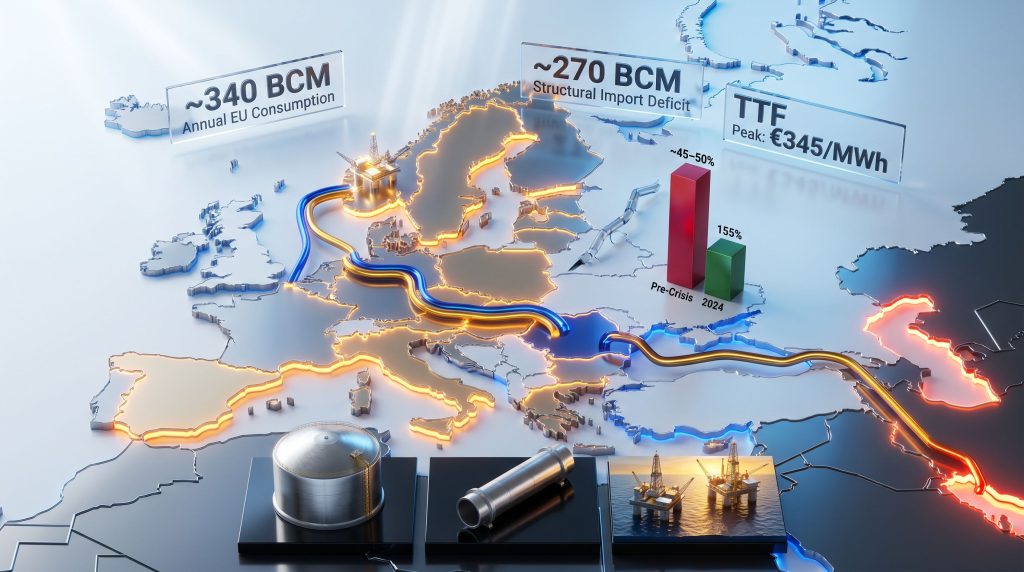
- Europe consumed approximately 340 billion cubic meters (BCM) of natural gas in 2025
- Roughly 50% of that total was sourced from imported liquefied natural gas (LNG)
- Norway, the single largest domestic producer, accounts for approximately 60% of European domestic supply
- Norwegian North Sea fields face a projected 20% production decline over the next decade
- The EU maintains a structural hydrocarbon import deficit of approximately 270 BCM annually
- Domestic production risks falling below 30 BCM by 2030 under a pessimistic scenario
"Europe's energy vulnerability is not simply a product of geopolitical misfortune. It is the cumulative result of decades of underinvestment in domestic production, compounded by regulatory frameworks that actively discouraged hydrocarbon exploration at precisely the moment resilience was most needed."
The European Commission's own findings confirm that the EU is structurally dependent on energy imports to a degree that sets it apart from other major economic blocs. Unlike the United States, which has transformed its energy position through domestic unconventional gas production, or China, which aggressively pursues both domestic production and diversified import routes, Europe allowed its internal production base to atrophy while regulatory complexity grew.
How Europe Became Locked Into Russian Gas: A Historical Framework
Post-War Origins of Soviet Energy Integration (1946 to 1970)
The structural dependency that would eventually threaten European economic stability did not emerge suddenly. Its roots stretch back to 1946, when Soviet natural gas exports to Eastern Bloc nations, beginning with Poland, first established the template of energy-for-influence that would define the relationship for decades.
The pivotal institutional breakthrough came in 1964, when the USSR and Czechoslovakia signed the landmark Bratstvo (Brotherhood) pipeline contract, with first deliveries commencing in 1967. Austria followed in 1968, signing a 23-year supply agreement for 142 million cubic meters annually. Italy and France joined in 1969, and then came the arrangement that would prove most consequential of all.
In 1970, West Germany under Chancellor Willy Brandt negotiated a gas-for-pipes arrangement that would define European energy dependency for a generation. Germany supplied high-grade, large-diameter pipeline infrastructure to the Soviet Union in exchange for long-term natural gas flows. First deliveries to West Germany commenced in 1973, and volumes expanded steadily throughout the decade, establishing the commercial and political logic that would make Soviet energy practically impossible to displace.
The Yamal Pipeline: Engineering Dependency at Continental Scale (1982 to 1984)
Construction of the Urengoy-Pomary-Uzhgorod pipeline, known in Western media as the Yamal pipeline, began in 1982. The pipeline stretched approximately 2,765 miles from the Urengoy gas field in Western Siberia, across Ukraine, and into Central and Western European distribution grids. Its annual delivery capacity reached approximately 32 BCM, serving Austria, Germany, France, Italy, and neighbouring nations.
The Reagan administration, alarmed by the strategic implications, imposed sanctions targeting both US oil and gas technology exports and European subsidiaries using licensed American components. However, Europe defied the restrictions and completed the network in 1984. The commercial logic was compelling: European governments secured reliable, below-market-priced gas while German, French, and Japanese banks recycled capital through infrastructure financing arrangements that created deeply embedded financial interests on both sides.
The Yamal network consequently transformed the Bratstvo pipeline from a regional Eastern Bloc arrangement into what analysts would later describe as a transcontinental energy monopoly. By creating long-term, high-volume supply contracts that were structurally difficult to exit, it locked in dependence in a manner that proved nearly irreversible.
Nord Stream and the Final Deepening of Dependency (2011 to 2021)
By the 2010s, Russian state energy company Gazprom held approximately 25 to 30% of EU natural gas market share. The Nord Stream pipeline project represented the culmination of six decades of supply integration.
| Pipeline | Completion Year | Capacity (BCM/year) | Primary Route |
|---|---|---|---|
| Bratstvo (Brotherhood) | 1967 (expanded) | ~32 BCM | Ukraine to Central Europe |
| Yamal-Europe | 1984 | ~32 BCM | Siberia to Western Europe |
| Nord Stream 1 | 2011 | 55 BCM | Baltic Sea, Russia to Germany |
| Nord Stream 2 | Completed, never operational | 55 BCM (additional) | Baltic Sea, Russia to Germany |
Nord Stream 1 consisted of two parallel subsea pipelines running beneath the Baltic Sea from Vyborg, Russia to Lubmin, Germany, with a combined annual capacity of 55 BCM. Planning for Nord Stream 2 began in 2015, with the stated objective of doubling capacity, supporting Germany's coal and nuclear phase-out, and reducing transit dependency on Ukraine.
Opposition centred on strategic vulnerability concerns from the United States, Ukraine, Poland, and the Baltic states. The US imposed sanctions through the Protecting Europe's Energy Security Act in 2019, temporarily delaying construction. A subsequent Biden administration waiver was granted conditional on a $1 billion German commitment to Ukrainian green energy infrastructure, a pledge that events would quickly render academic.
The 2022 Rupture: How Russian Gas Flows Collapsed
The Russia-Ukraine Conflict and the Cascade of Supply Disruptions
Russia's military actions in Ukraine commenced on February 24, 2022, triggering an immediate cascade of EU sanctions targeting Russian banks, technology exports, and high-net-worth individuals. In an unprecedented intervention, approximately $300 billion of Russia's foreign exchange reserves were frozen by Western governments.
Russia responded with Decree 172, mandating ruble-denominated payments for natural gas contracts with nations designated as unfriendly. Poland and Bulgaria were the first casualties, having their gas deliveries suspended in April 2022 following non-compliance.
The sequential dismantling of Russian gas flows to Europe then unfolded across the remainder of 2022:
- Nord Stream 1 deliveries to Germany were progressively reduced, then halted entirely
- Transit through the Yamal pipeline network to Europe was suspended
- Approximately 50% of flows through the Bratstvo and Soyuz pipelines via Ukraine were curtailed
- In September 2022, both Nord Stream pipelines were physically destroyed in a sabotage event, permanently eliminating the possibility of near-term renegotiation
Critical Statistic: Year-over-year, Russian gas deliveries to Europe fell by 55 to 60% in 2022, representing the largest single-year supply decline in modern European energy history.
The Price Shock: European Benchmark Gas Pricing in Crisis
The TTF benchmark, the primary European natural gas price reference, responded with extraordinary volatility:
| Period | TTF Benchmark Price |
|---|---|
| Pre-conflict average (2019 to 2021) | ~€30 to €35/MWh |
| Peak crisis (August 2022) | €345/MWh |
| Crisis period average (Oct 2021 to Oct 2023) | ~€90/MWh |
| Multiple vs. pre-crisis baseline | 3x to 10x |
The price spike transmitted globally. Furthermore, European buyers outbid developing Asian economies for LNG cargoes, forcing several nations to revert to coal combustion. This substitution effect, a direct environmental consequence of Europe's supply crisis, undermined global decarbonisation progress at a moment when the narrative around clean energy transition was intensifying.
The Real Economic and Social Costs of the Energy Crisis
Household Energy Poverty: Measuring the Human Toll
The impact on European households was measurable and severe. Eurostat data and the anatomy of the natural gas crisis documented the following progression:
- The share of EU households unable to adequately heat their homes rose from 6.9% in 2021 to 9.3% in 2022, peaking at 10.6% in 2023
- Total household energy expenditures increased by approximately 62 to 113% across member states
- Energy costs contributed 3.2 to 3.8 percentage points to Euro area headline inflation in 2022, eroding real wages and suppressing consumption
Industrial Deindustrialisation: Structural Damage That Persists
The impact on European manufacturing was not temporary. Euro area industrial output in energy-intensive sectors declined by approximately 15% in aggregate between 2022 and 2024. The economic mechanism was straightforward but damaging: when domestic production became uneconomical, firms substituted expensive local output with cheaper imports from less energy-exposed economies.
Germany, historically the EU's industrial engine, has consequently experienced an accelerating deindustrialisation trend that analysts note continues into 2026.
Global Spillover Effects
The consequences extended far beyond Europe's borders:
- An estimated 78 to 140 million people globally were pushed into extreme poverty as a secondary consequence of the energy price shock
- EU debt and fiscal deficits expanded significantly as energy import bills surged and foreign investment in the region declined
- Developing economies in Asia and Africa were structurally disadvantaged as European buyers crowded out their access to global LNG supplies
How the EU Responded: Policy Interventions and Their Limitations
The REPowerEU Framework: Diversification Under Pressure
The EU launched REPowerEU as its primary policy response, encompassing several parallel initiatives:
- Accelerated LNG import diversification from the United States, Norway, Qatar, Algeria, and other non-Russian suppliers
- Mandatory minimum gas storage targets for all member states, with storage reaching over 99% capacity in late 2023
- A joint gas purchasing platform designed to leverage collective bargaining power
- Direct market interventions including a revenue cap on electricity producers and a windfall profit tax redirected toward household energy bill relief
The LNG Pivot: Progress and New Vulnerabilities
| Supply Source Metric | Pre-Crisis | Post-Crisis (2024) |
|---|---|---|
| Russian gas share of EU imports | 45 to 50% | ~15% |
| LNG share of total EU supply | ~20.7% | ~37.5% |
| Russian gas volume delivered | ~150+ BCM | ~52 BCM |
| EU LNG import capacity expansion | Baseline | +13% near-term |
While the LNG pivot successfully reduced physical supply risk, it introduced a new structural vulnerability: deep coupling with Asian spot markets and global price indices. Replacing dependency on Russian pipeline gas with dependency on global LNG supply shifted the nature of the risk without eliminating it.
What the Policy Response Got Wrong
Several EU policy choices actively worsened the situation or created new problems:
- Germany accelerated the shutdown of nuclear power plants, replacing baseload capacity partly with lignite (brown coal), the most carbon-intensive fossil fuel available
- Subsidised wind and solar build-outs in regions with insufficient resource conditions produced economically unviable projects that consumed capital without resolving supply deficits
- ESG-oriented sustainable finance regulations discouraged domestic hydrocarbon exploration, creating additional green transition risks at precisely the moment supply resilience was most critical
- European LNG purchasing outbid developing nations, triggering coal switching in Asia and undermining global decarbonisation progress
The next major ASX story will hit our subscribers first
The Middle East Disruption: When One Crisis Compounds Another
The 2026 Iran Conflict and the Strait of Hormuz Shock
Europe's post-Russia diversification strategy was stress-tested by a second major geopolitical disruption in 2026. On February 28, 2026, coordinated US and Israeli strikes on Iranian military, nuclear, and command infrastructure triggered an immediate retaliatory response. Iran's most consequential strategic weapon proved to be economic rather than ballistic: the closure of the Strait of Hormuz, through which approximately 20% of global oil and 20% of global LNG transits.
Qatar Energy declared force majeure on all LNG contracts and halted production at the Ras Laffan and Mesaieed facilities, effectively removing approximately 20% of global LNG supply from the market in a single announcement.
The Cascading Impact on European Energy Markets
The effects on Europe were immediate and asymmetric:
- Italy experienced the most acute disruption, losing approximately 30% of its LNG flows
- Approximately 14% of EU LNG supplies sourced from the Middle East were reduced to a trickle
- Electricity prices surged: UK (+19%), Italy (+13%), Germany (+7%)
- Subsequent Israeli strikes on Iran's South Pars gas field prompted Iranian missile attacks on Qatar's Ras Laffan Industrial City, destroying approximately 17% of Qatar's LNG production capacity
- Recovery timelines for damaged Qatari infrastructure are estimated at three to five years
- The Europe natural gas crisis and energy security situation was further compounded as European gas prices surged approximately 35%, reaching their highest levels since the peak of the 2022 crisis
- The EU's additional fuel import costs in 2026 due to elevated prices reached approximately €24 billion
"The Middle East disruption exposed a critical flaw in Europe's post-Russia diversification strategy: replacing one geopolitically concentrated supply dependency with another, rather than building genuine structural resilience through domestic production."
Domestic Production: The Case for a European Gas Renaissance
Mapping Europe's Existing and Emerging Gas Production Landscape
| Country/Region | Current Status | Notable Projects |
|---|---|---|
| Norway (North Sea) | ~123 BCM projected (2026); ~97 active fields | Long-term decline trajectory |
| United Kingdom | 30 to 38 BCM current production | Subject to restrictive energy policy headwinds |
| Romania | Ramping up | Neptune Deep, largest upcoming offshore project in Europe |
| Hungary (Pannonian Basin) | Emerging production | Kiskunhalas light gas project, targeted early 2027 |
| Germany | Emerging production | Wietze Horst project, targeted mid-2026 |
| Netherlands | Legacy production | Mature, declining fields |
| Ukraine | Significant curtailment | Infrastructure damage from ongoing conflict |
| Italy | Potential expansion | Val d'Agri and Tempa Rossa by Eni and Shell |
| Bulgaria | Exploration phase | Han Asparuh Block by OMV Petrom and NewMed Energy |
| Austria | Small-scale development | Shallow gas drilling campaign by ADX Energy |
Romania's Neptune Deep: Europe's Most Significant Offshore Development
Romania's Neptune Deep project represents the largest upcoming offshore gas development on the European continent. Located in the Romanian sector of the Black Sea, the project is advancing toward production and is expected to materially contribute to regional supply diversification once operational. Its scale positions Romania as a strategically important emerging producer within the EU's domestic supply framework.
Hungary's Kiskunhalas Project: North American Technology Applied to European Resources
The Kiskunhalas light gas project in Hungary's Pannonian Basin represents one of the most technically interesting domestic gas development stories currently unfolding in Europe. Several factors distinguish it from other emerging projects:
- Located adjacent to established Central European pipeline infrastructure, enabling relatively straightforward route to market
- Independently verified contingent resources exceeding 16 BCM, with potential to surpass 31 BCM if further exploration confirms additional discoveries
- Applies North American-style unconventional extraction technology and operational best practices to a proven but historically underdeveloped legacy discovery
- Targeted for production commencement in early 2027, making it one of the most advanced near-term domestic gas development projects in the EU
- Located in Hungary's Pannonian Basin, a sedimentary basin with well-understood geology but historically underexplored using modern unconventional techniques
The application of North American unconventional extraction methods to European legacy discoveries is a relatively underappreciated dynamic in the European energy security conversation. In addition, the techniques that transformed US gas production over the past two decades have not been widely deployed across European basins. Kiskunhalas represents an early example of what this technology transfer could achieve at scale.
Germany's Wietze Horst Project: Rare Domestic Activity in a Retreating Market
Operated by Vermilion Energy, the Wietze Horst project in Germany is targeted for first production in mid-2026. It represents a rare example of new domestic gas development activity within a country that has otherwise been retreating from hydrocarbon production under regulatory pressure. In the context of Germany's ongoing deindustrialisation and its heavy exposure to pressure on European gas prices, even incremental domestic production carries disproportionate strategic value.
Quantifying the Structural Import Gap to 2030
The Numbers That Define Europe's Energy Security Challenge
| Metric | Current or Projected Figure |
|---|---|
| Annual EU natural gas consumption | ~340 BCM |
| Annual EU structural import requirement | ~270 BCM |
| Domestic production minimum to stabilise pricing | ~100 BCM |
| Projected domestic production (pessimistic scenario) | Below 30 BCM by 2030 |
| Implied LNG import requirement (worst case) | ~200 million tonnes per annum (MTPA) |
| Share of global LNG demand (worst case) | ~45% |
| EU gas demand reduction target by 2030 | -7% vs. recent baseline |
Gas consumption across the EU fell by approximately 18% in 2022 to 2023 relative to the prior five-year average, driven by efficiency measures, industrial contraction, and fuel switching. Despite this meaningful demand reduction, the structural import deficit remains the defining long-term challenge.
The worst-case scenario carries global consequences. If EU domestic production collapses toward 30 BCM while consumption stabilises, Europe would require approximately 200 MTPA of LNG, approaching 45% of current global LNG production capacity. This scale of demand would structurally disadvantage developing economies in Asia and Africa, repeating the 2022 pattern of wealthy European buyers crowding out lower-income nations.
Frequently Asked Questions: Europe's Natural Gas Crisis Explained
Has Europe Solved Its Natural Gas Supply Problem?
Europe has resolved the immediate physical supply shortage through LNG diversification and storage mandates, with storage reaching over 99% capacity in late 2023. However, the region remains highly exposed to global price volatility and geopolitical disruptions in supply corridors it cannot control. A price security crisis has effectively replaced the original supply security crisis.
How Much Has Europe Reduced Its Dependence on Russian Gas?
Russian gas imports fell from approximately 45 to 50% of EU supply before the conflict to roughly 15% by 2024. A binding prohibition on Russian gas imports is scheduled to take effect by November 2027, though residual volumes of approximately 52 BCM were still recorded in 2024.
Why Did the 2026 Middle East Conflict Affect European Gas Prices?
The closure of the Strait of Hormuz and force majeure declarations by Qatar Energy removed approximately 20% of global LNG supply from the market. Since European gas prices are now structurally coupled with global LNG indices, any major supply disruption, regardless of geographic origin, transmits directly to European benchmark pricing. This is the defining vulnerability of the LNG diversification strategy.
What Is the Most Significant Domestic Gas Project Currently Advancing in Europe?
Romania's Neptune Deep offshore project represents the largest upcoming domestic gas development in Europe by scale. Hungary's Kiskunhalas project, with independently verified contingent resources exceeding 16 BCM and a targeted early 2027 production date, and Germany's Wietze Horst project are among the most advanced near-term production developments on the continent.
Can Renewable Energy Alone Solve Europe's Energy Security Problem?
Most energy analysts argue that the renewable energy transition alone cannot bridge Europe's structural supply deficit within a timeframe consistent with economic and social stability. The experience of 2022 to 2026 has demonstrated that an energy system with insufficient baseload supply and excessive import dependency is acutely vulnerable to geopolitical shocks. A balanced strategy combining accelerated domestic gas production with continued renewable build-out represents the most widely supported path to genuine energy independence.
What Role Do ESG Regulations Play in Europe's Energy Vulnerability?
Sustainable finance regulations and ESG frameworks, while well-intentioned from an environmental perspective, actively discouraged domestic hydrocarbon exploration investment during the period when supply resilience was most needed. Critics argue that this regulatory environment deepened import dependency and contributed to the severity of the 2022 price shock. The policy debate now centres on how to balance decarbonisation objectives with the practical energy security requirements of the Europe natural gas crisis and energy security challenge facing the continent.
Want to Track the Next Major Resource Discovery Before the Market Does?
Europe's deepening energy security crisis is a stark reminder of what happens when supply vulnerabilities go unaddressed — and for investors, moments of structural disruption consistently precede significant resource discoveries and market re-ratings. Discovery Alert's proprietary Discovery IQ model delivers real-time notifications on significant ASX mineral discoveries the moment they hit the exchange, turning complex resource data into actionable opportunities — explore historic discoveries and their returns to see what early positioning can mean in practice, then begin your 14-day free trial to ensure you never miss the next major find.