June 13, 2026
How Geopolitical Risk Gets Priced Into Crude Oil Futures
Every experienced energy trader understands a fundamental truth about crude oil markets: prices rarely move on what has already happened. They move on what the market collectively believes might happen next. This forward-looking psychology sits at the core of geopolitical risk pricing, and it explains why Trump halts Iran strike and oil prices fall — a single presidential statement can send benchmark crude prices swinging by several percentage points within hours, even when not a single barrel of oil has been disrupted.
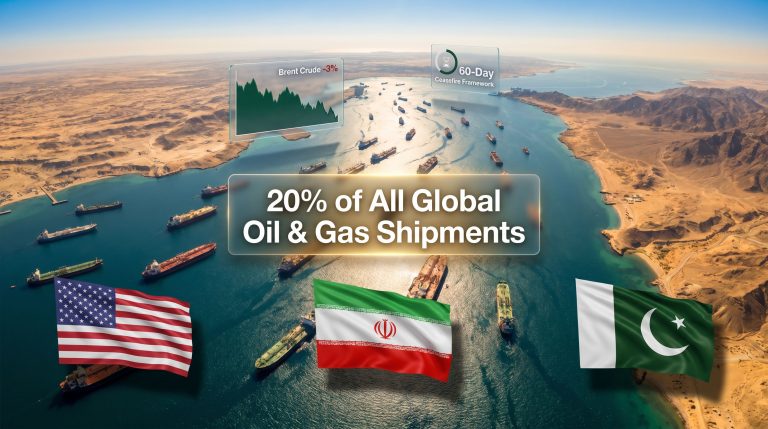
The Persian Gulf region sits at the absolute centre of this pricing dynamic. Roughly 20% of global seaborne oil trade transits through the Strait of Hormuz, the narrow chokepoint separating the Persian Gulf from the Gulf of Oman. Iran's geographic position adjacent to this corridor, combined with its status as the holder of the fourth-largest proven crude oil reserves on the planet, means any credible military threat involving Iranian infrastructure can shift Brent crude by $2 to $5 per barrel within a single trading session. That kind of movement does not require an actual supply interruption. The perceived probability of one is sufficient.
This mechanism is what traders call the war premium — an additional price layer embedded into futures contracts that reflects the probability-weighted cost of a potential supply shock. The war premium is asymmetric by nature: it accumulates gradually as tensions build over days or weeks, then collapses with remarkable speed when diplomatic signals emerge. Furthermore, understanding trade and geopolitics is essential for any investor attempting to navigate these rapid repricing events.
The war premium is not simply a reflection of current conditions. It represents the market's collective forecast of future supply risk, discounted back to today's price. When that forecast changes abruptly, the price correction is immediate and often violent.
When big ASX news breaks, our subscribers know first
Trump Halts Iran Strike: What the Markets Actually Processed
From Strike Authorisation to Diplomatic Pause
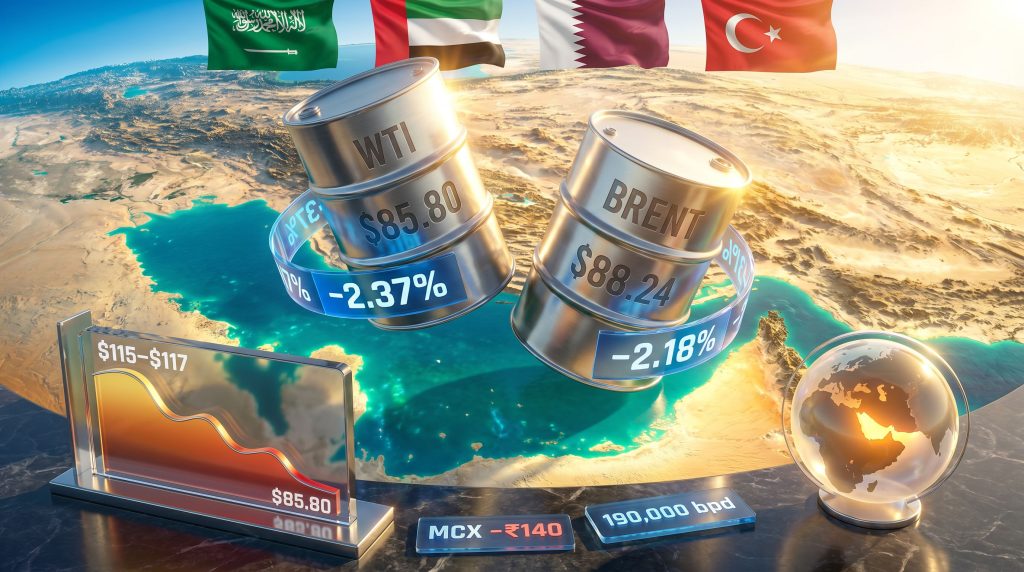
When news emerged that US President Donald Trump had moved away from authorising planned military strikes on Iranian oil infrastructure after citing meaningful progress toward a peace framework, energy markets repriced with extraordinary speed. The diplomatic pause was described as being supported by a coalition of regional partners including Saudi Arabia, the UAE, Qatar, and Turkey, adding a layer of multilateral credibility to the de-escalation signal. You can read more about the broader diplomatic context surrounding US-Saudi-Iran relations.
Prior to this announcement, WTI crude had been trading in the $115 to $117 per barrel range, a price level that embedded a substantial war premium reflecting the perceived high probability of imminent military action. Within hours of the Trump announcement, WTI slipped below $100 per barrel, representing one of the most dramatic single-session geopolitical repricing events in recent energy market history.
How Indian Futures Markets Reflected the Global Repricing
The impact was immediately visible across Indian commodity exchanges, where MCX crude futures closely mirrored the global benchmark decline. The correlation between MCX crude and global benchmarks like Brent is well-established, though it is also modulated by the INR/USD exchange rate, meaning Indian importers and traders face a dual exposure to both the commodity price and the currency movement simultaneously.
| Contract | Exchange | Price Movement | New Price | Volume (Lots) |
|---|---|---|---|---|
| Crude June Delivery | MCX | -₹140 (-1.68%) | ₹8,204/barrel | 12,005 |
| Crude July Delivery | MCX | -₹137 (-1.66%) | ₹8,103/barrel | 4,711 |
| Brent August Futures | Global | -$2.14 (-2.37%) | $88.24/barrel | Elevated |
| WTI July Futures | Global | -2.18% | $85.80/barrel | Elevated |
The elevated trading volumes across both MCX contracts are worth noting. June delivery recorded 12,005 lots and July delivery saw 4,711 lots, confirming that this was active and deliberate repositioning by market participants, not a thin-liquidity session distorting price signals.
Tehran's Response and the Diplomatic Ambiguity That Followed
What prevented a more complete unwind of the war premium was the Iranian side of the equation. Officials in Tehran publicly stated that no formal agreement had been reached or approved, directly contradicting the optimism embedded in Trump's announcement. This created a structurally ambiguous situation for traders: the threat had receded but had not disappeared, meaning the market moved to a risk-off but not risk-free posture.
This kind of diplomatic ambiguity is particularly challenging for energy traders to model. Standard futures pricing frameworks handle well-defined supply disruptions reasonably well, but they struggle with probability distributions that shift rapidly based on political statements. The result is typically elevated implied volatility in crude options markets, even as spot prices decline. Consequently, the geopolitical supply risks feeding into these pricing models remain genuinely difficult to quantify.
When the US signals de-escalation but the counterparty denies any agreement exists, markets are left pricing a scenario where the war premium has partially collapsed but the underlying risk has not been structurally resolved. This is arguably the most expensive type of uncertainty for traders to manage.
The OPEC Floor: Why Crude Cannot Fall Indefinitely
May Production Data Reveals Active Supply Management
One of the most significant counterweights to the diplomatic-driven price decline came from OPEC's latest monthly report, which revealed that Declaration of Cooperation (DoC) member nations collectively reduced crude output by 190,000 barrels per day during May, bringing total DoC production to 33.13 million barrels per day.
This production discipline is not coincidental. OPEC's market influence functions as a deliberate price management mechanism, with member nations adjusting output to prevent prices from falling below levels that jeopardise fiscal stability for oil-dependent economies. For many Gulf producers, breakeven oil prices sit in the $70 to $85 range, making sustained prices below those levels fiscally uncomfortable.
The practical consequence of this supply management is that even as geopolitical risk premiums deflate, a structural price floor is maintained through reduced production. The two forces interact in a way that compresses the downside range for crude, even during periods of diplomatic easing.
Asian Demand Growth as a Structural Support Mechanism
OPEC's monthly report also reaffirmed its long-standing view that China, India, and other developing Asian economies will drive the majority of incremental global oil demand growth in the medium term. This demand profile is structurally different from the mature consumption patterns seen in Western Europe and North America, where energy transition policies are gradually eroding per-capita oil consumption.
India's rapidly expanding refining capacity and China's consumption recovery trajectory represent genuine multi-year demand tailwinds that underpin crude prices independent of geopolitical factors. When combined with the Northern Hemisphere's peak summer fuel demand window between June and August, this creates a seasonal demand premium that can quickly absorb any supply surplus generated by diplomatic de-escalation.
Key demand-side factors to monitor include:
- China's post-reopening petrochemical and transportation fuel demand trajectory
- India's refining throughput expansion and domestic consumption growth
- US summer driving season gasoline demand as a leading indicator
- European industrial fuel consumption amid energy transition uncertainty
- Emerging market aviation fuel recovery as international travel normalises
Scenario Analysis: Three Paths Forward for Oil Prices
What Each Diplomatic Outcome Means for Benchmarks
The current market environment is best understood through scenario analysis rather than point forecasts. The range of plausible outcomes for Trump halts Iran strike developments creates genuinely divergent price trajectories, and the probability weighting between those scenarios remains highly fluid. In addition, the trade war oil impacts add another layer of complexity to any forward-looking price model.
| Scenario | Key Conditions | Estimated Brent Impact |
|---|---|---|
| Full peace accord formalised | Coalition pressure succeeds; Iran signs framework | Brent falls toward $82-$85 as war premium fully exits |
| Talks stall, no deal, no military action | Iran rejects terms; US maintains pause | Prices stabilise near current levels with elevated volatility |
| Negotiations collapse, military action resumes | Iran's denial hardens; US redeploys assets | Brent spikes toward $95-$100+ as supply risk returns |
The middle scenario, which is arguably the most likely near-term outcome given Tehran's initial denial of any agreement, is also the most difficult for traders to position against. It implies a prolonged period of elevated implied volatility with a relatively narrow price range, which favours options-based hedging strategies over directional futures positions.
The Pump Price Transmission Lag: What Consumers Should Understand
A critical and often misunderstood aspect of crude oil price movements is the transmission lag between futures markets and retail fuel prices. Even if Brent crude stabilises near $88 per barrel, it typically takes four to six weeks for that price level to fully flow through to what consumers pay at the petrol station. This lag exists because retail fuel pricing incorporates refinery margins, distribution infrastructure costs, regional taxation, and retailer margin structures that do not adjust instantaneously.
A $2 per barrel decline in Brent crude does not produce an equivalent reduction at the pump. Multiple cost layers absorb and dampen the transmission, meaning consumers should not expect immediate relief simply because futures benchmarks have moved lower.
Additionally, the currency dimension is especially important for countries like India, where crude is priced in USD but sold domestically in rupees. Rupee depreciation against the dollar can partially or fully offset the benefit of lower global crude prices for Indian consumers and refiners.
Key Risk Factors That Could Reignite the Oil Price Premium
Even with the current diplomatic pause, several catalysts could rapidly reverse the price decline associated with Trump halts Iran strike plans. Furthermore, tracking oil volatility trends remains critical for any investor seeking to anticipate where premiums may rebuild.
- Iran formally rejecting any peace framework in official diplomatic communications, a risk already partially flagged by Tehran's initial response
- Resumption of US military positioning in the Gulf region, which would signal that the pause was tactical rather than substantive
- OPEC+ announcing additional production cuts in response to price weakness near the structural floor
- Unexpected supply disruptions from other major producers including Libya, Nigeria, or Venezuela, which collectively add to global supply fragility
- Escalation of broader regional instability beyond the US-Iran bilateral dynamic, potentially drawing in other energy-producing nations
- A sharp USD weakening, which would mechanically push USD-denominated crude prices higher across all benchmarks
What the Oil Market's Reaction Reveals About Investor Psychology
Reading the Signals Embedded in Price Velocity
The speed and magnitude of the crude oil decline following Trump's announcement reveals something important about the psychological architecture of how markets had been positioned. The fact that WTI was trading near $115 to $117 per barrel immediately prior to the announcement confirms that a large portion of the active trading community had priced in a high-probability conflict scenario. The reversal was not gradual; it was near-instantaneous.
This pattern reflects a well-documented phenomenon in commodity markets: asymmetric de-escalation pricing. Risk premiums build slowly as uncertainty accumulates, each piece of escalatory news adding incrementally to the embedded premium. However, when a credible diplomatic signal emerges, the unwind is compressed into a very short window as traders simultaneously move to reduce long exposure.
For investors using crude oil as a macro risk barometer rather than a directional commodity trade, this dynamic has important implications. Oil price behaviour during geopolitical events tends to lead rather than lag diplomatic developments, meaning traders who wait for confirmed news before acting have typically already missed the majority of the price movement. Recent BBC reporting on Iran negotiations further illustrates just how rapidly these diplomatic signals can shift.
The Structural Case for Crude Remaining Historically Elevated
Even at post-announcement levels of $85 to $88 per barrel, Brent crude remains significantly elevated relative to the pre-2022 price environment, when the global energy system was operating under different supply assumptions. The convergence of OPEC production discipline, Asian demand growth, and chronic underinvestment in conventional oil production capacity over the previous decade has structurally shifted the price baseline upward.
This means geopolitical events are amplifying an already tight market rather than creating supply fragility from a position of abundance. When the baseline is elevated, the magnitude of risk premium additions is larger, and the volatility profile is more pronounced than it would be in a well-supplied market environment.
The next major ASX story will hit our subscribers first
Frequently Asked Questions About Trump, Iran, and Oil Market Dynamics
Why did oil prices fall when Trump paused Iran strikes?
The price decline reflected the rapid unwinding of a war premium that had been embedded in crude futures over preceding weeks. When the immediate threat to Iranian oil infrastructure and Gulf supply chains receded, traders unwound long positions that had been built in anticipation of a supply disruption. Since no actual disruption had materialised, the removal of the risk signal was sufficient to drive Brent lower by 2.37% and WTI by approximately 2.18% in a single session.
Could oil prices recover quickly if talks collapse?
Yes, and analysts have explicitly flagged this risk. The absence of a formally signed agreement, combined with Iran's public denial that any accord had been approved, means the geopolitical risk premium could be rebuilt rapidly if negotiations deteriorate. Peak summer fuel demand conditions and OPEC production constraints would amplify any such reversal.
How do OPEC production cuts interact with geopolitical risk premiums?
OPEC supply management and geopolitical risk premiums operate as separate but complementary price support mechanisms. OPEC cuts establish a structural price floor through constrained supply, while geopolitical premiums add a situational layer above that floor during periods of regional instability. When the premium deflates, the OPEC-supported floor prevents prices from falling to levels that would reflect purely demand-driven fundamentals.
What should investors monitor in the coming weeks?
- Formal diplomatic communications between Washington and Tehran confirming or denying any framework agreement
- OPEC's next monthly production report for revisions to output targets or demand forecasts
- US summer driving season gasoline demand data as a real-time consumption indicator
- Federal Reserve policy signals, given that USD strength directly influences USD-denominated crude pricing globally
- MCX crude futures volumes as a proxy for the intensity of trader repositioning in Indian markets
Disclaimer: This article contains forward-looking statements, scenario analyses, and market commentary that are subject to significant uncertainty. Oil price forecasts and diplomatic outcome projections involve assumptions that may not materialise. This content is intended for informational purposes only and does not constitute financial advice. Readers should conduct their own due diligence before making any investment decisions related to energy commodities.
Want to Stay Ahead of the Next Major Commodity Repricing Event?
Discovery Alert's proprietary Discovery IQ model scans ASX announcements in real time, instantly identifying high-potential mineral discoveries across more than 30 commodities — cutting through market noise so investors can act before the broader market catches on. Explore historic discovery returns that demonstrate just how significant early positioning can be, and begin your 14-day free trial at Discovery Alert to secure your market-leading advantage.