July 30, 2026
When Import Dependency Meets a Multi-Vector Supply Shock
Energy security debates in Europe have long centred on a single question: what happens when multiple supply chains fail simultaneously? For most of the post-2022 period, the answer remained theoretical. Policymakers pointed to diversification progress, new LNG terminals, and renewables buildout as evidence that the continent had rebuilt its resilience after the Russian pipeline severance. Heading into the winter of 2026/27, that theory is being tested in real time, and the results are uncomfortable.
Europe winter gas storage and diesel shortages represent not simply a story about one disrupted supply route, but a convergence of pressures across multiple energy vectors, each arriving at the worst possible moment in the annual storage cycle. Furthermore, these geopolitical trade disruptions are amplifying an already fragile supply picture heading into the heating season.
When big ASX news breaks, our subscribers know first
Why Europe's Energy Buffer System Is Under Unprecedented Stress in 2026
The Structural Gap Between Policy Targets and Physical Reality
The EU's mandatory gas storage framework, introduced in 2022 following the Russian supply crisis, required member states to reach 90% storage capacity by November each year. That target was designed to guarantee a meaningful buffer against the unpredictability of winter demand. In 2026, achieving it looks increasingly improbable.
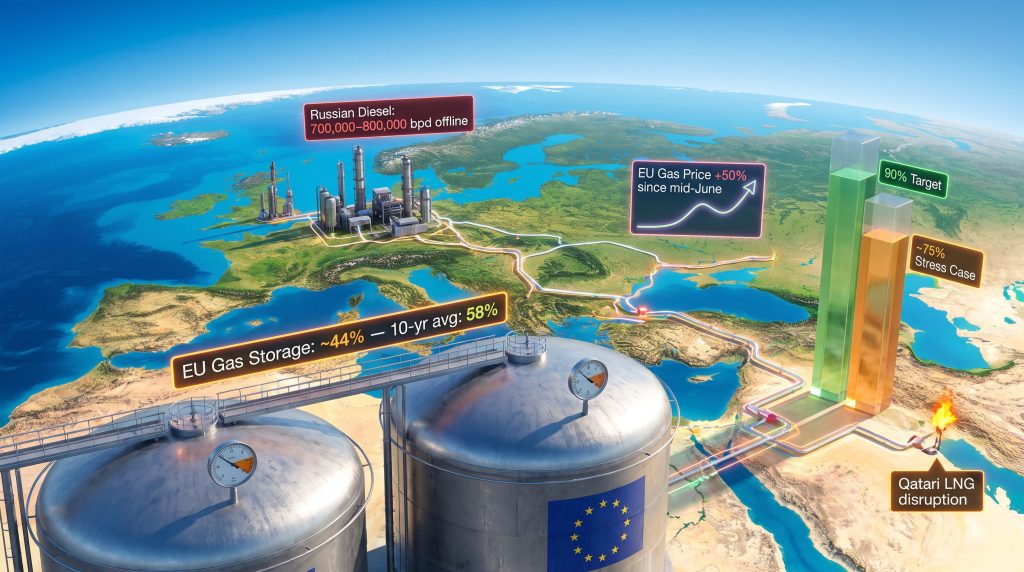
Storage entered the summer injection season at approximately 31 billion cubic metres (bcm), the lowest opening level since 2018. According to Wood Mackenzie analysis, EU benchmark gas prices have risen by 50% since mid-June 2026, a signal that markets are pricing in genuine scarcity rather than speculative positioning. Meanwhile, the European Commission has quietly moved to lower its November storage requirement, a political concession that does nothing to change the physical supply picture.
Key Metrics That Signal a Tighter-Than-Normal Winter Ahead
Snapshot: Europe's Energy Storage Position at a Glance (2026)
Indicator Current Level Benchmark / Target Risk Signal EU Gas Storage (Jan 2026) ~44% 10-yr avg: 58% ⚠️ Below average Gas Storage at Winter Start (2025) ~83% EU target: 90% ⚠️ Below target Injection Season Opening Stock ~31 bcm 2018 low comparison 🔴 Lowest since 2018 EU Gas Storage Target (November) 90% Revised lower by EC ⚠️ Target softened LNG Imports (July 2026 est.) ~6.3 million tonnes Sept 2024 low comparison 🔴 Near multi-year low EU Gas Price Change (since mid-June) +50% Pre-disruption baseline 🔴 Significant spike European Diesel Stocks Near multi-year lows 2022 trough comparison 🔴 Critically thin buffer Russian Diesel Export Volume (offline) 700,000–800,000 bpd Global balance contribution 🔴 Major supply gap
What Is Driving Europe's Gas Storage Deficit Heading Into Winter 2026?
The Collapse of Qatari LNG as a Low-Cost Supply Pillar
The first domino to fall was Qatar's LNG export capacity. The U.S.-Israeli military campaign against Iran inflicted significant collateral damage on Gulf energy infrastructure, forcing Qatar to invoke force majeure on LNG export commitments. For Europe, this was a critical blow. Qatari LNG had served as one of the continent's most cost-competitive import sources since the pivot away from Russian pipeline gas, and its removal during the summer injection season could not have been more poorly timed.
Key Insight: The removal of Qatari LNG from Europe's import mix during the active summer refill window is structurally more damaging than an equivalent disruption during winter, because it directly limits the volumes that can be injected before the heating season begins.
Why U.S. LNG Cannot Seamlessly Replace Qatari Volumes
The most obvious substitute for Qatari supply is U.S. liquefied natural gas, however the substitution is far from frictionless. The LNG supply outlook for 2025 and beyond highlights several structural barriers that limit how quickly American volumes can compensate:
-
Price differential: U.S. LNG carries a significant cost premium over Qatari supply, compressing the economics for European buyers already facing elevated benchmark prices
-
Liquefaction capacity constraints: U.S. export terminals are operating at or near capacity, limiting the volume flexibility available to redirect cargoes toward Europe
-
Regasification bottlenecks: Not all EU member states have equal access to LNG import terminals, creating geographic asymmetries in supply access across the bloc
-
Contract renegotiation timelines: Securing long-term replacement volumes requires months of commercial negotiation, a timeline incompatible with the urgency of pre-winter storage refilling
According to Eurostat data, the EU sources approximately 21% of its total energy from natural gas. That proportion understates the fuel's strategic importance, because gas serves as both a direct heating fuel and a significant input for electricity generation during periods when renewable output falls short.
How EU Benchmark Gas Prices Rose 50% in Six Weeks
The price signal is stark. Wood Mackenzie reported that EU benchmark gas prices increased by 50% between mid-June and late July 2026, reflecting the market's assessment of injection season progress. With storage sitting only just above 50% full at a point in the calendar when historical averages would place it considerably higher, traders and buyers are pricing in the risk that November inventories will fall materially short of the revised target.
Notably, despite this sharp appreciation, European gas prices remain well below their 2022 peak levels. This statistical fact, frequently cited by institutional reassurers, obscures an important reality: four consecutive years of elevated energy costs have already eroded industrial competitiveness and household purchasing power across the bloc. A further 50% price increase consequently compounds accumulated stress rather than arriving in a vacuum. These European gas price pressures are further exacerbated by ongoing trade policy uncertainty.
How Low Can Storage Go? Modelling Europe's Three Winter Scenarios
The trajectory of EU gas storage between now and November depends on two variables that are difficult to control simultaneously: the pace of LNG import recovery and the severity of early winter weather. According to analysis from the Columbia University Energy Policy centre, Europe's storage buffer has been structurally dwindling, making the current situation particularly precarious.
Scenario Modelling Table: EU Gas Storage Trajectory to November 2026
Scenario Projected November Storage Gap vs. 90% Target Risk Level Base Case (accelerated refill) ~82–85% 5–8 percentage points Moderate Stress Case (current import pace) ~75% 15 percentage points High Crisis Case (cold weather + disruption) ~60–65% 25–30 percentage points Severe
Wood Mackenzie's central projection, assuming LNG imports remain subdued at current pace, places November storage at approximately 75%. That is a 15-percentage-point shortfall against the original 90% target and represents a materially thinner buffer than Europe has carried into recent winters.
Featured Snippet Block:
How full should Europe's gas storage be before winter?
The EU set a mandatory target requiring member states to reach 90% gas storage capacity by November, the official start of the heating season. In 2026, with storage opening the injection season at approximately 31 bcm, the lowest level since 2018, and LNG imports running near multi-year lows at an estimated 6.3 million tonnes in July (Kpler data, as cited by Reuters), analysts project storage could reach only 75% under current conditions. That 15-percentage-point shortfall significantly reduces Europe's buffer against cold snaps or further supply disruptions.
The crisis scenario, which combines a cold weather event in October or November with further import disruption, could push the November figure toward 60-65%. That level would place the continent in genuine supply stress before the heating season reaches its midpoint.
The Diesel Crisis: Why Refined Fuel Markets Are More Vulnerable Than Crude
Understanding the Crude-vs-Products Distinction
A conceptual error frequently made in public energy discourse is treating crude oil prices as the primary metric for fuel cost exposure. In reality, consumers, businesses, and transport operators interact with refined products — principally diesel, gasoline, and heating oil — rather than with crude directly. The spread between crude prices and refined product prices is determined by refinery margins, product-specific supply balances, and seasonal demand patterns, none of which move in lockstep with headline crude benchmarks.
Amrita Sen of Energy Aspects made this distinction explicit in commentary cited by the Financial Times in July 2026, noting that product markets, which cover diesel and comparable refined fuels, are considerably tighter than crude markets, and that these products, rather than crude barrels, are the fuels that end consumers actually purchase and pay for. In addition, broader oil price impacts from ongoing geopolitical tensions are feeding through to refined product markets in ways that are difficult to hedge.
The Russian Diesel Disruption: Quantifying a 700,000-800,000 bpd Supply Gap
Russia had historically been one of the world's most significant diesel exporters, contributing between 700,000 and 800,000 barrels per day to global trade flows. Ukrainian drone strikes targeting Russian refinery infrastructure prompted Moscow to respond with an export ban, simultaneously removing a major supply source from the global market and redirecting competitive pressure onto alternative suppliers.
The cascading effect is layered:
-
Countries that previously imported Russian diesel must now source volumes from alternative origins
-
Those alternative origins are simultaneously being pursued by European buyers seeking to replace their own Russian supply losses
-
The competition for available non-Russian diesel volumes is occurring against a backdrop of already-tight Gulf refined product availability
As Rystad Energy analyst Janiv Shah observed in commentary cited by the Financial Times, the volume removed from Russian exports is significant enough to reshape global diesel trade flows, with destination countries that previously relied on Russia now directly competing with European buyers for the same pool of available supply.
How Persian Gulf Refined Product Exports Were Simultaneously Disrupted
The Middle East conflict that disrupted Qatar's LNG exports also affected Gulf refined product export flows. The Persian Gulf had been a meaningful contributor to global diesel and distillate trade, and the simultaneous removal of both Russian and Gulf product volumes created a supply vacuum that no single remaining export region can fill at short notice.
Key Distinction Table: Shortage vs. Buffer Erosion
Condition Shortage Buffer Erosion (Current Situation) Physical fuel unavailability Yes No, fuel remains accessible Price impact Severe rationing-level spikes Elevated and increasingly volatile Vulnerability to disruption Already critical High, thin margin for error Cold weather resilience Very low Low, limited reserve capacity Policy response window Minimal Still available but narrowing fast
European diesel inventories are currently at their lowest levels since 2022, the year the continent last experienced acute energy stress. Compounding this, U.S. diesel inventories have also declined considerably, reducing the capacity of the world's largest diesel exporter to redirect volumes toward European buyers even as American refineries operate at elevated utilisation rates.
The Compounding Risk: When Gas and Diesel Tightness Converge
One of the less-discussed dimensions of Europe's current energy predicament is that gas and diesel tightness are occurring simultaneously rather than sequentially. This matters because the two fuels serve different but overlapping functions in a modern economy.
-
Natural gas supplies approximately 30% of European household heating needs and contributes materially to electricity generation during periods of low wind and solar output
-
Diesel powers the logistics and transport infrastructure that underlies economic activity, including the trucks that deliver heating oil and the generators that provide backup power during grid stress events
When both fuels are simultaneously in short supply, the resilience mechanisms that normally allow substitution between energy sources become unavailable. Industrial facilities that might switch from gas to diesel backup generation face elevated diesel prices. Households dependent on heating oil face the same supply tightness as gas users. Furthermore, the wider consumer price impacts of these energy pressures risk compounding already-stretched household budgets across the bloc.
Callout Box: The Diversification Paradox
Europe successfully reduced its direct reliance on Russian pipeline gas following 2022, but in doing so it concentrated LNG import dependency on a small number of Gulf exporters. Qatar's force majeure declaration demonstrated how a single geopolitical disruption can cascade through an import-dependent system that lacks sufficient domestic buffering capacity to absorb the shock.
The next major ASX story will hit our subscribers first
Which European Economies Face the Highest Exposure This Winter?
Not all EU member states are equally exposed to the current supply stress. Vulnerability is shaped by three factors: the extent of gas dependency for heating and electricity, proximity to LNG import infrastructure, and the depth of national diesel inventory buffers.
Risk Exposure Snapshot by Energy Vector
Risk Category Most Exposed Regions Key Vulnerability Gas heating dependency Central and Eastern Europe Limited LNG terminal access Industrial gas demand Germany, Italy, Netherlands Gas-to-power conversion exposure Diesel/distillate tightness Northwest Europe Thin inventory buffers, winter spec requirements LNG import reliance Entire EU Price exposure to U.S. spot market premium
Central and Eastern European member states face compounded risk: they tend to have higher gas dependency for residential heating, less direct access to LNG regasification terminals, and less flexibility to rapidly substitute alternative fuels. Germany, Italy, and the Netherlands face particular exposure on the industrial side, where gas-to-electricity conversion during periods of low renewables output represents a significant demand floor that cannot be curtailed without economic cost.
Northwest Europe carries the greatest diesel vulnerability, partly because of the concentration of distillate storage and trading infrastructure in the ARA region (Amsterdam-Rotterdam-Antwerp), and partly because winter-grade diesel must meet lower cold-filter plugging point specifications, making it a tighter market than summer-grade supply.
What Policy Responses Are Available Before the Heating Season Begins?
The policy toolkit for addressing a pre-winter storage deficit is well understood, but each lever carries costs and constraints.
Step-by-Step: How the EU Could Close the Storage Gap Before November 2026
Maximise LNG import volumes through all available regasification terminals during the remaining injection months, prioritising cost-competitive spot cargo acquisition
Activate demand reduction programmes in industrial sectors to slow storage drawdown, particularly in energy-intensive manufacturing
Coordinate cross-border pipeline flows to distribute available gas efficiently across member states with uneven storage fill levels
Engage emergency supply agreements with alternative LNG exporters including the United States, Australia, and West African producers
Implement pre-winter diesel stock-building mandates to reduce distillate vulnerability before temperatures decline and winter-grade specification requirements tighten
Monitor weather forecasts closely and pre-position contingency response plans for cold snaps during October and November
The challenge is that measures one, three, and four are all constrained by the same fundamental limitation: global LNG supply is tight, alternative exporters are operating near capacity, and the price required to attract spot cargoes is rising. Demand reduction through industrial curtailment is effective but economically damaging for an EU industrial base already under competitive pressure from higher energy costs relative to Asian and North American peers.
What the Institutional and Market Signals Are Saying
There is a notable divergence between official EU communications on energy security and what physical market indicators are pricing in. Analysts at Clean Energy Wire have noted that while outright gas shortage remains unlikely under base-case scenarios, the margin for error is considerably thinner than in recent years.
Comparison Table: Official vs. Market Assessment
Dimension European Commission View Market/Analyst View Gas supply security No immediate crisis Injection shortfall risk is real and quantifiable Storage target Revised lower, manageable 75% projected under current pace, 15pp shortfall Price trajectory Controllable +50% since mid-June, further upside risk Diesel availability Not specifically flagged Multi-year inventory lows, high disruption exposure Winter outlook Workable if refill succeeds Highly sensitive to weather and further shocks
The Commission's decision to lower the November storage target is being interpreted by market participants not as a pragmatic adjustment but as an implicit acknowledgement that the 90% level is no longer achievable. That interpretation is itself a price signal, reinforcing the premium that buyers must pay to attract LNG cargoes during the remaining weeks of the injection season.
FAQ: Europe Winter Gas Storage and Diesel Shortages
How Full Is Europe's Gas Storage Heading Into Winter 2026?
EU gas storage opened the 2026 injection season at approximately 31 bcm, the lowest starting point since 2018. As of late July, storage was reported to be just above 50% full, below historical averages for this point in the calendar. Wood Mackenzie projects November storage at around 75% if current LNG import rates persist.
What Caused European Diesel Inventories to Fall to Multi-Year Lows?
The combination of Ukrainian drone strikes on Russian refinery infrastructure triggering an export ban, the loss of Gulf refined product exports due to Middle East conflict, and chronically limited European domestic refining capacity has pushed distillate inventories to their lowest levels since 2022.
Will Europe Face Gas Rationing This Winter?
Rationing is not inevitable. However, the probability of supply stress is materially higher than in recent winters. A cold weather event on top of a 75% storage fill would create significant pressure on prices and potentially trigger demand curtailment mechanisms in industrial sectors before household supplies are affected.
How Much Does Europe Rely on Natural Gas for Heating?
According to available data, natural gas supplies approximately 30% of European household heating needs. It also contributes significantly to electricity generation, meaning gas shortfalls affect both direct heating and power supply simultaneously.
What Is the EU's Official Gas Storage Target and Has It Been Changed?
The EU originally mandated a 90% storage fill by November for all member states. In 2026, the European Commission indicated it would lower this target in response to the challenging supply environment. The revised figure has not yet been formally published, but the policy shift signals institutional acknowledgement that the original benchmark is unlikely to be met.
Is the Diesel Situation in Europe Worse Than the Gas Situation?
In terms of inventory buffers relative to recent history, diesel is arguably in a more precarious position. Reuters reported in late July 2026 that European diesel stocks were at their lowest since 2022, and unlike gas, there is no equivalent of a strategic petroleum reserve mechanism specifically targeting diesel buffers for most EU member states.
The Bigger Picture: What 2026 Reveals About Europe's Energy Architecture
The convergence of Europe winter gas storage and diesel shortages in 2026 is not primarily a crisis of bad luck. It is a stress test of the energy architecture that Europe built in the years following 2022, and the architecture has revealed structural weaknesses that policy diversification alone cannot address.
The continent successfully severed its dependency on Russian pipeline gas, but replaced it with a different form of concentration risk: heavy reliance on a small number of Gulf LNG exporters and an assumption that U.S. spot market volumes could serve as a reliable and affordable backstop. Qatar's force majeure declaration consequently exposed the fragility of that assumption at the most operationally sensitive time of year.
Simultaneously, the long-standing belief that European refinery closures and diesel import dependency could be managed through diversified sourcing has collided with a world in which Russian, Gulf, and domestic refining capacity are all constrained simultaneously. The result is a refined products market that is, as energy analysts have noted, considerably tighter than the crude market it draws from.
For all the progress made in wind and solar capacity deployment, the EU's heating season remains fundamentally dependent on fossil fuels for both direct combustion and backup power generation. Battery storage technology is not yet capable of compensating for multi-day or multi-week periods of low renewable output during winter anticyclonic weather patterns, the precise conditions that drive peak gas demand.
The institutional response — adjusting targets and issuing reassurances — treats the symptom rather than the cause. The cause is structural: a continent that imports the majority of its energy across supply chains concentrated in geopolitically volatile regions, with limited domestic buffers and insufficient flexibility to substitute across energy vectors when multiple supply chains fail at once. Until that architecture changes, Europe's winters will remain a recurring stress test with results that depend heavily on weather and geopolitical fortune.
This article is intended for informational purposes only and does not constitute investment or financial advice. Energy market forecasts are subject to significant uncertainty. Readers should consult independent sources and professional advisers before making decisions based on energy market projections.
Want To Stay Ahead of the Commodity Disruptions Reshaping Global Markets?
Discovery Alert's proprietary Discovery IQ model scans ASX announcements in real time, instantly identifying high-potential mineral discoveries across more than 30 commodities — turning complex market signals into clear, actionable opportunities for both short-term traders and long-term investors. Explore how historic mineral discoveries have generated extraordinary returns and begin your 14-day free trial at Discovery Alert to position yourself ahead of the next major market move.