
July 30, 2026
The Hidden Cost of Extraction: Why Latin America's Mineral Wealth Flows Elsewhere
Every tonne of unrefined copper concentrate that leaves a Chilean port, every lithium brine shipment that departs Atacama without being converted to battery-grade lithium hydroxide, represents a transfer of economic value from one of the world's most mineral-rich regions to processing facilities located primarily in Asia. This is not an accident of geography or geology. It is the compounding result of decades of underinvestment in downstream infrastructure, regulatory complexity, and industrial policy misalignment. Understanding the Latin America critical minerals processing deficit requires looking beyond reserve statistics and production rankings to examine where, exactly, wealth is created along the mineral value chain and who currently captures it.
When big ASX news breaks, our subscribers know first
The Anatomy of a Processing Deficit
The term processing deficit describes a precise and measurable economic phenomenon: the gap between what a jurisdiction extracts from the ground and what it converts into refined, value-added products before export. For Latin America, this gap is not marginal. It is structural, deeply embedded, and growing more costly as global demand for battery materials, advanced manufacturing inputs, and clean energy components accelerates.
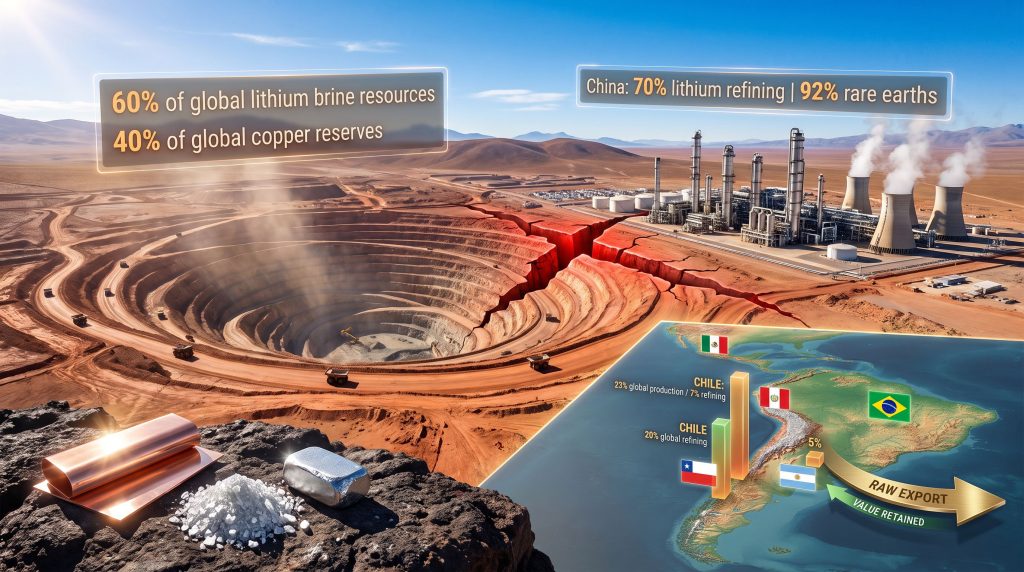
The region holds approximately 60% of global lithium brine resources and 40% of global copper reserves. Yet the overwhelming majority of output departs in raw concentrate or semi-processed form, with value-added refining occurring downstream at facilities operating primarily in China and, increasingly, Southeast Asia. According to Moody's Ratings analysis of the sector, the financial consequences are direct and measurable: operators exporting unrefined materials capture only a fraction of terminal commodity values, with the margin differential absorbed entirely by external processors.
The numbers that define China's processing dominance are stark and worth presenting in full:
| Mineral | China's Global Refining Share | Latin America's Refining Share |
|---|---|---|
| Rare Earth Elements | 92% | ~7% (separation only) |
| Cobalt | 78% | ~10% |
| Lithium | 70% | ~25% (Chile + Argentina) |
| Copper | 44% | ~27% (Chile + Peru) |
| Nickel | 31% | Minimal |
China's position is further reinforced by its dominance on the demand side of the equation. It consumes 74% of global lithium, 68% of cobalt, 62% of nickel, 57% of rare earth elements, and 55% of copper annually. This dual lock on both processing capacity and end-market demand creates a structural dependency that Latin American producers cannot easily circumvent through pricing leverage or contract diversification alone. Furthermore, the relationship between critical minerals and energy security makes resolving this imbalance increasingly urgent for both producing nations and consuming economies.
Jurisdiction by Jurisdiction: Where the Gaps Are Deepest
Copper: A Flagship Mineral With a Refining Ceiling
Chile's position in global copper markets is without parallel. It accounts for 23% of global copper production and holds 18% of global reserves, making it the single most important copper jurisdiction on earth. Yet its share of global copper refining sits at just 7% of world output. Peru presents a comparable picture, contributing 12% of global production against 9% of global reserves, while its downstream refining infrastructure remains comparably limited.
Mexico, with 3% of global production and 5% of global reserves, occupies a smaller but strategically significant position given its proximity to North American manufacturing demand. The copper supply crunch unfolding globally makes these refining shortfalls increasingly costly for regional economies seeking to capture full value from their resource endowments.
The World Bank has identified a substantial gap in smelting and refining capacity across Chile and Peru, noting that less than half of regional copper output is smelted and refined within the region before reaching international markets. For investors and operators, this translates directly into a ceiling on margin capture that cannot be resolved through production volume alone.
Lithium: High Output, Incomplete Chain
The lithium picture is more nuanced. Chile accounts for 19% of global lithium production and holds 25% of global reserves, while Argentina contributes 8% of production and 12% of reserves. Brazil adds a further 4% of production against a comparatively modest 1% of reserves. The Chile lithium strategy has made meaningful progress in downstream integration, however significant gaps remain at the battery-grade processing stage.
Chile's 20% share of global lithium refining and Argentina's 5% represent meaningful downstream capacity, particularly given the chemical characteristics of brine-based lithium extraction, which lends itself more readily to in-country processing than hard-rock spodumene operations. Technologies such as direct lithium extraction offer a promising pathway to accelerate in-country processing efficiency, though deployment at industrial scale remains a work in progress.
However, the regional refining share, while appearing substantial in aggregate, masks the absence of fully integrated battery-grade processing capacity at industrial scale. Converting lithium carbonate to battery-grade lithium hydroxide, the form demanded by leading electric vehicle cell manufacturers, requires precision chemical engineering that remains largely concentrated in China and South Korea.
Nickel, Cobalt, and Rare Earths: Near-Total Processing Voids
Brazil holds 11% of global nickel reserves but contributes only 2% of global nickel production, with downstream processing capacity negligible relative to the size of that reserve base. Regional cobalt refining at approximately 10% of global output and rare earth separation at approximately 7% reveal the near-complete absence of mid-stream and downstream infrastructure for battery-critical minerals.
Most significantly, no regional graphite refining capacity currently exists in Latin America. This matters enormously because graphite functions as the primary anode material in lithium-ion batteries, and its complete absence from regional value chains creates a critical dependency that is often overlooked in discussions focused on lithium and copper.
Key Insight: Latin America's processing deficit is not uniform across the mineral spectrum. Copper and lithium show partial downstream development. Cobalt, rare earths, and graphite represent near-total processing voids exposing the region to complete external dependency precisely at the moment when global demand for these materials is accelerating most rapidly.
The Financial Arithmetic of Staying Upstream
Unit value differentials across the refining chain illustrate the financial penalty of exporting raw materials with clarity that aggregate trade statistics obscure:
| Mineral | Approximate Refined Value (USD/tonne) |
|---|---|
| Neodymium | US$121,000 |
| Cobalt | US$56,000 |
| Lithium | US$20,000 |
| Nickel | US$18,000 |
| Copper | US$13,000 |
These figures represent the terminal values that refined material commands at the point of industrial application. Operators shipping concentrates or unprocessed ore capture only a portion of these values, with processing margins representing the difference between extraction economics and manufacturing economics. Regional production value growth between 2011 and 2025 reinforces how much is at stake: lithium production value expanded by a remarkable 1,378% over that period, cobalt by 166%, copper by 57%, and nickel by 32%.
The trajectory of demand is clearly established. The question is whether Latin American jurisdictions capture value commensurate with their resource endowment or continue exporting that value alongside their raw materials. As the IEA has noted, Latin America stands at a pivotal moment where the right policy choices could transform resource wealth into lasting industrial capacity.
Moody's Ratings analysis establishes that downstream refining capacity directly enhances credit profiles for regional operators, reducing exposure to raw material price volatility and improving margin predictability. Large, low-cost integrated operators including Codelco and SQM in Chile and Vale in Brazil possess balance-sheet flexibility sufficient to pursue downstream expansion. BHP and Rio Tinto maintain comparable structural advantages as globally diversified majors.
Smaller operators and new entrants, however, face disproportionately higher financing costs and execution risks, leaving them structurally exposed to spot market volatility without the margin buffer that refining integration provides. The Latin America critical minerals processing deficit therefore amplifies credit divergence within the industry, systematically widening the gap between major integrated producers and junior operators.
Policy Architecture and the Premium for Non-Chinese Processing
The IRA, CRMA, and Market Repricing
Two significant pieces of international industrial policy are materially altering the economics of critical mineral processing origin. The US Inflation Reduction Act (IRA, 2022), representing US$370 billion in industrial and clean energy investment incentives, creates direct financial preferences for processed critical minerals sourced outside China-dominated supply chains. The European Critical Raw Materials Act (2024) establishes strategic benchmarks for supply diversification; furthermore, the broader European raw materials strategy creates additional demand premiums for regionally processed materials qualifying under its sourcing frameworks.
The combined effect is a structural repricing of processing geography. As Moody's noted in its regional analysis, buyers have demonstrated a clear willingness to pay above-market rates specifically to reduce dependency on concentrated processing jurisdictions. This is not simply political preference; it reflects insurance premium logic applied to industrial supply chains, where the cost of disruption from concentrated sourcing now exceeds the premium required to diversify.
Mexico and the USMCA Nearshoring Advantage
Mexico's position within this evolving framework warrants specific attention. The country produces 23 minerals relevant to industrial supply chains, with nine classified as critical for North American security, including fluorite, molybdenum, copper, and silver. The Mexico-US Action Plan on Critical Minerals, announced on February 4, 2026, and anchored within the USMCA framework, creates a bilateral mechanism linking Mexican mineral production to North American electromobility, advanced manufacturing, and defence supply chains.
Mexico, Economy Minister Marcelo Ebrard, Deputy Minister Luis Rosendo Gutiérrez, and US Trade Representative Jamieson Greer outlined a bilateral framework establishing mechanisms designed to protect regional production from global market distortions and secure long-term investment stability. The USMCA framework positions Mexico as a nearshoring-compatible processing candidate for materials that can qualify for IRA incentive structures unavailable to Asian-processed equivalents. According to analysis from White & Case, this bilateral dynamic represents one of the most significant strategic shifts in regional mineral policy in decades. This is a strategic positioning advantage that no other Latin American jurisdiction currently shares in the same bilateral form.
Government Strategic Frameworks Across the Region
National-level policy frameworks are developing in parallel across the region's major mining jurisdictions:
- Chile: National Lithium Strategy and National Critical Minerals Strategy establish state-directed frameworks for value chain development and downstream investment coordination
- Argentina: Large Investment Incentive Regime (RIGI) targets capital attraction for large-scale resource and processing projects at the federal level
- Brazil: National Critical and Strategic Minerals Policy coordinates federal-level resource governance and downstream investment frameworks across mineral categories
Structural Barriers Preventing the Processing Gap From Closing
Capital Intensity, Timelines, and Technical Complexity
New downstream refining capacity requires five to ten years of development lead time from investment decision to operational output, a timeline that creates a structural lag even when capital is available and committed. High capital intensity, technical complexity, and limited domestic engineering capacity create compounding barriers for all but the largest operators.
This timeline reality means that policy decisions taken today will not generate operational refining capacity until the early-to-mid 2030s at the earliest, a sobering constraint given how rapidly the global competitive landscape for processing investment is evolving.
Regulatory Complexity and the Permitting Problem
Regulatory frameworks across Latin America are simultaneously becoming more demanding and less predictable. This dual movement extends permitting timelines, raises capital intensity, and increases execution risk for downstream investment. Pablo Méndez, Managing Partner at EC Rubio, has articulated the core tension in this dynamic, noting that a modern jurisdiction must be demanding but also clear, with rules that are understandable, transparent criteria, and reasonably predictable timelines.
The absence of this clarity creates an investment deterrent that operates independently of underlying resource quality or geological endowment. Mexico's sector faces a particular concentration of regulatory friction: a permitting backlog of significant scale, an unpublished ruling on the 2023 Mining Law Reform, and an underdeveloped exploration framework that constrains the upstream base required to justify any downstream investment commitment.
Country-Specific Operational Constraints
| Jurisdiction | Primary Operational Constraints |
|---|---|
| Chile | Water scarcity in Atacama Desert; rising energy costs; stringent environmental permitting |
| Argentina | Energy and logistics deficits; foreign exchange restrictions; regulatory unpredictability |
| Brazil | High capital costs; technology gaps; reliance on foreign technical partnerships |
| Peru | Social conflict; political instability; administrative delays in permitting |
| Mexico | Permitting backlog; pending Mining Law Reform ruling; upstream exploration decline |
The Upstream-Downstream Dependency Loop
Perhaps the most underappreciated structural barrier is what might be called the upstream-downstream dependency loop. Downstream processing investment cannot be economically justified without a functioning, scalable, and predictable upstream sector to supply it. When permitting delays, regulatory uncertainty, and declining exploration investment suppress upstream activity, the business case for constructing a refinery or processing facility in the same jurisdiction collapses.
As Méndez has argued in the context of Mexico specifically, there can be no resilient supply chain without a functioning upstream sector, meaning that downstream ambitions are directly conditional on resolving upstream regulatory dysfunction first.
The next major ASX story will hit our subscribers first
Competitive Foundations That Work in Latin America's Favour
The Latin America critical minerals processing deficit exists against a backdrop of genuine structural advantages that differentiate the region from frontier alternatives:
- Rich and geologically diverse mineral endowment spanning multiple critical mineral categories simultaneously
- Established infrastructure networks including deepwater ports, power transmission grids, and industrial logistics corridors built over decades of large-scale extraction
- Relatively low geopolitical risk compared to frontier mining regions in Sub-Saharan Africa or Central Asia, reducing the political risk premium demanded by institutional capital
- Legal frameworks offering more predictable contract enforcement than many competing jurisdictions, including most frontier alternatives
- Skilled technical workforce with operational expertise in large-scale extraction developed over multiple commodity cycles
- Better access to international capital markets and the long-term off-take contract structures that de-risk large downstream capital commitments
The region's closest competitive comparison is Indonesia, which has demonstrated in nickel that resource-rich nations can close processing gaps rapidly under the right combination of policy commitment and foreign direct investment attraction. Indonesia's emergence as a major integrated nickel processing hub over less than a decade provides both a model and a competitive benchmark. Latin America can study that trajectory but must adapt it to its own distinct regulatory, infrastructure, and social operating contexts.
Three Scenarios for How This Plays Out
Scenario 1: Incremental Upstream-First Development. Jurisdictions prioritise resolving permitting backlogs and exploration frameworks before committing capital to downstream infrastructure. Processing capacity grows slowly but on a stable and scalable upstream foundation. Timeline to meaningful refining scale: 10 to 15 years.
Scenario 2: Policy-Accelerated Integration. IRA and CRMA incentives, combined with bilateral frameworks such as the Mexico-US Action Plan, attract significant foreign direct investment into integrated extraction-to-refining projects. Major operators including Codelco, SQM, and Vale anchor regional processing hubs, with foreign technology partners bridging engineering gaps. Timeline to material downstream capacity: 7 to 10 years.
Scenario 3: Stagnation Under Regulatory Friction. Permitting delays, regulatory uncertainty, and infrastructure deficits persist across key jurisdictions. The region retains its extraction role but fails to capture refining value, remaining structurally dependent on Asian processing while competing jurisdictions consolidate their positions. Timeline: indefinite, with incremental deterioration of competitive standing.
The gap between these outcomes is not geological. Latin America has the mineral endowment to support any of the three. The determining variables are regulatory clarity, infrastructure investment commitment, technology transfer strategy, and the speed with which upstream frameworks can be stabilised to underpin downstream investment cases.
Strategic Observation: The Latin America critical minerals processing deficit is fundamentally a policy, infrastructure, and capital deployment problem rather than a resource problem. The geological endowment exists to support globally significant processing operations. The question is whether the institutional and investment environment can align quickly enough to capture that value before alternative processing geographies permanently consolidate their positions.
This article contains forward-looking analysis and scenario projections that involve assumptions and uncertainties. It should not be construed as financial or investment advice. Readers should conduct independent research and consult qualified advisers before making any investment decisions related to the sectors or companies discussed.
Want to Identify the Next Major Mineral Discovery Before the Market Does?
Discovery Alert's proprietary Discovery IQ model delivers real-time alerts on significant ASX mineral discoveries — instantly translating complex mineral data into actionable investment insights for both short-term traders and long-term investors. Explore historic discoveries and the substantial returns they generated, then begin your 14-day free trial at Discovery Alert to position yourself ahead of the market.