EV Resources Ltd
EV Resources Moves Closer to Antimony Production as Ball Mills Pass Dry Commissioning and First Feedstock Deal is Secured
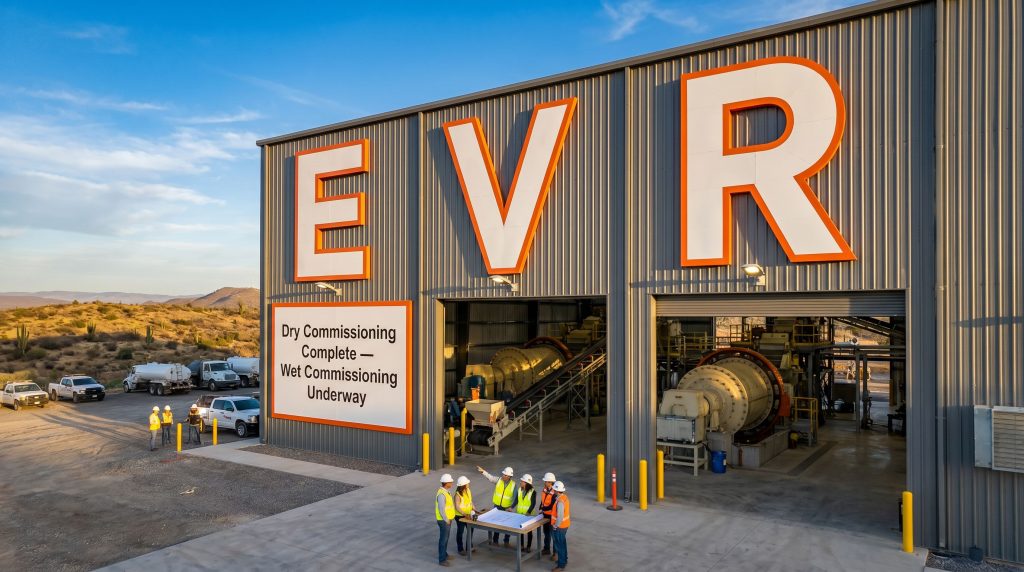
EV Resources Limited (ASX: EVR) has delivered a pair of operationally significant milestones that materially advance its pathway to EV Resources antimony production in Mexico after Tecomatlán ball mills dry commissioning and feedstock deal. All three ball mills at the Tecomatlán Processing Plant in Oaxaca, Mexico, have been fully refurbished and successfully dry commissioned, while the company has also executed its first third-party feedstock agreement — a non-binding Memorandum of Understanding (MOU) with a local mining operation located just 8km from the plant.
Together, these developments reduce both operational and feedstock supply risk as EVR targets first antimony concentrate production in the second half of calendar year 2026.
"Dry commissioning all three mills is the moment the Tecomatlán Plant takes a critical step in the refurbishment project and advances us significantly on the transition to producer. The grinding circuit is the heart of the operation — getting it running cleanly means every subsequent step towards first concentrate is now within reach. Importantly, securing an initial feedstock framework alongside commissioning progress materially improves our operational readiness and provides increasing confidence in the pathway toward sustainable first production." — Managing Director Mike Brown
When big ASX news breaks, our subscribers know first
The Grinding Circuit Reaches a Pivotal Milestone
The completion of dry commissioning across all three ball mills represents the most consequential technical achievement at Tecomatlán to date. These mills — which were included in the original plant acquisition and have never previously been used — form the foundational stage of the entire processing flowsheet.
Before ore can be concentrated into saleable antimony, it must first be ground to a particle size that allows the subsequent gravity concentration steps to work efficiently. Without the grinding circuit operating reliably, nothing downstream can function.
Dry commissioning confirms mechanical integrity across the entire grinding circuit — motors, drives, liners, gears, and rotating components — without introducing water or ore. It is the essential checkpoint that must be cleared before wet commissioning, which involves the introduction of process water and slurry, can begin.
Key details from the commissioning update include:
- All three ball mills fully refurbished and dry commissioned successfully
- Only minor gear adjustments remain prior to wet commissioning
- The mills were sourced as part of the plant acquisition and are new, previously unused units
- Successful dry commissioning directly enables the next phase: introduction of process water, slurry, and ultimately antimony ore
This progression positions the plant on a clear mechanical pathway toward first production.
What Is Dry Commissioning? A Beginner's Guide
Dry commissioning refers to the process of running newly installed or refurbished plant equipment — in this case, ball mills — without any material feed, water, or slurry present. Think of it as a test drive with no passengers and no cargo.
The purpose is to verify that all mechanical components are correctly assembled, aligned, and functioning as designed. Engineers check for abnormal vibrations, bearing temperatures, gear engagement, motor performance, and rotational consistency before the plant is exposed to the stresses of actual processing conditions.
Why Does This Matter to Investors?
Dry commissioning is a formal de-risking step. A plant that fails at this stage would require mechanical remediation — costing both time and money. Clearing dry commissioning cleanly across all three mills simultaneously confirms that EVR's refurbishment work has been executed to specification, and that the plant's core infrastructure is ready to advance to the next, more complex stage of commissioning.
Glossary of Relevant Terms:
| Term | Definition |
|---|---|
| Dry Commissioning | Running equipment without feed, water, or slurry to verify mechanical integrity |
| Wet Commissioning | Introducing process water and slurry into the circuit to test operational performance |
| Ball Mill | A rotating cylindrical vessel used to grind ore to a fine particle size for downstream processing |
| Grinding Circuit | The combination of mills and associated equipment that reduce ore particle size |
| Gravity Concentrator | Equipment that uses differences in density to separate heavier minerals (like antimony) from lighter waste material |
| Antimony Concentrate | The processed output containing a high proportion of antimony, suitable for sale or further refining |
| JORC Resource | A mineral resource estimate prepared under the Australian JORC Code, providing a standardised measure of mineralisation |
First Feedstock Agreement De-Risks the Start-Up Phase
Alongside the commissioning milestone, EVR's Mexican subsidiary Stibcorp S.A. de C.V. has signed a non-binding MOU with a local, experienced private mining group for the supply of antimony ore directly to the Tecomatlán Plant.
This is strategically significant for a plant designed to process third-party ore during its ramp-up phase while EVR's own Los Lirios project advances toward a maiden JORC Mineral Resource Estimate. Rather than waiting for its own project to deliver ore, EVR can utilise its processing infrastructure from the outset using regionally sourced feed — a model that reduces capital intensity and accelerates the path to revenue.
Key terms of the MOU:
| Parameter | Detail |
|---|---|
| Mine Location | Puebla, Mexico — approximately 8km from Tecomatlán Plant |
| Supply Volume | |
| Average Feed Grade | ~5% Sb (antimony) |
| Material Types | Low-grade (5%–29% Sb) and high-grade (>30% Sb) |
| Delivery Specification | Approximately 6-inch particle size at plant gate |
| Mining Method | 2-cubic-yard LHD; vein widths averaging 3–4 metres |
| Pricing Mechanism | Per-shipment basis, determined by grade, moisture, impurities, and prevailing market conditions following independent assay |
| Legal Standing | Reported to be in good standing with environmental permits in place |
| Expansion Potential | Completed geophysical studies have identified additional targets |
It is important to note that the MOU is non-binding in nature (except for confidentiality, compliance, and applicable law provisions) and does not constitute a legally binding obligation to purchase or sell mineral products. It is intended to serve as a framework for future definitive purchase contracts and ore delivery orders.
EVR is currently undertaking metallurgical recovery studies on representative samples from the operation to establish likely plant performance.
The proximity of this mine — just 8km away — is particularly noteworthy. Transportation cost is one of the key variables that determines whether third-party toll milling arrangements are economically attractive to local producers. At 8km, EVR offers a compelling alternative to shipping high-grade hand-sorted material to existing processing facilities in San Luis Potosí, which is located significantly further north.
A Region With Deep Antimony Heritage
Oaxaca and its neighbouring states have a long-established history of high-grade antimony mining. EVR's strategy to leverage this regional production base — by positioning Tecomatlán as a reliable, nearby processing hub for local miners — is consequently well suited to the geography.
The company is actively advancing discussions with additional regional third-party miners across Oaxaca and neighbouring states to secure further feedstock agreements. A diversified feedstock base would serve multiple operational objectives:
- Reduce dependence on any single ore source
- Underpin plant utilisation rates during the ramp-up phase before Los Lirios reaches production
- Accelerate the path to a commercially self-sustaining operation
- Provide a commercially attractive proposition to local producers seeking a nearby, cost-effective processing partner
Falcon Concentrators: The Next Major Equipment Milestone
In February 2026, EVR prepaid for two Falcon gravity concentrators to protect the plant commissioning timeline. These units will form the core of the antimony concentration circuit — the stage at which ground ore is separated into antimony-rich concentrate and waste material.
The first of the two units has now been crated and is being prepared for shipment to site, representing a tangible step forward in assembling the full processing circuit.
The significance of Falcon concentrators in an antimony processing context is worth noting. Gravity concentration is a low-cost, highly efficient method for separating high-density antimony minerals from gangue (waste) material. It avoids the need for chemical reagents and is well established in the processing of antimony ores, making it an appropriate fit for a plant designed for low capital intensity.
Understanding Antimony: The Critical Metal Driving Investment Interest
Antimony is a metalloid that has gained increasing strategic importance in recent years due to its critical role across multiple industrial applications. Furthermore, the metal is designated as a critical mineral by the United States, European Union, and Australia — classifications that reflect both its economic importance and supply chain vulnerabilities.
What Are the Key Applications for Antimony?
- Flame retardants: Antimony trioxide is used extensively in plastics, textiles, and electronics to improve fire resistance
- Battery technology: Antimony-based anodes are being developed for next-generation grid-scale energy storage systems
- Lead-acid batteries: Antimony alloys improve the performance and longevity of traditional automotive and industrial batteries
- Defence applications: Antimony compounds are used in ammunition, explosives, and military equipment
- Semiconductors: High-purity antimony is used in infrared detectors and other electronic components
How Do Global Supply Dynamics Shape the Market?
China dominates global antimony production, accounting for approximately 60% of worldwide output. This concentration creates supply chain risks for Western economies, particularly given increasing geopolitical tensions. The United States, despite being a major consumer, produces minimal amounts domestically.
Market fundamentals supporting price stability include:
- Limited new mine development outside of China
- Growing demand from energy storage and defence sectors
- Declining ore grades at existing operations
- Long lead times for new project development
These factors combine to create a supply-demand environment that favours new producers in mining-friendly jurisdictions — particularly those with established infrastructure and near-term production potential.
The Road to First Production: What Comes Next?
With dry commissioning complete and the first feedstock framework in place, EVR has a defined set of near-term operational steps that underpin its 2H CY2026 production target.
| Upcoming Milestone | Status / Timeline |
|---|---|
| Ball mills — dry commissioning | Completed |
| Minor gear adjustments to mills | In progress |
| Falcon concentrator #1 — shipment to site | Crated, being prepared for shipment |
| Falcon concentrator #2 — delivery | Prepaid, to follow |
| Wet commissioning of grinding circuit | Next phase following minor adjustments |
| Metallurgical testing of third-party feedstock | Underway on representative samples |
| Additional feedstock MOU discussions | Actively advancing with regional miners |
| First antimony concentrate production | Targeted 2H CY2026 |
| Los Lirios — maiden JORC Resource Estimate | Advancing in parallel |
The next major ASX story will hit our subscribers first
Why EVR Deserves a Place on Investors' Watchlists
EVR is executing a capital-efficient strategy that minimises the time and funding required between today and first revenue. Rather than building a greenfield processing facility from scratch, the company acquired an existing plant — complete with three new ball mills — and is refurbishing it toward production readiness.
By combining this infrastructure with third-party feedstock agreements, EVR can begin generating concentrate before its own Los Lirios resource is fully delineated. The investment case rests on several interlocking pillars:
- Near-term production target: First antimony concentrate targeted for 2H CY2026, with dry commissioning now confirmed across all three mills
- Third-party feedstock model: Reduces capital intensity and allows plant utilisation from start-up, independent of Los Lirios
- Low-cost processing approach: Falcon gravity concentration is reagent-free and well suited to the ore types present in the region
- Regional feedstock pipeline: Active discussions underway with multiple miners across Oaxaca and neighbouring states to diversify ore supply
- Flagship project in development: Los Lirios, located 50km from Tecomatlán, is advancing toward a maiden JORC Mineral Resource Estimate following first-pass drilling that confirmed a laterally extensive carbonate replacement deposit (CRD) system
- US assets as optionality: The Dollar and Milton projects in Nevada provide exposure to the US domestic antimony supply chain
- Antimony's critical mineral status: The metal is designated a critical mineral by the US, EU, and Australia, with applications across energy storage, battery technology, defence, and high-tech sectors — factors that underpin long-term demand
EV Resources has materially advanced its transition from explorer to producer, with all three ball mills at Tecomatlán now dry commissioned and a regional feedstock framework agreement in place. With wet commissioning the next operational step and first antimony concentrate targeted for 2H CY2026, investors focused on near-term production catalysts in the critical minerals space have clear and time-bound milestones to monitor.
Is EV Resources the Near-Term Antimony Producer Worth Watching?
EV Resources Limited (ASX: EVR) is rapidly closing the gap between refurbishment and first production, with all three Tecomatlán ball mills now dry commissioned and an initial third-party feedstock framework secured. For investors seeking exposure to a near-term critical minerals producer with a capital-efficient strategy and defined production milestones, EVR warrants a closer look. Visit evresources.com.au to explore the company's projects, progress, and investment case in full.