August 20, 2026
How Does Extreme Weather Expose Critical Vulnerabilities in US Energy Infrastructure?
Winter Storm Fern's devastating impact on American energy systems revealed fundamental weaknesses that extend far beyond temporary weather disruptions. The crisis demonstrated how interconnected vulnerabilities across multiple energy sectors can cascade into systemic failures, exposing the fragility of infrastructure designed for normal operating conditions rather than extreme weather events. This comprehensive analysis of winter storm Fern impact on US energy markets provides crucial insights into the vulnerabilities of modern energy infrastructure.
The Structural Fragility of America's Energy Grid
Modern energy infrastructure operates as an interconnected web where disruptions in one sector trigger failures across others. During Winter Storm Fern, this interconnectedness became a liability rather than a strength, as production losses cascaded through the entire energy supply chain.
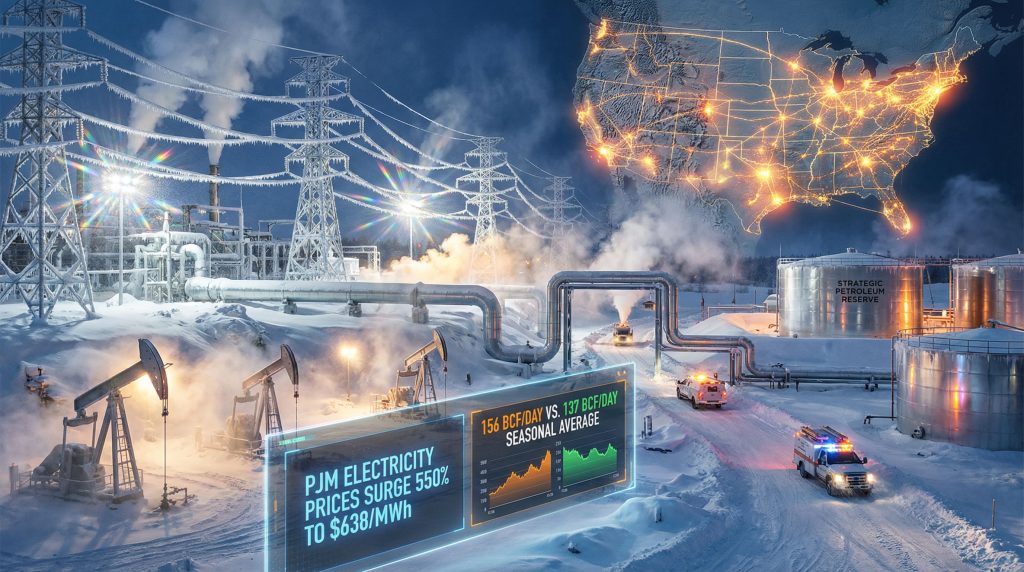
The scale of infrastructure failure during the storm was unprecedented in recent memory. Electricity markets experienced extraordinary price volatility, with day-ahead prices in the PJM Interconnection reaching $638 per megawatt-hour, representing a staggering 550% increase from normal winter levels.
This surge marked the highest electricity prices recorded since 2014, while New York markets saw even more extreme spikes to $680 per megawatt-hour. Furthermore, the US oil production decline highlighted broader structural issues facing domestic energy production.
| Energy Sector | Impact Magnitude | Recovery Timeframe |
|---|---|---|
| Oil Production | 2 million barrels/day curtailed | 7-10 days |
| Natural Gas Output | 10+ billion cubic feet/day reduction | 5-7 days |
| Electricity Generation | 550% price spike in PJM region | 7 consecutive days |
| Port Operations | 57% reduction in Gulf Coast loadings | 4-6 days |
Multi-Commodity Supply Chain Interdependencies
The storm revealed how natural gas production shut-ins create ripple effects throughout electricity generation systems. When wellhead freeze-offs reduced gas supply by more than 10 billion cubic feet daily, power generators faced immediate fuel constraints during peak heating demand periods.
North Dakota's Bakken Basin provided a stark example of upstream vulnerability. Production cuts of 100,000 to 110,000 barrels per day represented approximately 10% of the state's total output, caused entirely by freeze-offs at wellhead facilities. These failures occurred despite winterization efforts implemented following previous extreme weather events.
Transportation bottlenecks amplified regional price disparities as the storm progressed. Gulf Coast ports in Texas and Louisiana managed to load only 6 million barrels of crude between January 24-27, compared to the December 2025 average of 3.8 million barrels per day.
This 57% reduction in export capacity created immediate supply constraints for international markets while domestic inventories accumulated. In addition, critical minerals in the energy transition became increasingly important for building resilient infrastructure.
The crisis exposed critical gaps in cross-sector resilience planning. Unlike single-point failures that can be isolated and contained, Winter Storm Fern's impact demonstrated how weather-related disruptions propagate through interconnected energy systems, creating compound effects that exceed the sum of individual sector impacts.
When big ASX news breaks, our subscribers know first
What Economic Forces Drive Energy Market Resilience During Supply Shocks?
Despite production curtailments equivalent to 15% of national oil output, energy markets displayed surprising resilience through sophisticated price discovery mechanisms and inventory management systems. Understanding these stabilising forces provides insight into how modern energy markets absorb extreme supply disruptions without triggering proportional price escalations.
Price Discovery Mechanisms Under Stress
Oil markets demonstrated remarkable stability during the crisis, with Brent crude remaining near $66 per barrel despite massive production losses. This price resilience reflected the operation of multiple market mechanisms that helped absorb the supply shock without triggering panic-driven price escalations.
The oil price forecast analysis suggests that markets had already factored in potential weather-related disruptions. Moreover, forward market positioning, strategic inventory buffers, and market expectations of rapid supply recovery combined to prevent severe price escalation during the acute shortage period.
Natural gas markets showed more dramatic price responses, reflecting the commodity's limited storage capacity and immediate demand-supply balance requirements. Henry Hub futures reached $6.80 per MMBtu on Monday, representing a three-year high, before moderating to $6.55 per MMBtu by Tuesday.
The rapid price retreat suggested market confidence in supply restoration within days rather than weeks. The futures curve revealed sophisticated market expectations about recovery timing, with a $3.00 per MMBtu spread between February and March contracts indicating traders expected supply constraints to resolve within 4-6 weeks.
Regional Market Segmentation Effects
Geographic price differentials during the storm highlighted how transmission constraints create submarkets within national energy systems. The PJM Interconnection's $638 per megawatt-hour electricity prices compared to New York's $680 per megawatt-hour reflected varying degrees of supply stress and transmission capacity between regional grids.
These price disparities created arbitrage opportunities for market participants with flexible delivery capabilities, while revealing the limitations of physical infrastructure to balance supply and demand across regions during extreme events. However, US natural gas forecast models may need to incorporate more frequent extreme weather scenarios.
Demand Elasticity Under Extreme Conditions
Heating demand surged to 156 billion cubic feet per day during the storm week, compared to the five-year January average of 137 bcf per day. This 13.8% increase in demand coincided with supply disruptions, creating the perfect conditions for price volatility.
Industrial demand response programmes activated automatically as electricity prices reached extreme levels, with energy-intensive manufacturers curtailing operations to avoid peak pricing exposure. This demand flexibility helped prevent even more severe price spikes by reducing total system load during critical periods.
How Do Weather Events Reshape Energy Investment Priorities?
Winter Storm Fern's impact has triggered fundamental reassessment of infrastructure investment priorities across the energy sector. The scale of production losses and price volatility demonstrated that current winterization efforts remain inadequate for extreme weather scenarios, driving new capital allocation toward resilience rather than pure capacity expansion.
Infrastructure Hardening Economics
The storm's economic impact provides compelling justification for increased winterization investments. With 2 million barrels per day of oil production curtailed at $66 per barrel for seven days, the immediate production loss exceeded $920 million.
Natural gas curtailments added approximately $455 million in lost production value, creating total weekly losses exceeding $1.38 billion. Furthermore, these losses underscore the importance of robust energy security strategies that can withstand extreme weather events.
| Winterisation Investment Category | Estimated Cost Range | Payback Period |
|---|---|---|
| Wellhead freeze protection systems | $10,000-50,000 per well | 2-3 extreme weather events |
| Pipeline insulation and heating | $1-5 million per mile | 5-7 years |
| Compressor station cold-weather upgrades | $5-25 million per facility | 3-5 years |
| Power generation dual-fuel capability | $50-200 million per plant | 7-10 years |
Equipment-specific vulnerabilities identified during the storm provide clear targets for infrastructure improvements. Wellhead freeze-offs emerged as the primary production loss mechanism, particularly in the Bakken Basin where temperatures overwhelmed existing protection systems.
Compressor station failures created cascade effects throughout natural gas distribution networks, as these critical facilities could not maintain pressure during extreme cold conditions. Pipeline capacity constraints further amplified supply disruptions when transport infrastructure could not accommodate alternative routing around affected areas.
Strategic Reserve Utilisation Patterns
Emergency fuel switching capabilities proved crucial for maintaining electricity generation during natural gas supply constraints. Power plants with dual-fuel capacity activated backup systems using stored oil products, preventing even more severe electricity shortages.
The crisis highlighted the value of strategic fuel inventories positioned near critical infrastructure. Facilities with on-site storage capabilities maintained operations longer than those dependent on just-in-time delivery systems, demonstrating the importance of inventory buffers for extreme weather resilience.
Market Structure Evolution Post-Crisis
Regulatory authorities activated emergency protocols that waived certain environmental restrictions and expedited fuel transportation permits. The Department of Energy's emergency authorities enabled rapid response coordination, while grid operators implemented demand response programmes to manage peak loads.
These emergency measures revealed both the flexibility and limitations of existing market structures. While authorities could temporarily modify regulations to address immediate crises, the underlying infrastructure vulnerabilities require longer-term structural solutions.
What Are the Broader Macroeconomic Implications of Energy Supply Volatility?
Energy price volatility during extreme weather events creates ripple effects throughout the broader economy, impacting everything from manufacturing costs to household budgets. Winter Storm Fern's economic implications extended far beyond energy sector losses, affecting economic activity across multiple industries and regions.
GDP Impact Modelling from Energy Disruptions
Electricity price escalations of 1,400-1,900% above normal winter levels created immediate cost pressures for energy-intensive industries. Manufacturing facilities in the PJM Interconnection region faced unprecedented input cost increases, with some operations suspending production to avoid exposure to peak wholesale prices.
Quantifiable Weekly Economic Impact:
• Oil production losses: $924 million (2 million b/d × 7 days × $66/barrel)
• Natural gas production losses: $455 million (10 bcf/d × 7 days × $6.55/MMBtu)
• Electricity cost escalation: Regional industrial sectors facing 14-19x normal power costs
• Total measurable impact: $1.38+ billion in direct energy production losses
According to Bank of America's analysis, the winter storm Fern impact on US energy markets could significantly affect first-quarter economic growth projections.
Inflation Transmission Mechanisms
Natural gas price spikes translate directly to heating costs for residential and commercial customers, with spot market exposure varying by utility contract structure. The 60-130% increase in heating costs during peak demand periods placed significant burden on household budgets across cold-weather regions.
Transportation fuel costs escalated during port loading disruptions, adding 2-5% to logistics expenses for goods movement throughout the affected regions. These cost increases typically propagate through supply chains over 4-6 weeks following the initial disruption.
Financial Market Responses to Energy Volatility
Market participants recognised that weather-related production cuts are typically temporary, with rapid recovery expected once normal temperatures return. The temporary nature of weather disruptions limits their impact on long-term company valuations, despite massive supply disruptions.
Commodity futures markets displayed sophisticated risk pricing, with natural gas futures showing extreme volatility while oil futures remained relatively stable. This divergence reflected the different storage capabilities and demand elasticity characteristics of each commodity.
Insurance sector exposure became apparent as claims mounted from frozen equipment and business interruption losses. Energy infrastructure insurance rates typically increase following major weather events as insurers reassess risk models and coverage terms.
How Does Geopolitical Context Amplify Domestic Energy Vulnerabilities?
Winter Storm Fern's domestic energy disruptions occurred against a backdrop of complex international energy relationships that limited alternative supply options. Existing sanctions regimes and trade restrictions reduced the flexibility to compensate for domestic production losses through increased imports.
Strategic Resource Security During Crisis
Import dependency risks became apparent when domestic production cuts could not be immediately offset through increased foreign supplies. Sanctions on Russian energy imports, while strategically important, limited alternative supply sources during the domestic shortage period.
The crisis highlighted the timing challenges in activating alternative supply sources. LNG cargoes require 2-3 weeks lead time for delivery, while pipeline imports face capacity constraints during peak demand periods. These logistical realities emphasise the importance of domestic production reliability.
Sanctions Regime Interactions with Market Dynamics
Existing restrictions on Venezuelan oil market participation limited supply flexibility during the domestic production disruption. Chinese refiners reportedly paused Venezuelan crude purchases due to political uncertainties, further constraining alternative supply activation.
Middle Eastern suppliers faced their own seasonal demand peaks, limiting their ability to provide additional volumes to US markets during the crisis period. This timing coincidence demonstrates how global energy markets can become constrained when multiple regions face simultaneous supply or demand pressures.
Alliance Energy Cooperation Frameworks
Emergency fuel sharing agreements with allied nations provided limited relief due to transportation and infrastructure constraints. While cooperation frameworks exist, the physical realities of energy logistics limit their effectiveness during acute shortage periods.
Strategic coordination with major consuming nations helped prevent competitive bidding for scarce supplies, but the fundamental shortage required domestic production recovery rather than import solutions.
What Long-Term Structural Changes Could Emerge from Weather-Driven Energy Crises?
Winter Storm Fern's impact is likely to catalyse significant changes in energy infrastructure investment priorities, regulatory frameworks, and technology adoption patterns. The crisis demonstrated that current approaches to weather resilience remain inadequate for extreme events that are becoming more frequent and severe.
Technology Adoption Acceleration
Distributed generation investment is expected to accelerate following grid reliability concerns exposed during the storm. Businesses and institutions recognise that on-site power generation provides protection against regional grid failures and extreme wholesale price exposure.
Energy storage deployment for supply security enhancement represents a growing investment priority. Battery systems and other storage technologies can provide backup power during grid disruptions while helping manage demand during peak pricing periods.
Smart grid technologies for demand response optimisation showed their value during the crisis, enabling automated load reduction when electricity prices reached extreme levels. These systems will likely see expanded deployment as utilities seek more sophisticated demand management capabilities.
Furthermore, the renewable energy transition must consider resilience factors alongside decarbonisation goals to ensure reliable energy supply during extreme weather events.
Regulatory Framework Evolution
Mandatory winterisation standards are expected to evolve following repeated infrastructure failures during extreme weather events. Current voluntary guidelines have proven insufficient for protecting critical energy infrastructure during severe cold conditions.
Emergency response protocol standardisation across regions could improve coordination during multi-state energy crises. The storm revealed gaps in cross-border cooperation and resource sharing that hampered response effectiveness, as highlighted by experts studying grid vulnerabilities.
Market design modifications for extreme weather resilience may include capacity payments for winterised equipment and performance penalties for facilities that fail during emergency conditions.
Investment Capital Reallocation Patterns
| Investment Priority | Pre-Storm Allocation | Post-Storm Trend |
|---|---|---|
| Capacity expansion | 70% | 50% |
| Weather hardening | 15% | 35% |
| Backup systems | 10% | 12% |
| Smart grid technology | 5% | 8% |
Infrastructure hardening versus capacity expansion trade-offs are shifting toward resilience investments. Companies recognise that additional capacity provides limited value if weather events can disable large portions of existing infrastructure.
Regional investment flows are redirecting toward weather-resilient assets in areas prone to extreme weather events. This geographic reallocation reflects growing awareness of climate-related infrastructure risks.
ESG considerations in energy infrastructure development increasingly emphasise climate adaptation and resilience rather than solely focusing on emissions reduction. Investors recognise that infrastructure vulnerability to weather events creates significant financial risks.
The next major ASX story will hit our subscribers first
FAQ: Understanding Energy Market Dynamics During Extreme Weather
Why didn't oil prices surge more dramatically despite massive production cuts?
Strategic inventory levels, forward market positioning, and expectations of rapid supply recovery helped absorb the immediate supply shock. Oil markets have sophisticated mechanisms for managing temporary disruptions that distinguish them from longer-term supply constraints.
How do electricity markets handle extreme demand spikes?
Regional grid operators activate emergency protocols including demand response programmes, emergency generation capacity, and load shedding procedures. Price signals encourage demand reduction while emergency authorities can waive certain regulations to secure additional supply.
What makes natural gas infrastructure particularly vulnerable to cold weather?
Natural gas systems face multiple cold-weather vulnerabilities including wellhead freeze-offs, compressor station failures, and pipeline capacity constraints. Unlike oil, natural gas has limited storage capability, making supply disruptions immediately apparent in pricing.
How do energy companies prepare for extreme weather events?
Preparation includes winterisation investments, emergency response planning, strategic inventory positioning, and backup fuel arrangements. However, winter storm Fern impact on US energy markets demonstrated that current preparation levels remain inadequate for extreme scenarios.
What role do government agencies play during energy emergencies?
Federal authorities can waive environmental regulations, coordinate emergency fuel supplies, activate strategic reserves, and facilitate interstate cooperation. The Department of Energy's emergency authorities proved crucial for response coordination during Winter Storm Fern.
Disclaimer: This analysis is based on publicly available information and market data. Energy market conditions and infrastructure vulnerabilities can change rapidly. Readers should consult current sources and professional advisors for investment or operational decisions. Weather-related energy disruptions involve significant uncertainties, and future events may differ from historical patterns discussed in this analysis.
Want to Identify Energy Infrastructure Investment Opportunities Before the Market Responds?
Discovery Alert's proprietary Discovery IQ model delivers real-time alerts on significant ASX mineral discoveries, including critical materials essential for energy infrastructure resilience and modernisation. Understand why major mineral discoveries can lead to substantial market returns by exploring Discovery Alert's dedicated discoveries page, showcasing historic examples of exceptional outcomes, and begin your 30-day free trial today at discoveryalert.com.au.