June 24, 2026
The Commodity Beneath the Transition: Why Copper Is Reshaping African Mining Portfolios
Across the global mining industry, a fundamental reordering of capital priorities is underway. The commodities that powered industrial economies through the twentieth century are being supplemented, and in some cases displaced, by a new class of minerals whose value is defined not by steel production or thermal energy, but by electrons, circuits, and kilowatt-hours. Copper sits at the centre of this shift. It is the connective tissue of the energy transition, threading through electric vehicles, offshore wind turbines, solar installations, high-voltage transmission lines, and the rapidly expanding data centre infrastructure that underpins the digital economy.
For bulk commodity producers across Africa, this transformation is not a distant concern. It is an immediate strategic imperative. Among those navigating this inflection point with the greatest visibility is South African mining company Exxaro Resources, whose Exxaro copper investment diversification strategy is now entering a decisive phase.
When big ASX news breaks, our subscribers know first
From Coal Stronghold to Critical Minerals Contender
Understanding Exxaro's current strategic direction requires recognising what the company has historically been: one of South Africa's most significant thermal coal producers. Coal remains central to South Africa's energy mix and continues to generate the operating cash flows that make diversification financially feasible. However, Exxaro's leadership has been transparent about the need to evolve the company's earnings architecture before shifting global demand patterns erode the value proposition of coal-dependent revenue streams.
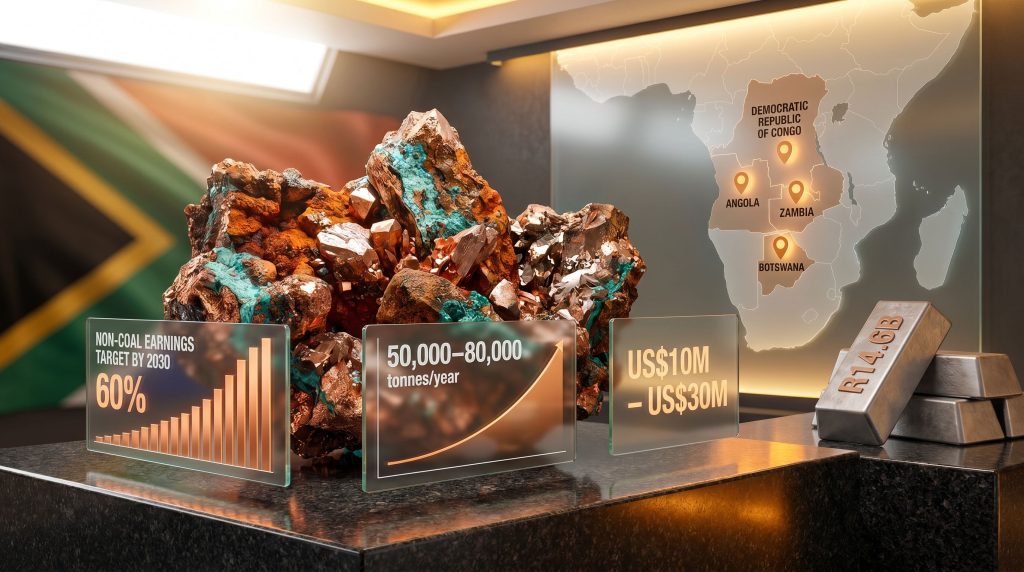
The company has publicly committed to deriving 60% of group earnings from non-coal operations by 2030, a structural transformation that requires deliberate, well-sequenced capital deployment into commodities with long-term demand visibility. This is not a passive aspiration; it is an investment programme with specific capital commitments, defined target commodities, and a governance framework designed to track progress against measurable milestones.
The three pillars of that framework are copper, manganese, and bauxite, each chosen for its alignment with electrification, battery technology, and lightweight materials manufacturing. Together, they form what Exxaro terms its Sustainable Growth and Impact (SG&I) strategy, which also encompasses renewable energy investments and a carbon neutrality target by 2050. Furthermore, the role of critical minerals transition in shaping such long-range strategies cannot be overstated.
The Manganese Precedent: Setting the Template for What Comes Next
Before copper entered the conversation as a near-term transaction target, manganese established the diversification precedent. Exxaro committed R14.6 billion to two South African manganese operations, representing one of the largest non-coal investment decisions made by a South African mining company in recent memory. The manganese commitment is significant not only for the capital it represents, but for what it demonstrates operationally.
Consequently, Exxaro has shown it can execute large-scale diversification investments, build new commodity expertise, and begin the process of restructuring its earnings profile away from coal. With manganese infrastructure now being established, copper represents the logical next layer in Exxaro's portfolio construction. It extends the company's geographic reach beyond South Africa's borders into the African Copper Belt while simultaneously adding exposure to the electrification demand cycle.
The Khoemacau Experience: A Costly Lesson With Strategic Value
Exxaro's copper ambitions were not born without setback. In 2023, the company pursued Botswana's Khoemacau Copper Mine, a high-quality underground operation with meaningful production capacity. The asset was ultimately acquired by China's MMG for US$1.6 billion, a valuation that illustrated precisely how aggressively state-backed and major mining entities were willing to compete for established copper assets.
The episode exposed a structural reality facing mid-tier African producers: operational copper mines at scale command acquisition premiums that can fundamentally compromise balance sheet integrity, particularly for companies simultaneously managing capital allocation across multiple commodity transitions. The competitive dynamics that priced Exxaro out of the Khoemacau process were not a one-off. They reflect a systemic pattern in which Chinese, North American, and European investors have deployed substantial acquisition capital to secure long-term copper supply.
Rather than pursuing another large-scale operational asset, Exxaro undertook a strategic recalibration. The company's Head of Business Development Richard Lilleke indicated during a capital markets presentation that the revised focus has shifted toward earlier-stage exploration and development opportunities, where entry costs are substantially lower and value can be created progressively through the development cycle.
Revised Investment Parameters: The Case for Exploration-Stage Entry
The shift toward earlier-stage copper projects is not simply a response to being outcompeted. It reflects a disciplined capital allocation logic that is increasingly being recognised across the mid-tier mining sector globally.
| Strategic Dimension | Post-Khoemacau Approach | Rationale |
|---|---|---|
| Asset Type | Exploration and development-stage projects | Lower entry cost, progressive value creation |
| Investment Outlay | US$10 million to US$30 million initial range | Preserves balance sheet through transition |
| Production Target | 50,000 to 80,000 tonnes per year | Mid-tier scale, commercially meaningful |
| Development Timeline | 5 to 7 years to commercial production | Aligns with 2030 earnings target horizon |
| Geographic Focus | Botswana, Zambia, Angola, DRC | African Copper Belt geological corridor |
The US$10 million to US$30 million initial investment range signals a preference for entry points where capital is at risk during exploration and feasibility phases rather than being committed at the peak of an asset's valuation cycle. For investors assessing Exxaro's risk profile, this approach offers a meaningful distinction: rather than paying full price for proven production, the company is seeking to build exposure at a stage where geological upside remains partially unrealised.
Exploration-stage entry into copper assets carries inherently higher geological and development risk than acquiring operational mines, but for companies with patient capital horizons and diversified funding sources, the risk-adjusted return profile can be structurally superior to late-cycle acquisition strategies.
This is a concept well understood within the junior exploration investment community but less commonly applied by large-cap producers managing transition strategies. Exxaro's willingness to accept development-stage risk reflects confidence in its ability to manage projects through the full mine development lifecycle.
Africa's Copper Belt: Understanding the Geological and Commercial Opportunity
The African Copper Belt is one of the world's most geologically significant copper-producing regions, stretching across the Democratic Republic of Congo and Zambia before extending into frontier jurisdictions including Angola and Botswana. The corridor contains some of the highest-grade copper deposits found anywhere on earth, with certain DRC and Zambian orebodies hosting copper grades well above the global average for new discoveries.
Understanding why this matters requires a brief examination of copper grade economics. Higher ore grades reduce the volume of rock that must be processed to yield a tonne of copper metal, directly improving cost efficiency and reducing the capital intensity of processing infrastructure. In an era of tightening capital markets and rising energy costs, grade is not merely a geological metric; it is a fundamental determinant of project economics and competitive positioning.
Several factors make the African Copper Belt particularly attractive to companies like Exxaro:
- The DRC and Zambia together account for a substantial share of global copper production, with established processing infrastructure and mining services ecosystems
- Angola and Botswana are emerging as frontier copper jurisdictions where geological surveys have identified prospective zones that remain largely underexplored
- African-domiciled companies carry inherent advantages in local regulatory navigation, community engagement, and relationship-based deal origination compared to external investors operating without regional presence
- The competitive landscape, while intensifying, remains less saturated at the exploration and development stage than at the operational acquisition level
In addition, the discovery of a major copper system in recent years has further demonstrated how significant geological upside can still be unlocked when exploration targets are approached with rigour and patience.
The next major ASX story will hit our subscribers first
Demand Dynamics: Four Structural Drivers Reinforcing the Investment Case
Copper's appeal as a portfolio commodity is underpinned by four distinct demand growth vectors that are expected to compound simultaneously over the coming decade:
- Electric vehicles: Each battery electric vehicle requires approximately three to four times the copper content of a conventional internal combustion engine vehicle, driven by wiring harnesses, electric motors, charging systems, and battery management infrastructure.
- Renewable energy infrastructure: Wind turbines and solar installations require significant copper for generators, cabling, transformers, and grid connection systems. Offshore wind in particular is copper-intensive at a per-megawatt basis.
- Power transmission networks: Ageing electricity grids across North America, Europe, and emerging markets require substantial copper investment to handle increased loads from electrification, distributed generation, and storage integration.
- Data centre expansion: The rapid growth of artificial intelligence computing, cloud services, and digital infrastructure has created a new category of copper demand that was largely absent from long-range supply-demand models published before 2020.
Industry analysis broadly supports the view that these vectors will collectively drive a structural demand surplus that existing supply pipelines may struggle to satisfy within the next decade. The copper supply crunch anticipated by many analysts is the fundamental commercial rationale underpinning Exxaro's interest in copper as a portfolio pillar.
Leadership Philosophy: Measured Expansion Over Reactive Acquisition
CEO Ben Magara, who assumed the chief executive role in April 2025, has articulated a clear philosophy around Exxaro's diversification ambitions. His position centres on using the company's coal-generated cash flow as the financial foundation from which a broader critical minerals portfolio can be constructed, without compromising operational continuity or balance sheet resilience.
This measured approach contrasts with the more abrupt coal exit strategies pursued by some global peers, who have divested thermal coal assets rapidly in response to ESG investor pressure, sometimes at the cost of near-term earnings stability and transition financing capacity.
Richard Lilleke has signalled that the company is currently in advanced talks on copper diversification, with the expectation that a transaction could be progressed within a 12-month horizon. In mining investment terms, the characterisation of discussions as advanced implies that due diligence processes are meaningfully underway, preliminary commercial terms are being explored, and the probability of transaction completion is higher than at earlier exploratory stages.
Partnerships as a Risk Management Tool
Why Collaboration Matters in New Geographies
One underappreciated dimension of Exxaro's copper strategy involves the potential role of collaborative investment structures. For a company entering a new commodity class in geographies where it lacks an established operational footprint, copper partnerships with junior explorers, emerging developers, or technical specialists can provide capabilities that would otherwise take years to build organically.
Joint venture structures, earn-in agreements, and strategic alliances have become standard mechanisms through which mid-tier miners access exploration-stage copper opportunities while distributing technical and financial risk. These structures also create pathways for downstream market partnerships and offtake arrangements, which can be critical for securing project financing at the development stage.
Exxaro's openness to collaboration reflects a pragmatic assessment of its own capabilities and the competitive realities of the African Copper Belt, where relationships with local communities, junior explorers, and national geological services can be as important as capital in securing access to quality opportunities.
The 2030 Scorecard: Tracking the Earnings Transformation
The trajectory of Exxaro copper investment diversification can be assessed against a structured set of milestones, each contributing to the overarching target of 60% non-coal earnings by 2030.
| Non-Coal Initiative | Current Status | Role in 2030 Target |
|---|---|---|
| Manganese Operations | R14.6 billion committed | Primary near-term non-coal earnings driver |
| Copper Investment | Advanced discussions, 12-month transaction horizon | Medium-term portfolio diversification |
| Bauxite Exposure | Under portfolio consideration | Longer-term critical mineral optionality |
| Renewable Energy | Active development across solar and wind | Green energy revenue stream alongside mining |
| 60% Non-Coal Target | In progress | 2030 strategic deadline |
A completed copper transaction within the next 12 months would represent a meaningful proof-of-concept, demonstrating that Exxaro can originate, structure, and execute critical mineral investments beyond its manganese anchor. It would also signal to capital markets that the 2030 target is being pursued through tangible investment action rather than strategic intent alone.
Africa's Role in the Global Critical Minerals Architecture
Exxaro's copper ambitions exist within a broader continental narrative. Across sub-Saharan Africa, governments are increasingly asserting greater control over the value captured from mineral extraction, pushing for local processing, beneficiation requirements, and strategic partnership structures that direct more economic benefit toward domestic economies.
Industry forums such as the Investing in African Mining Indaba have become important venues where these dynamics are actively debated and shaped, bringing together mining executives, government representatives, development finance institutions, and investors to navigate the intersection of resource nationalism, capital attraction, and responsible development.
For a regionally domiciled company like Exxaro, these conversations are not abstract; they directly influence the regulatory environment within which copper investments will need to be structured and operated.
"The next phase of African copper development will not simply reward those with the largest balance sheets. It will reward those with the deepest local knowledge, the most credible community engagement frameworks, and the most sophisticated understanding of how African resource policy is evolving."
This is precisely the terrain where Exxaro's African identity, operational history, and existing stakeholder relationships represent a structural competitive advantage over external investors entering the region purely through financial acquisition.
What Investors Should Monitor
For those tracking Exxaro's transition progress, several forward indicators are worth watching closely:
- Confirmation of a copper asset transaction within the 12-month window flagged by management
- The geographic jurisdiction of any completed investment, which will signal which part of the African Copper Belt management believes offers the most favourable risk-reward balance
- The specific development stage of any target asset, with earlier-stage projects indicating higher risk tolerance and potentially greater upside optionality
- Progress updates on the manganese operations as a signal of operational execution capability across non-coal commodities
- Any disclosure regarding partnership structures, which could indicate the form of collaborative investment model being pursued
Disclaimer: This article is intended for informational purposes only and does not constitute financial advice. Forward-looking statements regarding Exxaro's investment plans, production targets, and earnings milestones involve assumptions and uncertainties. Readers should conduct their own research and consult qualified financial advisers before making investment decisions. Past performance and stated intentions are not guarantees of future outcomes.
Readers interested in the broader investment dynamics shaping African critical mineral development can explore related industry content and market analysis published through the Investing in African Mining Indaba content platform at miningindaba.com. The platform offers perspectives from mining executives, government representatives, and investors engaged in shaping Africa's role in the global energy transition.
Ready to Capitalise on the Next Major Copper Discovery on the ASX?
Discovery Alert's proprietary Discovery IQ model delivers real-time alerts the moment significant mineral discoveries — including copper — are announced on the ASX, instantly translating complex geological data into actionable investment insights for traders and long-term investors alike. Explore historic discoveries and the returns they generated, then begin your 14-day free trial to position yourself ahead of the market.