August 14, 2026
The Structural Fault Line Running Through America's Copper Sector
For decades, the United States has exported raw mineral wealth while importing the finished industrial capacity to process it. In copper, this dynamic has quietly calcified into a strategic liability. While the country sits atop significant copper deposits across the west, particularly through Arizona, Nevada, Utah, and Montana, it has consistently lacked the domestic smelting and refining infrastructure to convert that raw material potential into finished product at scale. The result is a supply chain with a visible gap at its centre: ore and concentrate extracted domestically or sourced globally, but then shipped offshore for processing before returning as refined copper for US industrial consumption.
This structural gap matters more now than at any previous point in modern industrial history. Electric vehicles, grid-scale battery storage, renewable energy infrastructure, and advanced defence systems all depend on copper in quantities that analysts across the sector consistently project will outpace current global refining capacity within the next decade. Building a resilient, end-to-end domestic copper supply chain is no longer an abstract policy ambition. It is an operational imperative with measurable economic and strategic consequences.
It is against this backdrop that the emerging collaboration between Falcon Copper and Glencore International becomes significant, not simply as a bilateral commercial agreement, but as a structural intervention targeting one of the most consequential gaps in the Falcon Copper and Glencore US minerals supply chain conversation.
When big ASX news breaks, our subscribers know first
Unpacking the Memorandum of Understanding
What the Framework Actually Establishes
The memorandum of understanding signed between Falcon Copper and Glencore creates a non-exclusive framework for collaboration across global projects that supply copper and other essential minerals to the US market, according to Mining Technology (Mishra, May 1, 2026). At its core, the agreement assigns each party a distinct and complementary role: Falcon acts as operator and/or investor across qualifying projects, while Glencore contributes capital, logistics coordination, marketing infrastructure, and offtake support.
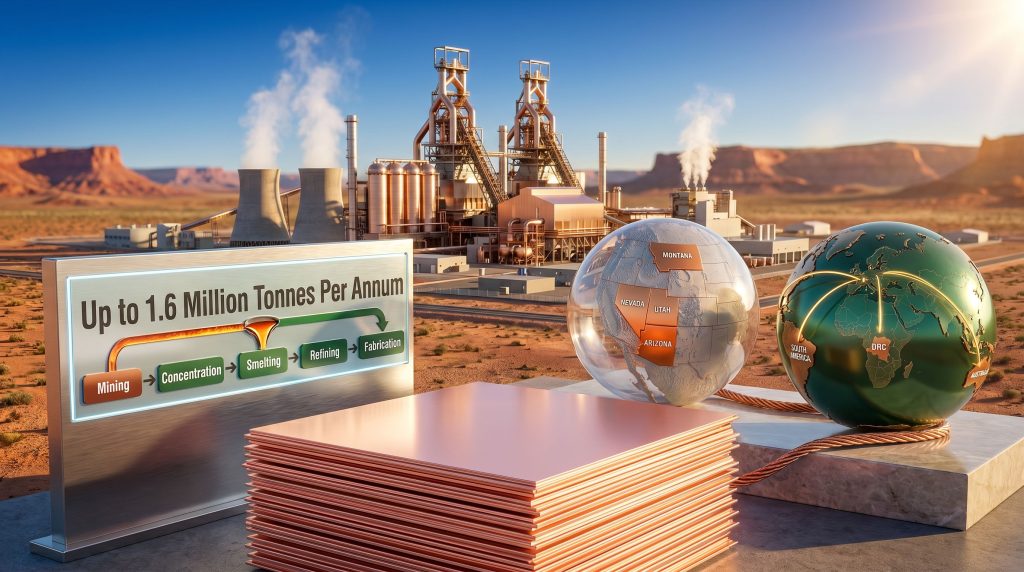
The headline commercial commitment within the framework is Glencore's plan to supply up to 1.6 million tonnes per annum (mtpa) of copper concentrate to Falcon's proposed smelting and refining facilities in the United States. This volume figure is significant when placed in context. Global copper concentrate trade typically flows toward smelting hubs in China, Japan, South Korea, and parts of Europe. Redirecting material of this scale toward domestic US processing capacity would represent a meaningful shift in that established flow.
The agreement structure itself carries several important nuances worth understanding:
- Non-exclusive nature: Both Falcon and Glencore retain full autonomy to pursue other partnerships and commercial arrangements independently of this framework
- Non-binding with enforceable exceptions: The MoU does not create legally binding commercial obligations in the traditional sense, but specific provisions covering confidentiality, regulatory compliance, and dispute resolution are explicitly enforceable
- Case-by-case project structuring: Rather than applying a single governance model, each qualifying project will be individually designed and negotiated, allowing flexibility across different asset types, geographies, and capital requirements
This architecture is deliberately modular. It allows both parties to test collaboration on smaller or lower-risk projects before committing binding capital at scale, while establishing governance guardrails that protect commercially sensitive information from day one.
Understanding What End-to-End Actually Means in Copper
The phrase end-to-end supply chain is used frequently in critical minerals discourse, but its specific meaning in copper processing deserves clarification. Copper moves through a complex, multi-stage industrial chain before it reaches its end use in wire, rod, or industrial components:
- Mining: Copper-bearing ore is extracted from open-pit or underground operations, typically at grades ranging from 0.3% to 1.5% copper content in most large-scale commercial mines
- Concentration: Run-of-mine ore is processed through crushing, grinding, and flotation circuits to produce copper concentrate, which typically carries 25% to 35% copper content by mass
- Smelting: Concentrate is fed into a smelter, which uses high-temperature pyrometallurgical processes to produce blister copper at approximately 99% purity
- Refining: Blister copper undergoes electrolytic refining to produce copper cathode at 99.99% purity, meeting the London Metal Exchange (LME) Grade A specification required for most industrial applications
- Fabrication: Cathode copper is then drawn into wire rod, sheet, or tube by downstream manufacturers serving electrical, construction, and industrial markets
The domestic processing ambition within the Falcon-Glencore framework targets steps three and four specifically. The United States currently processes relatively limited copper concentrate volumes domestically compared to its consumption requirements, meaning a functioning Arizona smelting platform would plug a structurally critical stage in this chain. Furthermore, the broader copper smelting expansion debate makes this domestic ambition all the more pressing.
Profiling the Two Partners
Falcon Copper: Western US Focus, Arizona Anchor
Falcon Copper is a privately held company with its operational focus concentrated across western US copper and critical metals jurisdictions. Its strategic anchor is a proposed smelting and refining platform in Arizona, a state with established copper mining heritage that accounts for the majority of US primary copper production historically. The company's executive chairman, Travis Naugle, has characterised the partnership as addressing a critical gap in the country's mineral infrastructure by combining domestic operational capability with a globally scaled supply partner (Mining Technology, Mishra, May 1, 2026).
As a privately held entity, Falcon operates without the public disclosure requirements that apply to listed mining companies, which means its project pipeline, financial structure, and permitting status are not subject to routine public reporting. This limits the independent verification of specific development timelines or capital commitments beyond what the company chooses to disclose.
Glencore: Global Scale, Established Concentrate Flows
Glencore (LSE: GLEN) operates as one of the world's largest copper producers by volume, with active extraction and processing operations spanning South America, the Democratic Republic of the Congo, and Australia. In North America, the company already operates copper scrap recycling infrastructure, providing an existing commercial footprint in the region. The Glencore copper operations model demonstrates a clear willingness to engage across multiple geographies in pursuit of supply chain integration.
| Attribute | Falcon Copper | Glencore |
|---|---|---|
| Listing status | Privately held | Publicly listed (LSE: GLEN) |
| Geographic focus | Western United States | Global (Americas, Africa, Oceania) |
| Role in MoU | Operator / Investor | Capital, logistics, offtake |
| Key strategic asset | Arizona smelting platform | Up to 1.6 mtpa copper concentrate supply |
| Existing North American presence | Proposed processing facilities | Copper scrap recycling operations |
Glencore's role in the Falcon agreement aligns with a broader commercial strategy the company has demonstrated in other critical minerals sectors. In March 2026, Glencore finalised a binding offtake agreement with Centaurus Metals for the supply of 20,000 dry tonnes of high-grade nickel concentrate annually from the Jaguar Nickel Sulphide Project in Brazil, delivering approximately 6,400 tonnes of contained nickel per year to Glencore (Mining Technology, Mishra, May 1, 2026). That precedent illustrates Glencore's willingness to lock in long-term concentrate supply relationships across multiple critical minerals commodities and geographies, with the Falcon Copper and Glencore MoU extending this pattern into copper and the US domestic market specifically.
The Critical Minerals Race and Where Copper Fits
Why Domestic Refining Capacity Has Become a Strategic Priority
The global conversation around critical minerals supply chains has intensified considerably over the past three years, driven by a combination of factors that intersect trade policy, energy transition timelines, and industrial security concerns. Copper occupies a particularly central position in this debate because, unlike some specialty metals with narrow applications, it is both a bulk industrial commodity and a critical input across virtually every decarbonisation technology deployed at scale.
Electric vehicles contain significantly more copper than their internal combustion counterparts, with estimates from industry sources typically placing the copper content of a battery electric vehicle at three to four times that of a conventional vehicle. Grid-scale infrastructure for renewable energy integration, including transmission upgrades, offshore wind installations, and utility-scale battery systems, is similarly copper-intensive. When these demand vectors are aggregated alongside continued growth in construction, electronics, and defence manufacturing, the pressure on global copper processing infrastructure becomes apparent. The global copper supply gap underpins much of this urgency.
The Smelting Bottleneck: A Lesser-Known Dimension of the Supply Gap
Public discussion of copper supply security tends to focus on mining capacity, with debates around permitting timelines, ore grade depletion, and new mine development. What receives comparatively less attention is the smelting and refining bottleneck. Even if new mines are permitted and developed, copper concentrate that cannot be processed domestically must travel to offshore smelters, typically in Asia, before returning to US markets as refined metal. This creates cost exposure, logistics vulnerability, and dependence on foreign processing infrastructure that persists regardless of the origin of the underlying ore.
The Falcon-Glencore framework targets this specific bottleneck. The Arizona smelting platform, if developed to operational scale, would address a stage of the value chain that has received limited domestic investment in recent decades. The last major new copper smelter construction in the United States occurred well before the current critical minerals policy cycle, meaning any new facility would represent a generational addition to domestic processing capacity. In addition, the US copper recycling expansion trend further illustrates the sector's growing appetite for onshore processing solutions.
If the Arizona smelting platform reaches full operational scale, it could represent one of the most significant additions to US copper refining infrastructure in decades, with implications extending beyond copper into the broader critical minerals processing ecosystem.
Structural Mechanics: How the Framework Operates
The Legal Architecture and Its Implications
Non-binding memoranda of understanding are standard instruments in early-stage mining and processing partnerships. They serve to establish intent, define roles, and create governance protocols before the commercial terms of specific projects are sufficiently developed to support binding agreements. The Falcon-Glencore MoU follows this pattern, with the case-by-case project structuring provision providing important flexibility as the partnership develops its project pipeline.
The enforceability of confidentiality and dispute resolution clauses within an otherwise non-binding MoU is a structurally meaningful detail. It means that commercially sensitive information shared during project evaluation is legally protected from day one, and that disagreements over the interpretation of the framework have a defined resolution pathway. These provisions protect both parties during the pre-binding development phase, which in large-scale mineral processing projects can span years.
Converting 1.6 Mtpa Concentrate Into Downstream Output
Understanding what 1.6 mtpa of copper concentrate actually represents in finished metal terms requires applying a recovery factor based on typical concentrate grades. Assuming a copper concentrate grade of approximately 28% to 30% copper content, and accounting for smelting and refining losses of roughly 2% to 4% across the processing chain, a concentrate input of 1.6 mtpa would theoretically yield somewhere in the range of 420,000 to 450,000 tonnes of refined copper cathode annually. This is a significant volume relative to US annual copper consumption, which has historically ranged between 1.6 million and 1.9 million tonnes depending on economic conditions.
Note: These output calculations are indicative estimates based on industry-standard processing parameters and are not confirmed figures from either company. Actual yields would depend on specific concentrate grades, smelter design, and operational recovery rates.
Risks, Limitations, and Variables
What Non-Binding Frameworks Cannot Guarantee
The commercial and reputational weight of Glencore's involvement lends credibility to the Falcon MoU, but it is important to recognise what the framework does not guarantee. Non-binding agreements do not obligate either party to deploy capital, develop specific projects, or deliver concentrate volumes on any particular timeline. Either party could withdraw from the arrangement without triggering commercial liability, provided the confidentiality and dispute provisions are respected. The 1.6 mtpa figure represents a stated aspiration for the framework's potential scale, not a contracted supply commitment.
Arizona Smelter Development: The Permitting and Infrastructure Challenge
Developing a copper smelter in the United States involves regulatory complexity that extends well beyond the financial and engineering dimensions. Environmental permitting for a new smelting facility typically encompasses air quality approvals under the Clean Air Act, water management requirements, hazardous materials handling protocols, and engagement with state and local jurisdictions. Timelines for major industrial facility permitting in the US can range from several years to over a decade, depending on the specific regulatory pathway, site characteristics, and community engagement requirements.
This permitting reality represents the most substantive execution risk in the Falcon-Glencore framework. The commercial logic of the partnership depends on the Arizona smelting platform achieving operational status, and that outcome is contingent on regulatory processes that neither party controls on a definitive timeline.
Trade Policy and Concentrate Flow Variables
The international movement of copper concentrate is also subject to trade policy variables that could affect the economics of the Falcon-Glencore supply arrangement. Tariffs on imported concentrate, export restrictions by producing countries, or shifts in bilateral trade relationships could all alter the cost and logistics profile of delivering Glencore's concentrate volumes to US facilities. These are systemic risks that apply to any cross-border mineral supply arrangement rather than risks specific to this partnership. However, the copper supply crunch already pressuring global markets adds another layer of complexity to these trade dynamics.
The next major ASX story will hit our subscribers first
Frequently Asked Questions
What did Falcon Copper and Glencore agree to?
The two companies signed a non-exclusive, non-binding memorandum of understanding establishing a framework for collaboration across global projects that supply copper and essential minerals to the US market, with Glencore providing capital, logistics, marketing, and offtake support and Falcon operating as the domestic processing and investment partner.
How much copper concentrate is Glencore expected to supply?
Under the framework, Glencore plans to supply up to 1.6 million tonnes per annum of copper concentrate to Falcon's proposed US smelting and refining facilities. This is a target figure within the MoU, not a binding contractual commitment.
Where will Falcon Copper's smelting and refining facilities be located?
Falcon's anchor processing asset is a proposed smelting and refining platform in Arizona, a state with established copper mining infrastructure and proximity to significant western US ore deposits.
Is the Falcon-Glencore MoU legally binding?
The agreement is non-binding in terms of commercial obligations, meaning neither party is legally required to proceed with specific projects or investments. However, provisions covering confidentiality, regulatory compliance, and dispute resolution are enforceable.
What other critical minerals does the partnership cover beyond copper?
The MoU framework references copper and other essential minerals broadly, indicating scope for collaboration across the wider critical metals space, though copper and the Arizona smelting platform are the primary focus of the announced arrangement. Market analysts tracking the Falcon Copper and Glencore US minerals supply chain partnership will be watching closely for any expansion into adjacent commodity categories.
Strategic Outlook: Milestones and Broader Significance
Near-Term Indicators to Monitor
For observers tracking the development of the Falcon Copper and Glencore US minerals supply chain partnership, several near-term indicators will signal whether the framework is progressing toward binding agreements:
- Whether any individual qualifying projects are announced with specific project structures and capital commitments
- Progress on Arizona smelter permitting, including environmental assessment milestones or site development applications
- Additional Glencore offtake or capital deployment announcements that contextualise the Falcon partnership within Glencore's broader US strategy
- Whether the non-exclusive MoU evolves into exclusive arrangements for specific projects or asset types
A Larger Pattern of Supply Chain Reshoring
The Falcon-Glencore partnership does not exist in isolation. It is part of a broader pattern of private-sector investment in domestic critical minerals processing capacity across multiple commodities. Across lithium, nickel, cobalt, and rare earths, the past several years have seen a wave of announced processing projects targeting domestic conversion of raw material into refined product or battery-grade intermediate. Copper has been comparatively slower to attract this investment wave, partly because its established trade flows through offshore smelters have been commercially functional, even if strategically suboptimal.
The logic of the Falcon-Glencore framework reflects a calculation that this commercial functionality will become increasingly strained as copper demand accelerates and geopolitical tensions around mineral supply chains intensify. Securing concentrate supply through a globally established partner while developing domestic processing infrastructure in parallel is a structurally sound approach to navigating this transition, provided the execution challenges, particularly Arizona smelter permitting, can be addressed on a commercially viable timeline.
This article is based on publicly available information and should not be construed as financial or investment advice. Forecasts, projections, and output estimates are indicative and subject to change based on project development, regulatory outcomes, and market conditions. Readers should conduct independent due diligence before making any investment decisions.
Want to Capitalise on the Next Major Copper Discovery Before the Market Does?
Discovery Alert's proprietary Discovery IQ model scans ASX announcements in real time, instantly identifying significant copper and critical mineral discoveries and translating complex data into actionable investment insights — precisely the kind of early-market intelligence that matters as domestic copper supply chains reshape global trade flows. Explore how historic mineral discoveries have generated substantial returns on Discovery Alert's dedicated discoveries page, and begin your 14-day free trial today to position yourself ahead of the market.