July 31, 2026
The Hidden Cost Multiplier Reshaping Battery Metals Development in 2026
Capital markets have a long memory for rate cycles, and the professionals who finance long-duration mining assets have an even longer one. The history of commodity project finance is littered with developments that were technically sound, geologically exceptional, and strategically vital, yet failed to reach construction simply because fed financing costs for nickel and lithium projects outpaced the pace of permitting. In 2026, that dynamic is reasserting itself with particular force.
When big ASX news breaks, our subscribers know first
The July 29 FOMC Decision and What Markets Actually Heard
On July 29, 2026, the Federal Reserve held its benchmark policy rate within the 3.5% to 3.75% range for a fifth consecutive meeting. On the surface, this was an unchanged outcome. Below the surface, the decision carried a materially more restrictive signal than the market consensus had anticipated.
A 9-3 vote saw three regional Federal Reserve presidents — Cleveland's Beth Hammack, Minneapolis's Neel Kashkari, and Dallas's Lorie Logan — dissent in favour of an immediate 25-basis-point rate increase. Chair Kevin Warsh simultaneously removed forward guidance from the post-meeting statement, effectively suspending the rate path anchor that project financiers rely upon when modelling multi-year capital structures.
Immediate market reaction following the July 29 FOMC decision:
| Market Indicator | Movement | Implication for Mining Projects |
|---|---|---|
| S&P 500 | -0.6% | Risk-off sentiment compresses equity financing appetite |
| 10-Year Treasury Yield | +5 basis points to 4.657% | Raises benchmark discount rates for long-duration assets |
| Fed Funds Rate (Upper Bound) | Held at 3.75% | Financing cost floor remains elevated |
| Rate-Cut Probability (H2 2026) | Materially reduced | Delays refinancing windows for pre-revenue developers |
Key Insight: When central banks remove forward guidance, the uncertainty does not sit with the Fed. It transfers directly onto the balance sheets of project developers, who must now model a wider spread of discount rate scenarios across construction timelines measured in years, not quarters.
The Fed's hawkish repositioning also reflects a broader concern that elevated energy prices, compounded by Middle East geopolitical tensions, could sustain inflationary pressure longer than previously modelled. Consequently, for battery metals developers, the implication is direct: financing assumptions built on expected rate cuts in the second half of 2026 must now be rebuilt from a higher baseline. The battery raw materials market is therefore absorbing this uncertainty at a particularly vulnerable moment in the capital cycle.
How Treasury Yields Mechanically Compress Battery Metals Project Economics
The Discount Rate Transmission Mechanism: From Policy Rate to NPV
The 10-year US Treasury yield functions as the risk-free rate foundation from which project finance discount rates are constructed. When yields rise, the Weighted Average Cost of Capital (WACC) applied to pre-revenue mining projects increases in tandem. For long-duration assets such as nickel sulfide operations or hard-rock lithium developments, the NPV sensitivity to even modest basis-point movements is substantial.
How discount rate changes affect pre-revenue project valuations:
- Every 50-basis-point increase in the discount rate applied to a 15-year mine life project can reduce NPV by 10% to 20%, depending on capital intensity and production ramp-up profile
- Projects with longer permitting and construction timelines face compounding NPV erosion because cash flows are pushed further into the discounting horizon
- Multi-lender financing structures, which are standard for large nickel and lithium developments, require each institution to independently price interest rate risk, meaning higher Treasury yields affect the entire capital stack simultaneously
- The removal of forward guidance extends this uncertainty until at least the September FOMC meeting, meaning lenders cannot accurately price rate risk for a critical two-month window
Strategic Implication: Projects that secured financing commitments before the current rate cycle hold a structural timing advantage that cannot be replicated by late-stage capital stack assembly. The gap between financing-ready projects and financing-seeking projects is widening with each successive FOMC meeting.
Battery Metals Capital Spending Was Already in Retreat
The Fed's hawkish positioning is amplifying a capital withdrawal that began well before July 29. According to the IEA's analysis of critical minerals demand and supply dynamics, the sector entered the current rate environment already significantly weakened, with spending declines across every major battery metals category.
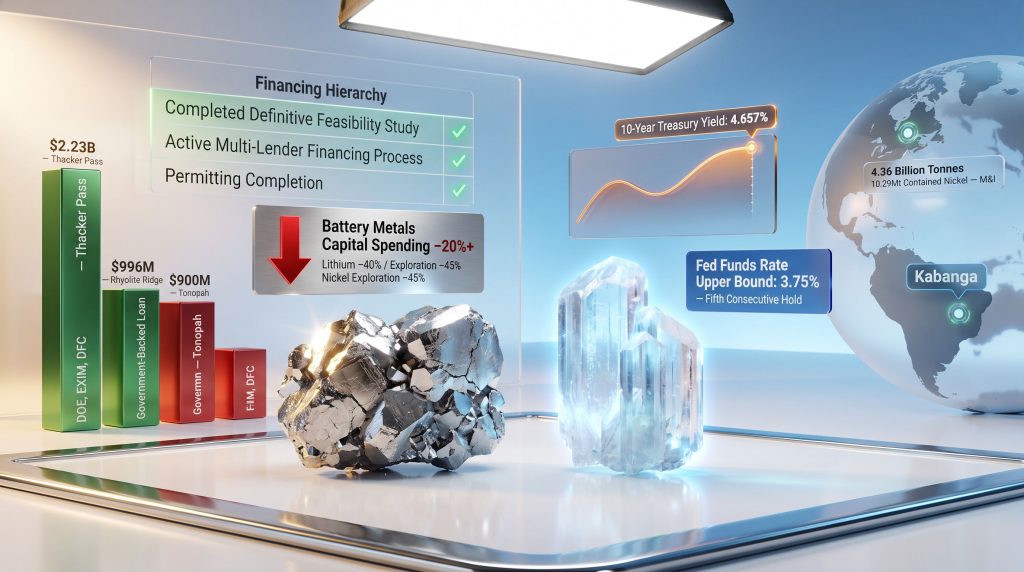
Critical Minerals Capital Spending Decline, 2025 data (IEA):
| Segment | Capital Spending Change (2025) |
|---|---|
| Battery metals overall | More than -20% (steepest decline in over a decade) |
| Lithium-focused companies | Approximately -40% |
| Lithium exploration spending | Approximately -45% |
| Nickel exploration spending | Approximately -45% |
This context matters enormously for interpreting the July 29 decision. Higher financing costs are not introducing a new capital shortage to the battery metals sector; they are reinforcing and extending one that is already well established. Furthermore, growing critical minerals demand driven by the energy transition means the structural need for these projects has not diminished, even as the capital environment tightens.
Why Project Readiness Has Become the Primary Differentiator in Battery Metals Finance
Redefining Competitive Advantage: From Resource Scale to Development Maturity
In lower-rate environments, geological quality and resource scale are the dominant variables that separate fundable projects from unfundable ones. Lenders are more tolerant of timeline uncertainty when the cost of capital is low, because the NPV penalty for delays is modest. In higher-rate environments, that calculus inverts entirely.
Lenders and strategic investors now place increasing weight on development maturity as a direct proxy for financing risk. A completed definitive feasibility study has consequently become one of the most bankable assets a project can possess in the current environment.
Development readiness hierarchy by financing impact:
- Completed Definitive Feasibility Study (DFS) — establishes bankable project economics and gives lenders a fixed cost basis to underwrite
- Active multi-lender financing process — signals institutional confidence and reduces execution risk perception
- Permitting completion or advanced status — removes a major source of timeline and cost uncertainty from lender models
- Secured site access and infrastructure agreements — reduces pre-construction risk to a quantifiable level
- Active engineering, procurement, and contractor engagement — demonstrates that construction readiness is not theoretical
- Political risk insurance or Export Credit Agency involvement — lowers the effective country risk premium embedded in lending rates
The FID Bottleneck: Financing Timelines Are Now Longer Than Resource Timelines
A critical structural inversion is now observable across the battery metals development pipeline. For the most advanced projects, the binding constraint on reaching a Final Investment Decision is no longer geological uncertainty or permitting completion. It is the pace of multi-institution financing negotiations.
Projects that have already engaged Development Finance Institutions (DFIs), Export Credit Agencies (ECAs), and strategic equity partners are operating on a financing timeline measured in months. Companies still in early-stage lender engagement are operating on a timeline measured in years. In a higher-rate environment, every quarter of delay compounds the NPV impact of elevated discount rates.
Federal and Multilateral Financing: The Structural Response to Higher Commercial Borrowing Costs
How Blended Capital Structures Are Reducing Effective Financing Costs for Select Projects
As commercial lending rates have tracked Treasury yields upward, US federal agencies and multilateral development finance institutions have increasingly positioned themselves as primary or anchor capital providers for qualifying critical minerals projects. This represents a structural shift in battery metals project finance, moving from pure commercial bank debt toward blended capital structures. Detailed coverage of US government funding for critical minerals companies illustrates just how significant this shift has become.
Key federal and multilateral financing mechanisms active in the US critical minerals sector:
| Agency | Instrument Type | Notable Commitment |
|---|---|---|
| Department of Energy (DOE) | Finalised loan | $2.26B for Thacker Pass lithium project |
| DOE | Project financing | $996M for Rhyolite Ridge lithium processing |
| Export-Import Bank (EXIM) | Letter of interest | $900M signal for Tonopah lithium mine and refinery |
| US Development Finance Corporation (DFC) | Political risk insurance / due diligence | Active on international nickel projects |
| Multi-agency coordination | Blended critical minerals packages | Coordinated across lithium, nickel, cobalt, copper |
The DOE's Thacker Pass loan structure is particularly instructive: it was priced with Treasury-linked rates and a minimal spread, directly reducing the effective cost of capital below what commercial markets would offer. This creates a two-tier financing landscape, where projects with access to federal-backed capital face materially lower borrowing costs than those relying solely on commercial debt markets.
When a federal agency provides an anchor loan or letter of interest, it simultaneously performs several functions for the broader capital stack:
- Reduces commercial lender risk by sharing or subordinating exposure
- Signals sovereign-level confidence in project viability, catalysing additional private capital
- Provides longer tenors and deferred repayment structures that commercial banks rarely extend to pre-revenue mining assets
- Enables projects to maintain construction momentum through rate cycles without full exposure to short-term Treasury yield movements
Nickel's Dual Constraint: Capital Costs and Geographic Concentration Risk
Why Large-Scale Nickel Sulfide Projects Face the Most Acute Financing Pressure
Nickel sulfide operations represent some of the most capital-intensive development pathways in the entire battery metals sector. Processing infrastructure requirements, multi-stage permitting across jurisdictions, and the need to engage multiple lending institutions simultaneously mean financing timelines for major nickel projects routinely extend across several years. In a rising-rate environment, this extended timeline directly increases the cost and complexity of assembling a bankable capital stack.
The growth of the Indonesian nickel industry has concentrated global supply to an unprecedented degree. Based on current development trajectories, Indonesia could account for 75% to 80% of global nickel production — a concentration level that creates supply chain fragility increasingly recognised by Western policymakers and institutional lenders alike.
Market Context: This level of geographic concentration is without modern precedent in a major industrial metal with direct relevance to electric vehicle battery supply chains. Supply chain fragility at this scale transforms non-Indonesian nickel projects from commercial opportunities into strategic necessities — a distinction that carries significant weight in DFI and ECA financing decisions.
Nickel supply concentration risk metrics:
| Metric | Current Estimate |
|---|---|
| Indonesia's projected share of global nickel output | 75% to 80% under current development trajectory |
| US classification of nickel | Critical material (energy security and supply chain criticality) |
| LME Nickel Cash Price trend (2026) | Elevated, supported by RKAB quota constraints |
| Primary FID constraint for advanced nickel projects | Government negotiation timelines, not capital availability |
Active Lender Engagement vs. Government Negotiation: The Kabanga Case Study
The Kabanga Nickel Project in Tanzania, advanced by Lifezone Metals, provides one of the most instructive case studies of how, for the most development-ready nickel projects, the primary constraint on FID timing has shifted from capital availability to host government negotiation pace.
Financing progress at Kabanga has reached multiple institutional milestones:
- Standard Chartered Bank in late-stage negotiations for a potential equity investment
- A Societe Generale-led project financing process with pathfinder DFIs and ECAs identified across Africa, Europe, and North America
- US Development Finance Corporation due diligence completed for political risk insurance
- FID timeline moved to Q1 2027, driven by Framework Agreement amendment negotiations with the Tanzanian government, not by any shortage of available financing capacity
This inversion is analytically significant. At the most advanced end of the nickel development pipeline, the question is no longer whether capital exists, but whether the contractual and regulatory framework for deploying that capital can be finalised within the lenders' underwriting timeline.
Resource-Stage Nickel Development: Building Technical Value Before Financing Becomes the Constraint
At the earlier end of the development spectrum, companies advancing resource definition in stable, low-negotiation-risk jurisdictions can continue building technical value during the current rate cycle without yet facing the financing bottleneck that constrains more advanced projects. Canada Nickel's Timmins Nickel District in Ontario is a substantive example of this approach.
Canada Nickel, Timmins Nickel District resource summary (July 23, 2026):
| Metric | Value |
|---|---|
| Total Measured and Indicated Resources | 4.36 billion tonnes |
| Average grade | 0.24% nickel |
| Contained nickel (M&I) | 10.29 million tonnes |
| Nesbitt Deposit (initial resource) | 176 million tonnes at 0.23% Ni |
| Deloro Deposit, Indicated Resource growth | +46% vs. 2024 estimate |
| Deloro Deposit, Inferred Resource growth | +39% vs. 2024 estimate |
| Additional exploration targets remaining | 7 |
| Next development milestone | Preliminary Economic Assessment (PEA) |
The district-scale resource base represents a technical foundation that positions the company for future financing negotiations from a position of geological strength. With a PEA still ahead and seven exploration targets yet to be tested, the resource definition phase is still expanding — meaning the technical de-risking work that lenders will eventually require is being completed ahead of the financing cycle rather than in parallel with it.
Canada Nickel CEO Mark Selby has previously characterised the structural shift in global nickel supply in terms that highlight why the Indonesian supply concentration dynamic is becoming an increasingly important financing catalyst. His assessment that Indonesia has fundamentally reset the nickel cost curve, and that the market is approaching a structural inflection point, reflects a view increasingly shared by the DFIs and ECAs that underwrite projects in competing jurisdictions. (Source: Crux Investor interview, 2026)
The next major ASX story will hit our subscribers first
Lithium's Parallel Problem: Supply Chain Concentration as an Independent Bottleneck
Why Lithium Developers Navigate Two Simultaneous Constraints
Lithium projects in the current environment face a more structurally complex challenge than nickel projects because they must navigate two distinct constraints operating on independent tracks. The first is monetary: higher commercial financing costs driven by elevated Treasury yields. The second is geopolitical: the structural inability to source battery-grade processed lithium outside China's dominant midstream processing infrastructure. Neither constraint can resolve the other.
The DLA Tender: A Case Study in Non-Chinese Supply Scarcity
The US Department of Defense's attempt to procure battery-grade lithium carbonate for the National Defense Stockpile illustrates the physical supply constraint with unusual precision. The Defense Logistics Agency sought 16,167 tonnes of battery-grade lithium carbonate at a committed value of $300 million, representing what would be lithium's first-ever inclusion in the National Defense Stockpile. Despite the financing barrier being entirely eliminated by committed government capital, the DLA was forced to extend its bid deadline twice.
DLA Lithium Carbonate Tender, key parameters:
| Parameter | Detail |
|---|---|
| Tender value | $300 million |
| Volume sought | 16,167 tonnes of battery-grade lithium carbonate |
| Strategic purpose | First-ever lithium inclusion in the National Defense Stockpile |
| Bid deadline extensions | Extended twice, most recently to August 5, 2026 |
| Reason for extension | Insufficient qualifying supply outside China's processing base |
Critical Distinction: The DLA tender failure is analytically important precisely because it controls for the financing variable. With $300 million of committed government capital, the constraint cannot be attributed to cost of borrowing or project economics. It is a pure physical supply constraint, confirming that the Western battery materials supply chain gap cannot be closed by financing alone.
Chinese Market Divergence and the Strategic vs. Commercial Disconnect
A significant divergence is emerging between Chinese lithium market pricing dynamics and the strategic imperatives driving Western lithium project development. Guangzhou lithium carbonate futures fell to a five-month low in late July 2026 as restarted Chinese mines increased expectations of a 2027 supply surplus.
For Western project developers, this creates an analytically awkward environment: falling Chinese spot prices reduce the commercial urgency for accelerating production, but they do not reduce the strategic urgency for governments seeking supply chain independence. This divergence is reshaping which financial signals actually drive project advancement, with government-backed capital and strategic offtake agreements increasingly displacing spot price benchmarks as the primary development catalyst.
Construction Readiness as a Rate-Cycle Hedge: The Bandeira Framework
Lithium Ionic's Bandeira Lithium Project in Minas Gerais, Brazil, demonstrates how a low-cost project with a completed DFS can maintain construction momentum through a higher-rate environment. Innovations such as direct lithium extraction are also contributing to cost improvements across the broader lithium development landscape, however conventional hard-rock projects with strong cost structures remain highly competitive.
Lithium Ionic, Bandeira Project construction readiness milestones (2026):
| Milestone | Status / Date |
|---|---|
| Definitive Feasibility Study | Completed September 2025 |
| 18-month construction-phase water access lease | Secured June 2026 |
| Life-of-mine plan refinement | Completed June 2026, validates DFS |
| Main crushing units tender | Issued to 5 suppliers; 5 proposals received and under evaluation |
| Underground mine portal RFQs | Issued to 7 contractors, July 2026 |
| Reported all-in sustaining cost | Approximately $600/tonne lithium carbonate equivalent |
The reported all-in sustaining cost of approximately $600 per tonne is the critical number in this context. At that cost structure, the project retains positive economics even when spot prices decline to $800 to $900 per tonne — a margin that allows procurement to continue without dependence on spot price recovery.
Lithium Ionic CEO Blake Hylands has articulated the competitive logic directly: projects capable of producing at this cost threshold can bring supply to market when higher-cost producers cannot, and the supply gap created by projects falling away becomes a structural advantage for developers who remained active through the price weakness. (Source: Crux Investor interview, 2026)
In a higher-rate environment, this cost-structure insight defines which projects lenders are willing to underwrite. A project with a $600 per tonne AISC presents a credible debt service coverage ratio at a broad range of price assumptions, giving lenders confidence that the project can service financing obligations through commodity price volatility.
Three Catalysts That Will Define the Next Phase of Battery Metals Financing Conditions
The near-term trajectory of fed financing costs for nickel and lithium projects will be substantially shaped by three discrete events, each testing a different dimension of the supply-financing nexus. Investors monitoring battery metals project development should treat these as sequential stress tests of the sector's underlying assumptions.
Upcoming catalyst framework:
| Catalyst | Event | Implication if Hawkish / Restrictive | Implication if Dovish / Supportive |
|---|---|---|---|
| 1. September FOMC Meeting | Fed reinforces or softens July hawkish stance | Extends higher discount rates; delays FIDs for projects still in financing | Opens refinancing windows; reduces NPV compression for advanced projects |
| 2. Indonesian RKAB Quota Review | Ministry communicates supplementary quota outcome post-July 31 deadline | Tighter quotas sustain nickel price premium regardless of financing conditions | Larger quotas ease supply constraints; reduces strategic urgency for non-Indonesian projects |
| 3. DLA Lithium Tender (August 5) | US government attempts to source qualifying non-Chinese lithium carbonate | Extended or cancelled tender confirms persistent non-Chinese supply deficit | Successful award demonstrates emerging supply chain diversification |
Investor Framework: These three catalysts are not equivalent in their market impact. The FOMC outcome affects the cost of capital across all pre-revenue battery metals projects simultaneously. The RKAB review affects nickel pricing and the relative attractiveness of non-Indonesian supply specifically. The DLA tender outcome tests whether the Western supply chain gap is a near-term solvable problem or a structural multi-year deficit. All three matter, but they matter through different mechanisms.
The Investment Thesis: Development Stage as a Rate-Cycle Differentiator
The Fed's July 29 decision did not alter nickel or lithium supply, demand, or project geology. What it did do is reinforce a higher-cost financing environment while simultaneously withdrawing the forward guidance that project financiers use to anchor their rate assumptions. For an industry already emerging from a multi-year capital pullback, this combination extends the advantage of early movers and increases the risk profile of late-stage capital stack assembly.
The practical investment framework for battery metals in this environment:
- Companies with multi-lender financing processes already underway — incorporating strategic equity, ECA-backed debt, and political risk insurance — face financing timelines measured in months rather than years
- Companies still building resource inventory in stable, low-negotiation-risk jurisdictions can continue advancing technical milestones before financing becomes the primary constraint
- The DLA tender's repeated extensions confirm that qualifying non-Chinese lithium supply scarcity is a physical constraint, not a financing constraint
- Construction readiness milestones, including completed feasibility studies, secured site access, awarded engineering contracts, and active procurement, provide the clearest signal of which projects can maintain development momentum through rate cycle uncertainty
- Cost structure — particularly all-in sustaining costs well below current spot prices — defines which projects retain lender confidence through commodity price volatility
The broader structural reality is that fed financing costs for nickel and lithium projects are not uniformly negative for battery metals development. They are, however, a powerful sorting mechanism. Projects with strong technical foundations, credible cost structures, and advanced financing processes will continue advancing. Projects that relied on a lower-rate environment to make marginal economics work will face increasing pressure. For investors with the analytical framework to distinguish between these two categories, the current environment is creating a widening performance gap that becomes unmistakable when financing timelines and procurement progress are examined alongside geological data.
Want to Identify the Next Major Battery Metals Discovery Before the Market Does?
Discovery Alert's proprietary Discovery IQ model delivers real-time alerts on significant ASX mineral discoveries across battery metals and critical minerals — instantly transforming complex geological data into actionable investment insights for both short-term traders and long-term investors. Explore historic examples of exceptional discovery returns and start your 14-day free trial today to position yourself ahead of the market.