August 24, 2026
The Mechanics Behind Gold's Sensitivity to Monetary Policy
Few relationships in financial markets are as frequently cited yet as poorly understood as the connection between interest rate policy and gold prices. Most commentators reduce it to a simple inverse rule: rates fall, gold rises. But experienced commodity analysts and portfolio strategists know that reality is considerably more textured. The interaction between Fed rate cuts and gold prices involves overlapping variables, lead-lag timing effects, and structural demand shifts that can either amplify or completely override the textbook relationship.
Understanding this complexity is not merely academic. For investors seeking to position around monetary policy cycles, the difference between a mechanical interpretation and a multi-driver framework can meaningfully affect portfolio outcomes.
When big ASX news breaks, our subscribers know first
Why the Rate-Gold Relationship Exists in the First Place
The Opportunity Cost Foundation
Gold generates no income. It pays no dividend, no coupon, and no yield. This means that every dollar allocated to gold is a dollar not earning interest in a Treasury bond, a money market fund, or a high-yield savings account. When interest rates are elevated, that forgone income becomes increasingly significant, and the relative attractiveness of gold weakens.
Conversely, when the Federal Reserve moves toward an easing cycle, the income advantage of interest-bearing assets shrinks. The opportunity cost of holding gold declines, making the metal comparatively more appealing to capital allocators. This is the core mechanical logic underpinning the widely observed inverse relationship between Fed rate cuts and gold prices.
Real Yields: The More Precise Signal
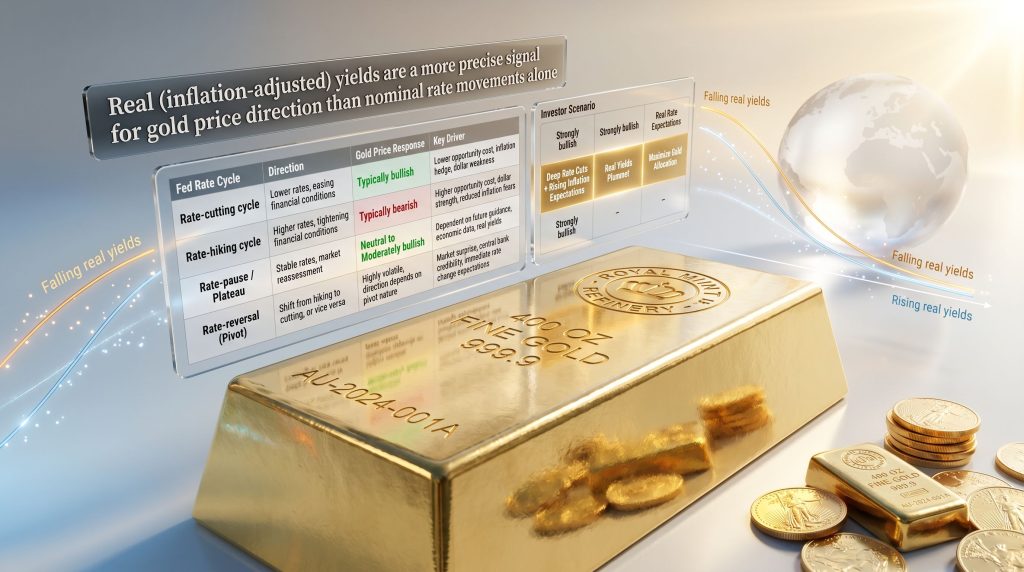
Here is where the analysis needs to move beyond nominal rate headlines. The metric that carries the most analytical weight is not the federal funds rate itself but rather the real interest rate, calculated as the nominal rate minus the prevailing rate of inflation.
When inflation-adjusted real yields decline, the relative cost of holding a non-yielding asset like gold decreases, historically supporting price appreciation. When real yields rise, even in a nominal rate-cutting environment, gold can face downward pressure as interest-bearing assets become comparatively more attractive.
The U.S. Treasury Inflation-Protected Securities (TIPS) market provides a forward-looking approximation of real yield expectations. Historically, gold and bond dynamics have shown a strong inverse correlation with 10-year real yields, making TIPS spreads a useful leading indicator for commodity analysts tracking gold's directional bias.
What Historical Rate Cycles Reveal About Gold's Behaviour
Pattern Recognition Across Policy Regimes
Examining past Federal Reserve cycles provides a useful, if imperfect, reference frame for evaluating how gold tends to behave across different monetary environments.
| Fed Policy Environment | Rate Direction | Gold Price Tendency | Primary Driver |
|---|---|---|---|
| Active easing cycle | Falling | Broadly bullish | Lower opportunity cost, softer USD |
| Aggressive hiking cycle | Rising | Typically bearish | Capital rotation toward yield-bearing assets |
| Prolonged hold at elevated rates | Flat/high | Bearish pressure | Non-yielding assets lose appeal |
| Rate hold amid geopolitical stress | Flat | Can remain bullish | Safe-haven demand overrides yield logic |
The Pre-Positioning Problem
One of the most important and least discussed dynamics in gold markets is the tendency for prices to move before the Fed acts, not after. Futures markets, options positioning, and institutional allocation shifts often price in anticipated rate cuts months in advance. By the time a formal Fed decision is announced, a substantial portion of the bullish case may already be embedded in the spot price.
This front-running behaviour means investors who wait for a confirmed rate cut before positioning into gold may be buying into a move that is already partially exhausted. Market participants who study forward rate expectations through instruments like fed funds futures contracts are better positioned to anticipate, rather than react to, gold price inflection points.
Steve Grasso, CEO of Grasso Global, outlined this dynamic in commentary featured on CNBC's Power Lunch, noting that while the Fed signalling openness to rate cuts is constructive for gold, the metal's response may unfold gradually rather than immediately following any single policy announcement.
Five Variables That Can Override the Rate-Gold Correlation
The rate-gold relationship is probabilistic, not deterministic. Several independent forces are capable of either amplifying or neutralising the expected directional response.
-
U.S. Dollar Strength: Gold is priced globally in U.S. dollars, so a strengthening greenback compresses gold prices in USD terms even when domestic rates are falling. A rate-cutting cycle that coincides with dollar weakness is typically far more bullish for gold than one where the dollar holds firm.
-
Inflation Trajectory: Rising inflation expectations can independently push gold higher, regardless of where nominal rates sit. Gold's historical function as a store of value during inflationary periods means that even a high-rate environment can coexist with gold strength if price pressures remain elevated.
-
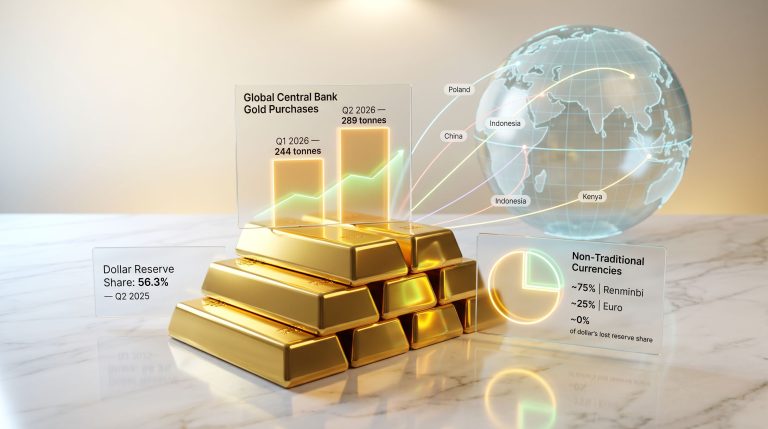
Central Bank Purchasing Activity: Since 2022, sovereign central bank gold demand has emerged as a structurally significant and largely rate-agnostic source of demand. Countries including China, Poland, and India have accumulated substantial reserves, adding a demand floor that does not respond to Fed policy signals in the conventional way.
-
Geopolitical Risk Premium: Conflict, sanctions regimes, and systemic financial instability generate defensive capital flows into gold as a safe haven independent of yield mathematics. The ongoing geopolitical tensions in the Middle East, including developments involving Iran and regional partners, have contributed to elevated risk premiums in commodity markets.
-
Real Yield Direction: Perhaps the most overlooked override: if nominal rates fall but inflation falls faster, real yields can actually rise even within a nominal easing cycle. This is a scenario in which gold may underperform despite headline rate cuts, confounding investors who rely solely on the nominal rate signal.
Historical evidence confirms that gold can sustain upward price momentum even when rate cuts are postponed, provided that macroeconomic uncertainty or geopolitical instability is generating sufficient defensive capital allocation to offset the yield-disadvantage headwind.
The 2025-2026 Macro Setup for Gold
A Data-Dependent Fed in a Complex Environment
Following the June 2026 FOMC meeting, analysts from major financial institutions including Morgan Stanley assessed the forward trajectory of monetary policy. Morgan Stanley's Chief U.S. Economist Seth Carpenter characterised the easing path as highly data-dependent, meaning the pace and timing of any rate reduction cycle remains contingent on evolving labour market conditions, inflation prints, and broader financial stability considerations.
This data dependency introduces meaningful uncertainty into the gold price forecast for the 2025 to 2026 period. Rather than a clean, telegraphed easing cycle, markets are navigating a scenario in which rate cuts may arrive later, more gradually, or in smaller increments than initially anticipated.
What This Means for Gold's Embedded Premium
Gold prices heading into mid-2026 already reflect a degree of anticipated easing, meaning the forward return potential hinges on whether actual Fed policy meets, exceeds, or disappoints the market's existing rate-cut expectations. If the Fed eases more aggressively than priced, gold's upside could be substantial. If cuts are delayed or modest, some of the embedded premium may unwind before reasserting itself on the next policy catalyst.
Beyond the Fed: A Multi-Driver Framework
Central Bank Demand as a Structural Floor
The scale of sovereign gold accumulation since 2022 represents one of the more significant structural shifts in gold market dynamics in decades. Central banks collectively purchased record volumes of gold in both 2022 and 2023, with 2024 continuing at elevated levels. This demand is driven by reserve diversification strategies, a desire to reduce exposure to the U.S. dollar-dominated financial system, and concerns about the long-term stability of fiat currency purchasing power.
Importantly, this buyer cohort is largely insensitive to short-term interest rate movements. Sovereign reserve managers operate on multi-decade investment horizons, meaning their accumulation patterns do not reverse in response to Fed hiking cycles the way speculative positioning does.
Supply-Side Constraints Adding a Structural Tailwind
On the supply side, the gold mining industry faces meaningful long-term headwinds. Discovery rates for large, high-grade deposits have declined over the past two decades. Furthermore, average ore grades at operating mines have fallen as high-quality reserves are depleted, requiring more tonnes of material to be processed per ounce of gold produced.
This grade deterioration raises all-in sustaining costs and constrains the industry's ability to rapidly expand output in response to higher prices. The average global all-in sustaining cost for gold production has risen meaningfully over the past decade, providing a higher structural price floor below which production becomes economically unviable at scale.
The next major ASX story will hit our subscribers first
Positioning Across Rate Scenarios: A Practical Framework
| Scenario | Rate Direction | Real Yield Trend | Gold Outlook | Portfolio Consideration |
|---|---|---|---|---|
| Aggressive easing with rising inflation | Falling sharply | Falling | Strongly bullish | Consider increasing gold allocation |
| Gradual cuts with stable inflation | Falling slowly | Flat | Moderately bullish | Maintain or modestly add exposure |
| Cuts delayed with elevated geopolitical stress | Flat or high | Elevated | Mixed, safe-haven offset | Selective exposure based on risk profile |
| Rate hikes or extended hold | Rising | Rising | Bearish | Reduce or hedge gold positions |
Choosing the Right Vehicle
Investors have multiple pathways to gold exposure, each with different sensitivity profiles:
-
Gold ETFs such as SPDR Gold Shares (GLD) offer direct price exposure with high liquidity, tracking spot prices closely without storage costs.
-
Physical gold via bullion or coins provides a direct store of value with no counterparty risk, though it carries storage and insurance costs.
-
Gold mining equities offer leveraged exposure to gold price movements, since miner profitability expands disproportionately when gold prices rise above fixed production costs. However, this leverage operates in both directions, amplifying losses when gold prices fall.
Frequently Asked Questions: Fed Rate Cuts and Gold Prices
Does gold always go up when the Fed cuts rates?
No. While lower rates reduce the opportunity cost of holding gold and tend to weaken the U.S. dollar, multiple variables can override this dynamic. A strengthening dollar, falling inflation expectations, or rising real yields even within a nominal cutting cycle can all weigh on gold simultaneously. For a deeper look at how the Fed impacts gold, the mechanics are well worth understanding before making any allocation decisions.
How quickly does gold respond to a Federal Reserve rate decision?
Gold markets often begin pricing in anticipated rate cuts weeks or months before a formal announcement. The actual rate decision may produce a muted price response if the move was already fully anticipated. Immediate post-decision volatility is common, but the sustained trend depends on how the decision shapes forward rate expectations.
What is the difference between nominal and real interest rates for gold investors?
Nominal rates are the headline policy rates set by the Fed. Real rates subtract the inflation rate from nominal rates. Gold analysts consistently find that real yields, not nominal rates, are the more reliable predictor of gold price direction, because they capture the true income sacrifice associated with holding a non-yielding asset.
Can gold fall during a rate-cutting cycle?
Yes. If the Fed cuts rates in response to deflationary pressures or a sharp economic contraction, falling inflation expectations can push real yields higher even as nominal rates drop. This scenario, sometimes called a deflationary downturn, can be unfavourable for gold despite surface-level rate easing.
Which matters more for gold: the Fed funds rate or the U.S. dollar?
Both are significant, and they are often correlated. However, the dollar's influence on gold pricing is immediate and mechanical, since gold is USD-denominated globally. Real yield direction provides the deeper structural signal, while dollar strength or weakness shapes the short-term price dynamic.
Key Takeaways for Investors
-
The inverse relationship between Fed rate cuts and gold prices is structurally grounded in opportunity cost theory but must be treated as probabilistic rather than guaranteed
-
Real inflation-adjusted yields are a more reliable directional indicator for gold than nominal rate movements alone
-
Central bank gold accumulation since 2022 has created a rate-agnostic structural demand floor that conventional yield-based models do not fully capture
-
Gold markets typically front-run Fed decisions, meaning the clearest opportunity often lies in anticipating policy pivots rather than reacting to them
-
A comprehensive gold price outlook in 2025 and 2026 requires a multi-driver framework incorporating real yields, dollar dynamics, geopolitical risk premiums, central bank demand, and mining supply constraints simultaneously
This article is intended for informational and educational purposes only and does not constitute financial advice. Forecasts, projections, and scenario analyses represent analytical perspectives and carry inherent uncertainty. Past relationships between interest rates and gold prices do not guarantee future outcomes. Investors should seek independent financial advice before making investment decisions.
Want to Track the Next Major Mineral Discovery Before the Broader Market Does?
Discovery Alert's proprietary Discovery IQ model delivers real-time alerts on significant ASX mineral discoveries, instantly converting complex mineral data into actionable insights for both short-term traders and long-term investors — start your 14-day free trial today or explore historic discovery returns to understand just how transformative a major find can be.