June 22, 2026
When a Waterway Becomes a Food Security Fault Line
Global food systems are rarely discussed in the same breath as maritime chokepoints, yet the two are more deeply intertwined than most policymakers acknowledge. The assumption that fertiliser trade flows freely and continuously is embedded in crop planning, government subsidy frameworks, and commodity price forecasting models across the world. When that assumption breaks down, the consequences ripple outward far beyond shipping ledgers and freight indices, reaching into the soil preparation cycles of hundreds of millions of farmers.
The events of early 2026 exposed precisely this vulnerability. The closure of the Strait of Hormuz, triggered by US and Israeli military strikes on Iran beginning February 28, did not merely disrupt oil markets. It severed the primary maritime artery for fertiliser exports originating from the Persian Gulf, creating a supply shock whose agricultural consequences were arguably more consequential than the energy disruptions that captured most of the headlines.
Understanding why requires examining how fertiliser ships crossing Strait of Hormuz routes became so indispensable to global food production, and what the months-long disruption revealed about the structural fragility at the heart of modern agricultural supply chains.
When big ASX news breaks, our subscribers know first
The Geography of Fertiliser Dependency
Why the Persian Gulf Became the World's Fertiliser Warehouse
The concentration of fertiliser production in the Gulf region is not accidental. It reflects a decades-long convergence of three factors: abundant natural gas reserves (the primary feedstock for urea and ammonia synthesis), proximity to large phosphate deposits, and sustained infrastructure investment by national energy companies seeking to monetise gas reserves beyond direct combustion.
Iran, Qatar, Saudi Arabia, and the UAE collectively account for a substantial share of global urea and ammonia export capacity. Qatar alone is one of the world's largest producers of ammonia, while Saudi Arabia's SABIC and its affiliated entities are major DAP and urea exporters. The Strait of Hormuz, connecting the Persian Gulf to the Arabian Sea, is the mandatory exit point for virtually all of this production destined for international markets.
This creates a geographic concentration risk that is structurally different from other commodity supply chains. Unlike grain, which can be sourced from multiple continental breadbaskets, or phosphate rock, which is available from Morocco to Russia to China, Gulf fertiliser exports are geographically bottlenecked through a single 33-kilometre-wide passage at its narrowest point. Furthermore, these geopolitical trade disruptions increasingly expose how fragile single-corridor dependencies can be.
The Dual Chokepoint Problem
What makes the Strait of Hormuz uniquely dangerous as a supply chain risk is its dual function. It serves simultaneously as the world's most critical oil transit corridor and as the primary export gateway for multiple agricultural input categories:
- Urea — the dominant nitrogen fertiliser for cereal, cotton, and pulse crops globally
- Ammonia — both a direct fertiliser and the essential feedstock for diammonium phosphate (DAP) manufacturing
- DAP — the most widely used phosphate fertiliser for soil preparation ahead of planting
- Sulphur — a critical manufacturing input for DAP production that receives almost no mainstream attention despite its indispensability
The sulphur dimension is particularly underappreciated. Most analysis of fertiliser supply chains focuses on urea and DAP as finished products, overlooking the fact that DAP production requires both ammonia and sulphur as manufacturing inputs. A disruption to sulphur supply from Gulf refineries does not just affect sulphur prices in isolation; it constrains DAP output capacity in importing nations that depend on Gulf-sourced raw materials for domestic manufacturing.
This compounding effect means a single chokepoint closure can simultaneously disrupt multiple nodes of the fertiliser production chain. According to Renewable Matter, a closure of the strait directly threatens fertiliser supply chains across Asia, Africa, and Europe in ways that food security frameworks have consistently underestimated.
A Chronology of Disruption
How the Backlog Built
The escalation from geopolitical event to fertiliser supply crisis followed a rapid and compounding sequence:
| Date / Period | Key Development |
|---|---|
| 28 February 2026 | US and Israeli strikes on Iran initiate conflict; Strait of Hormuz effectively closes |
| 7 March 2026 | Fertiliser-laden vessel departures from Gulf ports cease; a single vessel departs before the window closes |
| 11 March 2026 | 23 fertiliser vessels reported stranded in or near the strait |
| March to April 2026 | LNG supply disruptions begin suppressing domestic urea production capacity in India |
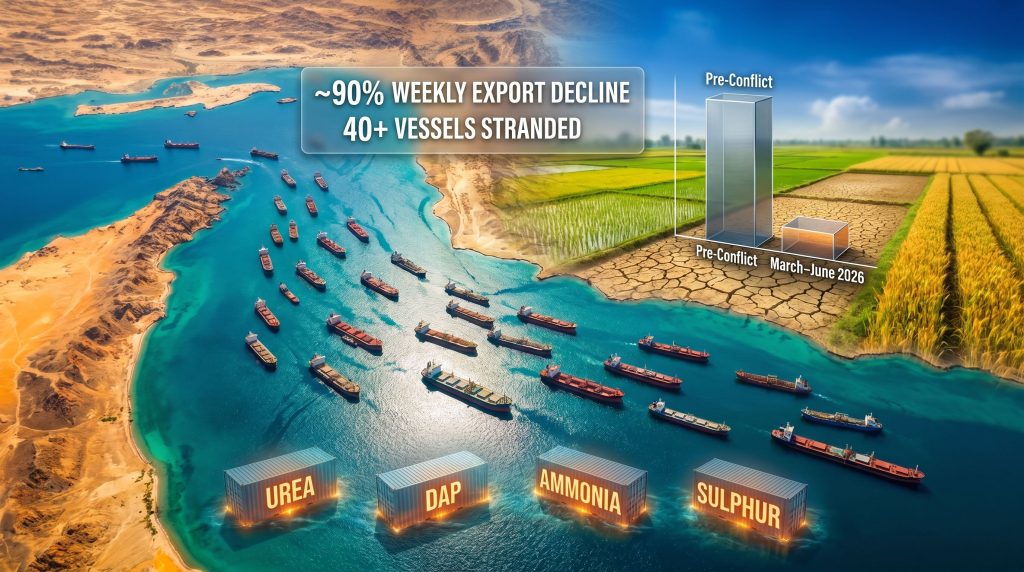
| Mid-June 2026 | Backlog peaks at over 40 fertiliser-laden vessels; weekly export volumes down approximately 90% from pre-conflict baselines |
| 22 June 2026 | Approximately 10 to 12 of the 16 India-bound fertiliser vessels successfully transit the strait |
At the peak of disruption, the stranded vessel composition reflected the full breadth of India's fertiliser import dependency:
- 8 urea vessels carrying the primary nitrogen input for India's kharif crops
- 4 DAP vessels supplying the phosphate fertiliser essential for pre-monsoon soil preparation
- 3 sulphur vessels carrying raw manufacturing input for domestic DAP production
- 1 ammonia vessel transporting feedstock for Indian fertiliser manufacturing facilities
The 90% Export Collapse: Understanding the Magnitude
A 90% decline in weekly fertiliser export volumes through a single maritime corridor is not a routine shipping disruption. For context, even the most severe weather events, port strikes, or equipment failures rarely reduce throughput by more than 20 to 30% over an extended period. A near-total cessation of fertiliser exports through the strait for approximately three and a half months represents one of the most severe agricultural input supply disruptions in the modern era of globalised commodity trade.
The timing amplified the severity. India's pre-monsoon fertiliser inventory build cycle runs from March through May, with the southwest monsoon onset in June marking the hard deadline for kharif sowing. The strait closure occupied precisely this window, compressing the margin for supply recovery.
The LNG-Urea Production Chain: An Overlooked Second-Order Effect
When Energy Disruption Becomes Fertiliser Disruption
One of the least-discussed dimensions of the Strait of Hormuz closure was its indirect impact on India's domestic fertiliser manufacturing capacity. The mechanism works as follows:
- Natural gas is the primary feedstock for urea synthesis in all modern urea plants; methane from natural gas reacts with nitrogen from air to produce ammonia, which is then converted to urea.
- India relies significantly on imported LNG to supplement domestic gas production and maintain urea plant utilisation rates.
- LNG supplies from Gulf producers transit the Strait of Hormuz on dedicated LNG carriers.
- The strait closure disrupted India LNG imports during March and April 2026, the precise months when urea plants should have been running at maximum output to build pre-monsoon inventories.
This created a dual supply shock: direct import disruption for finished fertilisers and production suppression of domestically manufactured urea. The two effects reinforced each other, creating a more severe inventory deficit than either would have produced independently.
The Indian government responded by securing supplementary LNG supply arrangements and issuing three separate global urea procurement tenders, providing a short-term policy buffer. However, emergency procurement at scale typically occurs at a price premium, adding to the fiscal cost of the disruption beyond the immediate supply impact.
How Fertiliser Cargoes Lose the Transit Queue
The Cargo Hierarchy Problem in Conflict Shipping
A critical and widely underappreciated dynamic in maritime conflict zones is the implicit hierarchy that governs which cargo types receive transit priority when a waterway partially reopens. This hierarchy is not formally codified but emerges from the intersection of commercial economics, insurance markets, and geopolitical energy security priorities.
When a strategic chokepoint like the Strait of Hormuz partially reopens after a conflict-related closure, the sequence of cargo resumption typically follows this pattern:
- Oil tankers move first, driven by the highest freight value per voyage and the energy security imperatives of consuming nations.
- LNG carriers follow closely, supported by long-term supply contracts with substantial penalty clauses for non-delivery.
- Container vessels carrying manufactured goods resume as risk assessments stabilise.
- Bulk carriers transporting agricultural commodities, including fertilisers, are consistently last in the queue.
The economic logic is straightforward but the agricultural consequences are severe. A crude oil tanker transiting the strait under elevated war-risk conditions can absorb the insurance premium increase as a small fraction of its cargo value. A bulk carrier loaded with urea or sulphur operates on far thinner margins, and the proportional war-risk premium increase can make the voyage economically unviable for shipowners without premium freight rate increases.
The result is a structural lag between energy supply normalisation and fertiliser supply recovery that is rarely factored into agricultural commodity price forecasting models.
War-Risk Insurance and the Fertiliser Shipping Economics
War-risk insurance represents a specific premium category added to standard marine cargo and hull insurance when vessels transit designated conflict zones. During periods of active conflict near the Strait of Hormuz, these premiums can increase voyage operating costs substantially, and the coverage itself may be subject to exclusion clauses that expose shipowners to uninsured risk for specific conflict-related damage types.
For bulk carrier operators hauling fertiliser, the calculus becomes particularly challenging. According to Kpler's analysis of fertiliser loadings, vessels were actively seeking ways to navigate the strait even as risk premiums surged, highlighting the acute commercial pressures facing operators:
- Lower cargo value relative to oil or LNG means the proportional premium burden is higher
- Bulk carrier charter rates for agricultural commodities are more volatile and less predictable than energy carrier rates
- The Cape of Good Hope alternative route adds approximately two to three weeks of transit time and substantially higher fuel and operating costs, eroding price competitiveness for time-sensitive cargo
Price Dynamics Across the Fertiliser Complex
What a Sustained Hormuz Closure Does to Fertiliser Markets
The price impacts of the 2026 disruption varied meaningfully across the fertiliser commodity spectrum, reflecting the different supply chain exposures of each product category. Broader shifts in global commodity markets have furthermore heightened the sensitivity of buyers to any additional supply-side shocks:
| Commodity | Primary Function | Price Sensitivity | Estimated Recovery Timeline |
|---|---|---|---|
| Urea | Primary nitrogen fertiliser | High | 2 to 4 months post-resumption |
| DAP | Phosphate fertiliser for soil preparation | High | 3 to 5 months post-resumption |
| Ammonia | DAP feedstock and direct fertiliser application | Very High | 4 to 6 months post-resumption |
| Sulphur | DAP manufacturing input | High | 3 to 5 months post-resumption |
Ammonia carries the highest price sensitivity because it functions simultaneously as a direct fertiliser input and as the primary feedstock for DAP manufacturing. A supply disruption to ammonia therefore propagates price pressure across multiple product categories, creating a broader fertiliser complex inflation that extends well beyond the ammonia market itself.
Notably, global urea prices began softening as vessel transits partially resumed in late June 2026, reflecting the market's forward-looking incorporation of improved supply availability. However, industry participants noted that a full price normalisation across the fertiliser complex was expected to take several months even after shipping resumed, as raw material supply chains for ammonia and sulphur require time to rebuild inventory buffers and stabilise procurement cycles.
The next major ASX story will hit our subscribers first
Strategic Implications: Rethinking Agricultural Supply Chain Architecture
The Case for Fertiliser Strategic Reserves
The 2026 Hormuz disruption has accelerated policy discussions around strategic fertiliser stockpiling as a food security instrument. The concept is directly analogous to strategic petroleum reserves, which were established precisely because concentrated energy supply chains through vulnerable corridors posed unacceptable national security risks.
Several structural arguments support the development of strategic fertiliser reserves for major importing nations:
- Fertiliser demand is highly seasonal and inelastic in the short term; farmers cannot defer soil preparation indefinitely without sacrificing entire crop cycles
- Unlike oil, fertiliser cannot be rapidly substituted with alternative inputs; soil chemistry requirements for specific crop types constrain flexibility
- The lead time between fertiliser application and harvest means supply disruptions have a lagged but highly certain impact on food production
- Strategic reserves could be sized to cover a 60 to 90 day buffer, sufficient to span most foreseeable conflict-related chokepoint closures
Diversification Beyond the Gulf: Alternative Supply Architectures
The concentration of fertiliser import dependency on Gulf-region sources represents a structural vulnerability that long-term agricultural security planning must address. Nations with high fertiliser import reliance face proportionally greater exposure when a single corridor fails. Credible alternative supply sources include:
- Russia and Belarus for potash and urea, though subject to their own geopolitical risk factors
- Morocco and Western Sahara for phosphate rock, representing the world's largest proven reserves outside of China
- Canada for potash, with production from Saskatchewan representing a stable, politically low-risk supply source
- Egypt and Nigeria for urea from gas-rich African producers seeking to expand fertiliser export capacity
The practical challenge is that diversification requires longer-term procurement contracts, investment in storage infrastructure at destination ports, and acceptance of potentially higher baseline costs compared to Gulf-sourced alternatives that benefit from proximity and scale advantages. In addition, the evolving LNG supply outlook suggests that gas feedstock availability will remain a key variable shaping where new fertiliser production capacity is located over the coming decade.
Scenario Analysis: What Extended Closure Would Mean
| Scenario | Probability | Agricultural Impact | Price Impact |
|---|---|---|---|
| Partial resumption (observed trajectory) | High | Moderate supply tightening; manageable with emergency procurement | Urea softening; ammonia and sulphur remain elevated |
| Full resumption within 60 days | Moderate | Rapid inventory normalisation ahead of rabi season | Broad price correction across fertiliser complex |
| Extended closure beyond 6 months | Low to Moderate | Severe kharif and rabi season supply risk; food inflation risk | Structural price elevation; potential crop acreage reduction |
| Permanent rerouting via Cape of Good Hope | Low | Persistent 15 to 25% increase in effective landed cost | Durable price floor elevation across fertiliser categories |
Disclaimer: The scenario assessments above are analytical frameworks based on supply chain dynamics and historical precedent. They do not constitute financial advice or definitive forecasts of commodity price movements.
Frequently Asked Questions
How many fertiliser ships were stranded at the Strait of Hormuz?
At peak disruption, more than 40 fertiliser-laden vessels were reported stranded in or near the strait. Of these, 16 were specifically India-bound, carrying urea, DAP, ammonia, and sulphur cargo. By 22 June 2026, approximately 10 to 12 of those 16 vessels had successfully transited the waterway.
Why does the Strait of Hormuz matter so much for fertiliser trade specifically?
The strait is the sole maritime exit point for fertiliser exports from Iran, Qatar, Saudi Arabia, and the UAE, collectively among the world's largest urea, ammonia, and DAP exporters. There is no viable alternative route that does not add weeks of transit time and substantially higher shipping costs.
Why does India face greater exposure than other nations?
West Asia is India's single largest external source of both finished fertilisers and raw manufacturing inputs including ammonia and sulphur. The disruption coincided with India's critical pre-monsoon inventory build window, and the simultaneous LNG supply disruption suppressed domestic urea manufacturing output during the same period.
When will fertiliser prices fully normalise after the strait reopens?
Industry participants indicate that a complete price normalisation across the fertiliser complex is a medium-term outcome, potentially requiring several months after shipping fully resumes. Ammonia and sulphur are expected to normalise more slowly than urea given their deeper supply chain disruption and longer inventory rebuild cycles.
What is the long-term lesson for agricultural supply chain planning?
The disruption demonstrates that fertiliser ships crossing Strait of Hormuz routes carry concentrated chokepoint risks that are comparable in severity to energy supply risks but receive significantly less policy attention and strategic investment in resilience infrastructure.
Want to Stay Ahead of the Next Major Commodity Supply Shock?
Discovery Alert's proprietary Discovery IQ model scans ASX announcements in real time, delivering instant alerts on significant mineral discoveries across fertiliser-linked commodities — from potash to phosphate — ensuring subscribers can act before the broader market catches up. Explore historic discovery returns on Discovery Alert's discoveries page and begin your 14-day free trial to secure a market-leading edge.