June 22, 2026
Tungsten's Supply Crisis Is Already Here — Vietnam Is the Answer the West Is Betting On
The global scramble for critical minerals demand has exposed a structural vulnerability that defence planners, semiconductor manufacturers, and energy transition engineers have quietly understood for years: tungsten supply is dangerously concentrated. Unlike lithium or cobalt, where multiple continents offer viable production alternatives, tungsten's industrial geography is almost entirely defined by a single country. When China tightened its export controls on tungsten in February 2025, it did not create the problem — it simply made it impossible to ignore any longer.
Against this backdrop, the Masan Nui Phao tungsten mine expansion in northern Vietnam has moved from a regional mining story into a conversation that stretches across defence ministries, semiconductor boardrooms, and sovereign wealth fund offices in Tokyo, Sydney, and Washington.
When big ASX news breaks, our subscribers know first
What Makes Tungsten Irreplaceable in the Modern Industrial Economy
Tungsten occupies a category of its own among critical minerals. With the highest melting point of any metal at approximately 3,422 degrees Celsius and an exceptional hardness rating, it performs functions in extreme environments that no commercially scalable alternative can replicate. This is not a gap that materials science is close to closing.
Its end-use profile spans some of the most strategically sensitive sectors in the global economy:
- Semiconductor manufacturing: Tungsten is used in the interconnect layers of advanced logic chips, making it foundational to every modern processor and memory device.
- Defence systems: Armour-piercing projectiles, radiation shielding, and missile components all rely on high-density tungsten. Rising global defence budgets, which the Stockholm International Peace Research Institute estimated reached a record $2.718 trillion in 2024, are translating directly into accelerating tungsten procurement cycles.
- Aerospace propulsion: Turbine components and rocket nozzles operating at extreme temperatures require tungsten's unique thermal stability.
- Electric vehicles and renewable energy: Wear-resistant cutting tools used in EV battery production, along with electrical contact materials in energy infrastructure, depend on consistent tungsten supply.
The irreplaceability problem is not theoretical. Industrial users cannot simply substitute a different material when tungsten becomes unavailable — they face production shutdowns or product redesigns measured in years, not weeks.
Furthermore, the tungsten strategic importance cannot be overstated when you consider that China produced approximately 83% of global tungsten output in 2024, according to data cited by Reuters. That figure alone defines the supply risk. When China implemented export restrictions beginning in February 2025, it created immediate procurement anxiety among Western industrial users who had largely assumed supply continuity.
The Strategic Architecture of the Nui Phao Mine
Vietnam is the world's second-largest tungsten-producing nation, and within Vietnam, the Nui Phao mine operated by Masan High-Tech Materials (MSR) stands as the dominant production asset. Located in Thai Nguyen Province in northern Vietnam, it is consistently cited as one of the largest tungsten operations functioning entirely outside Chinese jurisdiction.
What makes Nui Phao particularly valuable from an industrial and investment standpoint is its polymetallic character. The deposit yields tungsten as its primary product but co-produces significant volumes of fluorspar, bismuth, and copper alongside it. This multi-commodity revenue structure provides a natural hedge against price volatility in any single market and reduces the effective cost of tungsten production by spreading fixed costs across multiple product streams.
The mine currently operates under a permitted processing throughput of approximately 3.5 million tonnes of ore per year, a capacity ceiling that defines the current production envelope and against which the expansion's significance must be measured.
Breaking Down the Expansion: Nui Phao Extension and Nui Chiem
The Masan Nui Phao tungsten mine expansion involves two geographically adjacent zones that together represent one of the most consequential resource additions announced in the ex-China tungsten sector in recent memory.
| Expansion Zone | Estimated Resource | Location |
|---|---|---|
| Nui Phao Expansion Area | ~55.19 million tonnes | Thai Nguyen Province, northern Vietnam |
| Nui Chiem Area | ~60 million tonnes | Adjacent to existing Nui Phao complex |
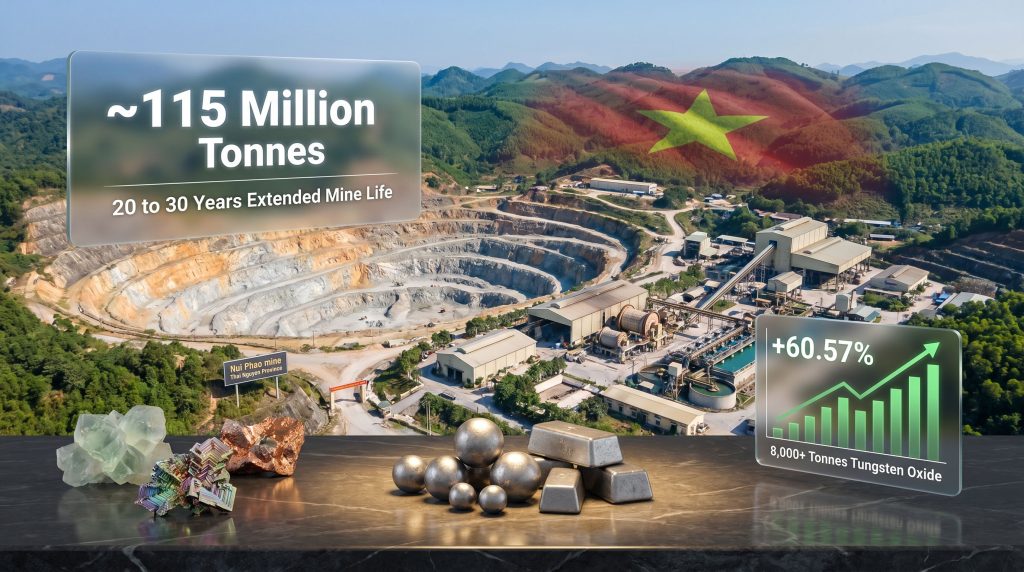
| Combined Potential | ~115 million tonnes | Northern Vietnam |
These figures are framed within Vietnam's National Mineral Master Plan, the regulatory architecture that classifies and governs mineral resource development across the country. It is important to understand the distinction between inferred resource potential and permitted mining reserves — the 115 million tonne figure represents exploration-stage resource estimates, not yet formally classified as bankable mining reserves under international reporting codes. This distinction matters significantly for investors conducting due diligence.
The expansion also targets underground reserve development. Within the existing mine complex, approximately 28 million tonnes of underground reserve potential has been identified, with an additional 20 to 21 million tonnes accessible within the mine's western pit zone.
What 115 Million Tonnes Actually Means for Mine Life
At the current permitted processing rate of approximately 3.5 million tonnes per year, the combined additional resource base theoretically supports between 20 and 30 years of additional mining and processing activity beyond current licensed periods. Existing mining licences carry expiry windows at 2028 and 2034, making the strategic case for operational tenure extension to 2036 and beyond commercially compelling.
From a valuation perspective, mine life extension of this magnitude fundamentally changes the asset's long-term cash flow profile. A mine with 30 years of additional operational runway can be modelled with entirely different discount rate assumptions than one approaching licence expiry, and the net present value implications are substantial for prospective strategic investors.
The Capital-Light Expansion Model: Why It Matters
One of the more technically significant aspects of the Masan Nui Phao tungsten mine expansion is its low capital intensity. MSR has confirmed that the expansion is expected to require no significant new capital outlay, because it will leverage existing crushing, milling, and flotation processing circuits already installed at Nui Phao.
In a sector where greenfield tungsten development projects routinely require hundreds of millions of dollars in upfront capital and face permitting timelines measured in decades, this is a genuinely differentiated proposition. The existing infrastructure can absorb incremental ore feed from the expansion zones without requiring parallel investment in entirely new processing facilities.
Additionally, prior geological drilling programmes conducted across the expansion zones mean that historical subsurface data can substitute for a significant portion of the exploration expenditure that would otherwise be required. This reduces pre-development risk and accelerates the timeline from resource classification to production-ready status.
For investors comparing tungsten development opportunities globally, the combination of an existing operating asset, established processing infrastructure, and a resource expansion requiring minimal incremental capital creates a risk-return profile that few competing projects can match.
Production Targets and Financial Performance
MSR is targeting an expansion of tungsten oxide production capacity to more than 8,000 tonnes annually, a figure that would materially increase Vietnam's share of global ex-China tungsten supply and position the operation as a genuinely significant counterweight to Chinese market dominance.
The processing pathway from raw ore to refined tungsten oxide involves multi-stage comminution, flotation separation of the polymetallic ore body, followed by hydrometallurgical refining to produce ammonium paratungstate (APT) and downstream tungsten oxide products suitable for industrial end-users in semiconductor fabrication, tooling manufacture, and defence applications.
On the financial side, MSR has set a profit target range for 2026 that reflects growing investor confidence in the business:
| Financial Metric | Value |
|---|---|
| 2026 Profit Target (Lower Bound) | 1.7 trillion Vietnamese dong (~USD $64.65 million) |
| 2026 Profit Target (Upper Bound) | 2.5 trillion Vietnamese dong (~USD $95.08 million) |
| Year-to-Date Share Price Movement | +60.57% (per LSEG data) |
The company has also announced plans to list on the Ho Chi Minh City Stock Exchange by early 2027, positioning the expansion programme as a core value driver for the public listing. This provides a defined liquidity pathway for early strategic investors who participate in pre-IPO equity rounds. Consequently, soaring tungsten prices have further added impetus to these efforts, drawing considerable attention from prospective international partners.
The next major ASX story will hit our subscribers first
Investor Geography and the Off-Take Structure
MSR is specifically targeting strategic investors from Japan, Australia, Europe, and the United States, nations whose industrial and defence sectors have the most direct stake in securing non-Chinese tungsten supply. This is not conventional open-market fundraising — it is a structured process that pairs equity participation with tungsten offtake agreements, meaning investors gain both financial exposure to the asset's value appreciation and guaranteed access to tungsten volumes at negotiated terms.
This off-take-linked equity model is becoming increasingly common in critical mineral transactions where supply security, rather than purely financial return, is the primary motivation for capital deployment. For a Japanese electronics manufacturer or a US defence contractor, the strategic value of locking in a decade of tungsten supply at predictable pricing may outweigh the pure equity return calculation.
Existing clients including Honeywell and Mitsubishi provide tangible evidence of product quality and supply reliability that materially de-risks the commercial proposition for prospective investors. These are not speculative offtake relationships — they represent established industrial supply chains built around Nui Phao's output.
The Geopolitical Dimension: Chinese Interest and Western Response
Reports indicate that two Chinese-affiliated firms have sought intermediaries to explore an ownership stake in the Nui Phao operation. This development has intensified scrutiny from Western governments who view non-Chinese tungsten access as a national security priority, creating a geopolitical overlay that adds both urgency and complexity to the investor targeting process.
The precedent from rare earth and battery mineral supply chain disruptions is instructive here. When supply concentration risk becomes visible through actual trade restrictions rather than theoretical analysis, allied-nation policy responses tend to accelerate rapidly. Indeed, critical mineral shortages driven by China's February 2025 tungsten export restrictions have created exactly that visibility, and the strategic framing of Nui Phao as a geopolitically aligned supply asset is a direct response.
Three Scenarios for the Expansion's Impact on Global Tungsten Supply
Scenario 1: Full Execution with Western Capital
If MSR successfully closes strategic investment from allied-nation partners and executes the expansion on schedule, the pathway to 8,000-plus tonnes of annual tungsten oxide production becomes achievable within the current decade. The impact on global ex-China tungsten availability would be material, providing semiconductor manufacturers, aerospace companies, and defence procurement agencies with a credible alternative supply source at scale.
Scenario 2: Partial Expansion with Constrained Capital
If off-take negotiations stall or equity investment falls short of target, a partial expansion scenario still meaningfully repositions Vietnam's tungsten export profile. The 2027 Ho Chi Minh City Stock Exchange listing provides a fallback capital mechanism, though public market valuations are inherently more volatile than strategic investor terms negotiated privately.
Scenario 3: Geopolitical Disruption and Tungsten Price Correction
A sustained period of tungsten price correction — possible if Chinese export restrictions are partially unwound through diplomatic negotiation — would compress project economics and potentially delay investment decisions. However, the polymetallic nature of the Nui Phao ore body provides meaningful revenue diversification through fluorspar, bismuth, and copper co-production, partially insulating the operation against single-commodity price movements.
Regulatory Framework and Operational Infrastructure
The expansion zones are classified within Vietnam's National Mineral Master Plan, which provides the overarching regulatory architecture for exploration licence progression in Thai Nguyen Province. Environmental compliance requirements for underground reserve development add procedural complexity but are not structurally different from the compliance framework already governing the existing open-pit operations.
Northern Vietnam's logistics infrastructure, including road access to the mine site and export pathways through Vietnamese ports, is well-established from the existing operation. Furthermore, energy security concerns surrounding the broader supply chain reinforce the urgency of operationalising these expansion zones as efficiently as possible. This is another element of the capital-light thesis that distinguishes Nui Phao from early-stage tungsten development projects in less accessible jurisdictions.
Frequently Asked Questions: Masan Nui Phao Tungsten Mine Expansion
What is the Masan Nui Phao tungsten mine expansion?
The expansion refers to Masan High-Tech Materials' programme to extend exploration and mining operations across two adjacent zones in Thai Nguyen Province, northern Vietnam, targeting approximately 115 million tonnes of additional polymetallic ore resources across the Nui Phao Expansion area and Nui Chiem area.
How long could the expansion extend mine operations?
Based on a processing throughput of approximately 3.5 million tonnes per year, the additional resource base is estimated to support between 20 and 30 years of additional mining and processing activity.
Why is tungsten from Nui Phao strategically important to Western nations?
China controlled approximately 83% of global tungsten production in 2024 and implemented export restrictions beginning in February 2025. Nui Phao represents one of the largest tungsten operations outside Chinese jurisdiction, making it a critical alternative supply source for Western defence, semiconductor, aerospace, and energy transition industries. Notably, Masan's Nui Phao is widely regarded as the world's largest tungsten mine outside of China.
Who are the target investors?
MSR is targeting strategic investors from Japan, Australia, Europe, and the United States, offering progressive off-take agreements alongside equity participation.
When is MSR planning to list publicly?
The company has announced plans to list on the Ho Chi Minh City Stock Exchange by early 2027.
Key Takeaways
- The ~115 million tonne resource addition positions Nui Phao as a generational tungsten asset with multi-decade operational potential
- A capital-light expansion model leveraging existing processing infrastructure reduces financial risk and accelerates timeline to increased production
- Existing client relationships with Honeywell and Mitsubishi provide commercial validation of product quality
- The 2027 stock exchange listing creates a defined liquidity pathway for early strategic investors
- Tungsten oxide production beyond 8,000 tonnes annually would materially shift Vietnam's share of global ex-China tungsten supply and create genuine supply chain diversification for allied-nation industrial users
- Polymetallic co-production of fluorspar, bismuth, and copper provides revenue resilience that pure-play tungsten operations cannot match
This article contains forward-looking statements and scenario projections that involve assumptions about future events, commodity prices, regulatory outcomes, and capital market conditions. These projections do not constitute financial advice. Readers should conduct independent due diligence before making any investment decisions related to the companies, assets, or markets discussed in this article.
Want to Stay Ahead of the Next Major Critical Mineral Discovery?
Discovery Alert's proprietary Discovery IQ model delivers real-time alerts on significant ASX mineral discoveries — instantly transforming complex data across more than 30 commodities into actionable investment insights for traders and long-term investors alike. Explore Discovery Alert's dedicated discoveries page to understand how historic mineral discoveries have generated substantial market returns, and begin your 14-day free trial today to position yourself ahead of the broader market.