August 7, 2026
The Hidden Architecture of Oil Price Volatility: Why Geography Still Governs Energy Markets
Long before algorithmic trading, ESG mandates, or OPEC+ quotas shaped crude benchmarks, the physical layout of the world's oceans determined which nations held energy leverage over others. That geographic reality has never changed. A single narrow passage between Oman and Iran, stretching roughly 33 kilometres at its most constrained point, continues to function as the jugular vein of global energy supply. When political tensions threaten that passage, markets do not deliberate. They react.
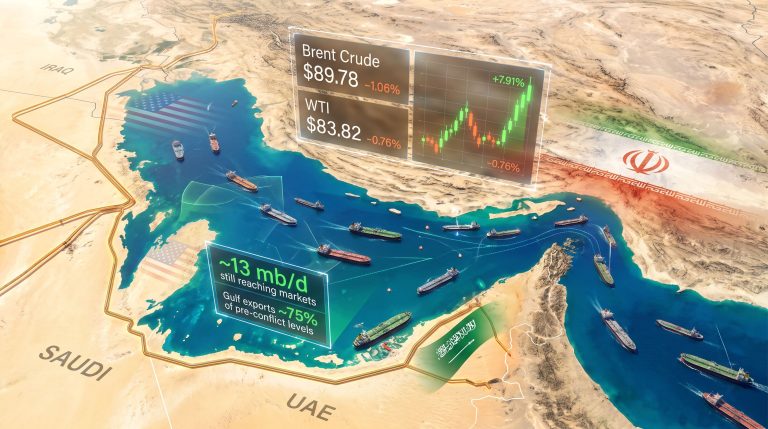
The events of late June 2026 have reinforced this dynamic with unusual clarity. Oil rises after Trump threatens fresh strikes on Iran became the defining market headline as crude futures surged, erasing days of diplomatic optimism within hours. Understanding why requires examining not just the political surface but the underlying mechanics of how chokepoint geography, inventory dynamics, and long-run demand erosion interact within a single volatile episode. For a broader view of these dynamics, our crude oil volatility guide provides essential context.
When big ASX news breaks, our subscribers know first
The Strait of Hormuz: More Than a Maritime Route
Why No Viable Alternative Exists at Scale
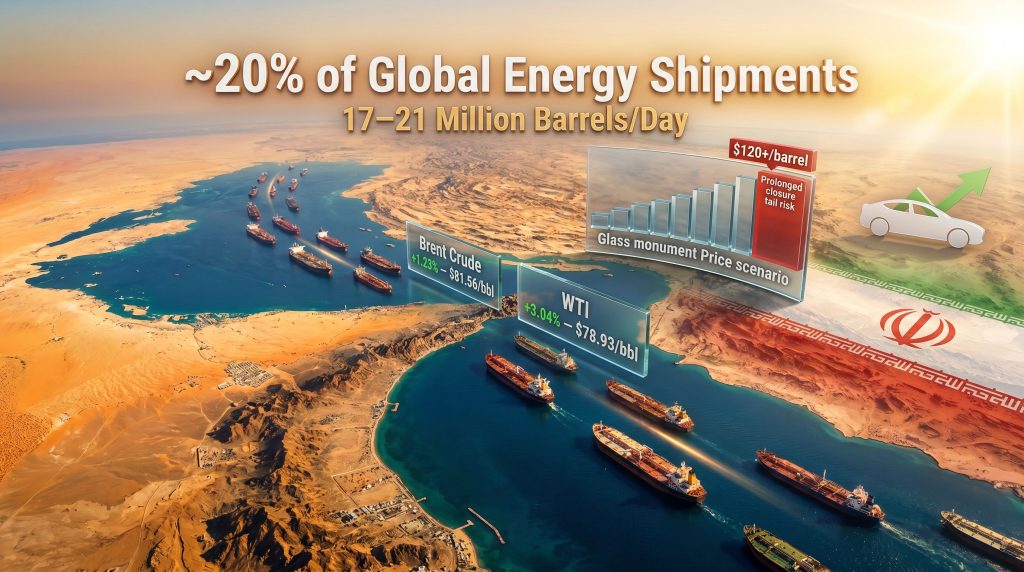
The Strait of Hormuz is not simply important; it is structurally irreplaceable for the volume of energy it handles. Approximately one-fifth of all global energy shipments transit this corridor daily, with crude oil throughput estimated between 17 and 21 million barrels per day depending on seasonal production levels across the Gulf states.
The nations whose export economics depend on unobstructed Hormuz transit include some of the world's largest producers:
- Saudi Arabia, which exports the majority of its crude via Persian Gulf terminals
- The United Arab Emirates, whose Fujairah export facility provides only partial bypass capacity
- Iraq, whose southern Basra terminals account for the overwhelming share of national oil revenue
- Kuwait and Qatar, both of whom have minimal alternative export infrastructure
- Iran itself, whose own crude and condensate exports rely on the same waterway
| Metric | Estimated Figure |
|---|---|
| Share of global energy shipments | ~20% |
| Daily crude oil throughput | 17–21 million barrels/day |
| Key dependent exporters | Saudi Arabia, UAE, Iraq, Kuwait, Iran |
| Viable alternative routing | Limited partial bypass via Suez Canal and overland pipelines |
What makes the strait uniquely vulnerable is the absence of meaningful redundancy. Saudi Arabia's East-West Pipeline and the UAE's Abu Dhabi Crude Oil Pipeline offer some rerouting capacity, but neither can absorb the full volume transiting Hormuz under normal conditions. Any sustained disruption leaves a supply gap that no combination of alternative routes can fully bridge in the short term.
How Threat Escalation Translates Into Immediate Price Premiums
The Geopolitical Risk Premium: A Mechanism Breakdown
Energy futures markets price probability, not certainty. When a credible threat to a critical supply corridor emerges, traders immediately embed a geopolitical risk premium into forward contracts. This premium is not speculative in the pejorative sense; it is a rational market response to the probability-weighted cost of supply shortfalls, elevated marine insurance rates, and rerouting delays.
The typical escalation-to-pricing sequence follows a recognisable pattern:
- A public escalation event occurs, such as a military threat or closure announcement affecting a key transit corridor
- Futures markets spike within hours, often well before any physical supply disruption materialises
- Diplomatic signals, including ceasefire talks or negotiation announcements, partially compress the premium
- Structural uncertainty persists, keeping prices above pre-event baselines until a durable resolution is confirmed and independently verified
What distinguishes the current episode is the compression of this cycle. Threat and diplomacy occurred simultaneously, creating an unusually ambiguous signal environment that markets found difficult to price with any confidence. Furthermore, OPEC's market influence has added another layer of complexity to an already volatile pricing environment.
Brent and WTI: Understanding the Divergence
| Benchmark | Movement | Price Level |
|---|---|---|
| Brent Crude (August futures) | +1.23% | $81.56/barrel |
| WTI (July futures) | +3.04% | $78.93/barrel |
WTI's sharper percentage advance relative to Brent reflects a structural feature of the U.S. benchmark. West Texas Intermediate is priced at Cushing, Oklahoma, a landlocked hub whose supply conditions are particularly sensitive to import disruption risks affecting Gulf Coast refinery inputs. When Middle East supply chains face potential interruption, the logistical implications for domestic U.S. crude distribution tend to amplify WTI's reaction relative to the internationally traded Brent benchmark.
The Escalation Timeline: Diplomacy Undermined in Real Time
A Compressed Geopolitical Cycle With Maximum Market Confusion
The sequence of events that drove the latest oil price surge is worth examining in granular detail, because the simultaneity of diplomatic engagement and military threats is itself the analytically significant feature. According to Reuters, the market's response was swift and decisive once the threat landscape became clear.
The key chronological markers were as follows:
- The week prior, Washington and Tehran formalised a memorandum of understanding establishing a framework to halt active hostilities and extend a ceasefire for a minimum of 60 days
- The accord explicitly required reopening of the Strait of Hormuz and a cessation of hostilities across the broader region, including Lebanon
- Over the subsequent weekend, U.S. President Donald Trump publicly threatened renewed military action against Iran, including potential strikes on power plants and bridges, if Hormuz remained blocked
- Simultaneously, Vice President JD Vance was engaged in the first formal negotiations under the interim accord at the Swiss resort of Bürgenstock, meeting with Iranian counterparts
- Tehran responded by announcing a re-closure of the Strait of Hormuz, citing Washington's alleged failure to enforce ceasefire terms in Lebanon
- Iran also indicated the Swiss talks would remain narrowly scoped to implementing the existing memorandum, with the nuclear programme explicitly excluded from discussion
Markets are not simply reacting to the possibility of military action. They are pricing the credibility gap between diplomatic commitments and concurrent political rhetoric. When simultaneous signals point in opposite directions, the market defaults to pricing the worst-case scenario until clarity emerges.
This dynamic, where a sitting executive simultaneously threatens military action while their administration's second-in-command pursues negotiations, introduces what traders term policy incoherence risk into the pricing model. It is structurally distinct from a clear escalation or a clear de-escalation, making mechanical hedging strategies far more complex. Indeed, the relationship between the trade war and oil pricing has similarly demonstrated how political signals can override fundamental supply-demand logic.
The Inventory Illusion: Why Apparent Supply Abundance Masks Deeper Vulnerability
Stockpile Drawdowns Versus Production Recovery
One of the most consequential analytical distinctions in the current market environment involves separating the appearance of supply adequacy from its structural reality. Analysis from Quantum Strategy's David Roche highlights that Middle East oil supply appears close to pre-conflict levels when crude held in storage facilities and aboard tankers is incorporated into the supply picture.
However, this surface reading conceals a structurally concerning dynamic:
- The apparent supply buffer reflects inventory drawdowns and tanker stockpile liquidation, not genuine upstream production recovery
- Once these stockpiles are exhausted, the market faces a supply shortfall with no immediate production ramp-up available to compensate
- This creates a pronounced asymmetric risk profile where short-term price stability actively masks medium-term vulnerability
This is a critical distinction for market participants. Inventory-driven supply is finite and non-renewable in the short run. Production-driven supply can be sustained and scaled. When markets mistake the former for the latter, they systematically underestimate forward price risk.
Supply Risk Scenarios and Price Implications
| Scenario | Probability Assessment | Price Implication |
|---|---|---|
| Full Hormuz reopening, ceasefire holds | Moderate | Prices ease toward $75–$78/barrel |
| Partial reopening with ongoing friction | Elevated | Prices rangebound $80–$90/barrel |
| Escalation to active military strikes | Lower but non-trivial | Brent potential retest of $100–$110+/barrel |
| Prolonged closure lasting weeks | Low but catastrophic tail risk | Potential for $120+/barrel with inflation spillover |
Disclaimer: Price scenario estimates represent analytical frameworks based on historical precedent and current market conditions. They do not constitute investment advice, and actual outcomes may differ materially from projections.
The Macro Transmission: How an Oil Shock Spreads Through the Economy
From Crude Futures to Consumer Prices
An energy price shock originating from a Hormuz disruption does not remain contained within commodities markets. The transmission mechanism operates across multiple economic channels within days to weeks:
- Gasoline and diesel prices rise at the retail level as refiners pass through higher input costs
- Marine insurance premiums surge for vessels transiting high-risk corridors, elevating shipping and freight costs globally
- Aviation fuel costs increase, with airlines facing pressure to pass these expenses through to ticket pricing
- Petrochemical input costs rise, affecting manufacturing supply chains dependent on oil-derived feedstocks
- Central bank policy complexity deepens, as energy-driven inflation may conflict directly with growth-supportive monetary stances already navigating post-pandemic legacies
In an environment where central banks are managing residual inflationary pressures from prior economic cycles, a sustained energy price shock introduces a stagflationary risk vector. Rising prices coinciding with slowing growth creates a policy dilemma that neither aggressive rate hikes nor accommodative settings can cleanly resolve.
The stagflation and market volatility risk scenario is particularly acute for oil-importing economies in Asia and Europe, where energy dependence on Persian Gulf supply is structurally higher than in the United States. Furthermore, domestic monetary policy tools in these regions have less room to absorb the dual shock of rising energy costs and weakening growth momentum.
The next major ASX story will hit our subscribers first
Goldman Sachs's Counterintuitive Thesis: Oil Shocks as EV Accelerants
The Paradox Embedded Within Every Supply Disruption
While near-term geopolitical escalation is unambiguously bullish for crude prices, Goldman Sachs has identified a structurally bearish long-term dynamic embedded within these same shock events. The analytical thesis works as follows:
- Sustained supply disruptions push retail fuel prices higher, lengthening consumer exposure to elevated energy costs
- Elevated fuel prices shorten the payback period on electric vehicle purchases, improving the economic case for EV adoption at the individual consumer level
- Faster EV penetration rates progressively erode the long-run demand base for crude oil
- The cumulative effect creates a paradox: the very shocks that inflate near-term oil prices may be systematically dismantling the structural demand foundation that sustains those prices over the medium and long term
| Factor | Short-Term Effect | Long-Term Effect |
|---|---|---|
| High gasoline prices | Bearish for consumer spending | Accelerates EV adoption decisions |
| Geopolitical supply risk | Bullish for oil futures | Strengthens energy security case for electrification |
| Government policy response | Emergency reserve releases | Potential acceleration of clean energy incentives |
| Investor sentiment | Energy sector outperforms | Longer-term capex rotation away from fossil fuel exploration |
Consequently, the EV transition impact on long-term crude demand deserves serious consideration from any investor evaluating today's oil price movements. This dynamic does not resolve the immediate supply risk, but it matters enormously for investors with multi-year time horizons. A sector that benefits from short-run geopolitical volatility while facing structural demand erosion driven partly by that same volatility presents a complex risk-reward calculation.
What Market Participants Should Be Watching
The Critical Variables Shaping Near-Term Price Direction
With the current situation remaining fluid, several variables will disproportionately influence where crude prices settle over the coming weeks. As the Wall Street Journal reports, supply disruption fears are already reshaping how institutional investors position themselves across energy markets.
The key variables to monitor include:
- The operational status of the Strait of Hormuz, specifically whether it remains fully closed, partially restricted, or reopened under verified conditions
- Diplomatic progress at the Bürgenstock talks and any subsequent negotiating rounds, particularly regarding Lebanon ceasefire enforcement
- Inventory data releases, which will clarify whether the apparent supply buffer from stockpile liquidation is narrowing faster than markets currently expect
- The degree of alignment between U.S. executive rhetoric and active diplomatic strategy, given that policy incoherence is itself a distinct market risk factor
- Institutional forecasts on EV adoption acceleration trajectories, as these increasingly inform longer-dated crude price expectations among professional investors
- Central bank communications in major oil-importing economies, where energy-driven inflationary resurgence could prompt policy pivots with broader market consequences
The oil market in mid-2026 is navigating a genuinely unusual configuration: short-term supply risk from geopolitical escalation layered over a long-term structural demand erosion narrative, with neither dynamic near resolution. Investors and analysts monitoring the story of oil rises after Trump threatens fresh strikes on Iran should resist treating it as a simple risk-on headline and instead engage with the layered complexity underneath. The interaction between these forces — geopolitical chokepoint risk, inventory illusions, and EV-driven demand destruction — will define crude price trajectories well beyond the immediate diplomatic cycle.
Want To Stay Ahead Of The Next Major Commodity Market Move?
Discovery Alert's proprietary Discovery IQ model scans ASX announcements in real time, instantly identifying high-potential mineral discoveries across more than 30 commodities — turning complex market data into clear, actionable opportunities for both short-term traders and long-term investors. Start your 14-day free trial today, or explore how historic discoveries have delivered exceptional returns to investors who positioned themselves early.