
August 7, 2026
The Structural Paradox at the Heart of Global Alumina Markets
Commodity markets occasionally produce conditions that defy surface-level interpretation. Rising import volumes are typically read as a signal of tightening domestic supply, competitive pricing advantages, or accelerating downstream demand. Yet China alumina imports surge and supply surplus conditions during the first half of 2026 have produced none of these expected outcomes. Instead, inventories have climbed to multi-year highs, futures prices remain anchored near production cost support levels, and the broader market consensus points toward a continued surplus extending well into year-end.
Understanding why this paradox exists requires moving beyond headline trade data and examining the simultaneous forces reshaping both Chinese domestic supply and global commodity trade flows.
Key Market Metrics: H1 2026 Snapshot
| Metric | Value | Context |
|---|---|---|
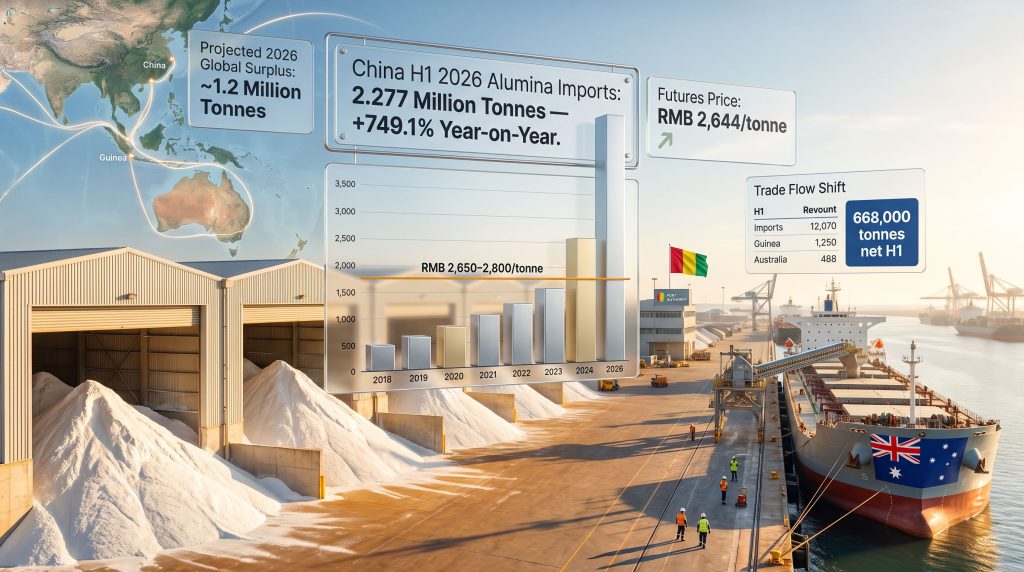
| China H1 2026 alumina imports | 2.277 million tonnes | +749.1% year-on-year |
| June 2026 monthly imports | ~449,050 tonnes | Near single-month record |
| Cumulative net imports (H1 2026) | 668,000 tonnes | Imports significantly exceed exports |
| Alumina exports (H1 2026) | 1.609 million tonnes | +19.8% year-on-year |
| Futures price (4 August 2026) | RMB 2,644/tonne | +0.38% intraday |
| Near-term price forecast range | RMB 2,650–2,800/tonne | Rangebound consensus (SunSirs) |
| Projected 2026 global surplus | ~1.2 million tonnes | S&P Global estimate |
| Inventory change since Jan 2026 | +1 million+ tonnes | Elevated across ports and warehouses |
Critical Insight: China's alumina import volumes have risen nearly eightfold year-on-year, yet prices remain capped near production cost support levels. This structural paradox is driven by simultaneous domestic supply expansion and the redirection of global trade flows converging on the same market at the same time.
When big ASX news breaks, our subscribers know first
Why Domestic Capacity Expansion Is the Missing Variable
The instinct when observing a near-eightfold import surge is to search for a demand driver. In China's case, no such driver exists in the conventional sense. The correct analytical frame is supply-side convergence: imported tonnes and domestically produced tonnes are both growing simultaneously, and the combined volume is outpacing any meaningful expansion in downstream consumption.
New refinery capacity in Guangxi province has been progressively commissioned throughout 2026. This is not marginal capacity coming online at the edges of existing operations. These are substantial commissioning events that are adding meaningful production volumes to an already well-supplied market. Alongside these greenfield additions, a number of previously idled refineries across multiple Chinese provinces have gradually returned to operational status, contributing incremental tonnes that compound the supply build.
The downstream impact on primary aluminium smelters is equally telling. Smelters have maintained comfortable raw material stockpiles and are not being compelled to draw down port inventories at pace. According to data tracked by the Shanghai Metals Market (SMM), weekly alumina production levels remained broadly stable through the first half of 2026, but the cumulative effect of stable-to-rising weekly output stacked against limited additional demand has created a progressively deepening inventory overhang.
Key Drivers Behind China's Alumina Inventory Build
- New Guangxi refinery capacity entering commercial production through H1 2026
- Previously curtailed refineries across multiple provinces returning to full operation
- Primary aluminium smelters maintaining surplus raw material buffers, reducing spot purchasing urgency
- Imported cargoes lifting port-level stockpiles faster than downstream consumption can absorb
- Macroeconomic headwinds limiting the appetite for aggressive primary aluminium production expansion
A critical but underappreciated dynamic here is the relationship between exchange warehouse receipts and price formation. When warehouse receipts remain significantly elevated above historical norms, futures contract holders have diminished incentive to take physical delivery. This compresses the basis between spot and futures pricing and pushes the forward curve into contango, a condition where near-term prices trade below longer-dated contracts.
Contango structures are self-reinforcing in bearish markets: they discourage near-term restocking and institutionalise a wait-and-see approach among buyers, which deepens inventory accumulation further. Furthermore, the aluminum and alumina markets are increasingly intertwined, meaning price suppression in one segment reverberates across the other.
Market Mechanism: Elevated warehouse receipts suppress the futures basis, push the forward curve into contango, and reduce buyer urgency to draw down inventories. This creates a self-reinforcing bearish cycle that is technically distinct from simple oversupply and is harder to break without an external catalyst.
How Global Trade Flow Disruption Amplified China's Import Surge
The China alumina imports surge and supply surplus dynamic cannot be fully explained through a domestic lens alone. A substantial component of the import acceleration reflects the structural rerouting of global alumina trade flows, a phenomenon that accelerated through the first half of 2026 and redirected large volumes of Australian-origin material toward Chinese buyers.
Australia has historically been a diversified exporter of alumina across Asia-Pacific markets. During the period under review, several factors converged to channel a disproportionate share of available Australian cargoes into China. Demand from alternative destination markets softened. Earlier supply disruptions linked to Middle East tensions had already begun rerouting shipments. And Chinese buyers, attracted by competitive import pricing relative to domestic production costs, absorbed available tonnage aggressively.
Trade Flow Dynamics: Before and After Disruption
| Factor | Pre-Disruption Pattern | Post-Disruption Pattern |
|---|---|---|
| Primary Australian cargo destinations | Diversified across Asia-Pacific | Concentrated toward China |
| Middle East alumina availability | Constrained by regional tensions | Gradually recovering (UAE restart) |
| Indonesian demand | Moderate, established | Rising from new smelter capacity |
| China net import position | Broadly self-sufficient | Strongly positive (+668,000t net, H1) |
This cargo redirection thesis is critical because it explains why the import surge is structural rather than cyclical. It is not the result of a temporary demand spike in China. It is the consequence of a global trade realignment in which Chinese buyers became the buyer of last resort for displaced volumes, absorbing surplus material that had no immediate alternative home.
The resumption of operations at the Atavira alumina refinery in the United Arab Emirates during July 2026 represents an important development in this context. While the immediate volume contribution from Atavira remains modest relative to total global trade flows, the restart signals that Middle Eastern supply capacity is recovering. As this capacity returns and Indonesian smelting demand absorbs more regional supply, the volume of competitively priced alumina available for redirection into China may increase further, deepening rather than relieving the domestic Chinese surplus over the medium term.
The Upstream Bauxite Market and Its Role as a Price Floor
Despite the weight of bearish supply dynamics, the alumina market is not without structural price support. The upstream bauxite segment provides a meaningful cost floor that limits the extent of downside price pressure, even in an oversupplied environment. Indeed, global bauxite supply conditions play a critical role in anchoring the cost economics of alumina refining worldwide.
Guinea has emerged as one of the most significant bauxite export origins for Chinese refineries. Strong shipment volumes from Guinea have ensured adequate raw material availability across the domestic refining base, preventing the kind of feedstock scarcity that might otherwise drive emergency procurement premiums. However, Guinea's export quota policy introduces an important asymmetric dynamic into bauxite price risk.
Asymmetric Risk Factor: Guinea's export quota framework makes upward price adjustments structurally more probable than downward moves. This creates a cost floor beneath alumina production economics that is policy-anchored rather than purely market-driven, and which persists regardless of alumina demand conditions.
This asymmetry matters for price forecasting. It means that while surplus inventories cap the ceiling for alumina prices, the floor is not infinitely elastic. When alumina spot prices approach marginal production cost levels, the cost support from Guinea's bauxite pricing dynamics creates resistance to further deterioration. This is precisely why SunSirs identifies the RMB 2,650 per tonne level as the lower boundary of its near-term reference range, and why a disorderly price collapse below production economics remains an unlikely scenario absent a dramatic demand destruction event.
Bauxite Cost Support: Key Structural Factors
- Guinea sustaining high-volume exports to China, maintaining refinery feedstock security
- Export quota mechanism creating structural upward price bias for Guinean bauxite
- Global bauxite availability broadly stable, preventing acute raw material shortages
- Alumina production cost proximity acting as a technical support level for spot prices
- Recovering output outside China providing incremental supply without eliminating cost anchors
It is worth noting that the quality characteristics of Guinean bauxite add another layer of complexity to the cost structure equation. Guinean bauxite is typically high in available alumina content and relatively low in reactive silica, making it highly desirable for refinery operations optimised for Bayer process efficiency. This quality advantage means that Guinean material commands a pricing premium over lower-grade alternatives, and any disruption to Guinea's export volumes would have an outsized impact on Chinese refinery input costs.
Price Outlook and Scenario Analysis for the Remainder of 2026
S&P Global's research projects a global alumina surplus of approximately 1.2 million tonnes for full-year 2026, consistent with the trajectory of inventory accumulation observed through H1. Multiple Chinese market analyses, including assessments from SunSirs and SMM, converge on a similar conclusion: absent a meaningful supply disruption or an unexpected acceleration in primary aluminium production, alumina prices are likely to remain rangebound and structurally weak.
Scenario Analysis: Conditions Required to Break the Rangebound Trend
| Scenario | Probability Assessment | Price Impact |
|---|---|---|
| Major supply disruption (Guinea, Australia) | Low to Moderate | Strongly bullish, potential breakout above RMB 2,800 |
| Accelerated Chinese smelter capacity additions | Moderate | Modestly bullish via demand-side absorption |
| Further refinery restarts outside China | Moderate to High | Bearish, deepens global surplus |
| Macroeconomic stimulus in China | Low to Moderate | Conditionally bullish via aluminium demand pull-through |
| Continued cargo redirection into China | High | Bearish, sustains inventory build |
For a durable price recovery to materialise, one or more of the following structural shifts would need to occur:
- Supply-side curtailment reducing Chinese refinery output or disrupting Guinea's bauxite export capacity
- Demand acceleration from a significant ramp-up in primary aluminium smelting in China or Southeast Asia
- Trade flow normalisation reducing the volume of competitively priced imports entering China
- Macroeconomic catalyst driving broader industrial metals demand across the complex
The most credible near-term demand recovery vectors sit outside China. New aluminium smelting capacity in Indonesia is generating restocking demand for alumina, and recovering Middle Eastern production is simultaneously adding supply while absorbing regional feedstock. These ex-China dynamics have contributed to tightening international alumina availability and upward pressure on overseas prices, even as the Chinese domestic market remains oversupplied. This divergence between ex-China tightness and Chinese surplus is one of the more analytically complex features of the current market.
China's Dual Role: Simultaneously an Importer and a Major Exporter
One feature of China's current alumina trade position that receives insufficient analytical attention is the country's simultaneous status as both a major importer and a significant exporter. With 1.609 million tonnes exported in H1 2026, up 19.8% year-on-year, alongside 2.277 million tonnes imported, China is actively participating in global alumina trade flows in both directions at scale. The aluminium supply chain leaders operating across this landscape are navigating these dual flows carefully to manage margin exposure.
This apparent contradiction reflects the geographic and logistical realities of China's alumina industry. Coastal refineries, which have efficient port access and benefit from cheaper seaborne freight, may find it economical to export surplus production to regional buyers while inland smelters simultaneously draw on imported supply that arrives through different port infrastructure. The economics of Chinese alumina trade are therefore not nationally uniform but are shaped by regional cost structures, logistics, and refinery configurations.
China's net import position of 668,000 tonnes in H1 2026 represents a meaningful structural shift. For a country that has historically operated as a broadly self-sufficient alumina producer, this transition toward net importing signals an integration into international markets that has significant long-term implications for global price discovery. Furthermore, as the China steel demand outlook continues to shape broader metals sentiment, alumina market participants are increasingly sensitive to any macro shifts emanating from Beijing.
Analytical Note: China's evolution from a self-sufficient alumina producer to an increasingly integrated net importer changes the architecture of global price formation. International alumina prices will progressively reflect Chinese domestic supply conditions in ways they have not historically, creating new correlations and volatility channels for market participants to navigate.
The next major ASX story will hit our subscribers first
Frequently Asked Questions
Why have China's alumina imports increased so dramatically in 2026?
The surge reflects a combination of redirected global trade flows, particularly from Australia, weakened demand in alternative destination markets, competitive import pricing relative to domestic production costs, and earlier Middle Eastern supply disruptions that rerouted available cargoes toward Chinese buyers.
Why are higher import volumes not translating into higher alumina prices?
Because domestic production has expanded simultaneously, total supply growth is outpacing demand. Inventories at ports and exchange warehouses have risen sharply, capping spot prices near production cost support levels rather than allowing a demand-driven price recovery. As Mysteel's analysis highlights, oversupply is the dominant near-term force keeping China alumina imports surge and supply surplus conditions entrenched.
What is the current alumina price forecast for China?
Near-term consensus places alumina futures in a reference range of RMB 2,650 to RMB 2,800 per tonne, with prices expected to remain rangebound absent a major supply disruption or macroeconomic catalyst. This assessment is consistent with views expressed by both SunSirs and SMM.
How does Guinea's bauxite export policy affect alumina prices?
Guinea's quota framework creates an asymmetric upward price bias for bauxite, establishing a cost floor beneath alumina production economics. This limits the downside for alumina prices even in an oversupplied market environment.
What is the global alumina surplus forecast for 2026?
S&P Global projects a global alumina surplus of approximately 1.2 million tonnes for full-year 2026, consistent with the inventory accumulation trajectory observed through the first half of the year.
Disclaimer: This article is intended for informational purposes only and does not constitute financial or investment advice. Commodity price forecasts and market projections involve inherent uncertainty and should not be relied upon as the sole basis for investment decisions. Past market conditions are not necessarily indicative of future outcomes. Readers are encouraged to conduct independent research and seek professional advice where appropriate.
Want to Stay Ahead of Major ASX Mineral Discoveries Before the Broader Market Reacts?
Discovery Alert's proprietary Discovery IQ model delivers real-time alerts on significant ASX mineral discoveries, instantly translating complex commodity data into actionable investment insights — whether you're tracking alumina, bauxite, or the broader resources sector. Explore historic discoveries and the substantial returns they've generated, then begin your 14-day free trial at Discovery Alert to position yourself ahead of the market.