August 7, 2026
When Geopolitical Risk Evaporates Overnight: How Oil Markets Price the Unthinkable
Commodity markets have always been susceptible to sudden repricing, but few forces move crude oil as violently or as swiftly as the threat of war in the Persian Gulf. Trump cancels attack on Iran nuclear deal oil prices — this sequence of events became one of the most dramatic examples of geopolitical risk unwinding in recent memory. Unlike equity markets, where valuations rest on earnings forecasts and balance sheets, oil prices carry an additional invisible layer: the geopolitical risk premium.
This premium is not visible in supply-and-demand spreadsheets, but it can represent several dollars per barrel at any given moment, built silently into futures contracts whenever tensions rise near the world's most critical energy corridors.
When that premium suddenly deflates, the price movement can be dramatic, disorienting, and easily misread by investors who focus only on physical supply fundamentals.
That is precisely what happened in early August 2026, after US President Donald Trump signalled a halt to planned military action against Iran, framing the pause as an opportunity to pursue a diplomatic resolution covering nuclear ambitions and Strait of Hormuz access. The resulting oil price crash of more than five percent in a single session was not a reflection of new barrels flooding the market. It was the rapid unwinding of fear itself.
When big ASX news breaks, our subscribers know first
The Numbers Behind the Drop: Parsing What Actually Moved
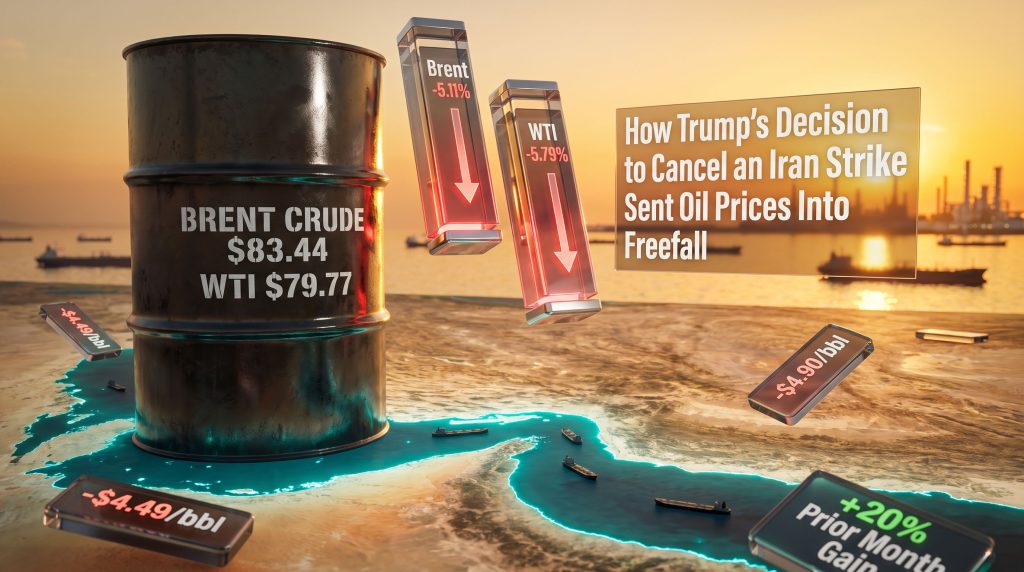
The price action on August 3, 2026 was striking in its speed and scale. Brent crude futures fell by $4.49 per barrel, a decline of 5.11%, settling at $83.44. West Texas Intermediate moved even more aggressively, dropping $4.90 per barrel, or 5.79%, to $79.77. For a broader perspective, the current crude market overview provides useful context around these movements.
| Benchmark | Price | Change | % Move |
|---|---|---|---|
| Brent Crude | $83.44/bbl | -$4.49 | -5.11% |
| WTI Crude | $79.77/bbl | -$4.90 | -5.79% |
| Prior Month Performance | Both benchmarks | +20%+ | Conflict-driven spike |
To fully appreciate the significance of this single-session decline, it needs to be viewed against the backdrop of what preceded it. Both benchmarks had surged by more than 20% across the prior month, driven by renewed US-Iran hostilities and a wave of tanker attacks in waters around Oman. The war premium that had been carefully built into crude prices over weeks was now being unwound in a matter of hours.
This is a crucial distinction for energy market participants to understand. The drop did not signal that new supply had entered the market. OPEC+ production had not suddenly surged. No new fields had come online. The decline reflected one thing almost exclusively: a reassessment of the probability that military conflict would physically disrupt the flow of oil through the Strait of Hormuz.
The Strait of Hormuz: Geography as Market Mechanism
Few geographic features on Earth have as direct a relationship with global commodity prices as the Strait of Hormuz. This narrow passage connecting the Persian Gulf to the Gulf of Oman serves as the transit corridor for a substantial share of the world's seaborne crude oil exports. Any realistic threat to vessel navigation through this chokepoint introduces immediate uncertainty into global supply chains that cannot be quickly resolved by alternative routes or reserve drawdowns.
Why This Corridor Cannot Simply Be Bypassed
The challenge with Hormuz is not just its volume of throughput. It is the absence of easily scalable alternatives. While pipelines such as the Abqaiq-Yanbu route in Saudi Arabia can divert some crude around the strait, their combined capacity falls well short of replacing the full volume that normally transits the waterway. Furthermore, for tanker operators, route diversions around the Arabian Peninsula add significant time and cost, which quickly feeds through into insurance premiums and freight rates.
In the weeks leading up to Trump's de-escalation announcement, the market was already processing tangible evidence of disruption. These geopolitical oil price pressures had been building steadily across the region:
- Multiple tanker strikes were reported in waters around Oman, deterring shipping operators from entering the Gulf to load cargo
- UK Maritime Trade Operations flagged three additional vessel attacks occurring from the preceding Saturday alone
- Shipping data released on Monday confirmed that traffic through the Strait of Hormuz had slowed materially
- Two Saudi oil-laden tankers were tracked crossing the Bab el-Mandeb Strait out of the Red Sea over the weekend, reflecting active route management by producers trying to maintain export flows
This combination of factors had not just elevated prices. It had fundamentally altered tanker operator behaviour, creating a deterrence effect that reduced effective throughput even without a complete blockade.
Trump's Truth Social Signal and How Markets Decoded It
Late on Saturday, August 2, Trump posted on Truth Social describing a decision to hold off on a fresh military strike against Iran. The framing was specific: Iran and other regional parties had requested time to finalise parameters for a comprehensive agreement. Trump outlined a three-part framework for what a successful deal would deliver:
- The immediate, complete, and total reopening of the Strait of Hormuz
- A definitive end to Iran's nuclear threat
- A formal diplomatic agreement formalising both commitments
Markets opened on Monday and immediately interpreted this as a meaningful reduction in near-term escalation risk. However, experienced energy traders understood something less obvious: a signal is not a deal.
"The oil market's reaction reflected a probability shift, not a certainty shift. Traders were pricing a reduced likelihood of imminent military action, not the confirmed resolution of the underlying conflict. This distinction becomes crucial when assessing whether the price decline is durable or temporary."
IG market analyst Tony Sycamore identified the central risk facing crude prices in the days following the announcement. His concern centred on whether the week ahead would mirror the prior one, where deal optimism evaporated as Iran maintained leverage over Hormuz access. The specific mechanism he flagged was the possibility of Iran reinforcing its bargaining position through further strikes on US assets or on vessels transiting the waterway — a scenario that would rapidly re-inject the conflict premium back into crude pricing.
This dynamic captures something essential about geopolitical oil pricing. The premium does not disappear because an announcement is made. It retreats to a holding pattern, ready to reassert itself the moment the diplomatic signal is contradicted by events on the water.
OPEC+ Production Policy: The Paper Supply Problem
Layered beneath the geopolitical drama is a structural supply story that has been quietly distorting market signals for most of 2026. On Sunday, August 3, OPEC+ approved a production quota increase of approximately 188,000 barrels per day effective from September, completing the unwinding of a voluntary output cut layer that had been in place for an extended period. Understanding OPEC's market influence is essential context for interpreting why these quota decisions matter well beyond the headline figures.
On paper, this represents additional supply entering the market. In practice, its impact has been almost entirely theoretical.
The reason is straightforward. Export disruptions caused by the Iran conflict in the Gulf, combined with the ongoing Ukraine war's impact on Russian and Kazakhstani output volumes, have meant that successive monthly OPEC+ quota increases throughout 2026 have not translated into meaningful additional physical barrels reaching global markets.
"Despite a series of OPEC+ quota increases across most of 2026, physical crude supply reaching end markets has remained constrained due to three compounding disruption sources:"
- Active conflict preventing normal Gulf loading operations
- Russian export volumes curtailed by sanctions and the ongoing Ukraine conflict
- Kazakhstani production flows disrupted by the broader regional instability affecting Russian transit infrastructure
This creates a particularly complex environment for oil price forecasting. The headline OPEC+ decisions suggest loosening supply, while the physical reality points to ongoing tightness. When the geopolitical premium deflates, as it did on August 3, the price drops sharply. But it drops into a market where fundamental supply is still constrained. That floor matters.
Scenario Analysis: Three Pathways for Crude in the Weeks Ahead
The trajectory of oil prices from this point depends almost entirely on how the Iran nuclear negotiations develop. Three distinct scenarios carry very different price implications:
Scenario A: A Deal Is Finalised and Hormuz Fully Reopens
This outcome would see Brent and WTI give back the remaining war premium, with prices drifting toward pre-conflict ranges. Gulf loading operations would resume at full capacity, OPEC+ quota increases would begin to have genuine physical market impact, and shipping insurance premiums would normalise as tanker operators re-enter Gulf routes. This is the most constructive scenario for energy consumers and the most bearish for crude prices.
Scenario B: Talks Continue but No Escalation Resumes
Prices stabilise in a volatile range with partial risk premium embedded. Hormuz traffic remains below normal capacity. OPEC+ production increases remain largely symbolic. This is arguably the most likely near-term scenario given the complexity of nuclear negotiations, and it implies continued price uncertainty rather than directional clarity.
Scenario C: Diplomatic Breakdown and Renewed Hostilities
A collapse in talks would trigger rapid re-pricing of the full conflict premium. Given that the prior escalation cycle drove Brent and WTI up more than 20% across a single month, a renewed breakdown could return prices to or above those elevated levels. Tanker attacks would resume, shipping lanes would face additional deterrence effects, and the OPEC+ supply picture would become even less relevant to real-world pricing.
The next major ASX story will hit our subscribers first
The Deeper Market Vulnerability This Episode Has Exposed
Beyond the immediate price action, the August 2026 oil market episode carries structural lessons worth examining carefully. Indeed, the broader geopolitical trade tensions reshaping global commerce in this period extend well beyond crude oil alone.
Are Geopolitical Risk Premiums Fundamentally Asymmetric?
Crude markets build geopolitical premiums slowly, over weeks of accumulated tension, but they can shed them within hours of a credible de-escalation signal. This asymmetry creates genuine risk for traders who positioned long during the escalation phase. The speed of the unwind on August 3 demonstrated that a single social media announcement from a head of state can move a multi-trillion-dollar global commodity market by more than five percent in a single session.
Single-Chokepoint Dependency Remains Unresolved
Despite decades of awareness, the global energy system remains critically exposed to disruptions at the Strait of Hormuz. The absence of adequate spare pipeline capacity, combined with the insurance and transit-time costs of alternative tanker routes, means that any credible military threat to this corridor immediately resets global oil pricing. According to the U.S. Energy Information Administration, the Strait of Hormuz is the world's most important oil chokepoint, a designation that underscores just how structurally fragile global supply chains remain. This vulnerability has not been resolved and is unlikely to be resolved quickly.
How Does OPEC+ Maintain Credibility in Conflict Environments?
The combination of conflict-driven export disruptions and repeated paper quota increases has complicated OPEC+'s ability to manage market expectations credibly. When the cartel announces production increases that cannot be physically delivered due to geopolitical constraints beyond its control, the market learns to discount those announcements. Rebuilding credibility in a post-conflict normalisation scenario will require demonstrated delivery of actual barrels, not just quota approvals.
Furthermore, the trade war impact on oil adds another complicating layer, as demand-side uncertainty compounds the already difficult supply picture facing producers.
Key Market Variables to Watch
For participants tracking crude prices through this volatile period, the following indicators will carry the most signal value. Analysts at Reuters continue to monitor these developments in real time:
- Whether Iran formally engages in structured nuclear deal negotiations or signals resistance to the framework Trump outlined
- New tanker incidents in the Strait of Hormuz or surrounding waters, as reported by UK Maritime Trade Operations and equivalent monitoring bodies
- Actual export volumes from OPEC+ members versus approved quota levels, particularly from Gulf producers whose loading operations have been disrupted
- Trump administration communications on deal timelines and any indications of renewed military planning
- Brent and WTI price action as a real-time probability indicator of deal progress, given how sensitively crude has been tracking diplomatic developments
Disclaimer: This article is intended for informational purposes only and does not constitute financial or investment advice. Oil price forecasts and scenario projections involve significant uncertainty. Past price movements are not indicative of future performance. Readers should conduct independent research and consult qualified financial advisers before making any investment decisions.
Want to Stay Ahead of the Next Major Market-Moving Commodity Discovery?
Discovery Alert's proprietary Discovery IQ model delivers real-time alerts on significant ASX mineral discoveries, instantly translating complex data into actionable opportunities — explore historic examples of exceptional discovery returns to understand the potential, and begin your 14-day free trial at Discovery Alert to position yourself ahead of the broader market.