July 24, 2026
Fertilizer Prices Since the Strait of Hormuz Closed: What the Surge Really Means for Food Markets
Commodity shocks rarely stay confined to commodity markets. A disruption that starts in shipping insurance, vessel access, or gas supply can work its way through fertiliser plants, farm budgets, planting decisions, harvest volumes, and finally household grocery bills. That chain reaction is exactly why interest in fertilizer prices since the Strait of Hormuz closed has accelerated far beyond the energy sector.
This is not only a story about geopolitics or oil trading. Rather, it is a case study in how modern food systems depend on a narrow set of energy-linked inputs moving through highly concentrated corridors. When one chokepoint breaks, agriculture discovers just how little slack the system really has.
“The key policy takeaway is simple: maritime disruption in an energy corridor can quickly become an agricultural supply shock, then a food security problem.”
How Much Have Fertilizer Prices Risen Since the Strait of Hormuz Closed?
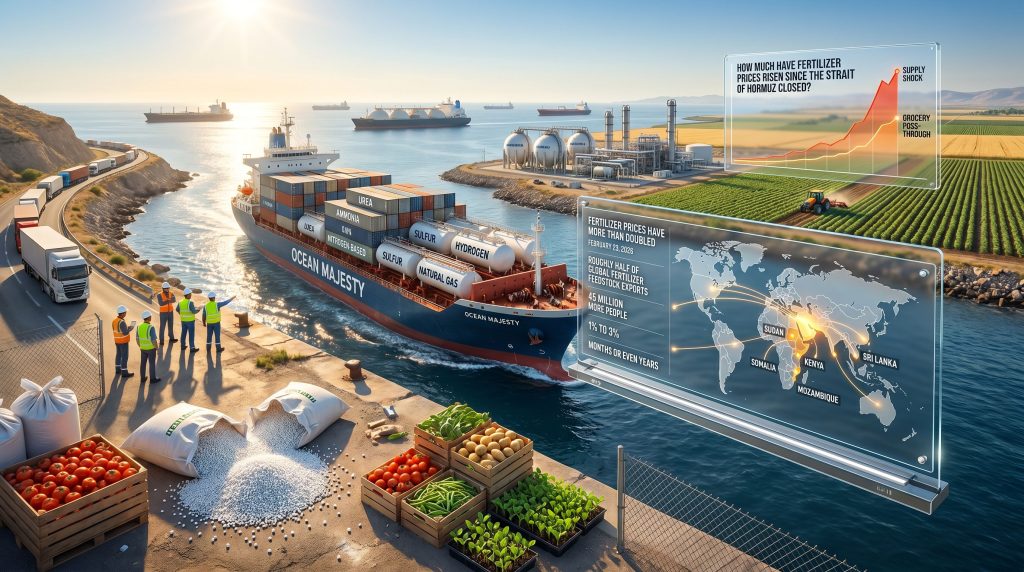
The short answer is clear: fertiliser prices have more than doubled since the Strait of Hormuz closed to nearly all shipping traffic on 28 February 2026. The move has been especially severe because the strait typically handles roughly half of global fertiliser feedstock exports on a normal day, according to The Fertilizer Institute.
That headline figure matters, but buyers should read it carefully. Benchmark or spot prices can jump much faster than local farm input prices. In practice, the full pain depends on spot exposure, long-term contracts, distributor inventories, currency weakness and freight premiums.
Fertiliser shock at a glance
| Metric | Reported figure | Why it matters |
|---|---|---|
| Strait closure date | 28 Feb. 2026 | Marks the start of the supply shock |
| Fertiliser price move | 100%+ | Signals severe upstream inflation |
| Feedstock exposure through Hormuz | ~50% of global exports | Shows chokepoint concentration risk |
| Additional hunger risk estimate | 45 million people | Highlights humanitarian exposure |
| Fresh food price effect | 1% to 3% | Suggests delayed retail inflation |
What doubled prices actually mean
There are several layers of pricing in fertiliser markets:
- Global benchmark prices react first.
- Landed import costs rise further once insurance and rerouting costs are added.
- Distributor prices may lag if older inventory remains in storage.
- Farmgate retail prices often follow later.
- Contract buyers may be partly shielded, while spot buyers feel the squeeze fastest.
Consequently, farmers often absorb the margin hit before consumers notice much movement at the supermarket.
Why Does a Shipping Chokepoint Hit Fertilizer So Hard?
Fertiliser is unusually exposed because it sits at the intersection of energy, chemistry and logistics. Nitrogen fertilisers are not simply transported using energy; they are also made from energy-linked feedstocks, especially natural gas and hydrogen.
This is the hidden mechanism behind the crisis. Maritime security in the Gulf is not just an oil issue. It is also a fertiliser issue and, by extension, a food policy issue. For more context, this aligns with recent reporting on natural gas price trends and how energy costs ripple into industrial inputs.
Key feedstocks and why they matter
| Feedstock or product | Role in the chain | Why disruption matters |
|---|---|---|
| Natural gas | Core feedstock for ammonia | Essential for nitrogen fertiliser production |
| Hydrogen | Input for ammonia synthesis | Often derived from natural gas |
| Ammonia | Building block for many nitrogen products | Directly linked to farm nutrient supply |
| Urea | Major nitrogen fertiliser | Widely used across staple crops |
| Sulphur | Used in processing and blends | Adds cost pressure to crop nutrition programmes |
| Nitrogen intermediates | Inputs into downstream products | Tightness spreads across blended formulations |
Why Hormuz matters more than many buyers realised
The problem is not only geography. It is concentration. When a large share of global fertiliser feedstocks passes through one narrow route, short-term substitution becomes difficult. This wider dependence also mirrors concerns around supply chain concentration.
A useful comparison is crude oil. Oil disruptions attract immediate headlines because fuel prices are visible. Fertiliser disruptions, however, can be broader and longer-lasting because they affect future crop output rather than only current fuel consumption.
Brent crude in related market coverage has traded in roughly the $114 to $120 range, reinforcing inflationary pressure across energy-linked industries. Furthermore, Pakistan’s reported 167% increase in oil import costs since the wider conflict began shows how import-dependent economies are being squeezed from multiple directions.
Which Fertilizers and Farm Inputs Are Most Exposed?
Nitrogen fertilisers face the clearest pressure
The strongest exposure is in nitrogen-based fertilisers, particularly ammonia and urea. These products are tightly linked to natural gas availability and processing capacity. When gas-linked feedstock flows are interrupted, nitrogen pricing can move violently.
A simplified chain helps explain the pressure:
- Feedstock shortage reduces available natural gas.
- Manufacturing disruption limits ammonia output.
- Downstream bottlenecks constrain urea and other products.
- Export disruption raises landed costs.
- Distributor shortages reach local markets.
- Farmers cut application rates or delay purchases.
- Yield risk increases.
Secondary exposure in blends
The pressure does not stop with pure nitrogen products. Blended fertilisers, speciality crop nutrition programmes and micronutrient systems can all become more expensive when nitrogen components spike.
That can affect:
- application timing
- total nutrient rates
- crop choice
- financing needs
- expected yields
Are phosphate and potash affected the same way?
Not to the same degree. Phosphate and potash are less directly tied to Gulf gas feedstocks than nitrogen products. However, they can still be affected through vessel scarcity, insurance premiums, rerouting delays and broader pressure in global commodity markets.
Why Haven’t Grocery Prices Fully Caught Up Yet?
A useful rule of thumb is this: fertiliser prices move first; grocery prices usually respond later.
That lag exists because food inflation is filtered through inventories, crop cycles, wholesale contracts and retail pricing schedules. Existing farm stocks, pre-bought inputs and already-planted acreage can delay the impact for weeks or months.
What the 1% to 3% fresh food projection signals
The International Fresh Produce Association has projected that the fertiliser shock could raise grocery prices for fresh foods by 1% to 3% while also tightening supply. That should be viewed as an early warning rather than a ceiling.
In addition, the International Food Policy Research Institute has outlined broader global fertiliser market impacts tied to conflict-related supply disruptions.
Farmers absorb the first shock
Before shoppers see higher prices, growers typically face:
- margin compression
- delayed planting
- lower application rates
- quality risks
- credit stress
“Farm-level pain often appears before consumer inflation because input decisions are made well in advance of harvest and retail sale.”
This is consistent with public comments from Iowa farmer Andy DeVries, who indicated that long-standing planting schedules become unreliable under sudden fertiliser shocks.
How Are Farmers Changing Planting and Fertilizer Decisions?
The agronomic problem is timing. Fertiliser is not a cost that can always be deferred without consequence. Miss the nutrient window, and even if supply improves later, the crop may not respond in the same way.
Jorge Moreira da Silva of the United Nations has warned that the urgency is tied to planting season already being underway. Therefore, poorer countries and vulnerable households face sharper risks if supply problems persist.
Three likely on-farm responses
- Reduce application rates
- Shift acreage towards less input-intensive crops
- Delay or stagger planting
What those responses can mean
Each response carries trade-offs:
- Lower nutrient use can reduce yields.
- Crop switching can alter food availability.
- Delayed planting can hurt output and quality.
- Smaller harvests can shrink exportable surplus.
This is why fertilizer prices since the Strait of Hormuz closed are becoming a food availability story, not just a cost story. It also matters most in economies with high fertilizer import reliance.
Which Countries Look Most Vulnerable?
The highest-risk countries are generally those with a difficult mix of fertiliser import dependence, limited fiscal capacity, foreign-exchange stress and existing food insecurity. Public reporting has highlighted Sudan, Somalia, Mozambique, Kenya and Sri Lanka as especially exposed.
Country exposure framework
| Country | Import dependence risk | Food insecurity baseline | Currency or import stress | Policy buffer strength |
|---|---|---|---|---|
| Sudan | High | High | High | Low |
| Somalia | High | High | High | Low |
| Mozambique | High | Elevated | Elevated | Limited |
| Kenya | Moderate to high | Elevated | Elevated | Moderate |
| Sri Lanka | High | Elevated | High | Limited |
The U.N.-linked warning that disruption could push 45 million more people into hunger underscores the humanitarian stakes. However, that figure remains a risk estimate rather than a guaranteed outcome.
Even if the Strait Reopens, Why Might Prices Stay High?
Reopening a waterway is not the same as restoring supply. Shipping access can return faster than molecule availability, plant output, financing conditions or vessel scheduling.
Public reporting has noted that even after a durable peace, restoring Gulf gas-linked feedstock supply could take months or even years. In related shipping analysis, global LNG supply trends show that more vessels alone do not remove physical feedstock constraints.
The logistics waterfall after reopening
| Friction point | Why it persists |
|---|---|
| Natural gas recovery | Production may not restart quickly |
| Plant utilisation | Chemical plants need stable inputs |
| Shipping backlogs | Delayed cargoes stack up |
| Insurance premiums | Risk pricing can stay elevated |
| Freight rates | Vessel dislocation raises costs |
| Credit terms | Traders may demand stricter conditions |
| Port congestion | Restart waves can overwhelm systems |
This is also where market psychology matters. Buyers often assume reopening equals normalisation. In practice, physical systems recover in stages.
What Policy Responses Could Help Stabilise Fertilizer Markets?
Near-term actions
- Temporary fertiliser subsidies
- Priority freight handling
- Humanitarian import guarantees
- Pooled procurement
- Targeted support for smallholders
Medium-term risk reduction
- Diversify ammonia and urea sourcing
- Expand regional storage
- Build more resilient import infrastructure
- Include fertiliser reserves in food security planning
Further evidence of cost pressures on growers appears in recent reporting on farm margins and fertiliser squeeze, which links higher input costs with tighter seasonal profitability.
What Does This Mean for Food Inflation and Political Stability?
Food shocks often become politically consequential when they hit staples, strain household budgets and arrive faster than governments can respond.
The pathway usually looks like this:
- Input inflation raises farm costs.
- Reduced fertiliser use weakens yields.
- Smaller harvests tighten supply.
- Higher imports collide with currency stress.
- Retail food inflation erodes affordability.
- Social strain intensifies.
Scenario outlook for the next two crop cycles
| Scenario | What happens | Likely result |
|---|---|---|
| Best case | Transit resumes and feedstock production recovers quickly | Prices ease, but not instantly |
| Base case | Partial reopening with persistent upstream constraints | Elevated costs linger |
| Worst case | Prolonged disruption and nutrient cutbacks | Material yield losses and broader food insecurity |
FAQ: Fertilizer Prices Since the Strait of Hormuz Closed
Have fertiliser prices really doubled since the Strait closed?
Yes. Public reporting indicates that fertiliser prices have more than doubled since 28 February 2026, although local outcomes vary by contract structure, inventory and logistics exposure.
Which fertilisers are most affected?
The greatest pressure is on nitrogen-based fertilisers, especially those linked to ammonia and urea production.
Will food prices rise immediately?
Not necessarily. Retail inflation usually lags because inventories, crop cycles and contracts delay pass-through.
How long could high fertiliser prices last?
Potentially months or even years, particularly if upstream gas production takes time to recover.
Which countries face the biggest risks?
Import-dependent and already fragile food systems, including parts of East Africa and South Asia, appear most exposed.
What Buyers and Policymakers Should Watch Next
For anyone tracking fertilizer prices since the Strait of Hormuz closed, the most important indicators are not just oil headlines. Instead, watch:
- ammonia and urea benchmark prices
- Gulf natural gas production updates
- marine insurance and freight rates
- vessel access and port throughput
- inventory drawdowns at import hubs
- planting progress reports
- subsidy or procurement announcements
- local currency weakness
The central issue is bigger than one commodity spike. Fertilizer prices since the Strait of Hormuz closed reveal how exposed food production remains to concentrated feedstock flows, narrow shipping routes and delayed policy response.
This article is for informational purposes only and should not be treated as investment, legal or policy advice. Forward-looking scenarios are inherently uncertain and depend on conflict developments, shipping conditions, energy supply recovery, weather and government response.
Could the Next Major ASX Discovery Offer a Better Inflation Hedge?
For investors tracking how energy and supply shocks ripple through commodities, Discovery Alert uses its proprietary Discovery IQ model to deliver real-time ASX mineral discovery alerts that turn complex market movements into actionable opportunities. To see how major discoveries have historically generated exceptional returns across volatile market cycles, explore Discovery Alert’s discoveries page and start a 14-day free trial.