July 24, 2026
When Geography Becomes Destiny: The Strait of Hormuz and the Aluminum Market's Hidden Fault Line
Most commodity markets absorb geopolitical shocks through price adjustments and inventory drawdowns. Aluminum in 2026 is different. The Norsk Hydro aluminum supply risks unfolding in the Strait of Hormuz represent something structurally more significant than a temporary price spike. They expose a systemic vulnerability baked into how the global aluminum industry has organised itself over the past two decades: a dangerous concentration of production capacity in one of the world's most geopolitically volatile maritime corridors.
Understanding why this matters requires stepping back from the headlines and examining the underlying architecture of global aluminum supply chains, because the risks are more interconnected, and more asymmetric, than most market participants currently appreciate.
When big ASX news breaks, our subscribers know first
Why the Strait of Hormuz Is the Aluminum Market's Most Critical Chokepoint
The Geography of Risk: What Makes Hormuz Irreplaceable for Metal Flows?
The Strait of Hormuz is a narrow waterway, roughly 33 kilometres wide at its narrowest navigable point, connecting the Persian Gulf to the Gulf of Oman and onward to the Indian Ocean. It is the only maritime exit for Gulf states, meaning there is no alternative shipping lane for vessels carrying cargo in or out of the region. For energy markets, this geography is well understood. For aluminum, it is chronically underappreciated.
What makes the Strait particularly dangerous as a chokepoint for aluminum is that it operates as a dual-direction vulnerability. Gulf-based smelters depend on alumina — the refined bauxite feedstock from which aluminum metal is produced — arriving via maritime freight through Hormuz. At the same time, the finished aluminum produced at those smelters exits through the same narrow passage destined for European and Asian buyers.
A disruption at the Strait therefore compresses both the input supply chain and the output distribution network simultaneously, compounding the market impact in ways that a disruption to a single mine or refinery simply cannot replicate.
A Single Waterway, Multiple Exposure Points: Alumina In, Aluminum Out
The alumina-to-aluminum production cycle is often overlooked in market commentary, but it is critical context here. Producing one tonne of aluminum requires approximately two tonnes of alumina. Gulf smelters do not mine bauxite or refine alumina domestically at scale. They are heavily reliant on seaborne alumina imports, primarily sourced from Australia, Guinea, and Brazil. Every shipment of alumina destined for a Gulf smelter must transit through Hormuz.
If that transit is interrupted, the smelters face a production halt that is not immediately recoverable, even once shipping resumes, because inventory buffers in this industry are structurally thin. This dynamic has broader implications for aluminum and alumina markets globally, where feedstock disruptions can cascade far beyond their immediate origin.
Typical Gulf smelter alumina inventory buffers sit at just 3 to 4 weeks of operating supply, meaning even a relatively short disruption to inbound shipping can trigger cascading production curtailments within a matter of days.
How Much of the World's Aluminum Passes Through Gulf Shipping Lanes?
The scale of Gulf aluminum production is frequently understated in mainstream financial commentary. The figures, however, tell a compelling story:
| Metric | Estimated Scale |
|---|---|
| Gulf smelters' share of global aluminum output | ~10% of world supply |
| Gulf's contribution to European aluminum imports | ~30% |
| Typical Gulf smelter alumina inventory buffer | 3 to 4 weeks |
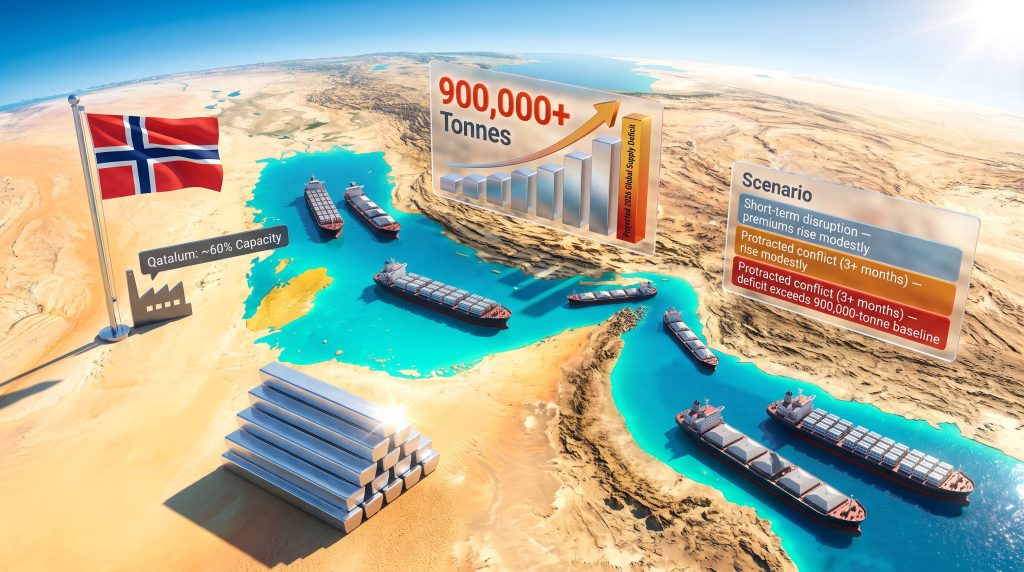
| Projected 2026 global aluminum supply deficit | 900,000+ tonnes |
For European manufacturers in particular, the Gulf is not a marginal supplier. It accounts for roughly 30% of the continent's aluminum imports, meaning any sustained disruption to Gulf output disproportionately tightens the European market relative to Asia or North America.
What Is Norsk Hydro's Actual Exposure to Gulf Supply Disruption?
Understanding Hydro's Strategic Footprint in the Persian Gulf
Norsk Hydro is primarily understood as a Norwegian aluminum producer with substantial European smelting and recycling operations. That framing, while accurate, obscures the company's direct exposure to Persian Gulf production risk. Through its joint venture stake in Qatalum, Hydro has meaningful skin in the game at precisely the geographic location where Hormuz-related disruption bites hardest.
Qatalum: The Joint Venture at the Centre of the Risk Equation
Qatalum is a large-scale aluminum smelter located in Qatar, jointly owned by Norsk Hydro and Qatar Petroleum. It represents one of the largest single smelting facilities in the Middle East. Under normal operating conditions, it is a significant contributor to Hydro's overall production volumes and earnings profile.
The deterioration of conditions through the Strait of Hormuz following the resumption of US-Iran hostilities has directly impacted Qatalum's operations:
- Norsk Hydro holds a 50% stake in the Qatalum joint venture
- Gas supply disruptions linked to the regional conflict reduced Qatalum's output to approximately 60% of nameplate capacity
- Hydro issued a force majeure declaration to its customers, formally signalling that contractual supply obligations could not be fulfilled under prevailing conditions
Force majeure declarations carry significant downstream consequences beyond the immediate production shortfall. They transfer price and availability risk onto buyers, who must then seek spot market supply at elevated premiums, effectively amplifying the price signal generated by the underlying physical disruption.
Why Hydro's Norwegian Assets Are Not the Primary Risk
It is worth drawing a clear distinction between Hydro's Norwegian smelting operations and its Gulf exposure. The Norwegian facilities, powered predominantly by hydroelectric energy and supplied through Atlantic-facing logistics networks, are largely insulated from Hormuz-related disruptions. The risk is geographically specific to the Gulf footprint.
This distinction matters for investors attempting to model Hydro's earnings sensitivity to an escalating or prolonged conflict scenario. Furthermore, the contrast between Hydro's stable Norwegian base and its exposed Gulf assets illustrates the uneven nature of geopolitical risk across even a single company's portfolio.
The Distinction Between Direct Asset Damage and Logistics-Driven Supply Erosion
A common analytical error in commodity market disruption scenarios is focusing exclusively on physical asset damage. In the Hormuz context, the more insidious risk is logistics-driven supply erosion: assets that remain physically intact but operationally compromised because inputs cannot arrive or outputs cannot depart.
Qatalum's reduction to 60% of nameplate capacity is a logistics and gas supply problem, not a physical infrastructure problem. Consequently, restoration depends on geopolitical resolution, not construction or repair timelines — a critical distinction for anyone modelling recovery scenarios.
How Does a Prolonged Hormuz Disruption Translate Into a Deeper Aluminum Deficit?
From 900,000 Tonnes to an Expanding Gap: Modelling the Shortfall
Norsk Hydro's baseline projection of a 900,000-tonne global aluminum supply deficit for 2026 was formulated under conditions of manageable, rather than sustained, disruption. A protracted conflict scenario introduces compounding variables that push the actual shortfall well beyond that baseline estimate. The key mechanisms are:
- Alumina supply compression: With 3 to 4 week inventory buffers, Gulf smelters face production curtailments within weeks of sustained shipping disruptions, removing primary metal output from the market progressively
- Logistics cost escalation: War risk insurance premiums surge during active conflict periods, rerouting costs accumulate as vessels avoid the Strait, and port access restrictions inflate the delivered cost of metal even when physical production continues elsewhere
- Regional premium divergence: European buyers face structurally larger exposure than Asian or North American counterparts, given the Gulf's outsized contribution to regional import volumes
- Demand-side inflexibility: Aluminum is embedded across aerospace, automotive, construction, and packaging supply chains, limiting the capacity for short-term demand destruction to serve as a pressure relief valve
Scenario Modelling: Short-Term Disruption vs. Protracted Conflict
| Scenario | Estimated Market Impact |
|---|---|
| Short-term disruption (resolved within weeks) | Inventory drawdowns absorb impact; premiums rise modestly |
| Medium-term disruption (1 to 3 months) | Alumina shortfalls trigger smelter curtailments; deficit widens materially |
| Protracted conflict (3+ months) | Deficit exceeds 900,000-tonne baseline; European supply crisis accelerates |
The scenario analysis above underscores why Hydro's CEO characterised the trajectory as one where a more extended Gulf situation logically produces tighter global market conditions. The relationship between conflict duration and supply deficit magnitude is not linear — it is exponential, because compounding curtailments across multiple smelters interact with progressively depleted inventory buffers.
How Are Global Producers Responding to the Supply Shock?
China and Indonesia: The Unexpected Supply Offset
One of the more analytically interesting developments during the 2026 disruption period has been the above-forecast aluminum output delivered by China and Indonesia. Both nations increased production beyond prevailing expectations, partially cushioning the global supply gap that Gulf curtailments created. However, this is not a neutral development for long-term market structure.
It accelerates a pre-existing trend: the migration of marginal aluminum supply capacity toward Asian producers, at the expense of Gulf-based facilities. Understanding China industrial demand dynamics is increasingly essential to modelling where this production migration leads over the medium term.
For European buyers, Asian-sourced aluminum involves longer shipping distances, higher freight costs, and exposure to different geopolitical risk profiles than Gulf supply. The substitution is real, but it is not frictionless.
Norsk Hydro's Recycling Operations: A Domestic Hedge Against Import Dependency
Perhaps the most strategically significant data point in Hydro's Q2 2026 results is the performance of its recycling segment. While the Qatalum joint venture faced severe curtailments, Hydro's European recycling operations moved in the opposite direction:
- Recycling segment output increased 15% quarter-over-quarter, reaching approximately 225,000 tonnes in Q2 2026
- Rising product prices driven by tightening overall supply conditions boosted profitability in this segment materially
- Recycled aluminum production requires significantly less energy than primary smelting and sources material from collected scrap rather than imported raw materials, making it structurally immune to Hormuz-related logistics disruptions
This dynamic illustrates a broader truth about secondary aluminum production that deserves more attention: in a world of increasing geopolitical supply chain fragility, recycling capacity functions as a strategic hedge, not merely an environmental initiative. The green metals pricing environment has also supported this segment, with sustainability-linked premiums providing an additional earnings tailwind.
European Manufacturers Drawing Down Port Inventories
European industrial buyers entered 2026 with relatively healthy port inventories, partly a consequence of front-loading purchases ahead of the introduction of a new carbon border adjustment mechanism on aluminum imports. That pre-positioning created a buffer that has helped absorb the immediate shock of Gulf supply disruption without triggering outright shortages.
However, the buffer is being drawn down. The critical variable for the remainder of 2026 is whether incoming cargo volumes — from Asian producers and rerouted Gulf supply — can replenish depleted European port inventories before the existing cushion is exhausted. As Hydro's CEO framed it, this represents the defining supply test for the second half of the year.
Market Watch: London Metal Exchange aluminum prices have tracked conflict escalation closely, rising as Gulf tensions intensified and retreating during brief periods of diplomatic de-escalation. This price behaviour confirms the market is actively pricing conflict duration as the primary demand variable in the short term.
What Does This Mean for Aluminum Prices and Market Structure in H2 2026?
LME Aluminum Price Dynamics: Conflict as a Pricing Variable
The LME aluminum price response to the Hormuz disruption has been notably reactive to news flow rather than fundamental supply data alone. This reflects a well-documented characteristic of commodity markets during geopolitical crises: sentiment and risk perception can temporarily displace physical fundamentals as the primary price driver.
The implication for traders and industrial buyers is that the market is likely to remain highly volatile through H2 2026, with large moves on geopolitical headlines that may or may not be sustained by underlying physical tightness. In addition, the broader aluminium tariff impact from US trade policy continues to layer further complexity onto an already stressed pricing environment.
Regional Premium Divergence: Europe vs. Asia vs. North America
One of the less-discussed structural consequences of the Hormuz disruption is the widening of regional aluminum premiums. European buyers are paying materially higher premiums over LME benchmark prices than their Asian or North American counterparts, reflecting the region's disproportionate exposure to Gulf supply disruption.
This premium divergence creates arbitrage incentives for producers to redirect supply toward Europe, but logistics constraints and existing contractual obligations limit how quickly that rebalancing can occur in practice.
The Carbon Levy Wildcard: How EU Import Policy Intersects With Supply Risk
The timing of the EU's carbon border adjustment mechanism for aluminum imports has intersected awkwardly with the Hormuz disruption. The levy incentivised European buyers to accelerate purchases ahead of implementation, creating the inventory cushion now being consumed. Future replenishment, however, will occur under the new, higher cost structure imposed by the levy, meaning European aluminum buyers face a structural cost step-up on top of the supply risk premium generated by Gulf disruption.
The next major ASX story will hit our subscribers first
What Are the Broader Strategic Implications for Aluminum Supply Chain Resilience?
Why Gulf Smelter Concentration Is a Systemic Vulnerability
The 2026 Hormuz disruption has made explicit a systemic risk that the aluminum industry has been accumulating for years. The Gulf's appeal as an aluminum production hub — abundant natural gas for smelting energy, stable long-term investment environments, and proximity to growing Asian and European markets — has driven a concentration of capacity that now constitutes a single point of failure for roughly one-tenth of global supply.
Key structural vulnerabilities the 2026 disruption has exposed:
- Geographic concentration risk driven by approximately 10% of global aluminum production clustering in a geopolitically sensitive region with a single maritime egress point
- Thin inventory buffers providing just 3 to 4 weeks of alumina coverage, creating a narrow window between shipping disruption and production curtailment
- Dual-direction logistics dependency with a single chokepoint controlling both input alumina inflows and output metal exports for a major producing region
- Demand-side inflexibility across aerospace, automotive, construction, and packaging applications, eliminating short-term demand destruction as a meaningful supply-demand rebalancing mechanism
How Producers Are Rethinking Raw Material Security
The Hormuz disruption is accelerating conversations within the aluminum industry about alumina supply diversification and inventory policy. The 3 to 4 week buffer that was standard practice before 2026 is now being scrutinised as structurally inadequate for a world in which geopolitical disruption to maritime shipping lanes is an increasingly plausible scenario rather than a tail risk.
Producers with access to domestically sourced or Atlantic-corridor alumina supply are reassessing the strategic value of that positioning. For context on how leading producers are structured to respond, reviewing the top aluminium companies and their respective supply chain configurations provides useful comparative insight.
The Role of Recycling and Secondary Production as Strategic Buffers
Hydro's recycling performance in Q2 2026 provides a compelling case study in supply chain resilience. Secondary aluminum production, drawing on scrap material collected domestically within consuming regions, is insulated from maritime logistics disruptions by design.
As the Hormuz episode demonstrates, this insulation translates directly into relative earnings stability when primary supply chains are compromised. The London Metal Exchange has noted increased hedging activity in aluminum contracts as industrial buyers seek greater price certainty in the current environment. The strategic case for expanding secondary production capacity in Europe and North America has never been more practically evident.
Frequently Asked Questions: Norsk Hydro, Hormuz, and the Aluminum Supply Crisis
What Is the Strait of Hormuz and Why Does It Matter for Aluminum?
The Strait of Hormuz is a narrow maritime passage connecting the Persian Gulf to the Gulf of Oman and the broader Indian Ocean. For aluminum markets, it functions as the primary shipping corridor for both alumina imports into Gulf smelters and finished aluminum exports from the region, making it a dual-direction chokepoint for approximately 10% of global aluminum supply.
How Much Aluminum Does the Gulf Region Produce?
Gulf-based smelters collectively account for approximately one-tenth of global aluminum output. The region carries particular weight for European buyers, supplying an estimated 30% of the continent's aluminum imports, making any sustained disruption to Gulf production disproportionately impactful on European industrial supply chains.
What Is the Qatalum Joint Venture and Why Is It Important?
Qatalum is a 50%-owned joint venture between Norsk Hydro and Qatar Petroleum, operating one of the largest aluminum smelters in the Middle East. Gas supply disruptions tied to the broader regional conflict reduced Qatalum's output to approximately 60% of nameplate capacity, prompting Hydro to issue force majeure notices to customers, shifting supply risk onto buyers and accelerating spot market premium widening.
How Large Is the Projected Aluminum Supply Deficit for 2026?
Norsk Hydro's baseline projection for 2026 places the global aluminum supply shortfall at approximately 900,000 tonnes. This figure represents a manageable disruption scenario, not a protracted conflict outcome. A sustained Hormuz disruption lasting beyond three months is widely expected to push the actual deficit materially beyond this baseline.
What Is Norsk Hydro's Financial Performance Amid the Supply Crisis?
Despite significant supply chain headwinds from the Qatalum curtailments, Norsk Hydro reported adjusted earnings before items of 8.92 billion Norwegian kroner (approximately $929 million USD) for Q2 2026, a 15% increase year-over-year that exceeded analyst consensus estimates. According to Norsk Hydro's investor relations, the outperformance was driven by higher product prices across the aluminium market and stronger-than-expected recycling segment results.
How Are European Aluminum Buyers Managing the Supply Disruption?
European manufacturers are currently drawing down pre-built port inventories accumulated ahead of the new carbon border adjustment on aluminum imports. The sustainability of this buffer through H2 2026 depends critically on whether incoming cargo volumes from Asian producers and rerouted supply routes can replenish stockpiles before they are depleted.
Key Takeaways: The Aluminum Market's Hormuz Stress Test
| Factor | Current Status | Risk Level |
|---|---|---|
| Gulf smelter output | ~10% of global supply disrupted | High |
| Qatalum capacity utilisation | ~60% of nameplate capacity | High |
| European import buffer | Inventory drawdown underway | Medium to High |
| Global supply deficit projection | 900,000+ tonnes (expandable) | High |
| LME price trajectory | Rising with conflict escalation | Medium |
| Recycling and secondary supply offset | +15% quarter-over-quarter at Hydro | Mitigating |
| Asian producer offset (China and Indonesia) | Above-forecast output | Partially Mitigating |
Disclaimer: This article contains forward-looking analysis, scenario modelling, and market projections that involve inherent uncertainty. Commodity market conditions, geopolitical developments, and company financial performance can change rapidly. Nothing in this article constitutes financial or investment advice. Readers should conduct their own research and consult qualified financial advisers before making investment decisions.
Want to Stay Ahead of Major Commodity Supply Disruptions Before They Move Markets?
Discovery Alert's proprietary Discovery IQ model delivers real-time alerts on significant ASX mineral discoveries — cutting through complex market data to surface actionable opportunities the moment they emerge on the ASX, whether in aluminium, energy metals, or the commodities reshaping global supply chains. Explore historic discoveries and the returns they generated, then begin your 14-day free trial at Discovery Alert to position yourself ahead of the market.