July 24, 2026
When Pipelines Meet Politics: Understanding Why Oil Supply Signals Have Decoupled From Reality
There is a quiet but consequential divergence unfolding at the centre of global oil markets. For decades, OPEC+ production quota announcements functioned as reliable leading indicators of physical supply. When the group raised targets, more barrels eventually arrived. When it cut, markets tightened. That relationship, never perfect, has now fractured so completely that the phenomenon of OPEC+ raise output even as members can't pump it has become one of the defining contradictions of 2026 energy markets.
Understanding why this has happened, and what it means for prices, trade flows, and downstream consumers, requires looking past the announcement and into the physical infrastructure that moves crude from wellhead to refinery. The story is ultimately about chokepoints, conflict, and the limits of policy coordination when geography becomes the binding constraint.
When big ASX news breaks, our subscribers know first
The Architecture of an OPEC+ Quota and Why It Has Always Been Partly Symbolic
OPEC+ production quotas are not legally binding production mandates. They function as coordinated voluntary targets, setting the level at which member nations agree to cap or direct their output as part of a collective supply management framework. The distinction matters enormously because compliance is always self-enforced, compensation for overproduction is negotiated rather than automatic, and the gap between target and delivery has varied considerably across different market environments.
Historically, the most common form of non-compliance has been overproduction, where members quietly pumped above their assigned ceilings during periods of high prices. What the current environment represents is the inverse: systematic underproduction relative to quota — not because members are voluntarily restraining supply for strategic reasons, but because physical infrastructure constraints prevent them from reaching their assigned targets regardless of intent.
This inversion is important for how markets should interpret OPEC+ decisions. When the group approves an increase, the correct analytical question is no longer simply whether members want to produce more, but whether they are structurally capable of doing so given current export route availability. Furthermore, OPEC's market influence has historically rested on the assumption that quota decisions translate into real-world supply movements — an assumption the current environment is aggressively testing.
The Numbers Behind the Shortfall: Quotas Versus Actual Output in 2026
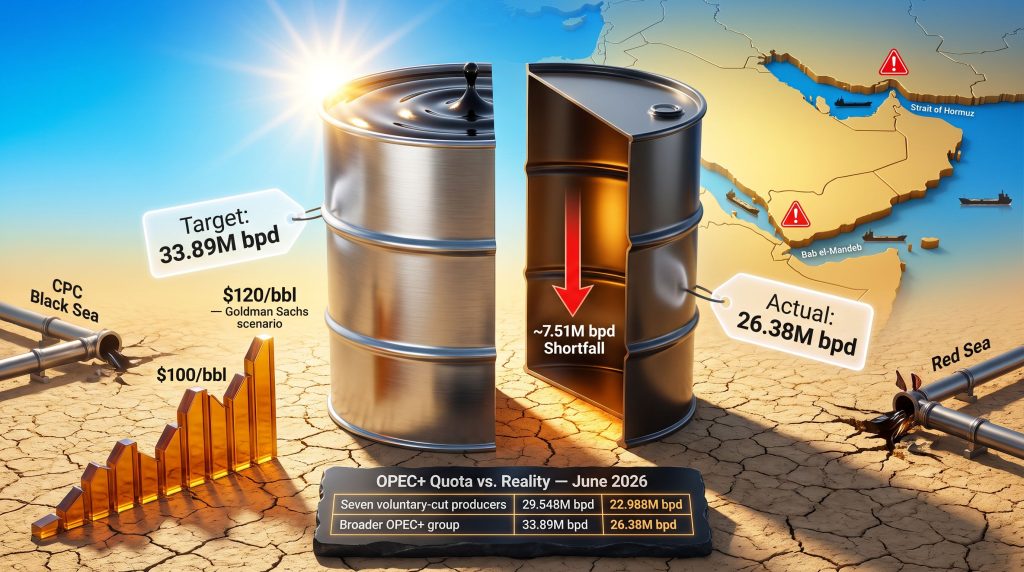
The production data for June 2026 illustrates just how wide the divergence has become.
| Metric | Target (bpd) | Actual Output (bpd) | Shortfall (bpd) |
|---|---|---|---|
| Seven voluntary-cut producers | 29.548 million | 22.988 million | ~6.56 million |
| Broader OPEC+ group | 33.89 million | 26.38 million | ~7.51 million |
| Full OPEC group (all members) | ~43 million (pre-war) | 36.28 million | ~6.72 million |
The broader OPEC+ group was producing roughly 7.51 million bpd below its collective target in June 2026. For context, that shortfall alone exceeds the total oil output of every OPEC member except Saudi Arabia and Iraq. The group's full membership was producing approximately 36.28 million bpd, compared to the roughly 43 million bpd it was delivering before the conflict escalation in February 2026.
This is not a marginal gap. It represents a structural dislocation in the relationship between assigned capacity and delivered supply that is without modern precedent in OPEC+ history.
The 188,000 bpd September Decision: What It Does and Does Not Mean
Eight core producers — including Saudi Arabia, Russia, Iraq, Kuwait, Algeria, Kazakhstan, Oman, and the UAE — convened on August 2 to approve a 188,000 bpd increase in their collective September production target. This mirrors the identical increases approved for June, July, and August, forming a four-month sequence of quota restoration.
Since April 2026, the group has cumulatively restored approximately 600,000 bpd in quota across its seven core voluntary-cut members. This rollback is proceeding against the backdrop of the 2023 voluntary cut agreement totalling 1.65 million bpd, now adjusted for the UAE's exit from OPEC earlier in 2026. According to reporting from Al Jazeera, OPEC countries have committed to expanding monthly production, however the physical reality on the ground tells a far more complex story.
What the quota restoration does not do is move an equivalent volume of physical crude to market. The September increase is better understood through three distinct functions:
- Forward guidance: It communicates that these volumes will flow once export infrastructure stabilises, preventing markets from pricing in permanent supply loss.
- Alliance maintenance: Continuing the structured unwinding of 2023 cuts keeps internal coordination mechanisms intact, preserving OPEC+'s institutional coherence for when conditions normalise.
- Price signal management: Announcing higher targets provides a partial offset to runaway price momentum, reducing the risk that Brent's trajectory triggers demand destruction or coordinated strategic reserve releases by consuming nations.
None of these functions requires physical barrels to be delivered. The quota increase is, in the current environment, primarily a communications instrument rather than a supply commitment.
Country-by-Country: The Infrastructure Crises Preventing Delivery
Saudi Arabia: The Dual-Route Vulnerability
Saudi Arabia holds considerable upstream production capacity, but accessing global markets requires navigating two shipping corridors that are simultaneously under threat. Following the escalation of Strait of Hormuz disruptions after February 2026, the Kingdom redirected significant crude export volumes toward Red Sea routing through the Bab el-Mandeb Strait. That alternative corridor is now under direct pressure.
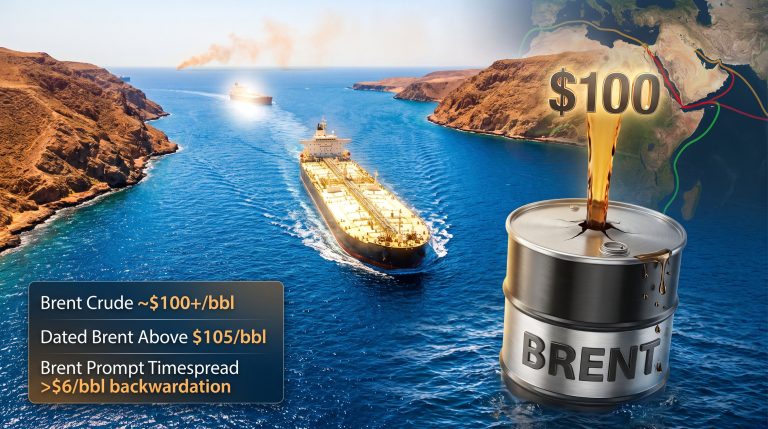
Houthi forces declared a naval blockade on Saudi Arabia and, within a 48-hour window, targeted two Saudi-linked oil tankers in the Red Sea. The attacks triggered Brent crude crossing $100 per barrel, a psychologically and technically significant threshold. The simultaneous degradation of both primary and secondary export routes creates a supply delivery problem that no quota adjustment can resolve.
Iraq: Structural Bottlenecks Predating the Conflict
Iraq's persistent underperformance relative to quota is not a new phenomenon created by the current conflict. Limited pipeline capacity, constrained port throughput at Basra, and inadequate export terminal infrastructure have functioned as a structural ceiling on Iraqi production growth for years. The current environment has worsened these constraints but did not create them. Consequently, the broader oil market disruption affecting global supply chains has compounded Iraq's pre-existing delivery challenges.
Kazakhstan: Non-Gulf Member, Front-Line Exposure
One of the less-discussed consequences of the broader conflict is how it has exposed non-Gulf OPEC+ members to logistics disruptions far from the Strait of Hormuz. Ukrainian drone strikes targeting the Caspian Pipeline Consortium (CPC) terminal on the Black Sea forced tanker loading suspensions at the facility, which handles the bulk of Kazakhstan's crude exports.
With no loading occurring at the terminal, upstream operators faced the choice of either storing crude with limited storage capacity or curtailing production. Many chose curtailment. This dynamic illustrates an underappreciated aspect of the current supply crisis: the conflict's impact on oil infrastructure has radiated well beyond the Gulf, reaching Central Asian export infrastructure through a completely separate military theatre.
Russia: Refinery Hits and Sanctions Complexity
Sustained Ukrainian drone campaigns against Russian refinery infrastructure have reduced domestic processing capacity, with knock-on effects on the volume of crude available for export. Russia's position as a major OPEC+ quota holder operating under Western sanctions adds a layer of opacity to its actual production and export data, making precise assessment of its real shortfall difficult.
Algeria and Oman: Natural Ceiling Constraints
Both nations are effectively producing at or near their natural capacity limits regardless of what quota targets are assigned to them. Chronic underinvestment in upstream development, combined with compensation cut obligations for periods of past overproduction, means their effective output headroom is negligible.
The Dual-Chokepoint Problem: Why This Situation Is Genuinely Unprecedented
Under normal conditions, approximately 20% of global seaborne oil trade transits the Strait of Hormuz. This single waterway represents the most significant physical chokepoint in the global energy system — something that energy security analysts have spent decades modelling as the primary tail risk in oil supply scenarios.
What current conditions present is a scenario that those models rarely captured: simultaneous sustained pressure on both Hormuz and the Bab el-Mandeb Strait. The oil price geopolitics driving this dual-chokepoint reality are without clear historical precedent in the modern OPEC era.
Risk Scenario: If both the Strait of Hormuz and the Bab el-Mandeb Strait face sustained disruption simultaneously, effective Gulf crude export capacity could be reduced by volumes far exceeding any quota increase OPEC+ could credibly announce in response.
The Bab el-Mandeb was never intended to absorb the full weight of Gulf crude exports. Adding active Houthi interdiction to that situation creates a scenario where the fallback route is nearly as constrained as the primary one. Higher insurance costs translate directly into higher landed crude costs for importing refiners, even for barrels that do successfully reach their destination.
The next major ASX story will hit our subscribers first
Goldman Sachs, the $120 Scenario, and the Price Discovery Challenge
Goldman Sachs has flagged $120 per barrel as a plausible Brent outcome if Middle East conflict conditions persist. With Brent having already crossed $100 following the Houthi tanker attacks, the pathway to that scenario requires a relatively modest further deterioration in export route conditions rather than a dramatic escalation.
This price sensitivity is itself a function of the quota-versus-reality gap. When physical supply is already running 7.5 million bpd below target, there is essentially no buffer capacity within the OPEC+ system to offset additional disruptions. Traditional oil market analysis relied heavily on OPEC spare capacity as the system's shock absorber — however, that capacity cannot be monetised without functioning export routes.
In addition, the trade war oil pressures already weighing on demand forecasts are complicating price discovery further, as markets simultaneously grapple with supply-side constraints and demand-side uncertainty.
The Downstream Reality: How the Shortfall Reaches Consumers
The upstream shortfall is propagating through the entire supply chain in ways that are now visibly affecting consumers and businesses across multiple continents.
- The IMF has flagged elevated oil prices as a material risk to India's GDP growth trajectory, noting that import-dependent economies face compounding fiscal pressure as crude costs rise.
- Japan's import bill has reached multi-decade highs, with yen weakness amplifying the already elevated dollar-denominated cost of crude purchases.
- Ryanair reported a 36% profit decline attributable to unhedged jet fuel cost exposure, illustrating how rapidly rising energy costs bypass the financial hedges that airlines typically deploy.
- Pakistan has been actively seeking alternative crude sources as Hormuz and Red Sea risks simultaneously constrain its access to Gulf supply.
- U.S. refinery utilisation has reached 96.2%, reflecting the tightness of global fuel markets and the pressure on domestic processing capacity.
- India's refining margins have surged, with a projected jump in fuel exports for July as the country's refining complex capitalises on the downstream tightness.
The global oil price shock is not confined to producing nations — it is radiating through import-dependent economies in ways that are reshaping fiscal planning across multiple governments simultaneously.
The Compensation Cut Mechanism: A Hidden Drag on Effective Output
One technical aspect of OPEC+ quota management that rarely receives adequate coverage is the compensation cut mechanism. When a member state produces above its assigned quota, it is expected to offset that excess by cutting output below quota in a subsequent period. This mechanism creates a situation where some members with physical delivery capacity are nonetheless obligated to restrain output.
The practical effect in the current environment is that quota increases and compensation obligations are partially offsetting each other for certain members. A country receiving a higher quota in September may simultaneously be required to apply a compensation cut for earlier overproduction, meaning its net effective target is lower than the headline increase implies. As noted in coverage from Reuters, the interplay between compensation obligations and new quota allocations makes interpreting headline OPEC+ announcements considerably more complex than they appear.
This makes the published 188,000 bpd increase somewhat misleading as a net supply addition even before accounting for physical export constraints. The true net incremental supply signal embedded in the September decision is materially smaller than the headline figure suggests.
What Normalisation Would Actually Mean for Prices
The scenario that oil market participants should be modelling is not continued escalation alone, but what happens if Hormuz and Red Sea disruptions ease. Saudi Arabia's available upstream capacity suggests it could ramp exports meaningfully once export routes stabilise. The latent supply overhang sitting behind the current chokepoints represents a significant potential price correction catalyst.
A rapid restoration of Gulf export capacity could introduce several million barrels per day of supply into a market that has priced for continued scarcity. Traders holding long positions at current levels carry material reversal risk if diplomatic or military developments shift the access calculus for either Hormuz or Bab el-Mandeb. This two-directional risk represents the defining investment uncertainty in crude markets for the remainder of 2026.
Frequently Asked Questions: OPEC+ Output Hikes and the Production Gap
Why is OPEC+ raising production targets if members cannot actually pump more oil?
Quota increases serve as forward guidance and market management tools. They communicate the group's intention to restore supply once export disruptions ease, help moderate price momentum, and maintain internal coordination mechanisms even when physical delivery falls short of announced targets. The reality that OPEC+ continues to raise output even as members can't pump it reflects this communications-first approach to quota management.
How large is the gap between OPEC+ quotas and actual production right now?
As of June 2026, the broader OPEC+ group was producing approximately 26.38 million bpd against a target of 33.89 million bpd, representing a shortfall of roughly 7.51 million bpd. For the seven core voluntary-cut producers specifically, the gap was approximately 6.56 million bpd.
What is causing OPEC+ members to fall short of their production targets?
Primary drivers include Strait of Hormuz shipping disruptions following the Iran conflict escalation in February 2026, Houthi attacks on Red Sea tanker traffic, Ukrainian drone strikes on the Caspian Pipeline Consortium terminal and Russian refinery infrastructure, and longstanding structural export bottlenecks in countries such as Iraq.
Could the production gap close quickly if conditions improve?
Saudi Arabia retains upstream capacity that could translate into higher exports if routes normalise. However, structural constraints affecting Iraq, Algeria, and Oman — combined with compensation cut obligations across multiple members — mean the broader group could not close the full shortfall rapidly even under favourable conditions.
What does the 188,000 bpd quota increase actually mean for oil prices?
On its own, it adds minimal physical supply to the market given current infrastructure constraints. Its primary function is as a forward supply signal. Prices remain far more sensitive to export route developments around Hormuz and Bab el-Mandeb than to headline quota numbers.
Key Takeaways for Understanding OPEC+ Output Dynamics
- OPEC+ has approved four consecutive quota increases totalling approximately 600,000 bpd since April 2026, with a September increase of 188,000 bpd forming the latest instalment.
- Actual group production in June 2026 was running roughly 7.5 million bpd below collective target — the largest sustained quota-to-output gap in the alliance's modern history.
- The binding constraint is not upstream capacity for all producers, but export route availability, with both Hormuz and the Bab el-Mandeb under simultaneous pressure.
- Brent crude has crossed $100 per barrel, with Goldman Sachs modelling a potential pathway to $120 per barrel if conflict conditions persist.
- The compensation cut mechanism means the net supply impact of quota increases is smaller than published headline figures imply.
- Quota increases currently function primarily as market communications instruments, not as near-term supply commitments.
- Any normalisation of Gulf export routes would introduce a substantial latent supply overhang into a market priced for ongoing scarcity, creating significant downside price risk alongside the current upside scenario.
This article contains forward-looking analysis and references to market forecasts including Goldman Sachs price projections. These represent analytical scenarios, not guaranteed outcomes. Oil market conditions are subject to rapid change based on geopolitical developments, and nothing in this article should be construed as investment advice.
Want to Stay Ahead of the Next Major Commodity Discovery Amid Market Volatility?
While geopolitical forces reshape global energy supply chains, Discovery Alert's proprietary Discovery IQ model scans ASX announcements in real time, instantly identifying significant mineral discoveries across more than 30 commodities — translating complex data into actionable opportunities for investors at every level. Begin your 14-day free trial at Discovery Alert today and position yourself ahead of the market before the next major discovery is announced.