June 18, 2026
Understanding Financial Derivatives in Battery Materials Markets
Battery materials markets have experienced unprecedented volatility across supply chains, creating urgent demand for sophisticated risk management tools. Modern lithium processing operations face complex exposure profiles spanning procurement timing, inventory valuation, and forward sales commitments. These operational realities drive institutional adoption of standardized derivative instruments designed specifically for battery-grade chemical specifications.
The transformation from bilateral contract negotiations to exchange-traded risk management reflects structural changes in how battery manufacturers approach working capital optimization. Traditional spot market purchasing exposes manufacturers to significant margin compression during price appreciation cycles, while inventory holding during price decline periods creates substantial balance sheet risk.
Financial innovation in commodity markets typically follows predictable adoption patterns, beginning with agricultural products, progressing through base metals, and eventually encompassing specialised industrial chemicals. The CME lithium hydroxide futures contract represents the latest evolution in this progression, addressing specific hedging requirements unique to battery supply chains.
When big ASX news breaks, our subscribers know first
Contract Architecture and Settlement Infrastructure
Technical Specifications and Trading Mechanics
The CME lithium hydroxide futures contract operates on standardised specifications designed to match industry procurement requirements. Each contract represents 1,000 kilograms (1 metric tonne) of battery-grade lithium hydroxide monohydrate, with minimum purity specifications of 56.5% LiOH content. This specification aligns with cathode manufacturing requirements for high-energy-density applications in electric vehicles and utility-scale battery energy storage systems.
Price movements occur in increments of $0.01 per kilogram, creating a contract value sensitivity of $10 per price tick (1,000 kg × $0.01). This granular pricing structure enables precise position sizing for manufacturers with varying consumption requirements, from boutique battery producers requiring 50-100 tonnes monthly to large-scale automotive suppliers consuming 5,000+ tonnes per month.
Trading occurs exclusively through the CME Globex electronic platform, providing 24-hour market access across global time zones. This continuous trading capability proves essential for supply chain managers operating across Asia-Pacific manufacturing centers, European processing facilities, and North American battery production sites.
Settlement and Price Discovery Framework
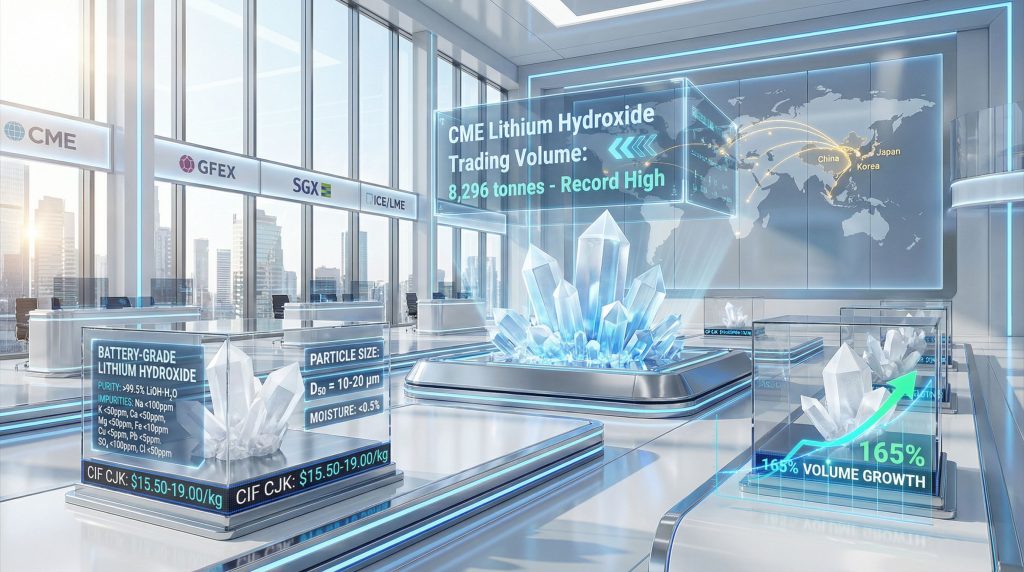
Cash settlement eliminates physical delivery logistics, focusing purely on financial risk transfer rather than commodity logistics management. Settlement prices derive from Fastmarkets' CIF China, Japan & Korea (CJK) assessment, which represents the most liquid regional market for battery-grade lithium hydroxide consumption.
The Fastmarkets assessment methodology employs daily price discovery through validated transaction data, supplier quotations, and buyer indications across the CJK region. This approach captures actual market conditions rather than theoretical pricing models, ensuring settlement prices reflect genuine commercial activity.
Daily settlement calculations utilise arithmetic averages of Fastmarkets' CJK assessments, providing transparent and reproducible price determination for all contract expirations. This methodology eliminates settlement disputes and enables predictable cash flow calculations for hedging strategies.
Record Trading Volume Analysis and Market Maturation
Liquidity Transformation Metrics
Trading volume evolution demonstrates dramatic institutional adoption acceleration. The 8,296-tonne weekly volume achieved in January 2026 represents a 165% increase from the 2,400-tonne quarterly baseline established in Q1 2023, compressed into a single week timeframe.
| Period | Volume (Tonnes) | Growth Rate | Market Development Stage |
|---|---|---|---|
| Q1 2023 | 2,400 | Baseline | Initial institutional testing |
| February 2025 | 6,366 | 165% increase | Adoption acceleration phase |
| January 2026 | 8,296 | 30% sequential | Mature liquidity establishment |
This progression illustrates market participants transitioning from experimental hedging programmes to systematic risk management integration. Monthly volumes that previously represented strong performance benchmarks now occur within single-week trading periods, indicating fundamental shifts in institutional behaviour.
Institutional Participation Expansion
Market development patterns suggest diversified participant growth across producer hedging, consumer procurement risk management, and financial investment strategies. The 30% volume increase between February 2025 and January 2026 indicates consistent month-over-month growth rather than episodic speculation.
Daily volume peaks of 1,988 lots (January 5) and 1,997 lots (January 7) represent the third- and fourth-highest single-day activity levels since contract inception in 2021. These sustained high-volume periods demonstrate market depth sufficient to absorb large institutional positions without excessive price impact.
According to market development analysis from Fastmarkets, trading patterns that previously required monthly timeframes for completion now occur within weekly cycles, reflecting enhanced liquidity provision and reduced transaction costs for market participants.
Multi-Exchange Ecosystem and Global Market Integration
Comparative Exchange Infrastructure
Multiple exchanges now offer lithium-based derivative products, creating a global ecosystem for battery materials risk management. Each platform provides distinct advantages for different participant categories and regional preferences.
| Exchange | Contract Focus | Settlement Basis | Regional Advantage | Launch Timeline |
|---|---|---|---|---|
| CME | Lithium Hydroxide | Fastmarkets CJK | North American access | 2021 |
| GFEX | Lithium Carbonate | Chinese domestic pricing | Yuan denomination | 2021 |
| SGX | Multiple lithium products | Fastmarkets assessments | Asian time zone | 2022 |
| ICE/LME | Lithium suite | Fastmarkets benchmarks | European access | 2023 |
Cross-Exchange Price Discovery Integration
Market efficiency improvements result from information integration across multiple trading venues. The 23% gain in GFEX lithium carbonate futures (May 2026 contract advancing from 126,560 yuan/tonne to 156,060 yuan/tonne during January 5-12) demonstrates synchronised price discovery between CME lithium hydroxide and Chinese carbonate markets.
This price correlation suggests market participants actively arbitrage between lithium chemical forms and geographic markets, creating integrated global pricing despite different contract specifications and settlement procedures. Furthermore, the Argentina lithium brine insights provide additional context for understanding regional market dynamics that influence these global pricing patterns.
Regional time zone advantages enable continuous price discovery across Asian trading hours (SGX), European sessions (ICE/LME), and North American periods (CME). This 24-hour price formation process reduces overnight gap risk and enables real-time hedging adjustments for global supply chains.
Supply Chain Disruption and Price Volatility Dynamics
Destocking Cycle Impact Mechanisms
Current market conditions reflect supply chain destocking patterns as inventory managers optimise working capital deployment. When battery manufacturers reduce holdings from typical 2-month consumption buffers to 1.5-month levels, they create temporary supply constraints in spot markets while simultaneously reducing storage costs.
This inventory optimisation creates dual pressures: reduced immediate supply availability (supporting higher spot prices) combined with eventual inventory liquidation requirements (creating future supply pressure). The CME lithium hydroxide futures contract enables participants to manage these timing mismatches through strategic position construction.
Working capital carrying costs, typically 8-12% annually for lithium hydroxide inventory, incentivise just-in-time procurement strategies. However, supply chain reliability concerns drive manufacturers toward hedging rather than complete inventory elimination.
Battery Energy Storage System Demand Acceleration
ESS sector demand represents a fundamental shift from automotive-focused lithium consumption toward utility-scale applications. Grid-scale battery projects require different procurement patterns compared to automotive production lines, particularly given the need for sophisticated market volatility hedging strategies.
Key ESS Demand Characteristics:
- Project-based procurement with 12-18 month lead times
- Fixed-price electrical grid contracts requiring cost certainty
- Large-scale installations (100MW/400MWh requiring 3,000-4,000 tonnes lithium hydroxide)
- Seasonal installation patterns driving concentrated demand periods
Utility-scale projects operating under competitive power purchase agreements (PPAs) cannot absorb raw material cost volatility, driving systematic hedging adoption. A typical 100MW battery facility represents $50-75 million in lithium hydroxide exposure at current prices, justifying sophisticated risk management strategies.
Industrial Metals Sentiment Correlation
Lithium price movements increasingly correlate with broader industrial metals sentiment, reflecting institutional investor integration of battery materials into diversified commodity portfolios. The 30-40% lithium hydroxide price appreciation during January 5-12 occurred simultaneously with strength across copper, nickel, and zinc markets.
This correlation suggests lithium has evolved from niche specialty chemical pricing to systematic industrial metals classification. Macro-economic factors including inflation expectations, currency movements, and industrial production forecasts now influence lithium futures positioning alongside traditional metals exposures.
Forward Curve Analysis and Price Structure Dynamics
Contango Structure Implications
The strong contango structure observed in the CME lithium hydroxide futures contract as of January 12, 2026, indicates forward month contracts trading at premiums to nearby delivery periods. This structure typically reflects storage costs, financing expenses, and convenience yield considerations.
Current Price Assessment Snapshot (January 12, 2026):
- Lithium Hydroxide CJK: $15.50-19.00/kg (up from $12.00-15.50/kg January 5)
- Lithium Carbonate CJK: $16.50-20.00/kg (up from $13.00-16.00/kg January 5)
- Weekly appreciation: 30-40% across both products
Contango positioning despite rapid spot appreciation suggests market participants expect current elevated prices to persist through near-term delivery periods, with gradual normalisation anticipated in outer months. This structure reflects supply constraint expectations through Q1-Q2 2026 followed by anticipated relief in Q3-Q4 2026.
Storage Cost and Financing Integration
Lithium hydroxide warehousing typically costs $0.15-0.35/kg monthly in major Asian storage facilities, depending on facility specifications and handling requirements. For contango structures to support physical arbitrage, forward premiums must exceed storage plus financing costs.
Example arbitrage calculation: If March 2026 contracts trade $0.50/kg above January 2026, potential arbitrage profit equals $0.50/kg minus storage costs ($0.30/kg for 2 months) minus financing costs (approximately $0.10-0.15/kg), yielding $0.05-0.10/kg profit potential.
These narrow arbitrage margins indicate efficient price discovery and limited risk-free profit opportunities, suggesting mature market development and active arbitrage participant engagement.
The next major ASX story will hit our subscribers first
Risk Management Applications Across Battery Supply Chains
Procurement Strategy Optimisation Framework
Modern battery manufacturing requires sophisticated approaches to raw material cost management. Traditional fixed-price supplier contracts (typically 3-6 months duration) create basis risk when spot market prices deviate significantly from contracted levels.
Hedging Strategy Categories:
- Volume-weighted average price (VWAP) hedging: Gradual position accumulation matching consumption schedules
- Fixed-price lock strategies: Complete forward requirement coverage at predetermined price levels
- Collar strategies: Downside protection with upside participation through option combinations
- Basis hedging: Regional price differential management between supply sources and consumption locations
Manufacturing Cost Stabilisation Techniques
Battery cathode manufacturers face complex exposure management requirements spanning raw material costs, foreign exchange risk, and finished product pricing commitments. Lithium hydroxide represents 15-25% of total cathode material costs, making price volatility management essential for margin predictability.
A typical automotive battery manufacturer with monthly consumption of 2,000 tonnes lithium hydroxide faces exposure of $30-38 million monthly at current price levels. Even 10% price movements create $3-4 million monthly impact on cost structures, justifying systematic hedging programme implementation.
Consequently, the development of battery-grade lithium refinery facilities in key markets becomes increasingly important for managing supply chain risks.
Investment Portfolio Integration Strategies
Financial institutions increasingly incorporate lithium exposure through futures positions rather than equity investments in mining companies. This approach provides direct commodity exposure without company-specific operational risks, management decisions, or jurisdictional complications.
Portfolio Integration Benefits:
- Direct price exposure without operational leverage
- Liquidity advantages over equity positions during volatile periods
- Precise position sizing capabilities for target exposure levels
- Reduced counterparty risk through exchange clearing mechanisms
Electronic Trading Infrastructure and Market Microstructure
Order Book Dynamics and Liquidity Provision
Market microstructure analysis reveals sophisticated electronic trading capabilities supporting institutional volume requirements. Average daily volumes exceeding 1,500 lots during peak periods indicate sufficient market depth for large-scale hedging programmes without excessive market impact.
Bid-ask spreads typically range $0.05-0.15/kg during normal trading conditions, representing transaction costs of approximately 0.3-0.8% of underlying commodity value. These narrow spreads indicate competitive market making and active arbitrage participation.
Block trading capabilities accommodate institutional requirements for large position establishment without revealing order information to other market participants. This functionality proves essential for battery manufacturers implementing comprehensive hedging programmes spanning multiple contract months.
Algorithm Trading Integration
Systematic trading strategies increasingly influence lithium futures price formation, bringing efficiency improvements observed in traditional commodity markets. Algorithm participation typically reduces bid-ask spreads while increasing quote frequency and market depth.
Price discovery efficiency improvements result from continuous electronic matching and real-time information processing capabilities. The CME Globex platform processes orders in microsecond timeframes, enabling rapid response to changing market conditions and news events.
In addition, advances in Chinese battery recycling breakthrough technologies are creating new dynamics in raw material supply that algorithmic trading systems must incorporate.
Future Market Development Scenarios and Innovation Opportunities
Regulatory Environment Evolution
Financial derivative oversight continues expanding to encompass battery materials markets, reflecting systematic importance for energy transition infrastructure. Position limit discussions and reporting requirements may emerge as open interest grows and institutional participation increases.
Environmental compliance integration represents a frontier development area. Future contract specifications might incorporate carbon footprint assessments, recycling content requirements, or supply chain sustainability metrics alongside chemical purity standards.
Technology Integration Prospects
Anticipated Development Timeline:
- 2026: Enhanced ESG reporting integration and sustainability metrics
- 2027: Cross-commodity basket products combining lithium, nickel, and cobalt exposures
- 2028: Sustainability-linked derivative structures with environmental performance adjustments
- 2029: Carbon footprint-adjusted pricing mechanisms and blockchain settlement systems
Blockchain technology applications could streamline settlement processes while providing immutable transaction records for regulatory compliance and audit requirements. Smart contract automation might reduce operational complexity for systematic hedging programmes.
Market Structure Innovation Pathways
Physical delivery options could emerge for participants requiring actual lithium hydroxide rather than financial settlement, though warehousing infrastructure development would be required. This evolution would parallel development patterns observed in other specialty metals markets.
Cross-commodity derivative products combining lithium exposure with nickel, cobalt, or manganese might address comprehensive battery materials hedging requirements. Such products would enable single-transaction exposure management across multiple raw material inputs.
Strategic Market Positioning and Industry Implications
Institutional Adoption Trajectory Analysis
Record trading volumes signal transition from experimental hedging to systematic risk management adoption across the battery supply chain ecosystem. Monthly volume benchmarks achieved in 2024 now occur within single weeks, indicating fundamental behavioural changes among institutional participants.
The 165% volume growth from Q1 2023 baseline levels demonstrates sustained adoption momentum rather than episodic speculation. This pattern suggests permanent structural changes in how battery materials participants approach price risk management.
Multi-exchange ecosystem development provides comprehensive global coverage for different participant types and regional preferences, eliminating previous limitations around time zone access or settlement currency preferences. For instance, the Australia lithium tax breaks are influencing regional supply dynamics that affect global pricing structures.
Forward-Looking Market Positioning Considerations
Supply chain integration through financial risk management tools enables more sophisticated procurement strategies and inventory optimisation. Manufacturers can now separate physical procurement timing from price risk management decisions, improving operational flexibility.
Regional price convergence through arbitrage mechanisms creates more efficient global pricing, reducing previous market segmentation between Asian, European, and North American markets. This integration benefits all participants through improved price discovery and reduced basis risk.
Technology integration opportunities spanning blockchain settlement, AI-powered forecasting, and sustainability metrics integration will drive next-generation market efficiency improvements. Early adopters of these technological advances may gain competitive advantages in risk management capabilities.
The CME lithium hydroxide futures contract evolution from niche derivative to essential supply chain infrastructure reflects broader energy transition financing requirements. As battery deployment accelerates globally, sophisticated risk management tools become increasingly critical for supply chain stability and investment confidence.
This analysis is based on publicly available market data and industry reporting. Forward-looking statements involve inherent risks and uncertainties. Market participants should conduct independent analysis and consult qualified financial advisors before implementing derivatives strategies.
Want to Stay Ahead of Battery Materials Market Opportunities?
Discovery Alert's proprietary Discovery IQ model provides instant notifications on significant ASX mineral discoveries, including critical battery materials like lithium, cobalt, and nickel. With record trading volumes in derivative markets signalling unprecedented institutional interest in battery materials, subscribers gain rapid insights into actionable exploration opportunities before the broader market recognises their potential. Begin your 30-day free trial today and discover why major mineral discoveries can generate exceptional returns by exploring Discovery Alert's historic success stories.