August 5, 2026
The Diamond Market Has Changed Structurally, and Finsch Mine Paid the Price
The natural diamond industry has spent the better part of three decades operating under a relatively stable demand premise: scarcity drives value, geological provenance commands a premium, and consumer aspiration does the rest. That premise is now under serious strain. Not because demand for luxury goods has evaporated, but because the very concept of diamond scarcity has been industrially disrupted. Lab-grown diamonds, once a novelty segment, now account for a rapidly expanding share of the global market and have systematically compressed prices for smaller, lower-quality natural stones. When that structural price shift collides with currency headwinds and a fragile global macroeconomic backdrop, the result is exactly the kind of financial distress that has forced the Petra Diamonds Finsch mine rescue process into motion.
Understanding why this happened, what it means legally and operationally, and where the situation may head next requires looking well beyond the immediate headlines.
When big ASX news breaks, our subscribers know first
What Business Rescue Actually Means Under South African Law
South African corporate law provides a formal mechanism for financially distressed companies to restructure under supervision, rather than collapse into liquidation. Codified under Chapter 6 of the Companies Act 71 of 2008, business rescue is designed to rehabilitate a company while preserving jobs, honouring creditor obligations where possible, and maintaining continuity of operations during the recovery process.
The formal appointment of a Business Rescue Practitioner (BRP) is central to this framework. Once appointed, the BRP assumes significant authority over the company's affairs, including the power to:
- Renegotiate supplier and creditor contracts
- Propose a restructured payment schedule to lenders
- Suspend or vary legal obligations during the rescue period
- Recommend asset sales, operational mergers, or partial wind-downs
Business rescue in South Africa is explicitly not synonymous with closure. It is a supervised rehabilitation process with defined legal obligations, and its outcome depends entirely on what the practitioner finds viable once the business has been fully assessed.
The critical distinction between business rescue and liquidation matters enormously for employees, creditors, and community stakeholders. Liquidation is terminal. Business rescue is a structured attempt at preservation, even if that preservation ultimately takes a form that looks different from the original operation.
Under the Companies Act, Petra Diamonds must meet ongoing disclosure obligations throughout the rescue process, including material updates to shareholders and relevant stakeholders as developments occur.
Why Finsch Reached This Point: Structural Deterioration, Not a Temporary Dip
The Lab-Grown Effect on Smaller Stone Pricing
The diamond market is not a monolithic commodity. Pricing is segmented by stone size, colour, clarity, and cut, and the performance of these segments has diverged dramatically since approximately 2022. Large, high-quality exceptional stones from historically significant mines have retained much of their value. Smaller commercial stones, however, have suffered sustained price compression.
Lab-grown diamond production has been the primary accelerant of this divergence. Industrial-scale chemical vapour deposition (CVD) and high-pressure high-temperature (HPHT) manufacturing have dramatically reduced the cost of producing gem-quality smaller diamonds. As lab-grown supply expanded, it did not merely add volume to the market. It fundamentally altered the pricing psychology for natural stones in overlapping size and quality categories.
Finsch mine's production profile sits squarely in the segment most affected by this shift. The Northern Cape operation produces predominantly smaller-sized diamonds, a category where structural price recovery in the near term is considered unlikely by Petra's own management. Furthermore, this challenge is not unique to South Africa — global diamond producers across Botswana, Russia, and Canada are grappling with similar structural headwinds.
Currency Exposure Compounding Revenue Pressure
Diamond sales are denominated in US dollars globally. Petra's operational costs, however, are predominantly incurred in South African rand. When the rand strengthens against the dollar, the rand value of each dollar earned on diamond sales shrinks, directly eroding operating margins even if the per-carat dollar price holds steady.
In the current environment, both variables are moving in the wrong direction simultaneously. Per-carat USD prices have declined, and the rand has strengthened, creating a compounding squeeze that disproportionately affects operations like Finsch where per-carat realisations are already at the lower end of the portfolio. The relationship between commodity prices and miners has rarely been more consequential than in this current cycle.
Tender Results That Made the Decision Unavoidable
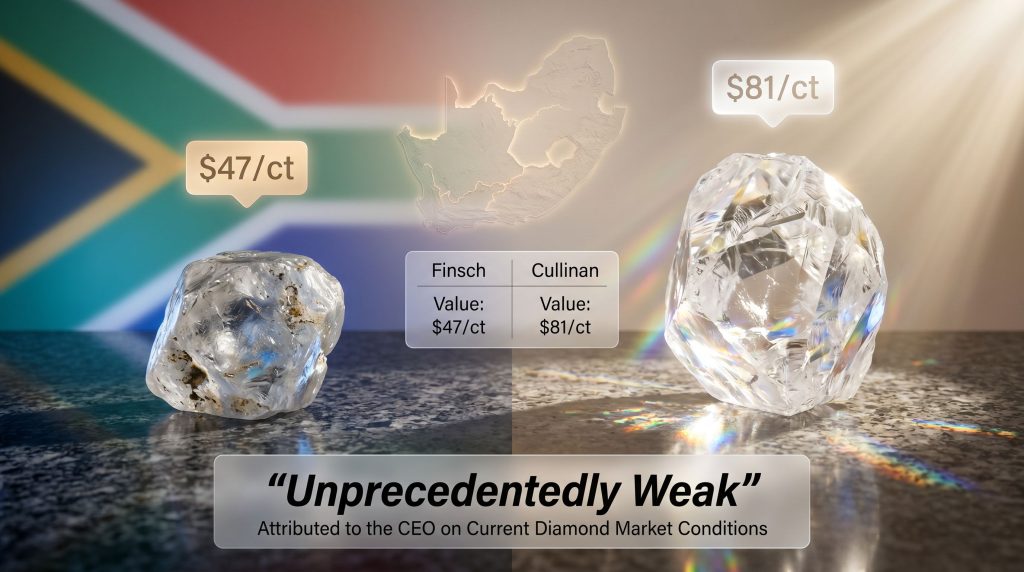
Petra sells its diamonds through a tender process, where buyers competitively bid on parcels of rough stones. Tender results therefore reflect real-time market pricing far more accurately than long-term contracts or spot indices. The April and May 2026 tender results delivered a sharp deterioration in achieved prices.
| Mine | Q3 Average Price | April-May 2026 Average | Change |
|---|---|---|---|
| Cullinan | ~$109/ct | ~$81/ct | -26% |
| Finsch | ~$56/ct | ~$47/ct | -16% |
While Finsch's percentage decline appears smaller in isolation, the absolute price level of $47 per carat against an operation with substantial fixed underground mining costs makes profitable continuation unviable without structural change. Cullinan's decline to $81/ct is significant but the mine's product mix provides considerably more margin headroom.
Consecutive weak tender cycles signal to management that the price weakness is not a one-off event but a sustained market condition requiring a structural operational response.
Immediate Operational Consequences of the Finsch Rescue
Capital Freeze and Resource Reallocation
All capital development expenditure at Finsch has been suspended immediately. In underground diamond mining, this is a consequential decision. Kimberlite pipe mines like Finsch require ongoing development to maintain access to new ore blocks as shallower material is depleted. Suspension of this work does not immediately halt current production but will progressively limit mining flexibility and accessible ore reserves if extended.
Equipment and technical personnel are being redirected toward Cullinan, where capital allocation will focus on high-value mining zones and productivity enhancement programmes.
The Section 189A Labour Process Explained
Alongside the business rescue, Petra has initiated a consultation process under Section 189A of the South African Labour Relations Act. This provision applies specifically to large-scale retrenchments, defined as cases where an employer contemplates dismissing 10 or more employees for operational reasons.
The Section 189A process requires:
- Formal written notice to employees and registered trade unions
- A structured consultation period, typically facilitated by the Commission for Conciliation, Mediation and Arbitration (CCMA)
- Disclosure of the reasons for contemplated retrenchments, the number of roles affected, selection criteria, and severance terms
- A minimum consultation window before any dismissals can proceed
Petra has not disclosed the number of roles at risk. This is consistent with the early stage of a Section 189A process where the consultation has been initiated but its scope has not yet been finalised. The scale of potential retrenchments at Finsch could be material given the size of the operation and the complete suspension of capital activity.
The initiation of Section 189A is a legally required precursor to large-scale job cuts, but it is not a predetermined outcome. The consultation process exists precisely to explore alternatives, including reduced hours, wage adjustments, or redeployment, before retrenchment is confirmed.
Cullinan Mine: The Asset Carrying the Business Forward
Why Type II Diamonds Occupy a Different Market Segment
Not all diamonds are equal in the context of the current market disruption. Cullinan mine is internationally recognised as one of the most significant sources of Type IIa diamonds on earth. These stones are chemically distinct from the more common Type Ia category: they contain virtually no nitrogen impurities, which produces a level of clarity and transparency that allows exceptional optical performance.
Type IIa diamonds represent less than two percent of all diamonds found in nature, and the largest and finest specimens from Cullinan have historically set auction records. The mine's namesake, the Cullinan Diamond discovered in 1905, remains the largest gem-quality rough diamond ever found at 3,106 carats. While day-to-day production does not yield stones of that magnitude, Cullinan's statistical propensity to produce large, high-value exceptional stones gives it a pricing floor that smaller-stone operations cannot replicate.
Critically, the structural price compression driven by lab-grown diamonds has had far less impact on large, exceptional Type II natural stones. Lab-grown production technology at scale still struggles to produce stones above a few carats with commercially viable yields, meaning the very top end of the natural diamond market retains pricing power that the lower end has lost.
Productivity Enhancement and Selective Mining Strategy
Petra is prioritising high-value mining zones within Cullinan and running productivity enhancement trials aimed at increasing the yield of exceptional stones from the most promising ore blocks. The strategy of selective, value-focused mining rather than maximum volume extraction reflects the reality that, in the current market, per-carat value matters far more than tonnage throughput.
| Metric | Cullinan Mine | Finsch Mine |
|---|---|---|
| Primary diamond type | High-value Type IIa | Predominantly smaller commercial stones |
| April-May 2026 avg. price | ~$81/ct | ~$47/ct |
| Capital expenditure status | Active, receiving redirected resources | Fully suspended |
| Business rescue status | Operational | Formal rescue initiated |
| Role in group strategy | Core anchor asset | Under restructuring |
Leadership Transition During a Critical Window
Petra's board announced that Juan Kemp, who served as joint CEO Operations for 18 years, stepped down from his role at the end of May 2026. Vivek Gadodia has assumed full CEO responsibilities and joined the board as an executive director. Leadership consolidation during a restructuring period is an inherently complex signal.
On one hand, it removes the dual-CEO structure and provides clearer executive accountability during a period where decisive decision-making is critical. On the other, any leadership transition during a financial restructuring introduces execution risk as the incoming executive simultaneously manages a rescue process, a labour consultation, and a revised business plan.
Petra's CEO has characterised current market conditions as exceptionally weak, attributing the deterioration to a combination of global macroeconomic factors and heightened geopolitical mining pressures, including instability in the Middle East that has dampened consumer sentiment in key diamond purchasing markets. Management's public view is that a material near-term recovery in smaller-stone pricing is not anticipated.
A revised group business plan is expected by the end of September 2026. The plan will integrate the outcomes of the business rescue process, the Section 189A labour consultation, Cullinan's production performance, and whatever trajectory diamond prices take through mid-2026.
The next major ASX story will hit our subscribers first
The Broader Diamond Industry in Structural Transition
The Petra Diamonds Finsch mine rescue does not exist in isolation. The global natural diamond market has been repricing since 2022 as lab-grown supply scaled aggressively. Producers across Botswana, Russia, Canada, and Southern Africa have all faced the same underlying dynamic: the commercial mid-market for natural diamonds is under structural pressure from synthetic competition.
What makes the current period particularly challenging is the confluence of multiple pressures simultaneously:
- Lab-grown supply expansion reducing pricing power in smaller stone categories
- Weak consumer demand in key markets, including China where post-pandemic luxury recovery has underperformed expectations
- Currency volatility affecting rand-denominated operating cost competitiveness
- Geopolitical disruption dampening discretionary spending in Middle Eastern and Western consumer markets
The causes of mining consolidation are well documented, and Petra's situation illustrates precisely how sustained commodity price weakness and cost structure misalignment eventually force structural action. South Africa's diamond sector carries additional weight in terms of employment and community dependency.
Operations in the Northern Cape, where Finsch is located near Lime Acres, support local economies that have limited economic alternatives. The social consequences of large-scale mine restructurings in South Africa extend well beyond the immediate workforce, affecting contractors, service providers, and dependent households across entire regions.
In addition, broader mining consolidation trends suggest that Petra's response — redirecting capital to higher-value assets while placing underperforming operations into rescue — is consistent with how the wider industry is adapting to prolonged commodity price weakness.
Three Scenarios for Finsch's Future
Business rescue processes are genuinely open-ended in their early stages. The practitioner's findings, diamond market conditions during the rescue period, and the appetite of potential third-party buyers or partners will all shape the eventual outcome. According to reporting on the rescue process, the range of outcomes remains genuinely wide at this stage.
Scenario 1: Successful Rescue and Partial Resumption
Diamond prices recover sufficiently during the rescue period to allow a restructured Finsch to resume limited operations. The BRP negotiates a reduced cost base, creditors accept a compromise, and a smaller workforce continues mining at a scale that matches the new pricing reality.
Scenario 2: Sale or Joint Venture with a Lower-Cost Operator
Finsch is sold outright or placed into a joint venture with a party capable of operating at a lower cost structure. This could include an operator with existing Northern Cape infrastructure, lower overhead, or access to alternative processing capacity. Petra exits or substantially reduces its exposure to the smaller-stone segment and concentrates entirely on Cullinan.
Scenario 3: Controlled Wind-Down
If neither rescue nor sale proves viable, the BRP oversees an orderly closure of Finsch. Retrenchments proceed at scale under the Section 189A process, surface assets are realised, and the mine enters care and maintenance or permanent closure. This would have significant community impact in the Lime Acres area.
Business Rescue Practitioners in South Africa hold broad statutory powers, including the ability to restructure outstanding debt, suspend contractual obligations, negotiate creditor compromises, and propose asset disposals. The practitioner's independent assessment will be the primary driver of which path is ultimately taken.
Frequently Asked Questions: Petra Diamonds Finsch Mine Rescue
What is business rescue in South Africa?
Business rescue is a formal legal process under the South African Companies Act that places a financially distressed company under the supervision of an independent practitioner. The goal is to restructure operations and finances to avoid liquidation while maximising returns for creditors and preserving employment where possible.
Why is the Finsch mine being placed into business rescue?
The operation generates revenue primarily from smaller-sized diamonds, a category that has experienced sustained structural price deterioration accelerated by lab-grown diamond competition. Combined with the compounding impact of rand strength on dollar-denominated earnings, the operation became financially unviable at current market prices.
Will Finsch mine close permanently?
Not necessarily. Business rescue is designed to explore all viable options before closure, and the outcome will depend on the rescue plan developed by the appointed practitioner alongside prevailing diamond market conditions.
How many jobs could be lost at Petra Diamonds?
Petra has initiated a Section 189A consultation process, the legally required precursor to potential large-scale retrenchments. The company has not yet disclosed the number of positions at risk, and final figures will emerge through the consultation.
What is the difference between Cullinan and Finsch production?
Cullinan produces high-value Type IIa diamonds, including large exceptional stones that command premium pricing resistant to lab-grown competition. Finsch primarily produces smaller commercial stones in the size and quality categories most affected by structural price compression in the current market.
When will Petra release its revised business plan?
A revised group business plan incorporating the outcomes of both the rescue process and the labour consultation is expected by the end of September 2026.
Disclaimer: This article contains forward-looking statements, scenario projections, and market analysis that are subject to significant uncertainty. They should not be construed as financial advice. Readers are encouraged to conduct independent research and consult qualified advisers before making investment decisions.
Want to Stay Ahead of Significant Mineral Discoveries on the ASX?
Discovery Alert's proprietary Discovery IQ model delivers real-time alerts the moment significant ASX mineral discoveries are announced, turning complex geological and commodity data into actionable investment insights for both short-term traders and long-term investors. Explore historic examples of exceptional discovery returns and begin your 14-day free trial today to ensure you're positioned ahead of the broader market.